Wayground logo

Free Printable Worksheets

Font size

S
M
L
XL
Worksheets

Volcanoes

Total questions: 50

Worksheet time: 30mins

Name
Class
Date
1.
What is the opening in Earth's crust through which molten rock, gases, and ash erupt?
a)
Divergent Boundary
b)
Magma
c)
Subduction Boundary
d)
Volcano
2.
What is molten rock that has formed deep within the Earth?
a)
Hot Spot
b)
Magma
c)
Lava
d)
Volcano
3.
Why does magma tend to rise to the surface?
a)
It has large amounts of silica.
b)
It contains very little silica.
c)
It is denser than the surrounding material.
d)
It is less dense than the surrounding material.
4.
The volcanoes on the Hawaiian Islands form due to which of the following?
a)
Divergent Boundary
b)
Hot Spot
c)
Subduction Boundary
d)
Transform Boundary
5.
What is the resistance of a liquid, such as lava, to flow?
a)
Elasticity
b)
Pyroclasticity
c)
Silica
d)
Viscosity
6.

What is a dense, fast moving current of very hot ash, lava fragments, and gases ejected explosively from a volcano and typically flowing downslope at great speed called

a)

Lahar

b)

Magma

c)

Pyroclastic Material

d)

Silica

7.
What type of volcano has steep slopes made of alternating layers of ash and silica rich lava?
a)
Caldera
b)
Cinder Cone
c)
Composite Volcano
d)

Shield Volcano

8.
What type of volcano is made of lava fragments that have been ejected from a volcanic vent?
a)
Caldera
b)
Cinder Cone
c)
Composite Volcano
d)
Shield Volcano
9.
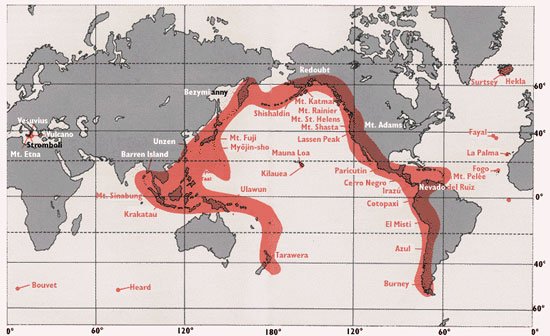
Where are most volcanoes found?
a)
Southern Hemisphere
b)
Ring of Fire
c)
Mid-Atlantic Ridge
d)
Hot Spots
10.
What is molten rock that has reached the Earth's surface?
a)
Aa
b)
Lava
c)
Magma
d)
Pahoehoe
11.
What do you call a large crater formed by the collapse of a volcano?
a)
Caldera
b)
Cinder Cone
c)
Composite Volcano
d)
Shield Volcano
12.

Where do volcanoes come from?

a)

Places where plates move apart

b)

Places where plates are moving together

c)

Hot Spots

d)

All of these options

13.

What is a volcano that has not erupted in a long time, but may erupt again called?

a)

dormant

b)

extinct

c)

active

d)

invisible

14.
What are scientists that study volcanoes called?
a)
doctor
b)
vet
c)
volcanologist
d)
volcano scientist
15.

A volcano that has gentle sloping sides and is formed from runny lava

a)

Shield volcano

b)

Cinder cone

c)

Composite

d)

None of these

16.

When an explosive eruption forms a mixture of hot rock, ash, and gas, this material is called a ________________.

a)

Land slide

b)

Lava

c)

Eruption trail

d)

Pyroclastic flow

17.

This is the name for the chain of volcanos around the edge of the Pacific Plate.

a)

Circle of Fire

b)

Ring of Lava

c)

Ring of Fire

d)

Circle of Magma

18.

Dormant volcanoes might erupt in the future.

a)

True

b)

False

19.

What is a hot spot?

a)

unusually HOT regions of the Earth's mantle where plumes of magma rise to the surface

b)

Ring of Fire

c)

an area in the mantle where magma does not exist

d)

continental drift

20.

What type of volcano is the largest?

a)

convergent

b)

shield

c)

cinder cone

d)

composite?

21.

What type of volcano is the smallest?

a)

composite

b)

convergent

c)

cinder cone

d)

shield

22.

What type of volcano has only quiet eruptions?

a)

composite

b)

shield

c)

cinder cone

d)

convergent

23.

What type of volcano has quiet and explosive eruptions?

a)

composite

b)

shield

c)

cinder cone

d)

convergent

24.

What type of volcano is this..

a)

Shield

b)

Cinder Cone

c)

Composite

d)

Convergent

25.
What is the spread of lava as it pours out of a vent?
a)
magma chamber
b)
pipe
c)
lava flow
d)
crater
26.

_____________ is a dent or depression on a volcano.

a)

side vent

b)

bump

c)

dent

d)

crater

27.

A volcano that will not ever erupt again is called _____________.

a)

active

b)

dormant

c)

extinct

d)

hot spot

28.

Beneath a volcano, magma collects in a _________________.

a)

magma chamber

b)

magma pocket

c)

vent

d)

hole

29.

The huge pieces of the earth's crust that cover its surface are called ____________________________.

a)

crust

b)

tectonic plates

c)

directions

d)

astehnosphere

30.

Which of the following is NOT a type of magma?

a)

Rhyolitic Magma

b)

Shield Magma

c)

Andesitic Magma

d)

Basaltic Magma

31.
What other geological event sometimes occurs in the same area as a volcano?
a)
tornado
b)
flood
c)
earthquake
d)
whirlwinds
32.
A bowl-shaped area that forms around a volcano's central opening.
a)
vent
b)
pipe
c)
aa
d)
crater
33.
Name this boundary
a)
Convergent
b)
Divergent
c)
Transform
d)
Sergent
34.
Name the boundary
a)
divergent
b)
convergent
c)
transform
d)
sergent
35.
Name the boundary
a)
convergent
b)
transform
c)
divergent
d)
sergent
36.
Which of the following is where one plate slides under another plate?
a)
submarine zone
b)
divergence zone
c)
subduction zone
d)
lower zone
37.
Which of the following is associated with transform boundary?
a)
volcanoes
b)
mountains
c)
trenches
d)
earthquakes and fault line
38.
Mountains form from....
a)
Plates sliding past one another
b)
collision of plates
c)
plates moving away from each other
d)
none of these
39.
Oceanic crust is.....
a)
Younger and less dense than continental crust
b)
Thinner, younger, and more dense than continental crust
c)
older, thicker, and less dense than continental crust
d)
Bigger and younger than continental crust
40.
Earth's plates are....
a)
Constantly moving and changing the face of the Earth
b)
Never moved
c)
Move seldom and very fast
d)
move when they feel like it
41.
What was the name given to all the continents when they were joined as one super continent?
a)
Supreme Continent
b)
Eurasia
c)
Plate tectonics
d)
Pangea
42.
Plate movement is caused by _____
a)
The rotation of the Earth
b)
Ocean tides
c)
Convection current in the mantle
d)
The moon's gravity
43.
What are mid-ocean ridges?
a)
A chain of underwater falls
b)
A chain of underwater volcanoes
c)
A chain of underwater mountains
d)
A chain of underwater rocks
44.
What type of boundary creates a new seafloor?
a)
convergent continental to continental
b)
convergent ocean to continental
c)
convergent ocean to ocean
d)
divergent 
45.
A subduction zone is formed....
a)
when one tectonic plate sinks below another
b)
at all plate boundaries
c)
when plates diverge
d)
at transform boundaries
46.
Which of the following is the softer moving area of the mantle that contains convection current?
a)
asthenosphere
b)
lithosphere
c)
outer core
d)
oceanic crust
47.
This is the driving force behind the movement of tectonic plates.
a)
Mantle convection currents
b)
Oceanic convection currents
c)
Atmospheric convection currents
d)
Solar convection currents
48.
Which is older oceanic or continental crust?
a)
Oceanic
b)
Continental
49.
The rocks closer to the mid-oceanic ridge are younger than the rocks further away from the mid-oceanic ridge.
a)
True
b)
False
50.
The movement of plates at a divergent boundary
a)
move towards each other
b)
slide past each other
c)
move up and down
d)
move away from each other