Wayground logo

Free Printable Worksheets

Font size

S
M
L
XL
Worksheets

Solubility, Gas Laws, and Phases of Matter

Total questions: 50

Worksheet time: 43mins

Name
Class
Date
1.

Describe a solute

a)

part of solution present in largest amount

b)

gets dissolved

c)

water

d)

surrounds and breaks apart

2.
How does a solution become supersaturated?
a)
dissolve lots of solute in it.
b)
dissolve a little solute in it. 
c)
dissolve more solute than you should be able to. 
d)
dissolve a super amount of solvent in it. 
3.

Solution where more solute can still be dissolved at the given temperature.

a)

Saturated

b)

Unsaturated

c)

Supersaturated

d)

Homogeneous solution

4.

The ___ is the part of the solution that is being dissolved.

a)

solute

b)

solvent

c)

mixture

d)

suspension

5.
Which solute is the most soluble at 10 ⁰C?
a)
KI
b)
KClO3
c)
NH4Cl
d)
NH3
6.
Which solute is the least soluble at 90 ⁰C?
a)
SO2
b)
KClO3
c)
KI
d)
HCl
7.
Which solute does not increase in solubility as temperature rises?
a)
NH3
b)
NaNO3
c)
KNO3
d)
NaCl
8.
How many grams of SO2 can dissolve at 50 ⁰C?
a)
5 g
b)
10 g
c)
20 g
d)
39 g
9.
How many more grams of KNO3 dissolve at 50 ⁰C compared to 0 ⁰C?
a)
85 g
b)
15 g
c)
70 g
d)
100 g
10.
Solubility refers to the ____ of solute that can dissolve in a certain volume or mass of solvent, at a certain temperature.
a)
Volume
b)
Proportion
c)
Mass
d)
Particles
11.
When 20 grams of potassium chlorate, KClO3, is dissolved in 100 grams of water at 80 ºC, the solution can be correctly described as:
a)
supersaturated
b)
saturated
c)
unsaturated
12.
__________ are made up of solutes and solvents.
a)
Solutions
b)
Suspensions
c)
Heterogeneous Mixtures
d)
Pure Substances
13.

Which is an example of a solute?

a)

Egg whites

b)

Gatorade powder

c)

Water

d)

Acetone

14.
Which is an example of a solvent?
a)
Salt
b)
Egg whites
c)
Water
d)
Sugar
15.

What is a solvent

a)

The largest part of a solution; does the dissolving.

b)

Another word for solution.

c)

A thing that make drinks turn colors.

d)

Its a metal molecule.

16.
You can make a solution more concentrated by adding __________.
a)
solute
b)
solvent
c)
water
17.

NaCl (salt) in water

a)

soluble

b)

insoluble

18.
When a solvent contains as much of the solute as it can hold, the solution is said to be
a)
supersaturated
b)
diluted
c)
saturated
d)
unsaturated
19.
If I dissolve sugar in water, what is the solute?
a)
Water
b)
Hydrogen
c)
Sugar
d)
Carbon
20.
If I dissolve carbon dioxide in water, what is my solvent?
a)
Carbon Dioxide
b)
There is no solvent
c)
Oxygen
d)
Water
21.
How are pressure and volume related?
a)
Directly
b)
Indirectly
c)
They aren't related
22.
What does Boyle's law relate to?
a)
Temperature and Volume
b)
Volume and Pressure
c)
Temperature and Pressure
23.
If a balloon is cooled what will happen to the volume?
a)
Volume will increase
b)
Volume will decrease
c)
Volume will not change
24.
When the temperature of matter increases the particles...
a)
speed up and move closer
b)
speed up and move farther apart
c)
slow down and move closer together
d)
slow down and move farther apart
25.
What happens to the average kinetic energy of matter when it is heated?
a)
It increases
b)
It decreases 
c)
It doesn't change
d)
It cannot be determined
26.
Gas molecules can easily be compressed  because ___________. 
a)
gas molecules are soft
b)
gas molecules are far apart
c)
gas molecules follow the shape of the container
27.

How do gas molecules move?

a)

in an orderly fashion

b)

constantly and randomly

c)

in straight line paths

d)

in a circular motion

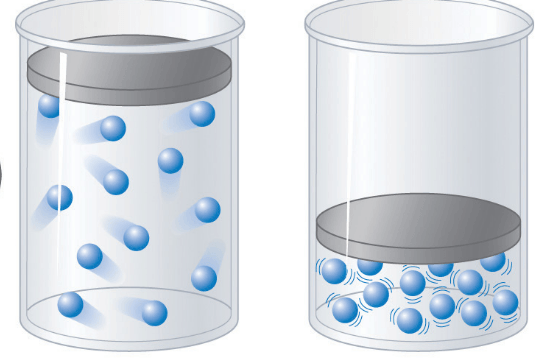
28.
Which container will have lower pressure?
a)
left
b)
right
c)
they both have the same pressure
29.
You decide to make a balloon animal. As the balloon is being twisted, it increases the pressure inside of the balloon. What happens to the volume?
a)
It increases
b)
It decreases
c)
It stays the same
30.
You shake a can of soda and then open it, decreasing its pressure. What happens to the volume of the carbon dioxide in the soda?
a)
It increased
b)
It decreased
c)
It stayed the same
31.
The energy of an object as it is in motion is defined as
a)
Kinetic Theory
b)
Kinetic energy
c)
Potential energy
d)
Electric energy
32.
The higher the average kinetic energy the __________________ 
a)
the higher the volume
b)
the higher the mass
c)
the higher the temperature
d)
the higher the density
33.
The following graph shows ____ relationship. 
a)
Direct
b)
Inverse
34.
Boyle's law :  The pressure and volume of a gas show a _____ relationship. 
a)
Inverse 
b)
Direct 
35.

5. As per Charles' Law, if temperature of any gas is increased its volume will ..................

a)

increase

b)

decrease

c)

remains the same

36.

What might the arrows be showing in this diagram?

a)

Decrease in energy thus more particle movement

b)

Increase in energy thus less particle movement

c)

Decrease in energy thus less particle movement

d)

Increase in energy thus more particle movement

37.
Which changes of state are endothermic changes?
a)
freezing and evaporation
b)
evaporation and melting
38.

What phase change is occurring at line segment B-C if the graph is exothermic?

a)

melting

b)

freezing

c)

boiling

d)

condensation

39.

What example is endothermic?

a)

melting

b)

freezing

c)

deposition

d)

condensation

40.

Which is exothermic?

a)

melting

b)

condensing

c)

boiling

d)

sublimation

41.

Which of the following is true regarding an endothermic change?

a)

condensation could occur

b)

freezing could occur

c)

heat is being released from the matter

d)

intermolelcular forces are getting weaker

42.
What would you expect to see if temperature increased if you were using Charles's Law?
a)
volume would decrease proportionally
b)
volume would increase proportionally
c)
pressure would increase proportionally
d)
pressure would decrease proportionally
43.
Gay-Lussac's law shows the directly proportional relationship between which two variables?
a)
pressure-temperature
b)
volume-temperature
c)
volume-pressure
d)
temperature-number of moles
44.
Whose law states that as pressure goes up, volume goes down?
a)
Charles 
b)
Boyle
c)
Aglow
d)
Mazias 
45.

Pick the best answer to explain all properties of gases....

a)

They're fluids, can be compressed, little space between particles

b)

They're solids, can be compressed, lots of space between particles

c)

They're fluids, cannot be compressed, lots of space between particles

d)

They're fluids , can be compressed, lots of space between particles

46.
What is the name of the law that involves these two variables:
Temperature increases // Pressure increases 
a)
Gay-Lussac's Law
b)
Boyle's Law
c)
Charles' Law
d)
Ideal Gas Law 
47.
A hot air balloon is an example of
a)
Charles' Law
b)
Boyle's Law
c)
Gay-Lussac's Law
48.

Consists of positive ions and excited electrons, typically at very high temperatures

a)

Solid

b)

Liquid

c)

Gas

d)

Plasma

49.

During a PHASE CHANGE, like freezing, temperature...

a)

increases.

b)

decreases.

c)

does NOT change.

d)

varies.

50.
Which container will have a lower pressure?
a)
left
b)
right
c)
they both have the same pressure
d)
I don't know