Wayground logo

Free Printable Worksheets

Font size

S
M
L
XL
Worksheets

Sky Science Review all Topics

Total questions: 73

Worksheet time: 47mins

Name
Class
Date
1.
How does night and day occur?
a)
The Earth rotates on its axis in front of the sun
b)
The Earth revolves on its axis in front of the sun
2.
How long is one day from morning to night?
a)
24 minutes
b)
24 hours
3.
What causes the different seasons in a year?
a)
The position the Earth is tilted as it moves around the sun
b)
The position the Sun and Moon are in during 1 year
4.
If the Earth moves around the sun in one full circle this equals:
a)
Half a year
b)
1 year
5.
How many days are there in 1 year?
a)
250 days
b)
365 days
6.
What season is it when the northern hemisphere on Earth (Canada) is tilted TOWARD the SUN?
a)
Winter
b)
Summer
c)
Spring
7.
True or False 
A astronaut from U.S.A was the first person to land on the moon.
a)
True
b)
False
8.
True or False
The sun is the biggest planet in the solar system
a)
True
b)
False
9.
How long does it take for the sun's rays to travel to earth?
a)
8 seconds
b)
8 minutes
10.
Why is the SUN important to the way we live?
a)
The sun keeps us warm
b)
The sun supports plant and tree growth
c)
The sun gives people a tan
11.
Which is NOT a planet part of our solar system?
a)
Mars
b)
Saphire
c)
Pluto
12.
How many phases does the moon go through?
a)
3
b)
5
c)
8
13.
What tool was one of the first tools to help with telling time?
a)
Sunscope
b)
Sun Dial
14.
When the SUN is in the highest point in the sky what time is it?
a)
10 am
b)
12 pm
c)
5 pm
15.
What is the line called that divides the Earth in half?
a)
The Axis
b)
The Equator
16.

Sunrise is occurring at position ________ and sunset is occurring at position _________. What goes in those blanks?

a)

Z , X

b)

Y , W

c)

X , Z

d)

W , Y

17.

The moon makes a complete revolution around Earth approximately once each

a)

day

b)

week

c)

year

d)

month

18.

In order to safely view the sun, a person should...

a)

view the sun while wearing sunglasses

b)

place a piece of dark paper over the lens of a telescope

c)

view an image of the sun projected onto a piece of paper

d)

place a piece of coloured glass over the lens of a telescope

19.

Using the image, which order of words identifies possible names for the missing X, Y, and Z in the picture.

a)

Universe, Solar System, Galaxy

b)

Galaxy, Solar System, Universe

c)

Milky Way, Galaxy, Solar System

d)

Solar System, Milky Way, Universe

20.

The gibbous moons are labelled...

a)

I and II

b)

I and IV

c)

II and III

d)

III and IV

21.

If the position marked W on the diagram above represents the constellation Cepheus in June, then the position marked Y represents the constellation Cepheus in

a)

March

b)

May

c)

September

d)

December

22.

Which of the following rows shows the phases of the moon that would be seen on day 14 and day 21?

a)
b)
c)
d)
23.

Which of the following diagrams shows the orientation of Earth when it is summer in Canada?

a)
b)
c)
d)
24.

Paul wanted to investigate the movement of the Sun over the course of a day. He used a sundial to measure the length of a shadow once every hour from sunrise to sunset.


Which of the following variables must be kept the same in order to obtain reliable data from this activity?

a)

Type of sundial and location of sundial

b)

Length of shadow and location of sundial

c)

Type of sundial and times at which measurements were taken

d)

Length of shadow and the times at which measurements were taken

25.

One similarity between asteroids and ___________ is that both ___________ light

a)

stars, emit

b)

stars, reflect

c)

comets, emit

d)

comets, reflect

26.

Which of the following statements can be made based on this chart?

a)

Mercury is the closest planet to Venus

b)

Earth is the coldest of the inner planets

c)

Mars has the shortest day of the inner planets

d)

Venus is the closest planet in diameter to earth

27.

How long will it take for Earth to rotate so that X position is directly facing the sun?

a)

6 hours

b)

8 hours

c)

12 hours

d)

18 hours

28.

Which of the following lists orders the components of the universe from the component with the LARGEST diameter to the component with the SMALLEST diameter

a)

Galaxies, stars, comets, planets

b)

Galaxies, stars, planets, comets

c)

Planets, comets, stars, galaxies

d)

Comets, planets, stars, galaxies

29.

Which diagram represents the phase of the Moon seen from Earth when the Moon is directly between Earth and the Sun?

a)

A

b)

B

c)

C

d)

D

30.

Students are asked to measure the length of the shadow on a sundial once every hour from sunrise to sunset. Which graph most likely represents data gathered during summer?

a)
b)
c)
d)
31.
The spinning of the Earth on its axis is
a)
rotation
b)
revolution
c)
precession
d)
nutation
32.
How does distance affect gravity?
a)
Gravity decreases as distance increases.
b)
Distance decreases as gravity decreases
c)
Distance increases as gravity increases
d)
None of the above
33.
True or false: When mass increases, gravity increases?
a)
False
b)
True
34.
What is the force that pulls the earth towards the sun?
a)
Gravity
b)
inertia
c)
A force
d)
distance
35.
Why do globes lean sideways?
a)
To allow them to spin easier.
b)
To demonstrate the tilt of Earth's axis.
c)
To demonstrate the effects of gravity.
d)
To demonstrate day and night.
36.
What happens when the area in which you live tilts away from the sun?
a)
It is summer.
b)
It is spring.
c)
It is winter.
d)
It is fall.
37.
What are the reasons for the seasons?
a)
Earth's tilt and rotation.
b)
Earth's rotation and revolution.
c)
Earth's tilt and revolution.
d)
Earth's tilt and resolution
38.
Which movement of Earth causes day and night?
a)
rotation
b)
revolution
39.
A group of planets that orbits a star is called:
a)
A galaxy
b)
A universe
c)
A solar system
d)
A constellation
40.
A large space rock that floats around in space. Can be found in the belt between the terrestrial and gaseous planets.
a)
A meteorite
b)
An Asteroid
c)
A comet
d)
A satellite
41.
A rotating group of stars and planets, such as the Milky Way, or Andromeda.
a)
A solar system
b)
A constellation
c)
A galaxy
d)
A universe
42.
A group of stars that form a picture if you really squint at it and use your imagination
a)
A constellation
b)
A galaxy
c)
A universe
d)
A solar system
43.
A circular path around a planet or a star. 
a)
Light Year
b)
Trajectory
c)
Rotation
d)
Orbit
44.
The distance light can travel in 365 days. This is a measure of speed, similar to km per hour, but WAY WAY WAY FASTER!
a)
Warp Drive
b)
A light year
c)
A light month
d)
A space year
45.
The layer of gas and oxygen that surrounds the Earth and is held there by gravity. 
a)
Orbit
b)
Satellite
c)
Atmosphere
d)
Pollution
46.
An object that orbits a planet. Example. The moon.
a)
Satellite
b)
Comet
c)
Asteroid
47.
A shooting star that enters our atmosphere.
a)
A comet
b)
An asteroid
c)
A meteor
d)
A meteorite
48.
A giant ball of ice and dust that comes from outer space. It appears to have a tail as it gets closer to the sun.
a)
A meteorite
b)
A satellite
c)
A comet
d)
An asteroid
49.
Why do other stars appear so much smaller than the sun?
a)
They are much smaller
b)
They are so far away
c)
They are not as bright
d)
They are dwarf stars
50.
What color of star is the hottest?
a)
Blue
b)
Red
c)
Yellow
d)
Orange
51.
What color of star is the coolest?
a)
Red
b)
Yellow
c)
Blue
d)
White
52.
What is the name of the largest stars?
a)
Protostars
b)
Supergiants
c)
Red Giants
d)
Dwarf Stars
53.
Why does the sun look small in the sky to us?
a)
It is 93,000,000 miles away
b)
It is smaller than Earth
c)
It is not very bright
d)
It travels around Earth
54.
What is the name of baby stars?
a)
Dwarf
b)
Supergiant
c)
Protostars
d)
Nebulas
55.
What is the name of the gas/dust clouds that form stars?
a)
Nebulas
b)
Protostars 
c)
Supernova
d)
Neutron Star
56.
True or False
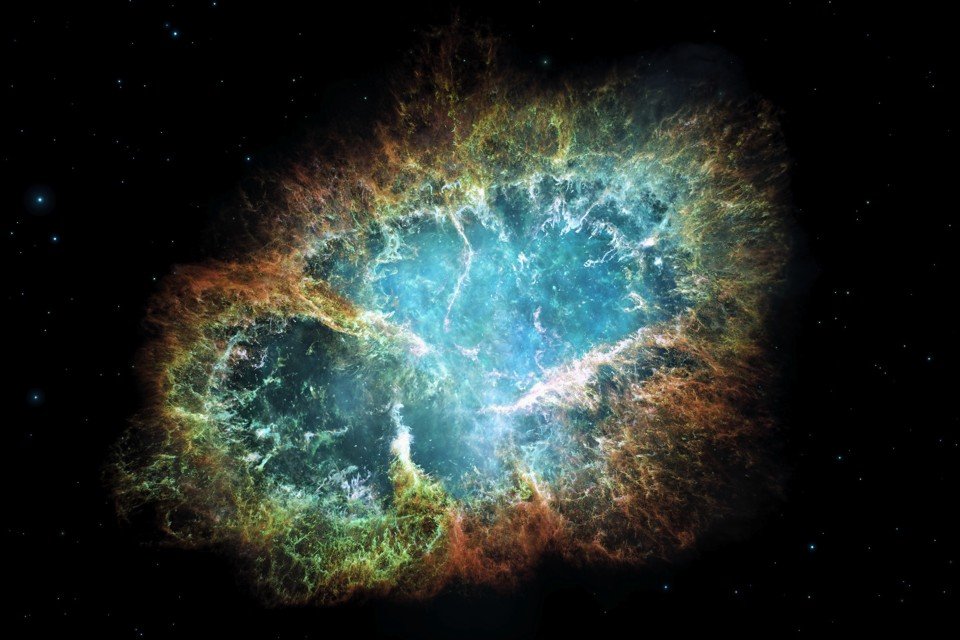
Constellations are stars that appear to be in a pattern.
a)
True
b)
False
57.
What is the name of the explosion at the death of a massive star?
a)
Supergiant
b)
Supernova
c)
Black Hole
d)
Nebula
58.
What are stars?
a)
Rocky bodies
b)
Hot exploding balls of gas
c)
5 pointed shapes
d)
Hollywood actors
59.
The stars we see in each constellation are very close to us.
a)
True
b)
False
60.
As the earth rotates on its axis, the constellations and stars in them appear to _________.  
a)
move across the sky
b)
stand still in the sky
c)
move around each other
d)
rotate
61.
The stars in a constellation appear to be close to each other in the shape, but may be ______  in space.
a)
very close
b)
some are close
c)
great distances apart
d)
some are great distances apart
62.
Why do the stars appear to move across the sky at night? 
a)
The Moon revolves.
b)
Earth rotates on its axis.
c)
Earth revolves around the Sun
63.
Why do you see different stars in winter and summer?
a)
Earth rotates on its axis.
b)
The Moon revolves around Earth.
c)
Earth revolves around the Sun.
64.
Put the stars in order from hottest to coolest.
a)
Blue, Red, White, Yellow, Orange, 
b)
Red, White, Yellow, Orange, Blue
c)
Blue, White, Yellow, Red, Orange
d)
Blue, White, Yellow, Orange, Red
65.
What moon phase is this picture?
a)
This is the full moon phase.
b)
This is the waxing gibbous moon phase.
c)
This is the waning gibbous moon phase.
d)
This is the first quarter moon phase.
66.
What moon phase is this picture?
a)
This is the waning crescent phase.
b)
This is the waxing gibbous phase.
c)
This is the waning gibbous phase.
d)
This is the new moon phase.
67.
What is this moon phase?
a)
This is the waxing crescent phase.
b)
This is the full moon phase.
c)
This is the waxing gibbous phase.
d)
This is the last quarter moon.
68.
What is this moon phase?
a)
This is the waxing gibbous moon phase.
b)
This is the last quarter moon phase.
c)
This is the first quarter moon phase.
d)
This is the new moon phase.  
69.
What moon phase is this picture?
a)
This is the full moon phase.  
b)
This is the waxing crescent moon phase.
c)
This is the waning gibbous moon phase.
d)
This is the waning crescent moon phase.
70.
What moon phase is this picture?
a)
This is the new moon phase.
b)
This is the waxing crescent moon phase.
c)
This is the waxing gibbous moon phase.
d)
This is the waning crescent moon phase.
71.
What phase of the moon is this image?
a)
This is the last quarter moon phase.
b)
This is the full moon phase.
c)
This is the first quarter moon phase.
d)
This is the waxing gibbous moon phase.
72.
As the moon's shape appears to get smaller, we say that the moon is _.
a)
swelling
b)
waxing
c)
waning
d)
disappearing
73.
Phases of the moon in which the moon appears to be getting larger are referred to as _.
a)
waxing
b)
waning
c)
new
d)
eclipse