Wayground logo

Free Printable Worksheets

Font size

S
M
L
XL
Worksheets

ocean life, chemistry and floor

Total questions: 69

Worksheet time: 50mins

Name
Class
Date
1.

How much of the earth's surface is water?

a)

30

b)

17

c)

70

d)

90

2.

Without the ocean absorbing CO2 what group would be adversely impacted

a)

fish

b)

mammals

c)

plants

d)

fresh water

3.
Which process does NOT lead to a decrease in the salinity of water?
a)
runoff from land
b)
precipitation
c)
sea ice melting
d)
evaporation
4.
Which term refers to a rapid change of temperature with increasing depth of the ocean?
a)
pycnocline
b)
thermocline
c)
abyssalocline
d)
isothermal cline
5.
In addition to salinity, what factor affects the density of seawater?
a)
depth
b)
latitude
c)
temperature
d)
salt content
6.
What happens to pressure as you go deeper into the ocean? 
a)
increases
b)
decreases
c)
stays the same
d)
doubles
7.
The salt that is in your salt shaker is the same salt that is in our oceans?
a)
true
b)
false
8.
Which of the following is not a process that decreases the salinity of seawater?
a)
runoff from land
b)
icebergs melting
c)
precipitation
d)
evaporation
9.
What is the most abundant salt in the sea?
a)
calcium chloride
b)
potassium chloride
c)
magnesium chloride
d)
sodium chloride
10.
The highest salinity would be found in which of the following areas?
a)
an area with high rates of precipitation
b)
an area with high rates of evaporation
c)
an area with plenty of runoff
d)
all of the above
11.
In addition to salinity, what factor affects the density of seawater?
a)
depth
b)
latitude
c)
temperature
d)
salt content
12.
Which process increases the salinity of water?
a)
runoff from land
b)
formation of sea ice
c)
precipitation
d)
melting of sea ice
13.
Why is the ice shelf floating?
a)
The ocean water is
filled with vegetation
that keeps
the ice from sinking. 
b)
The ice is melting faster than it can sink
c)
The ice is warmer than the ocean water
d)
The ice is less dense than the ocean water.
14.

One cause of the salinity of the ocean is

a)

Runoff from land

b)

Metamorphism

c)

Underwater volcanism

d)

CO2 emissions

15.
What term is the measure of dissolved salts in water?
a)
Thermocline
b)
Salinity
c)
Saltiness
d)
Tides
16.
The higher the salt content in the ocean the ________ dense the water will be.
a)
less
b)
more
c)
nothing happens
17.
If I have freshwater that is less dense, what will it do in comparison to salt water that is more dense?
a)
The more dense water will float and the less dense water will sink.
b)
The more dense water will sink and the less dense water will float
c)
Nothing they will mix evenly.
18.
What ocean is on the west coast of the United States?
a)
Pacific
b)
Indian
c)
Arctic
d)
Southern
19.
The Pacific Ocean is the _________ ocean.
a)
largest
b)
smallest
c)
bluest
d)
saltiest
20.

Plants can no longer photosynthesize beyond this zone

a)

Photic

b)

Supralittoral

c)

Abyssal

21.

Which zone are bioluminescence fish most likely to be found

a)

Bathyal

b)

Pelagic

c)

Aphotic

22.

Water confined above the continental shelf are in what zone

a)

Photic

b)

Epipelagic

c)

Neritic

23.

The Benthic zone is/are

a)

All zones found on the Ocean bottom

b)

water that is found only in deep ocean tranches

c)

Spongebob's home

24.

A zone at the bottom nearly devoid of life is called the

a)

Aphotic Zone

b)

Benthic Zone

c)

Abyssal Zone

25.

The open ocean environment that is divided into neritic province and oceanic province.

a)

aphotic

b)

photic

c)

pelagic

d)

benthic

26.
What is a nekton organism?
a)
It is an active swimmer that would dive in many zones of the ocean.
b)
It lives on the floor or bottom of the ocean.
c)
It is passive and is carried away by the current and wind. 
d)
It is part of the Hadalpelagic zone in the trenches on the Ocean floor
27.
The sunlight zone is also known as the __________________________ zone.
a)
hot
b)
bright
c)
happy
d)
euphotic
28.
The midnight zone is also known as the __________________ zone.
a)
frozen
b)
aphotic
c)
frightening
d)
dark
29.
T2 - Which of the following organisms is an example of nekton?
a)
Lobster
b)
Dolphin
c)
Clam
d)
Seastar
30.
T2 - Free-swimming animals that can move throughout the water column are called
a)
algae.
b)
nekton.
c)
benthos.
d)
plankton.
31.
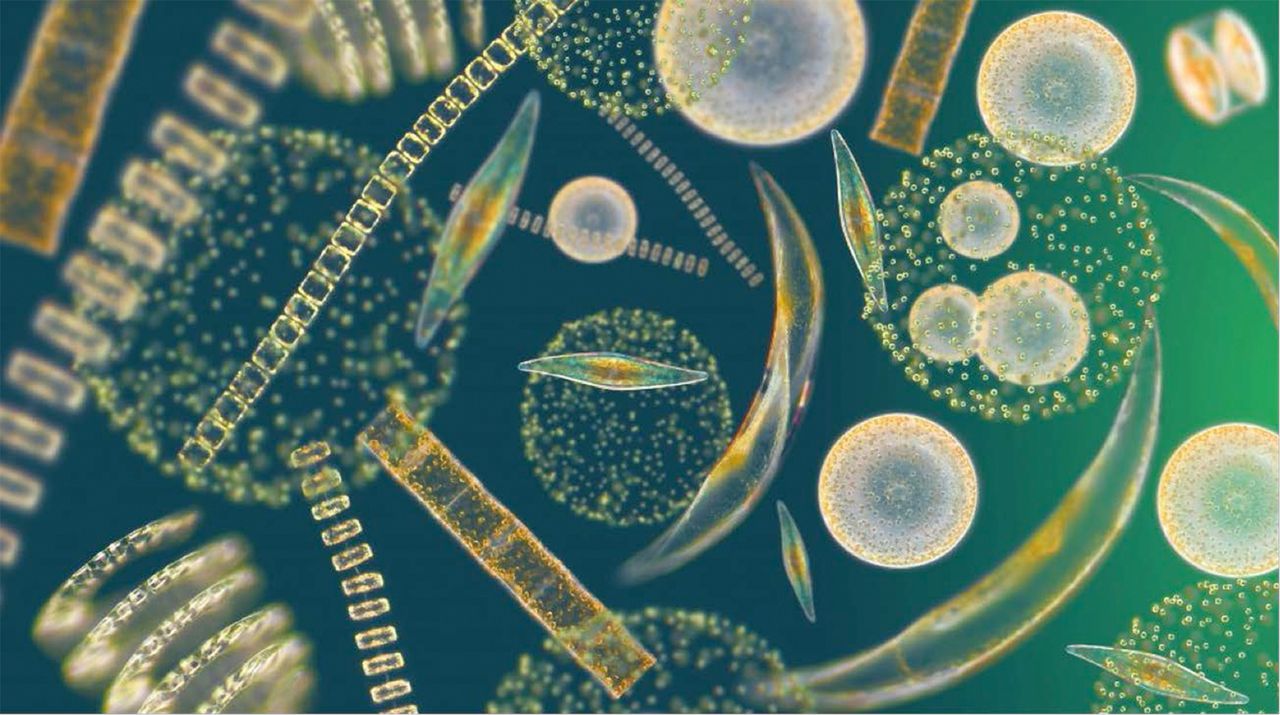
What is Phytoplankton
a)
A microscopic thing that lives in watery places.
b)
a dumb plant
c)
A food source for all animals
d)
something that you eat
32.
What is the primary producer in most ocean food webs?
a)
Phytoplankton 
b)
Zooplankton
c)
Small Fish
d)
Bacteria
33.
Which of the following using photosynthesis to make its own food?
a)
phytoplankton
b)
zooplankton
c)
small fish
d)
shrimp
34.
Which of the following most likely gets their energy from eating phytoplankton?
a)
zooplankton
b)
sharks
c)
seals
d)
algae
35.
Which organism would most likely be at the top of an ocean food web? 
a)
Killer Whale (orca)
b)
Phytonplankton
c)
zooplankton 
d)
Sea lions
36.
Which of the following in a producer in some marine food webs?
a)
zooplankton
b)
kelp (seaweed)
c)
shellfish
d)
coral
37.
Organisms that can create their own food/energy are called.....
a)
consumers 
b)
producers
c)
predators
d)
prey
38.
Which of the following would be a consumer?
a)
phytoplankton near the oceans surface
b)
kelp growing near the coast
c)
bacteria living near hydrothermal vents
d)
zooplankton floating on an ocean current
39.
Jack has a rock. The rock has a mass of 14g and a volume of 2cm3. What is the density of the rock?
a)
7 mL
b)
7 g/cm3
c)
28 g/cm3
d)
1/7 g/cm3
40.
Why do ice cubes float in a  glass of water?
a)
the ice cubes are more dense than the water
b)
the water is more dense than the ice cubes
c)
the water is more dense than the glass
d)
the ice is more dense than the glass
41.
Helium balloons rise on earth because
a)
helium is less dense than air
b)
helium is more dense than air
c)
helium is cooler than air
d)
helium is warmer than air
42.
If two objects have the same volume but one has a greater mass, the one with greater mass 
a)
Has a lower density
b)
 Has a higher density
c)
Will float
d)
Will sink 
43.
Which of the following 4 words or phrases does not fit with the other 3?
a)
Heterotroph
b)
Zooplankton
c)
Photosynthetic
d)
Nekton
44.
Plankton that uses photosynthesis:
a)
Phytoplankton
b)
Zooplankton
45.
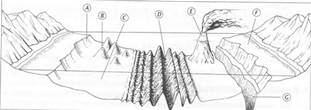
What is letter D?
a)
Cont. Shelf
b)
Mid-Ocean Ridge
c)
Volcanic Island
d)
Seamount
46.
Seamount is similiar to...
a)
a volcanic island
b)
a small mountain or volcano
c)
The Great Plains
d)
The Grand Canyon
47.
The place where new ocean floor forms is called the...
a)
mid ocean ridge
b)
abyssal plain
c)
trench
d)
continental shelf
48.
The shallowest(least deep) part of the ocean is the ____________________
a)
trench
b)
abyssal plain
c)
continental shelf
d)
continental slope
49.
What is the deepest part of the ocean?
a)
a rift zone
b)
an abyssal plain
c)
a seamount
d)
an oceanic trench
50.
The Maraina __________ is the deepest known place on Earth
a)
Volcanoe
b)
Seamount
c)
Ridge
d)
Trench
51.
Which best represents the order of seafloor features as you move from the shoreline to the deep ocean?
a)
 Continental slope – continental shelf- continental rise – mid-ocean ridge
b)
 Continental rise – continental shelf – mid-ocean ridge -  continental slope
c)
 Continental shelf – continental slope – continental rise – mid-ocean ridge
d)
   Mid-ocean ridge – continental rise – continental shelf- continental slope
52.
The gradually sloping part of a continent that extends under the ocean is the...
a)
continental slope
b)
continental shelf
c)
abyssal plain
d)
trench
53.
What is the flat land located on either side of the mid-ocean ridge?
a)
continental slope
b)
continental shelf
c)
abyssal plain
d)
ocean basin
54.

1. Bathymetry is______

a)

a. The study of submarine volcanoes

b)

a. The study of plate tectonics

c)

a. The study of sea water

d)

a. The study of ocean contours

55.

Which of the following statements about continental margins is true?

a)

Passive margins occur at subduction zones and active margins occur where the sea floor and continent are part of the same tectonic plate

b)

Active margins occur at subduction zones and passive margins occur where the sea floor and continent are part of the same tectonic plate

c)

Active margins occur at the mid-ocean ridge and passive margins occur on the deep-ocean basin.

d)

Passive margins occur at the mid-ocean ridge and active margins occur on the deep-ocean basin.

56.

Ocean trenches are formed--

a)

at the mid-ocean ridge

b)

at the subduction zone where two plates collide

c)

at the passive continental margin

d)

from water erosion during the last ice age

57.
SONAR uses which of the following to determine the depth of the ocean?
a)
sound waves and echoes
b)
satellites
c)
submarines
58.
Which of the following is NOT one of the four main oceans?
a)
Pacific
b)
Indian
c)
Antarctic
d)
Atlantic
59.
Which is the largest ocean?
a)
Pacific
b)
Atlantic
c)
Arctic
d)
Indian
60.
Which is the smallest ocean?
a)
Pacific
b)
Atlantic
c)
Arctic
d)
Indian
61.
This ocean is smaller than the Atlantic with the same depth and is found mostly in the Southern hemisphere.
a)
Pacific
b)
Atlantic
c)
Arctic
d)
Indian
62.
The measuring of ocean depth and charting of topography (or shape) of the ocean floor is known as
a)
SONAR
b)
oceanography
c)
bathymetry
d)
telemetry
63.
A small, underwater craft used for deep sea research is called a
a)
satellite
b)
SONAR
c)
submersible
64.

Which continental margin is found on the East coast of the United States (

a)

active

b)

passive

65.
How did submarines map the ocean floor?
a)
Satellite altimetry
b)
Sonar
66.
Organisms that drift with ocean currents are
a)
nekton
b)
pelagic
c)
neritic
d)
plankton
67.
Which term describes the upper part of the ocean into which sunlight penetrates?
a)
neritic zone
b)
intertidal zone
c)
oceanic zone
d)
photic zone
68.
Phytoplankton are usually found in the 
a)
photic zone
b)
benthic zone
c)
abyssal zone
d)
aphotic zone
69.
The amount of dissolved solids present in the water
a)
salinity
b)
chlorine
c)
nitrogen
d)
density