
 Worksheets
Year 9 Physics End of Term Quiz
Total questions: 143
Worksheet time: 2hrs 32mins
Name
Class
Date
1.
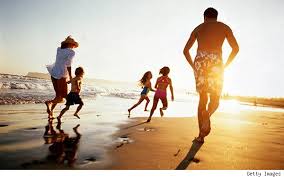
The sun shines down on this family as the play on the beach.
a)
conduction
b)
convection
c)
radiation
2.

A group of friends gather around a fire to stay warm.
a)
conduction
b)
convection
c)
radiation
3.
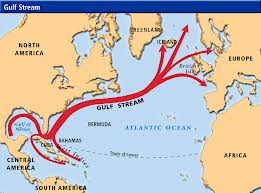
The Gulf Stream is a current that brings warm ocean water from the south to the north.
a)
conduction
b)
convection
c)
radiation
4.

Walking on the warm sand sand with your bare feet.
a)
conduction
b)
convection
c)
radiation
5.

Blow drying your wet hair.
a)
conduction
b)
convection
c)
radiation
6.

Which direction will the heat flow while this person holds a hot cup of tea?
a)
from the cup to her hand
b)
from her hand to the cup
c)
no heat is transferred
7.

Which direction will the heat flow while this ice cap melts?
a)
there is no heat transfer
b)
from the icecap to the water
c)
from the water to the icecap
8.
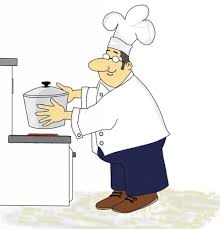
The man goes to take the hot pot off the stove with his bare hands.
a)
conduction
b)
convection
c)
radiation
9.
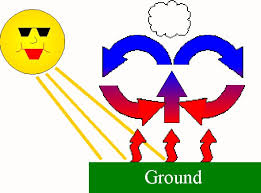
Warm air rises and the cool air sinks.
a)
conduction
b)
convection
c)
radiation
10.
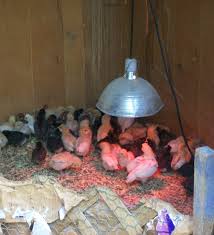
The baby chickens are kept warm from the heat lamps.
a)
conduction
b)
convection
c)
radiation
11.

In some cultures, walking on fire is the ultimate sign of strength.
a)
conduction
b)
convection
c)
radiation
12.

In this experiment, the WARM red dye and the COLD blue dye was placed in the water at the same time. The warm red dye rose to the top while the cold blue dye sank to the bottom.
a)
conduction
b)
convection
c)
radiation
13.
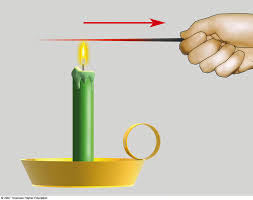
The candle will slowly heat the metal and transfer the heat directly to the mans hand.
a)
conduction
b)
convection
c)
radiation
14.
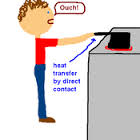
Johnny accidentally grabbed the handle of the hot pot.
a)
conduction
b)
convection
c)
radiation
15.

The warm air from this heater creates a current when the warm air rises and the cold air sinks.
a)
conduction
b)
convection
c)
radiation
16.
Poor conductors like wood and plastic are called:
a)
conductors
b)
insulators
c)
burners
17.
How many kinds of heat transfer are there?
a)
1
b)
2
c)
3
d)
4 or more
18.
In heat transfer, heat always flows from the _______________ substance to the _______________ substance.
a)
Hotter to colder
b)
Colder to hotter
c)
Hotter to hotter
d)
Colder to colder
19.
The type of heat transfer that happens through direct contact of molecules or particles with each other is ___________________.
a)
Convection
b)
Conduction
c)
Radiation
d)
insulation.
20.
Which of the following is the best example of conduction?
a)
A light bulb warming a lampshade
b)
An egg cooking in a frying pan
c)
Water boiling in a pot
d)
Gases circulating in the atmosphere
21.
Which of the following is an example of convection?
a)
A hair dryer is drying up your hair.
b)
When the AC or heater changes the temperature.
c)
When a car engine turns hot after being turned on.
d)
When you are making soup and the water is rising and lowering.
22.
Ironing a shirt is an example of...
a)
condensation
b)
conduction
c)
convection
d)
radiation
23.

A group of friends gather around a fire to stay warm.
a)
conduction
b)
convection
c)
radiation
24.
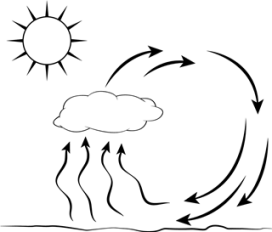
What causes the circulation of air in the atmosphere?
a)
Air in the atmosphere is heated by the sun and sinks to the ground.
b)
The ground is heated by the sun and then heats the air, causing the air to rise.
c)
Air loses heat to the ground and then rises upward to obtain more energy.
d)
The sun heats the clouds which forces the cooler air to move away and sink.
25.
Ms Jo Jo rubbed two balloons with a piece of wool. What will happen when the balloons are brought near each other?
a)
The balloons will repel each other.
b)
The balloons will attract each other.
c)
The balloons will become positively (+) charged.
d)
The balloons will pop.
26.
The difference between attract and repel is that to attract is to pull something closer and repel is to push something away.
a)
True
b)
False
27.
When socks get stuck to towels in your dryer, this is an example of________________
a)
current electricity
b)
static electricity
28.
What types of charges attract?
a)
Positive and Positive
b)
Positive and Neutral
c)
Negative and Neutral
d)
Positive and Negative
29.
The accumulation of excess electric charge on an object is called
a)
Static electricity
b)
Electric discharge
c)
Resistance
d)
Circuit
30.
Electric charges that are alike _______ each other.
a)
Attract
b)
Repel
31.
What charge does a proton have?
a)
negative (-)
b)
positive (+)
c)
neutral or no charge (0)
32.
What charge does an electron have?
a)
negative (-)
b)
positive (+)
c)
neutral or no charge (0)
33.
If a substance has a higher number of electrons than protons on its surface, what type of charge does it have?
a)
A positive charge.
b)
A negative charge.
c)
A neutral charge
d)
No charge at all
34.
What is the major difference between static electricity and current electricity?
a)
Current electricity involves a continuous flow of neutrons; static electricity is a sudden transfer of protons
b)
Current electricity can be deadly; static electricity is almost always safe
c)
In current electricity, there's a single transfer of electrons; in static electricity, there's a steady flow of electrons
d)
Current electricity involves a flow of electrons; static electricity involves a single transfer of electrons
35.
What happens when you touch a metal doorknob after rubbing your shoes on the carpet?
a)
The doorknob sends a burst of electric current into your body
b)
Millions of electrons go from your finger into the doorknob
c)
The doorknob sends millions of electrons into your finger
d)
our finger becomes negatively charged
36.
Which of the following is caused by static electricity?
a)
a stove getting hot when it is turned on
b)
a magnet being attracted to a refrigerator
c)
a lightning strike during a storm
d)
a light bulb coming on when a switch is turned on
37.
True or False, Lighting is a form of static electricity.
a)
True
b)
False
38.
Why can you get a shock if you touch a metal doorknob after walking across a wool carpet?
a)
You have gained electrons; the doorknob has no electrons.
b)
You have gained neutrons; the doorknob has fewer electrons.
c)
You have lost electrons; the doorknob has many electrons.
d)
You have gained electrons; the doorknob has many electrons.
39.

Is the circuit pictured complete or incomplete?
a)
Complete
b)
Incomplete
40.

What can we do to make this circuit pictured complete?
a)
connect wire to the terminal
b)
disconnect the wire from the lightbulb
c)
screw in the lightbulb
d)
replace the battery
41.

What is the power source for this circuit?
a)
Battery
b)
Electric socket
c)
Wires
d)
Magic
42.

The red and black plastic wire coverings are excellent ______.
a)
Conductors
b)
Insulators
c)
Currents
d)
Magnets
43.

What kind of circuit is this?
a)
series
b)
parallel
44.

What kind of circuit is this?
a)
Series
b)
Consecutive
c)
Parallel
d)
Training
45.
the type of current that is used in outlets
a)
apparating current
b)
diverting current
c)
AC
d)
DC
46.
measure of electric current
a)
watt
b)
ohm
c)
volt
d)
amp
47.

What type of circuit is this?
a)
series
b)
parallel
48.
Electricity is the flow of ______.
a)
electrons
b)
protons
c)
neutrons
d)
atoms
49.
there is only one path for the electrons to follow
a)
conductor
b)
insulator
c)
parallel circuit
d)
series circuit
50.
A disturbance that travels through a medium as a longitudinal wave
a)
sound
b)
wavelength
c)
pitch
d)
frequency
51.
The number of wavelengths that pass a point each second
a)
frequency
b)
wavelength
c)
pitch
d)
amplitude
52.
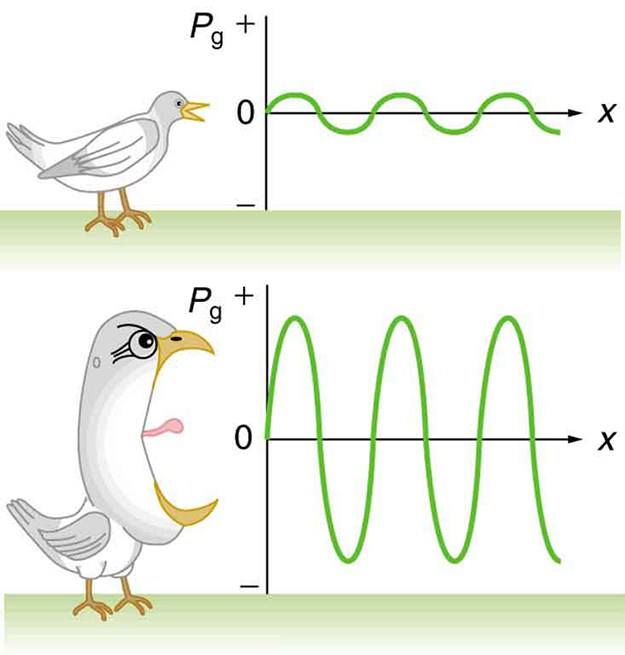
When a sound is louder what measurement gets bigger?
a)
Frequency
b)
Amplitude
c)
Wavelength
d)
Crest
53.
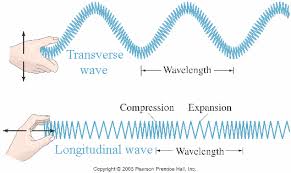
Sound waves are ALWAYS what type of wave?
a)
Transverse
b)
Longitudinal
c)
Depends
d)
always different
54.

What is B?
a)
crest
b)
trough
c)
compression
d)
rarefaction
55.
True or False: Sound travels better through solids than through liquids
a)
True
b)
False
56.
All waves carry
a)
energy
b)
light
c)
matter
d)
particles
57.
What do we call the part of a compressional wave that is spread a part?
a)
compression
b)
rarefaction
c)
crest
d)
trough
58.
The part of a longitudinal wave where the particles of the medium are close together.
a)
rarefaction
b)
compression
c)
crest
d)
trough
59.
A part in a longitudinal wave where the particles are spread apart
a)
compression
b)
rarefaction
c)
crest
d)
trough
60.
A wave that requires a medium through which to travel
a)
mechanical wave
b)
chemical wave
c)
electromagnetic wave
d)
pitch
61.
If you want to change the pitch of a sound, you have to change the ___
a)
frequency
b)
amplitude
c)
speed
d)
volume
62.
This is the unit used to measure the volume of a sound.
a)
Decibel
b)
Medium
c)
Vibration
d)
Oscilloscope
63.
The speed of a sound wave depends on
a)
the frequency
b)
the medium
c)
both air temperature and medium
d)
the air temperature
64.
As a sound source approaches and then moves past a stationary observer, the observer will hear
a)
a steady rise in pitch
b)
a sudden drop in pitch
c)
a drop in pitch, then a rise in pitch
d)
a rise in pitch, then a drop in pitch
65.
Bats use ________ TO LOCATE MOSQUITOES IN THE AIR.
a)
solar
b)
ecology
c)
echolocation
d)
evolution
66.
Which is a tool that is used in medicine to view internal organs and pregnancy.
a)
radar
b)
doppler
c)
ultrasound
d)
sonar
67.
A medium can be a .....
a)
solid
b)
liquid
c)
gas
d)
all of the above
68.
Sound needs a medium to transfer its energy therefore it can be classified as a _______________________ wave.
a)
electromagnetic
b)
mechanical
c)
medium
d)
massive
69.
A longitudinal wave is also known as a __________
a)
Constitutional
b)
Conditional
c)
Confessional
d)
Compressional
70.
When our ears pick up sounds, our ears are really sensing...
a)
Transverse waves
b)
Echoes in time and space
c)
Vibrations
d)
Photons
71.
Which type of interference does a pair of noise-cancelling headphones utilize?
a)
Destructive
b)
Constructive
c)
Compressional
d)
Transverse
72.
Which travels faster: sound or light waves?
a)
sound
b)
light
73.
Which comes first: lightning or thunder?
a)
lightning
b)
thunder
74.
What is the part of your ear you can see called?
a)
ear drum
b)
stirrup
c)
cochlea
d)
pinna
75.
What part of your body sends messages from your ears to your brain?
a)
optic nerve
b)
auditory nerve
c)
ear canal
d)
semi-circular canals
76.
Are volume and pitch the same thing?
a)
No
b)
Yes
77.
Does a man's snore have a high pitch or a low pitch?
a)
high
b)
low
78.
Does a spider make a high volume noise or a low volume noise?
a)
high volume
b)
low volume
c)
high pitch
d)
low pitch
79.
Sound is caused by ______________.
a)
vibrations
b)
light
c)
the sun
80.
Which part of the ear is the sound amplifier?
a)
outer ear
b)
ear canal
c)
middle ear
d)
inner ear
81.
How does increasing the amplitude of a sound wave affect the sound?
a)
it makes the sound louder
b)
it makes the sound travel faster
c)
it increases the wavelength of the sound
d)
it increases the frequency of the sound
82.
Which part of the ear acts as the sound collector?
a)
outer ear
b)
ear canal
c)
middle ear
d)
inner ear
83.
When sound waves cause the eardrum to vibrate, these vibrations are immediately passed on to the_________.
a)
outer ear and ear canal
b)
inner ear
c)
tiny hairs
d)
three small bones in the middle ear
84.
What is the first place in the ear where sound vibrations traveling in air are transferred?
a)
the ear bones
b)
the eardrum
c)
the ear liquid
d)
the ear hairs
85.
Containing three tiny bones( hammer,anvil,and stirrup).
a)
Cochlea
b)
Inner ear
c)
Middle ear
d)
None
86.
What are the three parts of the ear?
a)
Outer ear, middle ear and inner ear
b)
Cochlea,middle ear and inner ear
c)
Frequency,audition,and pitch,
d)
Neither
87.
What is the purpose of the ear?
a)
the ability to hear humans only
b)
The ability to hear
c)
Both
88.

The measure of energy a wave carries
a)
sound wave
b)
wavelength
c)
amplitude
d)
pitch
89.
An object that does not vibrate cannot produce
a)
sound
b)
light
c)
heat
d)
electricity
90.
A medium can be a .....
a)
solid
b)
liquid
c)
gas
d)
all of the above
91.
Where is a place a person would hear no sound?
a)
in a cave
b)
in a forest
c)
in space
d)
in water
92.

Where are the three smallest bones in your body found?
a)
outer ear
b)
middle ear
c)
inner ear
d)
eye
93.
Which part of the ear is responsible for capturing sound and moving it into your ear?
a)
outer ear
b)
middle ear
c)
inner ear
d)
eardrum
94.

What happens in the inner ear?
a)
Sound waves are captured.
b)
Sound waves move deeper into the ear.
c)
Sound waves are reflected.
d)
Sound waves are converted into nerve impulses.
95.
Which part of your ear contains earwax?
a)
outer ear
b)
middle ear
c)
inner ear
d)
eardrum
96.
Where does HEARING (interpreting the nerve impulses) take place?
a)
outer ear
b)
middle ear
c)
inner ear
d)
brain
97.

What is #19?
a)
Semicircular Canals
b)
Ear Canal
c)
Auditory Nerve
d)
Cochlea
98.

What is #13?
a)
Eardrum
b)
Anvil
c)
Hammer
d)
Cochlea
99.

What is #23
a)
Eardrum
b)
Anvil
c)
Hair Cells
d)
Cochlea
100.

What is #2?
a)
Ear Canal
b)
Pinna
c)
Hammer
d)
Anvil
101.

What is #12?
a)
Oval Window
b)
Auditory Nerve
c)
Anvil
d)
Eustachian Tube
102.

What is #8?
a)
Auditory Nerve
b)
Eustachian Tube
c)
Cochlea
d)
Eardrum
103.
An object is __ when all or most of the light passes through it.
a)
opaque
b)
transparent
c)
translucent
d)
near sighted
104.
When some, but not all light passes through an object, the object is __.
a)
opaque
b)
translucent
c)
transparent
d)
illusion
105.
When no light passes through an object, the object is __.
a)
convex
b)
translucent
c)
transparent
d)
opaque
106.
When a person can only see things that are near, they are ___
a)
some sighted
b)
near sighted
c)
not sighted
d)
far sighted
107.
When a person can only see things that are far, they are __.
a)
near sighted
b)
somewhat sighted
c)
not sighted
d)
far sighted
108.
A spectrum is ___.
a)
A wide ruler.
b)
5 colors of the rainbow.
c)
All the colors of the rainbow.
d)
An illusion
109.
A surface that bows outward and causes an images to always appear right side up.
a)
Concave
b)
Cave
c)
Convex
d)
Coordinate
110.
A surface that curves in like a cave and the image can be upside down or right side up.
a)
Concave
b)
Vexed
c)
Color
d)
Convex
111.
Roy G. Biv names ___.
a)
Red, orange, yellow, green, blue, indigo, violet
b)
Red, oily, yucky, green, intelligent, violet
112.
True or False.
Refraction causes light to bend and separate into the colors of the rainbow.
Refraction causes light to bend and separate into the colors of the rainbow.
a)
True
b)
False
113.
True or False.
The eye sees, and the brain is the messenger.
The eye sees, and the brain is the messenger.
a)
True
b)
False
114.
True or false.
The eye sees an image upside down.
The eye sees an image upside down.
a)
True
b)
False
115.
Which part of the eye controls the size of the pupil?
a)
pupil
b)
iris
c)
retina
d)
cornea
116.
Which part of the eye allows light in?
a)
Optic nerve
b)
retina
c)
pupil
d)
iris
117.
True or false.
The iris is a voluntary muscle
The iris is a voluntary muscle
a)
True
b)
False
118.
The color part of the eye is called the ___.
a)
lens
b)
pupil
c)
iris
d)
cornea
119.
True or false.
An image is upside down on the retina in the back of the eye.
An image is upside down on the retina in the back of the eye.
a)
True
b)
False
120.
When light waves bend this is called ____.
a)
flexable
b)
bendable
c)
refraction
d)
illustration
121.
Which is an example of a translucent object?
a)
books
b)
sunglasses
c)
water
d)
folder
122.
What is the name of a transparent, triangular object that refracts light?
a)
prism
b)
book
c)
paper
d)
pencil
123.
Light travels in a ___ line.
a)
circular
b)
triangular
c)
crooked
d)
straight
124.
Light that humans can see is called the __ spectrum
a)
dark
b)
visible
c)
concave
d)
near sighted
125.
Does reflection occur when the light waves bounce or bend?
a)
bounce
b)
bend
126.
A black t-shirt ___ all of the colors
a)
reflects
b)
absorbs
127.
A white car ___ all of the colors.
a)
reflects
b)
absorb
128.
A red shirt __ only red.
a)
reflects
b)
absorbs
129.
A teacher wanted to see how different types of music affected students pulse rates. She played, country, rap, rock, jazz, and classical, and measured the students pulses for 10 mins each. What is the independent variable?
a)
pulse rate
b)
type of music
c)
length of time measuring pulse
d)
age of student
130.
A researcher did an investigation to see if corn seeds would sprout at different times depending on the temperature of the water in which they were placed. What is the independent variable?
a)
How long to sprout
b)
type of seed used
c)
water temperature
d)
how much water used
131.
It is January, and Haley and Sarah are tired of cold feet. They decide to design and experiment looking at the effectiveness of wool versus cotton versus nylon as insulators. They fill identical water bottles with 1000F water and put them in each different type of sock, and measure the temperature every 20 mins. What is the independent variable being measured.
a)
Water Temperature
b)
Type of sock used
c)
Amount of water
d)
Month of the year
132.
A study was done to see if different tire treads affect the braking distance of a car.
What is the dependent variable?
What is the dependent variable?
a)
Tire treads
b)
Braking distance
c)
Road conditions
d)
Model of car
133.
The higher the temperature in an oven, the faster a cake will bake.
What is the independent variable?
What is the independent variable?
a)
Cake flavor
b)
Temperature
c)
Time
d)
Type of oven
134.
I believe the number of lemons produced by a lemon tree increases when the tree receives more water.
This statement is
This statement is
a)
A hypothesis
b)
A law
c)
A variable
d)
A conclusion
135.
Bees have been dying at an unprecedented rate for the last decade. Scientists believe it is due to a family of chemicals called neonicotinoids which has seen increasing use recently.
How would you classify the first statement above?
How would you classify the first statement above?
a)
A hypothesis
b)
A law
c)
An observation
d)
Quantitative data
136.
An investigation found that more potatoes would be produced on a farm if the soil was fertilized more.
What is a constant in this experiment?
What is a constant in this experiment?
a)
Number of potatoes
b)
Amount of fertilizer
c)
Science
d)
The location of the farm
137.
Students measured the temperature of the water at different depths in Lake Skywalker and found that the temperature varied.
What was the dependent variable?
What was the dependent variable?
a)
Time
b)
Temperature
c)
Student taking the measurement
d)
Water depth
138.
The amount of energy that water takes to boil will change with the volume of water.
What would you graph on the X axis for the above statement?
What would you graph on the X axis for the above statement?
a)
Boiling temperature
b)
Amount of water
c)
Amount of energy
d)
Flavor of ramen noodles
139.
Find the IV: You experiment to see if the Fortune Teller fish reacts to different amounts of heat.
a)
Movement of Fish
b)
Amount of Heat
c)
Amount of Moisture
d)
Oil on hand
140.
Find the DV: You experiment to see if a bouncy ball or a tennis ball bounces higher.
a)
Type of ball
b)
Same drop height
c)
Height of bounce
d)
Same surface
141.
Find the IV: You experiment to see if a bouncy ball or a tennis ball bounces higher.
a)
Type of ball
b)
Same drop height
c)
Height of bounce
d)
Same surface
142.
Find the DV: You experiment to see if the type of liquid changes how fast it can drain out of the tornado tube
a)
Amount of liquid
b)
Type of liquid
c)
Technique of swirl
d)
Speed to drain
143.
Find the IV: You experiment to see if the type of liquid changes how fast it can drain out of the tornado tube
a)
Amount of liquid
b)
Type of liquid
c)
Technique of swirl
d)
Speed to drain
100 %

