
NEW
Font size
S
M
L
XL
 Worksheets
UNIT 7: MOLECULAR GENETICS PRETEST
Total questions: 50
Worksheet time: 39mins
Name
Class
Date
1.

What is the name of this image
a)
Image 51
b)
Series 51
c)
Franklin's Photograph
d)
Photograph 51
2.

Who is responsible for producing this image?
a)
Francis Crick
b)
James Watson
c)
Rosalind Franklin
d)
Watson and Crick
3.
Which sugar is contained in DNA
a)
Dextrose
b)
Ribose
c)
Deoxyribose
d)
Glucose
4.

In a molecule of double-stranded DNA, the amount of Adenine present is always equal to the amount of
a)
cytosine
b)
guanine
c)
thymine
d)
uracil
5.
DNA is found in...?
a)
cell membrane
b)
vacuole
c)
chloroplast
d)
nucleus
6.
Watson and Crick were the first to suggest that DNA is _____
a)
a short molecule
b)
the shape of a double helix
c)
a protein molecule
d)
the genetic material
7.
What are the chemical components of DNA?
a)
A phosphate, nitrogenous base, and an amino acid
b)
A nitrogenous base, a sugar, and an amino acid
c)
A phosphate, a sugar, and a nitrogenous base
d)
A nitrogenous base, sugar, and a helix
8.
The instructions governing the traits of an organism are determined by...?
a)
The order of bases
b)
The length of the DNA
c)
Which bases are paired with which
d)
The proportions of A,G,C, and T
9.
The bonds that hold the strands of DNA together are between the...
a)
Bases and the Sugars
b)
Bases and the Phosphates
c)
Bases and other Bases
d)
Sugars and Phosphates
10.
Erwin Chargaff discovered what feature regarding DNA
a)
The Helical structure
b)
The constant ratio of the bases
c)
The Sugar-Phosphate Backbone
d)
The length of a strand of DNA
11.

The image illustrates which of the following structures?
a)
Amino acid
b)
Nucleotide
c)
Protein
d)
Peptide Bond
12.
What makes up the sides, or backbone, of a DNA molecule?
a)
Alternating sugars and nitrogen bases
b)
Nitrogen base pairs
c)
A sugar, a phosphate, and a nitrogen base
d)
Alternating sugars and phosphates
13.

Why is DNA important?
a)
it is very small and very complicated
b)
it's in everything
c)
it serves as the blueprint for traits of all living things
d)
because we eat it every day for energy
14.
If a sample of DNA has 20% ADENINE, how much GUANINE will it have?
a)
30%
b)
20%
c)
80%
d)
60%
15.
By using radioactive isotopes, Hershey and Chase were able to conclude that __ is/are the carrier(s) of genetic information.
a)
DNA
b)
Proteins
c)
Carbohydrates
d)
Lipids
16.
If a DNA sample has 40% CYTOSINE, how much THYMINE will it have?
a)
10%
b)
20%
c)
40%
d)
60%
17.
What does DNA stand for?
a)
Deoxyribonucleic acid
b)
Denitrogenous acid
c)
Deribonucleic acid
d)
Diribonucleic acid
18.

Transcription is a process that in eukaryotic cells takes place in the:
a)
Nucleus
b)
Cytoplasm
c)
Golgi Apparatus
d)
Rough E.R.
19.

What is the RNA synthesized from a section of DNA with the code: GATTACA ?
a)
CUAAUGU
b)
GATTACA
c)
GAUUCA
d)
CTAATGA
20.

The enzyme that produces RNA in Transcription is called
a)
RNA Polymerase
b)
DNA Polymerase
c)
Transcriptase
d)
RNA Intrase
21.

Translation is a process in eurkaryotic cells takes place in the:
a)
Cytoplasm
b)
Nucleus
c)
Nucleolus
d)
Golgi Bodies
22.

Translation is a process that produces
a)
mRNA
b)
Protein
c)
Polypeptide Chains
d)
tRNA
23.
The process of copying a gene's DNA sequence into a sequence of RNA is called:
a)
Transcription
b)
Translation
c)
Splicing
d)
Protein Synthesis
24.

RNA contains which bases?
a)
adenine, guanine, uracil, cytosine
b)
thymine, guanine, cytosine, uracil
c)
thymine, uracil, cytosine, guanines
d)
adenine, uracil, guanine, thymine
25.
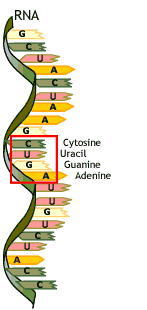
In RNA, Uracil pairs with ______.
a)
cytosine
b)
adenine
c)
guanine
d)
thymine
26.
The process to go from mRNA to a protein is called ____
a)
transcription
b)
rRNA
c)
replication
d)
translation
27.
DNA holds the code for
a)
lipids
b)
carbohydrates
c)
protein
d)
sugar
28.
What is the location in the cell for translation?
a)
nucleus
b)
mitochondria
c)
ribosome
d)
chloroplast
29.
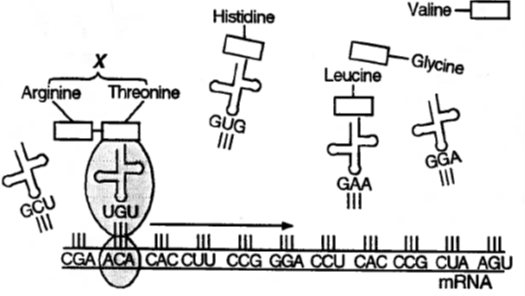
What process is going on in this photo?
a)
Transcription
b)
Translation
c)
Replication
d)
Transpiration
30.
How many amino acids are coded for by this sequence of nucleotides:
ATG GGA ACT CCA
ATG GGA ACT CCA
a)
4
b)
2
c)
6
d)
12
31.

The mRNA leaves the ________ to find the ribosome to make proteins.
a)
cell
b)
nucleotide
c)
nucleus
32.
How many codons are needed to specify for five amino acids?
a)
3
b)
5
c)
15
d)
30
33.

This image is most likely showing...
a)
Transcription
b)
Translation
c)
mRNA processing
d)
Post Translational Modification
34.
What are the three types of mutation?
a)
Insertion, Deletion, Subsitution
b)
Deletion, Newstion, Subsitution
c)
Newstion, Deletion, Insertion
d)
Insertion, Newstion, Substitution
35.
DNA molecule segment is : TTACGCAAG
The mutated DNA segment is TTCGCAAG. This is an example of ___ mutation.
The mutated DNA segment is TTCGCAAG. This is an example of ___ mutation.
a)
Substitution
b)
Deletion
c)
Insertion
d)
Inversion
36.
Normal-
GAG-CTC-GAC-AGA
Mutant
GAG CTC-CAC-AGA
GAG-CTC-GAC-AGA
Mutant
GAG CTC-CAC-AGA
a)
no mutation
b)
substitution
c)
insertion
d)
deletion
37.
What do helpful mutations do?
a)
Increases chances of survival
b)
Decreases changes of survival
c)
Increases chances of developing cancer
d)
Decreases skills
38.
Which of the following is an example of a helpful mutation?
a)
Develops speed
b)
Decreases speed
c)
Increases weight gain
d)
Develops no camflauge
39.
What is the definition of DNA mutation?
a)
The original DNA strand
b)
The strand with four pairs
c)
A change in the DNA strand
d)
The strand in a double helix
40.
DNA molecule segment is : TTACGCAAG
The mutated DNA segment is TTCGCAAG. This is an example of ___ mutation.
The mutated DNA segment is TTCGCAAG. This is an example of ___ mutation.
a)
Substitution
b)
Deletion
c)
Insertion
d)
Inversion
41.
A chromosome is -
a)
tightly packaged DNA
b)
a mutation in the nucleus
c)
tightly packaged RNA
d)
used for the synthesis of proteins in the ribosome
42.

Identify the mutation in the picture.
a)
Inversion
b)
Deletion
c)
Duplication
d)
Translocation
43.
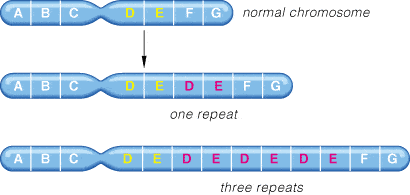
Identify the mutation in the picture.
a)
Inversion
b)
Duplication
c)
Deletion
d)
Translocation
44.

Identify the mutation in the picture.
a)
Deletion
b)
Inversion
c)
Duplication
d)
Translocation
45.
When can a mutation be passed on to offspring?
a)
only when the mutation is present during or occurs during mitosis
b)
only when the mutation is present during or occurs during meiosis
c)
when the mutation occurs during mitosis or meiosis
d)
when the mutation occurs in somatic cells
46.
What process occurs during meiosis that can result in chromosomal disorders?
a)
crossing over
b)
non-disjunction
c)
anaphase I
d)
prophase II
47.

Trisomy 21 means you have what?
a)
Three copies of chromosome 21
b)
Twenty one copies of chromosome 3
c)
Three omies and 21 means
d)
Two copies of chromosome 21
48.

The chromosomal mutation shown in the image is a
a)
deletion
b)
duplication
c)
inversion
d)
translocation
49.
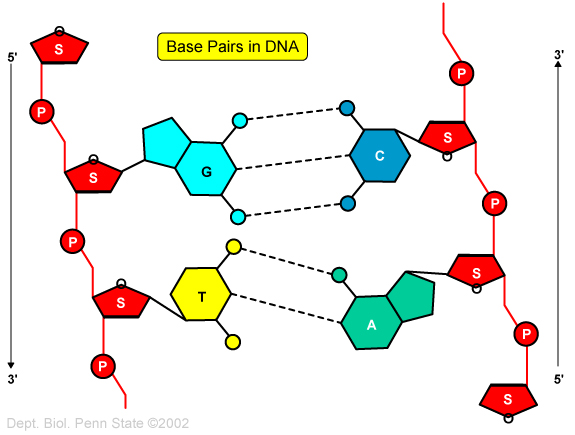
Nitrogenous bases are joined by which type of bond?
a)
polar bonds
b)
ionic bonds
c)
covalent bonds
d)
hydrogen bonds
50.

Replicate the following strand of DNA:
AATCATGGA
AATCATGGA
a)
AATCATGGA
b)
TTAGTACCT
c)
UUAGUACCU
d)
GGATAUCUA
Reset

