wayground logo

Free Printable Worksheets

Font size

S
M
L
XL
Worksheets

Waves revision AQA GCSE

Total questions: 44

Worksheet time: 15mins
Name
Class
Date
1.

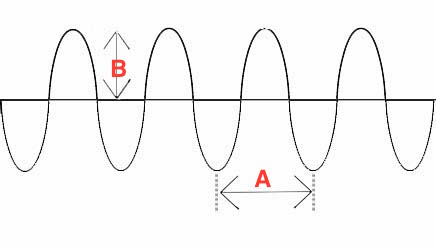
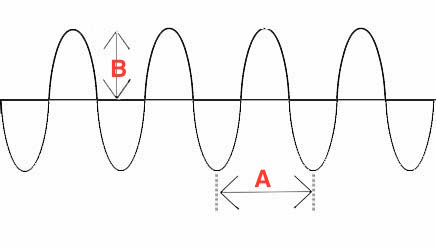
What property of this wave is represented by the letter "A"

a)

amplitude

b)

crest

c)

trough

d)

wavelength

2.
What property of the wave is represented by the letter "B"?
a)
amplitude
b)
crest
c)
trough
d)
wavelength
3.
The highest point on a wave is:
a)
the crest
b)
the trough
c)
the top
d)
the coast 
4.
The lowest point on a wave is the:
a)
Amplitude
b)
Crest
c)
Trough
d)
Wavelength
5.
The number of wavelengths that pass a point each per second is:
a)
frequency
b)
period
c)
longitudinal 
d)
transverse wave 
6.
The type of waves that require medium to pass:
a)
Mechanical Waves
b)
Electromagnetic Waves
7.
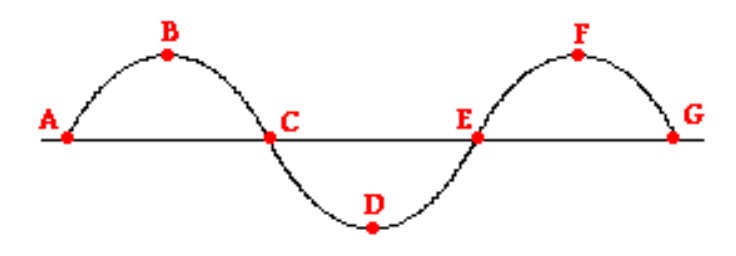
Which vocabulary term is used to identify the distance between points C & G?
a)
Amplitude
b)
Crest
c)
Frequency
d)
Wavelength
8.
When the frequency of a wave increases, what happens to the wavelength?
a)
The wavelength is not directly affected by the frequency of a wave.
b)
The wavelength increases.
c)
The wavelength decreases.
d)
More specific information is needed to form a conclusion about the wavelength.
9.
A mechanical wave cannot travel through...
a)
a vacuum(empty space).
b)
water.
c)
air. 
d)
glass.
10.
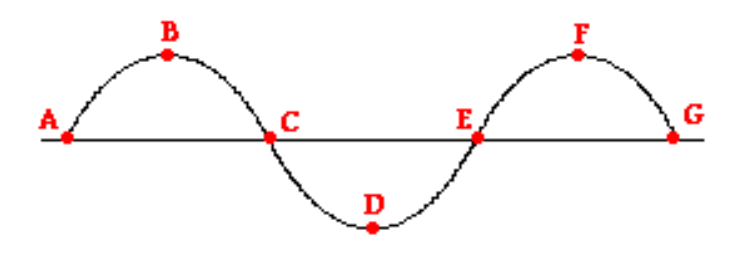
Which letter(s) represent the trough of the wave?
a)
A
b)
B & D
c)
D
d)
C & G
11.
Which letter(s) represent the crest of the wave?
a)
A
b)
B & D
c)
B & F
d)
F
12.

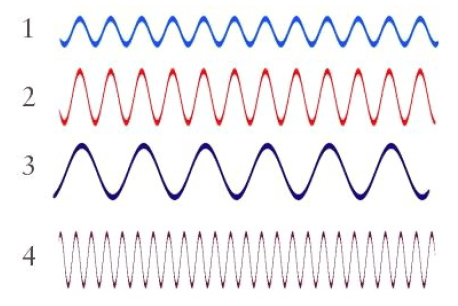
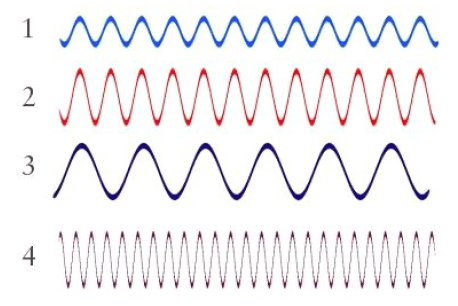
Which wave in the diagram has the highest frequency?

a)

1

b)

2

c)

3

d)

4

13.

Which wave in the diagram has the longest wavelength?

a)

1

b)

2

c)

3

d)

4

14.
Which of the following can sound travel through?
a)
solid
b)
liquid
c)
gas
d)
all of the above
15.
crest to crest or trough to trough
a)
crest
b)
trough
c)
amplitude
d)
wavelength
16.
Electromagnetic waves include the following except
a)
radio waves
b)
X-rays
c)
doing the wave at a football game
d)
microwaves
17.

What is the term describing regular disturbances that carry energy through matter or space?

a)

crest

b)

energy

c)

wave

d)

trough

18.

Through which material does sound travel the fastest?

a)

solid

b)

liquid

c)

gases

d)

vacuum

19.

What is the term when a wave strikes and object and bounces off (example echo).

a)

medium

b)

refraction

c)

reflection

d)

interference

20.

What is the term describing when a wave bends, as it passes through at an angle, from one medium to another. (example: pencil in a glass of water)

a)

medium

b)

refraction

c)

reflection

d)

interference

21.
What kind of wave can travel through space?
a)
electromagnetic waves
b)
compressional waves
c)
transverse waves
d)
longitudinal waves
22.
A wave carries...?
a)
energy only
b)
matter only
c)
the matter carries the energy
d)
neither
23.
What is the measure of how many waves pass a point in a certain amount of time?
a)
frequency
b)
wavelength
c)
midpoint
d)
crest and trough
24.
The action of a wave bouncing off a surface is called __________________.
a)
rarefaction
b)
refraction
c)
reflection
d)
diffraction
25.
This type of Electromagnetic wave shows a break in bones.
a)
gamma ray
b)
x-ray
c)
brokenometer
d)
radio wave
26.
Which wave has a greater frequency?
a)
A
b)
B
27.
_______ carry the greatest amount of energy. 
a)
x-rays
b)
gamma rays
c)
infrared rays
d)
visible light
28.
How much of the electromagnetic spectrum is visible?
a)
All of it
b)
None of it
c)
Most of it
d)
Only a small part
29.

Mobile phones use _____________ waves for the signal to link to the mobile network.

a)

Microwaves

b)

Gamma

c)

XRays

d)

Radio

30.
Sound will travel slowest through which of the following forms of matter?
a)
milk
b)
desk
c)
air
d)
door
31.
Why is sound able to travel faster through a solid than a gas?
a)
Gas molecules are packed tightly.
b)
Sound does not travel faster through a solid than a gas.
c)
Solid molecules are packed tightly.
d)
Gas molecules move slowly.
32.
The units for frequency are measured in _____________.
a)
hertz
b)
seconds
c)
m/s
d)
m
33.
If a star is being observed from Earth and it's light has shifted towards the blue side of the electromagnetic spectrum it would be...
a)
Moving towards the Earth
b)
Moving away from the Earth
c)
This is a trick question that cannot be answered
d)
It isn't a star, it is a very large blueberry.
34.
The vast majority of galaxies in our universe are moving away from us.  We know this because we observe __________ in the galaxies absorption spectra.
a)
Redshift
b)
Blueshift
c)
Turbulance
d)
Superposition
35.
What best describes the doppler effect?
a)
An apparent change in frequency of a wave due to the relative motion between a wave source and an observer
b)
When sound changes pitch
c)
When light changes color
d)
An apparent change in the amplitude of a wave due to the relative motion between a wave source and an observer.
36.
Which discovery(ies) came from our understanding redshift/ blueshift?
a)
The universe is expanding
b)
Most galaxies are moving away from us
c)
Andromeda galaxy will collide with the Milky way in 3.75 billion years
d)
All of the above (and many more)
37.
A ray of light is incident on a plane mirror and the angle of incidence is 25 degrees. What is the angle of reflection?
a)
A. 0 degrees
b)
B. 50 degrees
c)
C. 90 degrees
d)
D. 25 degrees
38.
________is when a surface directs light beams in different directions.
a)
Refraction
b)
Diffuse reflection
c)
Absorption
39.
The Law of Reflection:
The angle of incidence is _________ the angle of reflection
a)
bigger than
b)
the same as
c)
smaller than
40.
What kind of wave is pictured?
a)
Transverse
b)
Longitudinal
c)
surface
d)
none of the above
41.
Why can you not hear sound in space?
a)
Distance is to great
b)
It has no medium
c)
The medium is too thin
42.

For Electromagnetic waves (EM waves). As frequency increases, the ___________ decreases.

a)

amplitude

b)

wavelength

c)

brightness

d)

sound

43.

What is the correct order for the electromagnetic spectrum? (select two)

a)

Radio, Micro, UV, Visible, IR, X-ray, Gamma

b)

Gamma, X-ray, UV, Visible, IR, Micro, Radio

c)

Radio, Micro, IR, Visible, UV, X-ray, Gamma

d)

Gamma, X-ray, IR, Visible, UV, Micro, Radio

44.

What range of wavelength does the EM spectrum cover?(from radio waves to gamma rays)

a)

1015 to 10-4

b)

104 to 10-15

c)

108 to 10-8

d)

10 to 10-32