wayground logo

Free Printable Worksheets

Font size

S
M
L
XL
Worksheets

Adaptations, Natural Selection, Dichotomous Keys

Total questions: 85

Worksheet time: 1hrs 20mins

Name
Class
Date
1.
Which feature of a rose helps it grow without being eaten by large animals?
a)
flowers with bright colors
b)
sharp thorns
c)
small seeds
d)
deep roots
2.
Which feature helps an animal hide from other animals?
a)
looking like a dangerous animal
b)
being the same color as the place it lives (camoflauge)
c)
having sharp claws or a strong shel
d)
having only a few young and caring for them
3.
A giraffe has a long neck in order to better reach leaves to eat.  This is an example of _____. 
a)
an adaptation
b)
environment
c)
response
d)
stimulus
4.
Which adaptation (for the underlined animal) serves the function of defense?
a)
A walking stick looks like the twig on which it rests.
b)
A porcupine’s quills cause a predator to seek another meal.
c)
A whale filters plankton and krill from the water in which it swims.
d)
A penguin is dark on top and white below to blend in with the water.
5.
Which of the following is a physical adaptation for the underlined animal?
a)
A butterfly has bright colors to warn predators that it is poisonous.
b)
A hognose snake rolls over, slows its breathing, and hangs its tongue out to play dead.
c)
A herd of buffalo encircle their young to protect them from a pack of wolves.
d)
A dung beetle rolls a piece of dung across the desert.
6.
How do adaptations help animals?
a)
To escape animals
b)
to hunt for food
c)
to survive in their habitats
d)
All of these are correct
7.
Plants with spines and waxy leaves are well suited for life in which environment?
a)
Desert
b)
Temperate forest
c)
Grassland
d)
Tropical Rainfroest
8.
Dandelions have light furry seeds that allow them to spread easily. 
a)
True
b)
False
10.
Why do animals use camouflage?
a)
To look pretty
b)
To stay safe
c)
To play Hide and Go Seek
d)
To eat food
10.
Why do animals use camouflage?
a)
To look pretty
b)
To stay safe
c)
To play Hide and Go Seek
d)
To eat food
11.
How an animal protects itself Adaptation: Skunk and its spray
a)
Defense
b)
Hibernation
c)
Locomotion
d)
Migration
12.
A resting state through the winter. 
Adaptation: Bear sleeping in a cave during the winter months
a)
Locomotion
b)
Hibernation
c)
Migration
d)
Defense
13.
Traveling done by an animal to find food and water. 
Adaption: birds flying south for the winter
a)
Camouflage
b)
Migration
c)
Hibernation
d)
Locomotion
14.
How an animal gets food?
a)
Defense
b)
Camouflage
c)
Food Obtainment
d)
Life Cycle
15.
Being able to move around to find resources that animals need. Adaptation: A bunny hopping around looking for food.
a)
HIbernation
b)
Locomotion
c)
Migration
d)
Food Obtainment
16.
 A giraffe has a long neck.  Why would the giraffe need this adaptation?
a)
to keep warm
b)
to reach food high above the ground
c)
to have room to eat more
d)
to catch birds
17.
A Porcupine has sharp quills.  Why would a porcupine need this adaptation?
a)
to protect itself
b)
to keep warm
c)
to kill its prey
d)
to cover its skin
18.
The raccoon has hands and feet.  Why would the raccoon need this adaptation?
a)
to fight
b)
to help them find and pick up food
c)
to hang from trees
d)
to dig a tunnel
19.
Color or pattern that helps an animal blend in with its habitat
Adaptation: polar bears in the Artic
a)
Hibernation
b)
Locomotion
c)
Camouflage
d)
Migration
20.
This is a period of deep sleep that occurs in some animals when outside temperatures are cold: ______
a)
hibernation
b)
migration
21.
Which adaptation would NOT help a hawk catch a mouse?
a)
Hollow Bones 
b)
Good eye sight
c)
Talons
d)
Camouflage
22.
The space, conditions and all the living and non-living things around an organism is its _________________.
a)
home
b)
environment
c)
neighborhood
d)
ecosystem
23.
An organism that hunts and feeds on another organism is a ______________________.
a)
prey
b)
producer
c)
predator
d)
decomposer
24.
An animal that is hunted as food
a)
prey
b)
predator
c)
decomposer
d)
producer
25.
An inherited trait that helps those organisms that have it to survive
a)
niche
b)
structure
c)
characteristic
d)
adaptation
26.
When an organism copies a characteristic of something else in order to better its chances for survival and reproduction
a)
hibernation
b)
camouflage
c)
mimicry
d)
migration
27.
A group of organisms which are similar to each other and can combine to have offspring
a)
species
b)
characteristic
c)
club
d)
organisms
28.
features that help identify something
a)
appearance
b)
characteristics
c)
behaviors
d)
structures
29.
All the populations in a specific area or region
a)
community
b)
ecosystem
c)
population
d)
species
30.
A group of organisms of the same species
a)
ecosystem
b)
community
c)
population
d)
group
31.
How do adaptations help animals?
a)
To hide from predators
b)
to hunt for food
c)
to survive in their habitats
d)
All of these are correct
32.
What is the purpose of a dichotomous key?
a)
to find a common ancestor
b)
to show the evolution of organisms
c)
to show relationships between organisms
d)
to identify organisms
33.
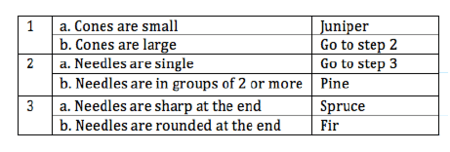
A dichotomous key for trees is provided. Hikers found a tree that has large brown cones and single sharp needles. What species of tree have the hikers found?
a)
Juniper
b)
Pine
c)
Spruce
d)
Fir
34.
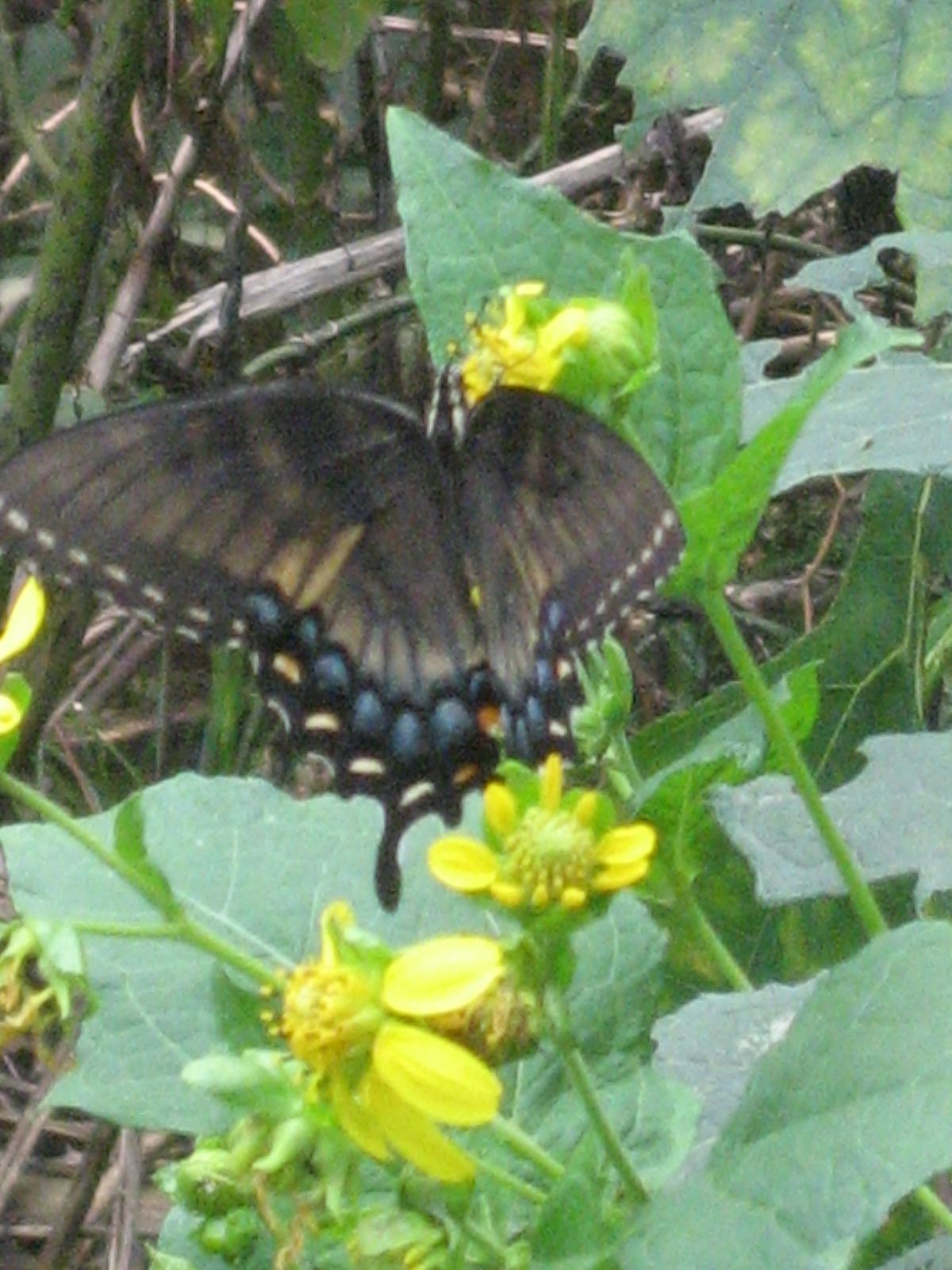
A dichotomous key for insects is given. To what order does an insect with two pairs of scaly wings belong?
a)
Coleoptera
b)
Heteroptera
c)
Diptera
d)
Lepidoptera
35.
What step do we always start with when using dichotomous keys?
a)
1
b)
2
c)
3
d)
4
36.
When using a dichotomous key to identify organisms, what do we look at?
a)
physical features
b)
weather patterns
c)
environment
d)
diet
37.
The 8 levels of classification, most broad to most specific.
a)
Domain, Genus, Family, Order, Class, Phylum, Kingdom, Species
b)
Domain, Species, Kingdom, Genus, Phylum, Family, Class, Order
c)
Domain, Kingdom, Phylum, Class, Order, Family, Genus, Species
d)
Order, Kingdom, Species, Domain, Phylum, Family, Class, Genus
38.
Term given to describe the 2 name naming system is:
a)
dichotmous key
b)
binomial nomenclature
c)
2 scientific names
d)
binomial key
39.
The first part of a scientific name is an organism's _______________ and the second part is its ________________.
a)
species, genus
b)
phylum, order
c)
class, spices
d)
genus, species
40.
Take your time and read carefully! Timer is 3 minutes!
---------
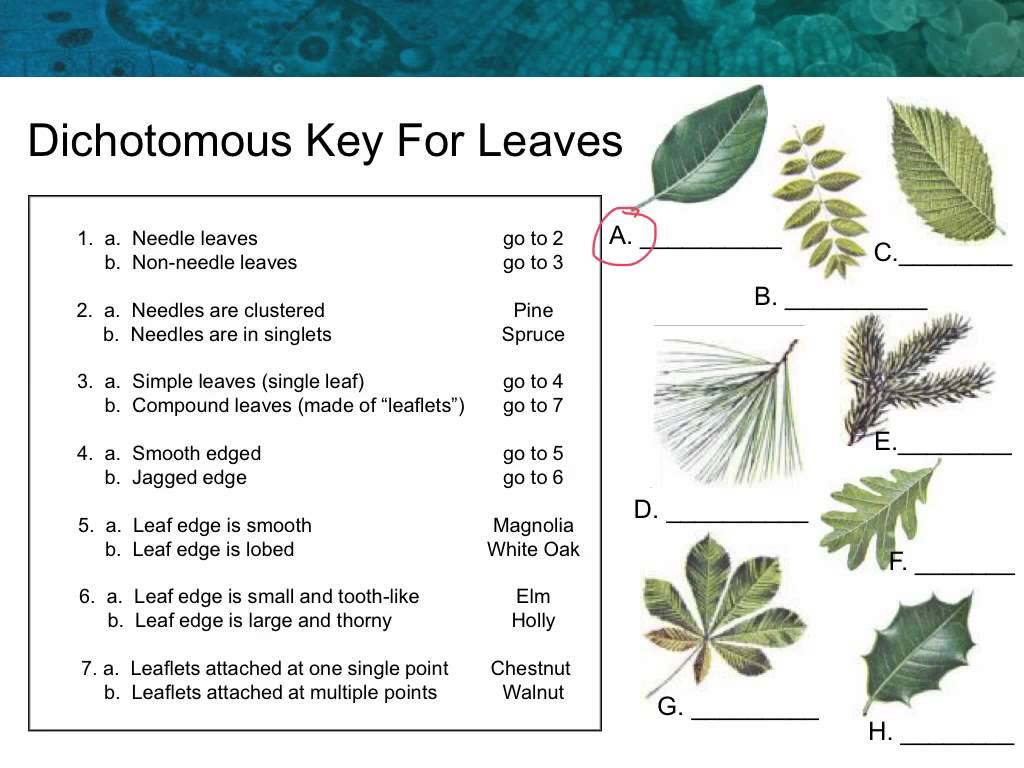
An illustration and a dichotomous key are given. What is the correct classification for this organism?
a)
Class Insecta
b)
Order Amblygygi
c)
Order Araneae
d)
Order Scorpiones
41.
What is a dichotomous key used for in science?
a)
To organize biomes
b)
Classify organisms
c)
Identify bacteria only
d)
None of these
42.
Take your time and read carefully! Timer is 3 minutes!
---------
A student discovers an arachnid with a segmented abdomen, long legs, and a tail with no stinger. The student uses the dichotomous key below to identify it. Which arachnid has the student found?
a)
Whip Scorpion
b)
Wind Scorpion
c)
Tick
d)
Scorpion
43.
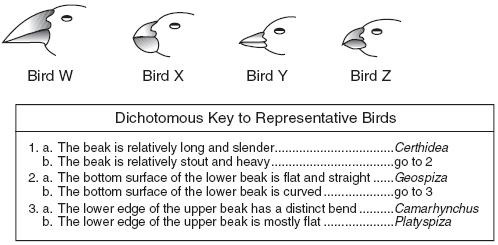
What is the name of bird Z?
a)
Certhidea
b)
Geospiza
c)
Camarhynchus
d)
Platyspiza
44.
What is the name of bird W?
a)
Certhidea
b)
Geospiza
c)
Camarhynchus
d)
Platyspiza
45.

Which organism has feathers but does not swim?

a)

Duck

b)

Hen

c)

Lizard

d)

Snake

46.

What is the genus: Castor canadensis?

a)

Castor canadensis

b)

Castor

c)

canadensis

47.

What is the species: Castor canadensis?

a)

Castor canadensis

b)

Castor

c)

canadensis

48.

Di = two; and, you only have two choices at the splitting of groups

a)

True

b)

False

49.
Common names given to organisms are misleading (confusing)...
a)
True
b)
False
50.

A species is a

a)

groups of the same organism

b)

a group of the same organism

c)

groups of different organisms

d)

a group of organisms that can mate with each other and produce fertile offspring.

51.

What is a behavioral adaptation?

a)

a physical characteristic that does not help it to survive and reproduce in its environment.

b)

a physical characteristic that allows it to survive and reproduce in its environment.

c)

a behavior performed by an organism that does not help it to survive and reproduce in its environment.

d)

a behavior performed by an organism that allows it to survive and reproduce in its environment.

52.

What are structural adaptations?

a)

physical characteristics that help an organism to survive and reproduce in its environment

b)

characteristics passed from parent to offspring by genes

c)

a behavior that characteristics that help an organism to survive and reproduce in its environment.

d)

group of organisms that can mate with each other and produce fertile offspring
53.
Survival of the Fittest and Evolution were proposed by what scientist?
a)
Charles Darwin
b)
Albert Einstein
c)
Steven Hawking
d)
Isaac Newton
54.
Where the better adapted organisms survive to pass traits along to offspring.
a)
Evolution
b)
Natural Selection
c)
Extinction
d)
Artifical Selection
55.
What is the advantage of having different shaped beaks?
a)
To look different from other species.
b)
To be able to eat the food readily available in the environment.
c)
To protect itself against predators.
d)
To protect itself against prey.
56.
Why are advantageous traits more likely to be passed onto offspring?
a)
Because they are more likely to survive and reproduce.
b)
Because they come from dominant alleles.
c)
Because they come from recessive alleles.
d)
Because the trait is an acquired phenotype.
57.
Mutations are a change in what?
a)
DNA
b)
tRNA
c)
genotype
d)
phenotype
58.
Do organisms "decide" to evolve and change?
a)
Yes, they know they need to change to survive 
b)
No, they change because of natural selection
59.
The differences among a species, like different bird beaks, are called
a)
genes.
b)
variations.
c)
traits.
d)
theories.
60.
When every organism of a given species has died
a)
Natural Selection
b)
Homeostasis
c)
Extinction
d)
Selective Breeding
61.
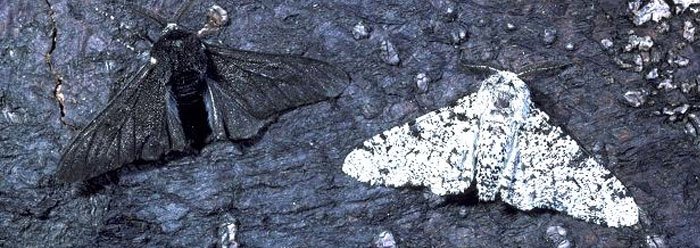
The trees these moths used to live on were white, but have been covered in soot from coal factories. Which moth will be more successful in this environment?
a)
Dark moth
b)
Light moth
c)
Both will be equally successful
d)
Neither will be successful
62.
Since the 1800s humans have stopped burning coal, and the trees have returned to their original color. Which moth will be more successful in this environment?
a)
Dark moth
b)
Light moth
c)
Both will be equally successful
d)
Neither will be successful
63.
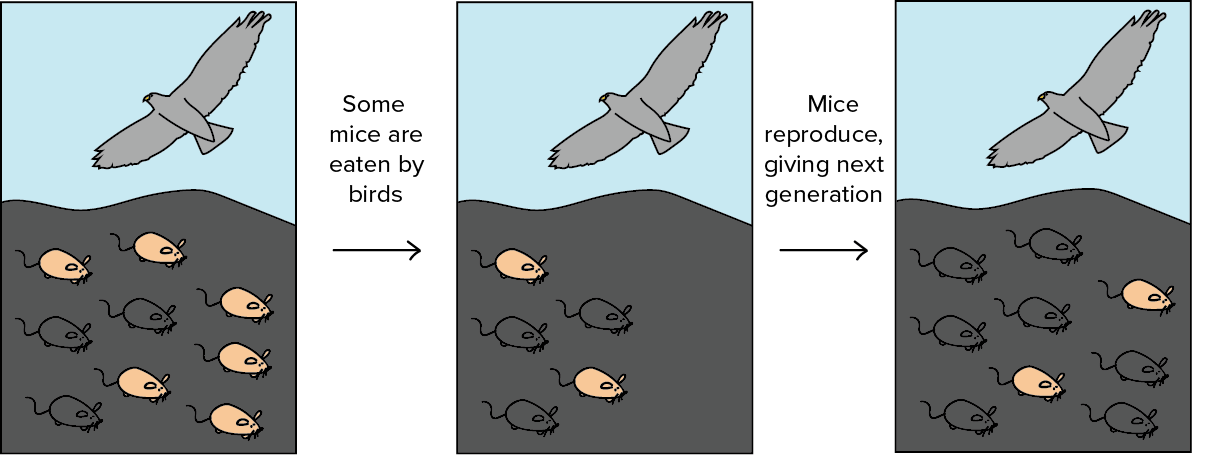
What process is being shown in this image?
a)
Variation
b)
Natural Selection
c)
Selective Breeding
d)
Homeostasis
64.
Why is the mouse population changing over time?
a)
The light mice can reproduce more successfully than the dark mice
b)
The hawks eat more dark mice than light mice because the dark mice taste better
c)
The hawks eat more light mice than dark mice because they can see the light mice more easily
d)
The hawks eat more dark mice than light mice because they can see the dark mice more easily
65.
Which of these statements best describes what Darwin observed on the Galapagos Islands?
a)
The finch population on each island was unique
b)
The finches on the islands ate seeds and nuts, but no insects
c)
The finches on the islands were the same as the finches in Ecuador
d)
The finches could produce offspring only with finches from other islands
66.
Where do adaptations come from?
a)
The individual organism decides to adapt
b)
Mutations that give an organism an advantage in its environment
67.
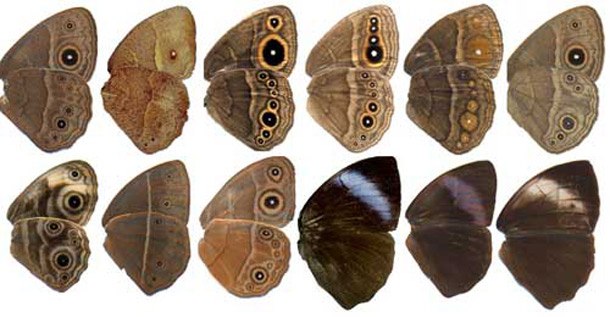
These moths are all the same species. The differences between their wings is an example of ________________
a)
Natural Selection
b)
Variation
c)
Homeostasis
d)
Extinction
68.
Who first proposed a process by which species change over many generations?
a)
Marie Curie
b)
Alexander Fleming
c)
Charles Darwin
d)
Robert Hooke
69.
Which is another term for selective breeding?
a)
Artificial selection
b)
Natural Selection
c)
Intelligent selection
70.
When two organisms from the same family tree breed, then what is it called?
a)
Crossbreeding
b)
Inbreeding
c)
Hyridization
d)
Normal
71.
What is it called when two dogs from the same liter mate?
a)
Inbreeding
b)
Crossbreeding
c)
Natural selection
d)
Intrabreeding
72.
The purpose of selective breeding is to 
a)
Get bigger animals
b)
get smaller animals
c)
create animals with desirable traits
d)
create animals with bad traits
73.

It is very common for yellow labs to have bad hips. This is because owners want purebred yellow labs who are good hunting dogs. This is an example of

a)

Natural Selection

b)

Inbreeding

c)

Hybridization

d)

Fossil Record

74.
All of the following statements are reasons for selective breeding except:
a)
To produce offspring with desirable characteristics
b)
Farmers increase their profit by improving crops
c)
To improve the quality of food products
d)
To increase migration patterns
75.

Crossing a red sweet apple with a large disease resistant apple is an example of ________________.

a)

inbreeding

b)

cloning

c)

natural selection

d)

hybridization

76.

Which statement explains how a population’s genetic variability and diversity can be affected by selective breeding?

a)

Genetic variability and diversity decrease because only select individuals are bred.

b)

Genetic variability and diversity increase because only select individuals are bred.

c)

Genetic variability increases and diversity decreases because only select individuals are bred.

d)

Genetic variability decreases and diversity increases because only select individuals are bred.

77.
Mating a California Navel Orange and a Florida Blood Orange
a)
Inbreeding
b)
Crossbreeding
c)
Overbreeding
d)
Underbreeding
78.
Artificial selection is a slow process.
a)
True
b)
False
79.
A farmer has bred his pineapple plants from the sweetest pineapples from his last harvest to get even sweeter pineapple plants. What is this an example of?
a)
Selective breeding
b)
Natural selection
c)
Extinction
d)
Mutagenesis
80.
 Which of the following correctly defines the term “genetic engineering”?
a)
Changing the genetic sequence of a DNA strand so that a particular trait is produced
b)
Leaving the modification of DNA in nature’s hands
c)
Identifying the genome of plants.
d)
◦A trait that shows even in the presence of its recessive form
82.
1.  Study the picture to the left. A population of insects is sprayed with a new insecticide. Most of the insects are killed but a few survive. In the next generation, spraying continues, but many more of the insects are unaffected by the insecticide than the first spraying. Which of the following BEST explains these results?
a)
The insecticide caused a mutation in the species
b)
A few insects in the first population were immune and passed this trait to their offspring
c)
a.  The insecticide caused a side effect of immunity that was passed on to the next generation of insects. The insects learned to fight off the insecticide.
82.
1.  Study the picture to the left. A population of insects is sprayed with a new insecticide. Most of the insects are killed but a few survive. In the next generation, spraying continues, but many more of the insects are unaffected by the insecticide than the first spraying. Which of the following BEST explains these results?
a)
The insecticide caused a mutation in the species
b)
A few insects in the first population were immune and passed this trait to their offspring
c)
a.  The insecticide caused a side effect of immunity that was passed on to the next generation of insects. The insects learned to fight off the insecticide.
83.
1.  A farmer noticed that some of her sunflower plants were healthy but most of the plants were infested with worms that were killing plants. How could the farmer use selective breeding to try to produce a greater number of healthy plants next season? Choose best answer:
a)
Use plants that require less sunlight
b)
Use plants that are distasteful to bugs
c)
Plant only seeds from the healthy plants
d)
Plant only seeds that require less water from growth.
84.
What is the most likely explanation of the data shown below?
a)
There has been a drought in the area that is affecting all life forms
b)
The population of natural predators of the moths has gotten smaller.
c)
The moths are living in an environment with light trees.
d)
The moths are living in an environment with dark trees.
85.
The variation among domesticated animals is due to
a)
natural selection.
b)
artificial selection.
c)
A.  genetic modification.
d)
random chance