
NEW
Font size
S
M
L
XL
 Worksheets
soil
Total questions: 42
Worksheet time: 3hrs 29mins
Name
Class
Date
1.
Physically breaking down rocks and materials is called__________weathering.
a)
Chemical
b)
Mechanical
c)
Biological
d)
Permeable
2.
A rock containing iron is soft, crumbly, reddish in color. It's been chemically weathered by__.
a)
Carbon Dioxide
b)
Oxygen
c)
Nitrogen
d)
Sulfer
3.
Soil formation begins with the weathering of_______.
a)
Humas
b)
Subsoil
c)
Litter
d)
Rock
4.
The layer of soil which the topsoil is found.
a)
Horizon A
b)
Horizon B
c)
Horizon C
d)
Horizon D or R
5.
The MAIN thing Decomposers do for the the soil is the following:
a)
Store moisture
b)
Burrow deep in the soil
c)
Make space for air and water
d)
Break down and digest dead organisms
6.
What effect did over plowing and cutting down trees in the Great Plains during the 1930’s?
a)
It had little effect
b)
It increased soil fertility
c)
It was a primary cause of the Dust Bowl
d)
Farmers had a great harvest
7.
Decayed organic material in soil is called______.
a)
Litter
b)
Silt
c)
Humus
d)
Clay
8.
The two main factors that determine the rate of weathering are the TYPE of rock and_____.
a)
Music
b)
Climate
c)
Size of rock
d)
Weight of rock
9.
The movement of rocks and weathered materials is called_________.
a)
Chemistry
b)
Physical
c)
Weathering
d)
Erosion
10.
Soil conservation includes all of the following EXCEPT_______.
a)
Desertification
b)
Contour plowing
c)
Terracing
d)
Crop rotation
11.
Topsoil which contains the HUMUS is the soil layer best for growing plants.
a)
True
b)
False
12.
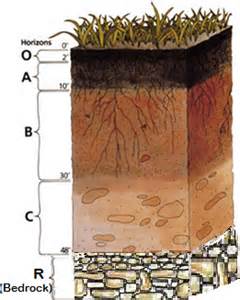
Which horizon is made up of partially weathered rocks?
a)
Horizon A
b)
Horizon B
c)
Horizon C
d)
Horizon D or R
13.
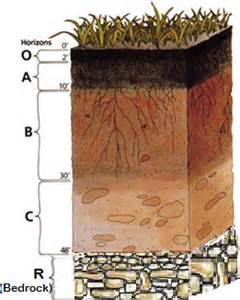
In which horizon is most of the HUMUS?
a)
Horizon A
b)
Horizon B
c)
Horizon C
d)
Horizon D or R
14.
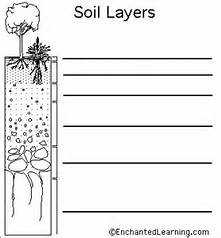
Which horizon contains clay, silt, minerals, and a little humus?
a)
Horizon A
b)
Horizon B
c)
Horizon C
d)
Horizon D or R
15.
In which horizon is the Bedrock
a)
Horizon A
b)
Horizon B
c)
Horizon C
d)
Horizon D or R
16.
There is an unlimited supply of fertile soil.
a)
True
b)
False
17.
Soil's one of the Earth’s most valuable resources. Everything on Earth depends on soil somehow.
a)
True
b)
False
18.
Soil layers are called horizons because...
a)
The layers are all different
b)
The layers are vertical
c)
The layers are horizontal
d)
The layers are above one another
19.
The non-decomposed organic material that lies on top of the A Horizon is called...
a)
Trash
b)
Stuff
c)
Litter
d)
Dog poop
20.

The smallest part of an element...
a)
atom
b)
molecule
c)
electron
21.
The idea that everything is made up of small particles called atoms...
a)
Big idea
b)
Atomic Theory
c)
Einstein's Theory
22.
Type of matter made of two or more elements...
a)
element
b)
mixture
c)
compound
23.

Substance with NO definite volume or shape...
a)
solid
b)
liquid
c)
gas
24.
Amount of matter in a solid, liquid, or gas...
a)
mass
b)
volume
25.
Amount of space an object takes up...
a)
Mass
b)
Volume
26.
Anything that takes up space and has mass...
a)
Electron
b)
Atom
c)
Matter
27.
The type of plate boundary where two plates come together is a .....
a)
Convergent Boundary
b)
Divergent Boundary
c)
Transform Boundary
d)
Plate Boundary
28.

What type of event will occur at this boundary?
a)
Earthquake
b)
Volcano Eruption
c)
Tornado
d)
Mountain Building
29.
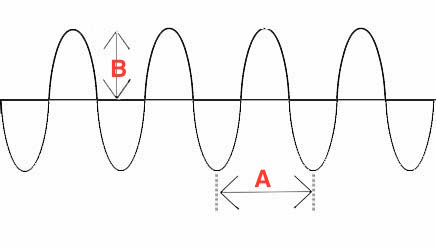
What property of this wave is represented by the letter "A"
a)
amplitude
b)
crest
c)
trough
d)
wavelength
30.
The highest point on a wave is:
a)
the crest
b)
the trough
c)
the top
d)
the coast
31.
The lowest point on a wave is the:
a)
Amplitude
b)
Crest
c)
Trough
d)
Wavelength
32.
The number of wavelengths that pass a point each per second is:
a)
frequency
b)
period
c)
longitudinal
d)
transverse wave
33.
The number of wavelengths that pass a point each per second is:
a)
frequency
b)
period
c)
longitudinal
d)
transverse wave
34.
When the frequency of a wave increases, what happens to the wavelength?
a)
The wavelength is not directly affected by the frequency of a wave.
b)
The wavelength increases.
c)
The wavelength decreases.
d)
More specific information is needed to form a conclusion about the wavelength.
35.
A mechanical wave cannot travel through...
a)
a vacuum(empty space).
b)
water.
c)
air.
d)
glass.
36.
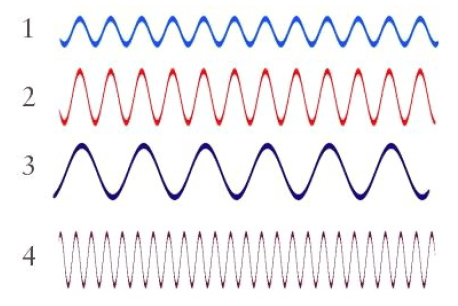
Which wave in the diagram has the greatest frequency?
a)
1
b)
2
c)
3
d)
4
37.
When a wave bends as it passes through at an angle from one medium to another.(example: pencil in a glass of water-)
a)
medium
b)
refraction
c)
reflection
d)
interference
38.
Sound is caused by....
a)
molecules
b)
vibrations
c)
people
d)
space
39.
A longer string makes a _______ pitch than a short string.
a)
louder
b)
softer
c)
higher
d)
lower
40.

Sound is a form of?
a)
energy
b)
pitch
c)
volume
41.
Sound travels FASTEST through which of these materials?
a)
Air
b)
Empty space
c)
Metal
d)
Water
42.
Wax paper or a foggy window is an example of what type of material.
a)
transparent
b)
translucent
c)
opaque
Reset

