wayground logo

Free Printable Worksheets

Font size

S
M
L
XL
Worksheets

EOC REVIEW PHYSICAL SCIENCE

Total questions: 84

Worksheet time: 1hrs 18mins

Name
Class
Date
1.
Valence electrons are found by looking at what __________ the atom is located in on the periodic table.
a)
group
b)
column
c)
row
d)
box
2.
_________ are located to the right of the stair-step line.
a)
Metals
b)
Nonmetals
c)
Metalloids
3.
___________ are located to the left of the stair-step line.
a)
Metals
b)
Nonmetals
c)
Metalloids
4.
Properties for Representive Elements:
__________________________
-Solids at room temperature
-Conduct electricity
-very reactive
-ductile (wires)
a)
Metals
b)
Nonmetals
c)
Metalloids
5.
Atomic number is equal to the number of _______ in the atom.  It is also the atoms' identity ---  it's the small number of the periodic table.
a)
neutrons
b)
isotopes
c)
protons
6.
_______________ is equal to the average mass of all the isotopes of a particular element.  It is the big number on the periodic table.
a)
Atomic Number
b)
Atomic Mass
c)
Atomic Exponent
7.
____________ is the same number of protons and different numbers of neutrons.
a)
Isotope
b)
Neutron
c)
Elemental Identity.
8.
The electron cloud is divided in to energy levels or shells.  The first level will hold _____ electrons and the second level will hold ______ electrons.
a)
8, 2
b)
2,8
c)
1, 8
9.
Substance being dissolved
a)
solute
b)
solvent
10.
Doing the dissolving
a)
Solute
b)
Solvent
c)
Conductivity
11.
No more solute can dissolve
a)
Saturated Solution
b)
Unstaurated solution
12.
More solute can dissolve
a)
Saturated Solution
b)
Unsaturated Solution
13.
There are factors that affect the rate at which a solution dissolves.  Name the factor.
____________-
Define: Movement of particles
Affect: Increase solubility
a)
Agitation
b)
Size of Particles
c)
Temperature
d)
Number of Particles
14.
There are factors that affect the rate at which a solution dissolves.  Name the factor.
____________-
Define: Smaller particles dissolve faster due to increased surface area
Affect: Increase solubility
a)
Agitation
b)
Size of Particles
c)
Temperature
d)
Number of Particles
15.
The law of conservation of ___________ states that energy, like matter, cannot be created nor destroyed; it can only be changed from one form of energy to another.  Energy takes takes many forms in the world around us.  Each form of energy can be converted to and from other forms of energy.
a)
energy
b)
solubility
c)
conduction
d)
radiation
16.
____ energy is stored in the bonds that hold atoms together in molecules.  When fuels or foods are broken down, this energy is converted to heat or kinectic energy.
a)
Nuclear
b)
chemical
c)
kinetic
17.
______ energy, also known as stored energy, is the energy of position. When a boulder sits on top of a cliff, it has gravitational _____energy as a result of its height above the ground.  When the boulder tumbles off the cliff, its gravitational ______ energy is converted to kinectic energy.  
a)
Kinetic
b)
Potential
c)
Mechanical
d)
Nuclear
18.
Kinetic and potential energy are types of _______ energy.
a)
Nuclear
b)
Mechanical
c)
Sound
d)
Light
19.
________________
Define: The transfer of heat energy between materials that are in direct contact with each other
a)
convection
b)
conduction
c)
radiation
20.
Circulation of air or water
a)
conduction
b)
convection
c)
radiation
21.
The amount of heat energy gains or loses (Q), depends on the mass (m), the specific heat, and the change in temperature (ΔT) of the substance.  The formal for finding heat energy is the product of 3 factors:
a)
T= mΔQ
b)
Q=mcΔT
22.
What is the change called from a solid to a liquid?
a)
melting
b)
sublimation
c)
freezing
d)
evaporation
23.
What is the change called from a solid to a gas?
a)
melting
b)
sublimation
c)
freezing
d)
evaporation
24.
What is the change called from a liquid to a solid?
a)
melting
b)
sublimation
c)
freezing
d)
evaporation
25.
What is the change called from a liquid to a gas?
a)
melting
b)
sublimation
c)
freezing
d)
evaporation
26.
Alpha particle consists of a large _______ nucelus
a)
helium
b)
small electrons
c)
atomic
27.
____________ is two protons and two electrons
a)
Alpha
b)
Beta
c)
Gamma
28.
Alpha particles can be stopped by ______, but is most damaging when inside the body.
a)
lead
b)
paper
c)
aluminum
29.
___________ gives off an electron
a)
Alpha
b)
Beta
c)
Gamma
30.
__________ is splitting of an atom into 2 atoms.  It occurs in nuclear power plants.
a)
Fission
b)
Fusion
c)
Half-Line
31.
__________ combines two small atoms to make a larger one.  It occurs in the sun and stars.
a)
Fission
b)
Fusion
c)
Half Line
32.
This is an example of
a)
Fission
b)
Fusion
c)
Radioactive decay
33.
The amount of time it takes for a radioactive element decay by half
a)
Half life
b)
Radioactive decay
c)
Half Bloods
34.
__________= Mass/Volume
(remember My Dear Valentine)
a)
Density
b)
Mass
c)
Velocity
35.
Mono means
a)
1
b)
4
c)
2
d)
10
36.
Di means
a)
2
b)
4
c)
10
37.
The Law of Conservation of Matter means 
a)
it can be created or destroyed
b)
it can be created but not destroyed
c)
it can't be created or destroyed
38.
__________ combines to from a larger compouned
EX: Element + Element → Compound or
A + B= AB
2Na + Cl2= 2NACL
a)
Synthesis
b)
Decomposition
c)
Single Replacement
d)
Double Replacement
39.
______________ is breaks down into smaller parts.
Compound→ _______ Element + _______ Element ______ or
Compound→ ___ Coumpound ____ + ___ Compound ___
AB= A + B or 2 H2O = 2H2 + O2
a)
Synthesis
b)
Decomposition
c)
Single Replacement
d)
Double Replacement
40.
_______ is one atom changes places
Element + Compound→Element + Compound
A + BC = B + AC
Cu + 2AgNO3= 2Ag + Cu(NO3)2
a)
Synthesis
b)
Decomposition
c)
Single Replacement
d)
Double Replacement
41.
____________ is 2 atoms change places
Compound + Compound→ Compound + Compound
AB+CD=AD+CB
CaCO3 + 2HCl=CaCl2+H2CO3
a)
Synthesis
b)
Decomposition
c)
Single Replacement
d)
Double Replacement
42.
The distance an object moves per unit of time is known as _____.
a)
speed
b)
velocity
c)
acceleration
43.
The ______ is the speed of the object plus its direction.  The average speed can be found by dividing the change in the displacement of an object by the change in time.
a)
speed
b)
velocity
c)
acceleration
44.
Newton's _________ Law
An object at rest must stay at rest unless acted upon
Example: Boulder
a)
First
b)
Second
c)
Third
45.
Newton's _________ Law
Greater the force, greater the acceleration
Example: Baseball (pitching)
a)
First
b)
Second
c)
Third
46.
Newton's _________ Law
Every action has an equal and opposite reation
Example: Recoil of a gun/car wash
a)
First
b)
Second
c)
Third
47.
____ force is a force between any two objects. The strength of the force is related to the mass of the objects and the distance between them  The more mass an object has, the greater the _______ force it exerts.  The Moon has less than the earth.  The result the lower ___ forcemade the astronauts appear nearly "weightless" as they moved across the lunar surface. 
a)
Gravitational
b)
Electromagnetic
c)
Nuclear
d)
Frictional
48.
The stored energy in a battery can BEST be described as:
a)
Thermal
b)
Nuclear
c)
Kinetic
d)
Chemical
49.
Which of the following could be used to convert wind energy to electrical energy?
a)
A chemical storage battery.
b)
A solar cell.
c)
A windmill.
d)
Rotating coils in a magnetic field. 
50.
Which of the following is example of potential energy?
a)
Gasoline in a car.
b)
A rock at the top of a hill.
c)
A baseball bat held motionless in the ready position. 
d)
All of these are examples of potential energy.
51.
Newton's 3rd Law states that:
a)
An object in motion will stay in motion unless acted on by an unbalanced force. 
b)
For every action, there is an equal and opposite reaction. 
c)
The acceleration of an object depends on the mass of the object and the force applied to it.
d)
Energy cannot be created or destroyed, only transferred. 
52.
A metal spoon is used to stir a pot of boiling soup.  The person holding the spoon feels the spoon get hot.  Which BEST describes the transfer of heat in the spoon?
a)
Radiation
b)
Electrical
c)
Conduction
d)
Convection
53.
In an exothermic reaction, heat is ...
a)
taken in
b)
given out
54.
In an endothermic reaction, heat is ,,,
a)
taken in
b)
given out
55.
If a chemical reaction is EXOTHERMIC, the temperature would....
a)
Stay the same
b)
Increase
c)
Decrease
56.
The following is what type of reaction:
PbCl2 + AgNO3 → Pb(NO3)2 + AgCl
a)
Synthesis
b)
Decomposition
c)
Single Replacement
d)
Double Replacement
57.
The following is what type of reaction:
NH3 + HCl  → NH4Cl
a)
Synthesis
b)
Decomposition
c)
Single Replacement Replacement
d)
Double Replacement Replacement
58.
Balance this equation:
 2Li + Cl2 → LiCl
a)
2Li + Cl2 → 4LiCl2
b)
2Li + Cl2 → LiCl2
c)
2Li + Cl2 → 2LiCl
d)
2Li + 2Cl2 → 2 LiCl2
59.
v = d/t
is the formula for...
a)
Velocity and Speed
b)
Just Speed
c)
Just Velocity
d)
Acceleration
60.
a = vf - vi / t
is the long formula for...
a)
Velocity
b)
Speed
c)
Acceleration
d)
Force
61.
F = m*a
is the formula for...
a)
Force
b)
Acceleration
c)
Kinetic Energy
d)
Speed
62.

I have to build a box for my scouting project with a

volume of 36 cubic centimeters. The base of the box is

6 cm long and 2cm wide. How high should I build the box?

a)

net force =(mass) (acceleration)

b)

Velocity = displacement

time

c)

Acceleration = final velocity – initial velocity

time

d)

Volume of a rectangular solid = length* width* height

(V = lwh)

63.

Acceleration = final velocity – initial velocity

time

a)

Emily rides her horse with a constant speed of 18 km/h. How far can she travel in 3 1/2 hours?

b)

An airplane accelerates down a runway at 3.20 m/s2 for 32.8 s until is finally lifts off the ground. Determine the distance traveled before takeoff

c)

An object of mass 300 kg is observed to accelerate at the rate of 4 m/s2. Calculate the force required to produce this acceleration.

d)

Amy uses 20N of force to push a lawn mower 10 meters. How much work does she do?

64.

A runner races in the 100 meter dash. It takes her 10 seconds to finish. What is her average speed?

a)

Average speed= total distance

total time

b)

net force =(mass) (acceleration)

c)

Work = force x distance (W = Fd)

d)

Acceleration = final velocity – initial velocity

time

65.

How long would it take for a car to travel a distance of 200 kilometers if it is traveling at a velocity of 55 km/hr?

a)

Acceleration = final velocity – initial velocity

time

b)

Work = force x distance (W = Fd)

c)

Average speed= total distance

total time

d)

Acceleration = final velocity – initial velocity

time

66.

A student did 60 Newton-meters of work by pulling a box 6 meters. Approximately how much force did the student apply?

a)

Acceleration = final velocity – initial velocity

time

b)

Work = force x distance (W = Fd)

c)

Average speed= total distance

total time

d)

Average speed= total distance

total time

67.

If you push a coffee mug 1.4 m using a force of 5 N, the work done on the mug is?

a)

net force =(mass) (acceleration)

b)

Average speed= total distance

total time

c)

Work = force x distance (W = Fd)

d)

AcceleratioAcceleration = final velocity – initial velocity

68.

An irregularly shaped stone was lowered into a graduated cylinder holding a volume of water equal to 2 ml. The height of the water rose to 7 ml. If the mass of the stone was 25 g, what was its density?

a)

Volume of a rectangular solid = length* width* height

(V = lwh)

b)

d=m/v

c)

Acceleration = final velocity – initial velocity

time

d)

Average speed= total distance

total time

69.
Suppose an astronaut were to visit a planet where the gravity is half that of Earth.  His MASS on that planet would be ______________.
a)
half his Earth mass
b)
the same as his Earth mass
c)
twice his Earth mass
d)
zero
70.
What is happening at D?
a)
Stationary
b)
Accelerating
c)
Fast steady speed; moving away from the starting position
d)
Slower steady speed; moving away from the starting position
71.
What is happening at A?
a)
Stationary
b)
Accelerating
c)
Slower steady speed; moving away from the starting position
d)
Steady speed; returning to start position
72.
Which runner won the race?
a)
A
b)
B
c)
C
73.
What is this graph showing?
a)
Constant Speed
b)
Acceleration (speeding up)
c)
Deceleration (slowing down)
d)
No motion
74.
What does this graph represent?
a)
Constant speed
b)
Acceleration
c)
Not moving
75.
How many grams of K2Cr2O7, are soluble in 100 g of water at 95 ºC?
a)
83 grams
b)
75 grams
c)
40 grams
d)
12 grams
76.
How does a solution become supersaturated?
a)
dissolve lots of solvent in it.
b)
dissolve a little solute in it. 
c)
dissolve more solute than you should be able to. 
d)
dissolve a super amount of solvent in it. 
77.
When 20 grams of potassium chlorate, KClO3, is dissolved in 100 grams of water at 80 ºC, the solution can be correctly described as:
a)
supersaturated
b)
saturated
c)
unsaturated
78.
When 50 grams of KCl is dissolved in 100 grams of water at 50 ºC, the solution can be correctly described as:
a)
supersaturated
b)
unsaturated
c)
saturated
79.
When 42 grams of potassium chloride, is dissolved in 100 grams of water at 50 ºC, the solution can be correctly described as:
a)
supersaturated
b)
saturated
c)
unsaturated
80.
What line segment represents only the solid state?
a)
A-B
b)
B-C
c)
C-D
d)
D-E
81.
In which segment is the kinetic energy remaining constant?
a)
A-B
b)
B-C
c)
C-D
d)
E-F
82.
What state(s) of matter are present at D-E?
a)
Solid-liquid
b)
Liquid
c)
Liquid-gas
d)
Gas-Solid
83.
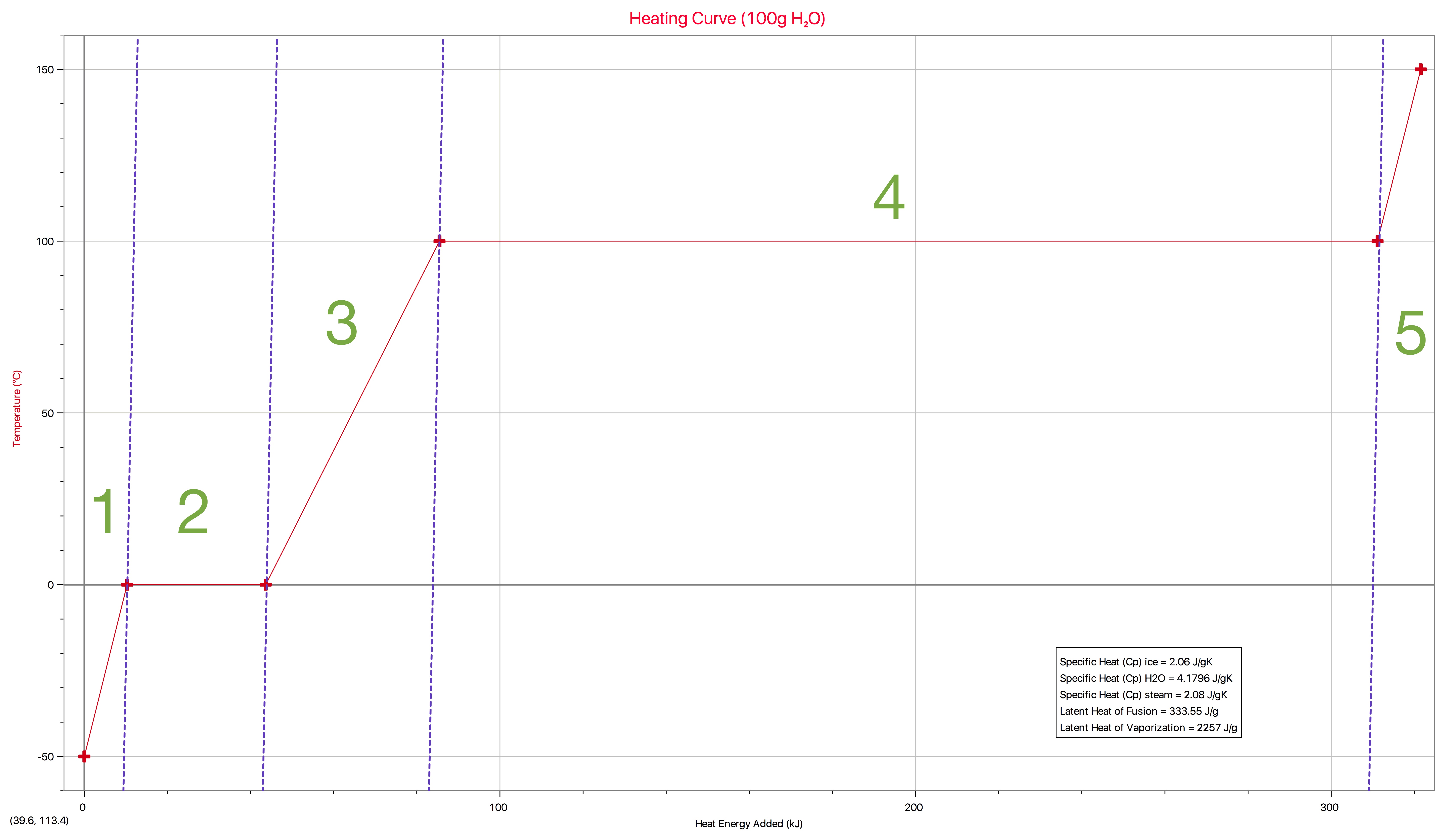
What state of matter is segment 5?
a)
Solid
b)
Liquid
c)
Gas
d)
Plasma
84.
In which region(s) of the graph does a phase change occur?
a)
Region 1, 3, & 5
b)
Region 2 & 4
c)
Region 1 only
d)
Region 1 & 2