wayground logo

Free Printable Worksheets

Font size

S
M
L
XL
Worksheets

muscular system summative

Total questions: 50

Worksheet time: 17mins

Name
Class
Date
1.
Which muscle type is found in your stomach, bladder, and intestines?
a)
Skeletal
b)
Smooth
c)
Cardiac
d)
Straight
2.
Which muscles are involuntary?
a)
skeletal
b)
cardiac
c)
smooth
d)
smooth and cardiac
3.
Which types of muscle tissue are voluntary?
a)
Cardiac
b)
Skeletal
c)
Smooth
d)
Cardiac and Smooth
4.

What type of muscle is found in the bladder?

a)

cardiac

b)

skeletal

c)

smooth

d)

voluntary

5.
Involuntary muscle is 
a)
muscle found in the heart
b)
muscle found in the organs
c)
muscle that works automatically
d)
all of these are true
6.
What is a voluntary muscle?
a)
You have control over the muscle 
b)
You have no control over the muscle
c)
Muscle works automatically
d)
Muscles fuse together
7.
What type of muscle are the biceps and triceps that are located in your upper arm?
a)
skeletal
b)
cardiac
c)
smooth
d)
involuntary
8.
What is smooth muscle responsible for?
a)
Responsible for voluntary body movements.
b)
Carries out mostly involuntary processes like digestion and pumping blood through arteries.
c)
Prevents the actin from rubbing with the myosin.
d)
Rigor mortis
9.
What is skeletal muscle responsible for?
a)
Responsible for voluntary body movements.
b)
Carries out mostly involuntary processes like digestion and pumping blood through arteries.
c)
Prevents the actin from rubbing with the myosin.
d)
Rigor mortis
10.

How many skeletal muscles are there in the human body?

a)

550

b)

230

c)

950

d)

over 640

11.

How many types of muscles are there in the body?

a)

206

b)

3

c)

over 640

d)

some say about 8 billion

12.

The Muscular System makes nearly _________ of the weight of the human body?

a)

25%

b)

Half

c)

90%

d)

40%

13.

A bundle of fascicles best describes a...

a)

muscle fiber

b)

muscle belly

c)

myofibril

d)

tendon

14.

The structural level of organization that contains actin and myosin.

a)

Tendon

b)

myofibril

c)

myofilament

d)

Fiber

15.

Another name for a muscle cell.

a)

myocyte

b)

Sacrolemma

c)

Sacromere

d)

Fascicle

16.
Contractile unit of a muscle.
a)
sarcomere
b)
motor unit
c)
fascicle
d)
myofibril
17.

Thick filaments are in a myofilament are

a)

ATPase

b)

Sarcoplasmic reticulum

c)

Actin

d)

Myosin

18.

Thin filaments in a myofilament are

a)

Sarcomeres

b)

Sarcoplasm

c)

Actin

d)

Myosin

19.
What two chemicals are necessary for muscle contraction to occur?
a)
Niacin and Potassium
b)
Calcium and ATP
c)
Sodium and Potassium
d)
Ach and Potassium
20.
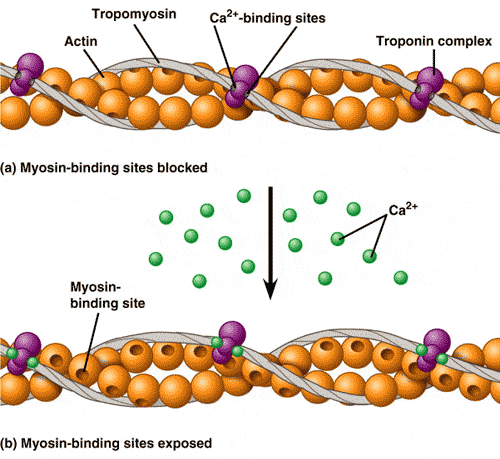
Calcium:
a)
causes ATP binding to actin
b)
increases the action potential along the sarcolemma
c)
binds to proteins on myosin
d)
triggers the binding of myosin to actin
21.
The energy needed to perform a muscle contraction comes directly from
a)
ATP
b)
Oxygen
c)
Glucose
d)
Calcium
22.

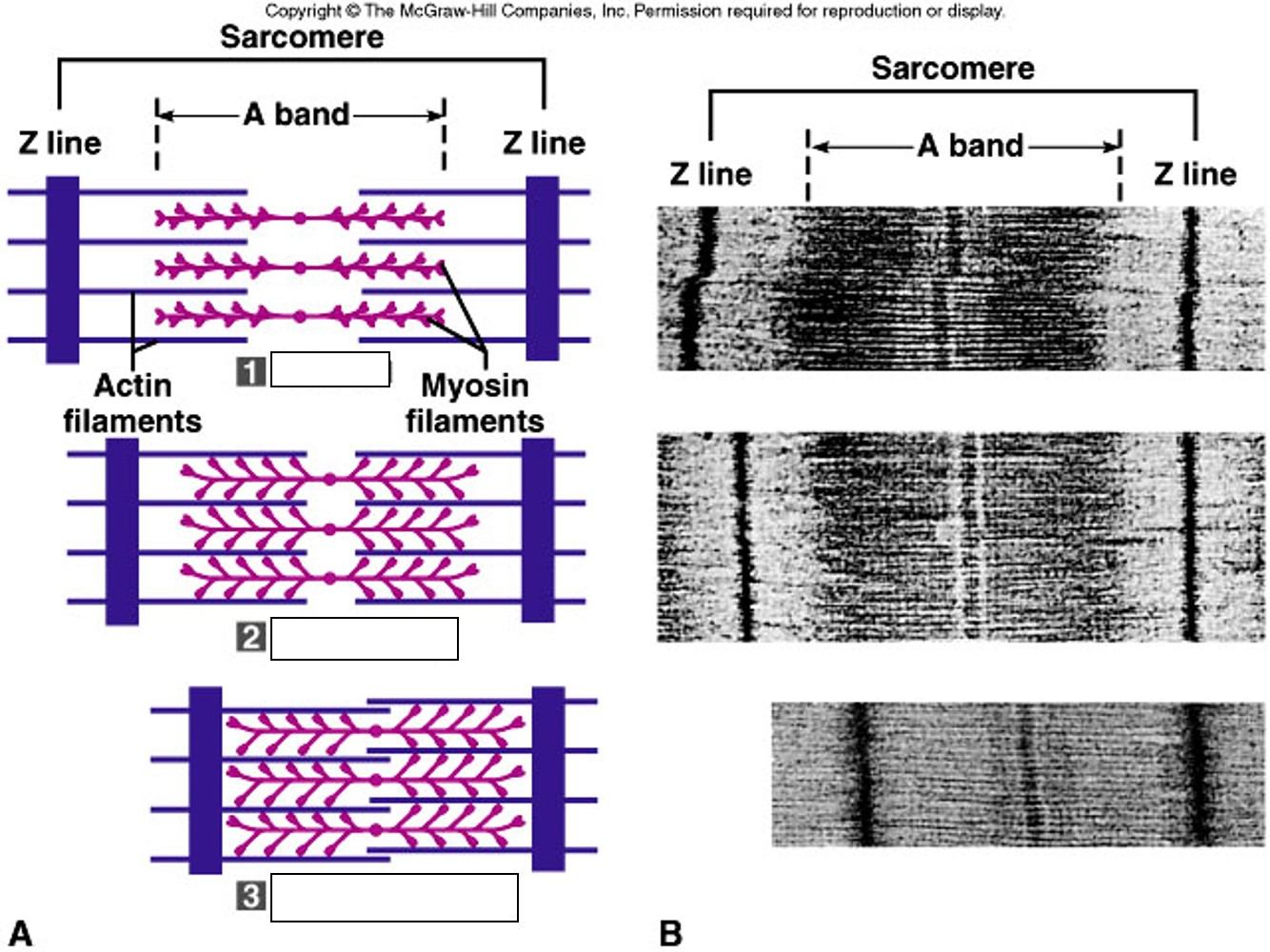
What state is the sarcomere in the first row of pictures?

a)

Relaxed

b)

Contracting

c)

Fully Contracted

d)

None of the above

23.

the increase in the size of a muscle fiber in response to resistance training

a)

atrophy

b)

hypertrophy

c)

muscle strength

d)

muscle endurance

24.

the decrease in the size and strength of a skeletal muscle when it's not used

a)

atrophy

b)

skeletal muscles

c)

muscle endurance

d)

tendon

25.
What is a characteristic of cardiac muscle?
a)
Found in the bicep
b)
Under conscious control
c)
Unconsciously controlled
d)
Found in arteries
26.

In order for muscle to grow, we need to include these ingredients, rest, ______________________, testosterone, AABBC's.

a)

protein

b)

at least 40 hr.s of relaxation

c)

microtraummas

d)

oxygen

27.

A z line in a sarcomere is actually the ________________ we see on skeletal and cardiac muscle

a)

actin

b)

striations

c)

myosin

d)

contractile unit

28.

A bundle of sarcolemmas comprise a....

a)

fasiculus

b)

myofibril

c)

myofilament

d)

sarcomere

29.
Identify this muscle:
a)
latissimus dorsi
b)
pectoralis major
c)
gluteus maximus
d)
masseter
30.
Identify this muscle:
a)
latissimus dorsi
b)
pectoralis major
c)
gluteus maximus
d)
masseter
31.

Skeletal muscle fibers are made up of tiny rods, as pictured in 5, called:

a)

myofibrils

b)

endomysium

c)

muscle fibers

d)

fascicles

32.

Skeletal Muscles use (blank) to connect muscles to bones.

a)

Smooth Muscles

b)

Tendons

c)

Cardiac Muscles

d)

Skeletal bones

33.
The part of the sarcomere that A (green) refers to is the?
a)
Z Line
b)
M Line
c)
H Line
d)
A Line
34.
The part of the sarcomere that D (Red) refers to is the?
a)
Actin
b)
Myosin
c)
Troponin
d)
Tropomyosin
35.
What state is the sarcomere in #2
a)
Relaxed
b)
Contracting
c)
Fully Contracted
d)
None of the above
36.

How may sarcomeres are shown above?

a)

6

b)

5

c)

4

d)

3

37.

Which of the following is NOT a muscle of the hamstrings?

a)

Biceps femoris

b)

Rectus femoris

c)

Semitendinosus

d)

Semimembranosus

38.

During the upward motion of a bicep curl exercise, which muscle acts as the antagonist muscle?

a)

Brachialis

b)

Biceps brachii

c)

Triceps brachii

d)

Brachioradialis

39.

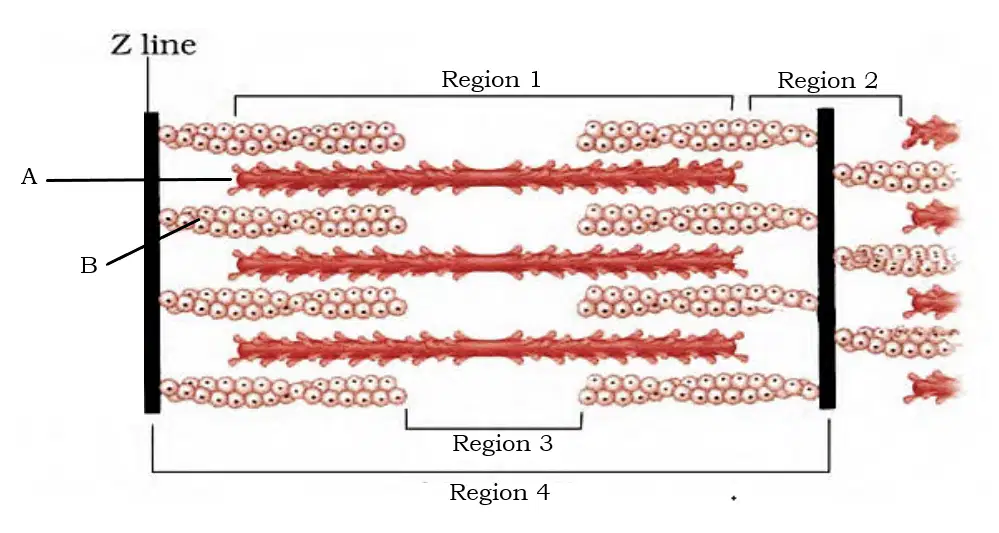
What is Region 4 in the image?

a)

A Band

b)

I Band

c)

H Zone

d)

Sarcomere

40.

which skeletal muscle is represented in the image?

a)

brachioradialis

b)

biceps brachii

c)

biceps femoris

d)

deltoideus

41.

which skeletal muscle is represented in the image?

a)

biceps femoris

b)

semimembranosus

c)

semitendinosis

d)

gastrocnemius

42.

which skeletal muscle is represented in the image?

a)

external obliques

b)

serratus anterior

c)

rectus abdominis

d)

pectoralis major

43.

which skeletal muscle is represented in the image?

a)

latissmus dorsi

b)

teres major

c)

infraspinatus

d)

deltoideus

44.

which skeletal muscle is represented in the image?

a)

pectoralis major

b)

serratus anterior

c)

rectus abdominis

d)

deltoideus

45.

which skeletal muscle is represented in the image?

a)

pectoralis major

b)

serratus anterior

c)

rectus abdominis

d)

deltoideus

46.

which skeletal muscle is represented in the image?

a)

semitendinosus

b)

semimembranosus

c)

biceps femoris

d)

gastrocnemius

47.

which skeletal muscle is represented in the image?

a)

serratus anterior

b)

rectus abdominis

c)

external obliques

d)

pectoralis major

48.

which skeletal muscle is represented in the image?

a)

sternocleidomastoid

b)

trapezius

c)

zygomaticus

d)

depressor anguli oris

49.

which skeletal muscle is represented in the image?

a)

semitendinosus

b)

semimembranosus

c)

biceps femoris

d)

gastrocnemius

50.
Muscle contraction can only take place in the presence of ___________.
a)
calcium
b)
potassium
c)
magnesium
d)
selenium