wayground logo

Free Printable Worksheets

Font size

S
M
L
XL
Worksheets

Y7 Heart & Lungs

Total questions: 60

Worksheet time: 37mins

Name
Class
Date
1.
Which does not make up the circulatory system?
a)
heart
b)
blood
c)
lungs
d)
blood vessels
2.
What is the largest artery in the body?
a)
femoral artery
b)
brachial artery
c)
carotid artery
d)
aorta
3.
Which blood vessels carry blood to the heart?
a)
Aorta
b)
veins
c)
arteries
d)
arterioles
4.
Which blood vessels carry blood away from the heart?
a)
capillaries
b)
veins
c)
arteries
5.
What does Deoxygenated mean?
a)
Oxygen-rich
b)
Blood flow
c)
Oxygen-poor
d)
Water Flow
6.
The heart is the main organ in the _________ system
a)
respiratory
b)
endocrine
c)
circulatory
d)
nervous
7.
Smoking is?
a)
Bad for your lungs
b)
Great for every part of the body
c)
Only a little bad
d)
delicious 
8.
When you exercise, your heart beats faster to...
a)
spread oxygen throughout your body more quickly.
b)
make you feel excited.
c)
let you know you're working hard.
9.
What is the respiratory system? 
a)
Body's food processing system
b)
Body's breathing system
c)
Body's reproduction system
d)
Body's nervous system
10.
What is the main organ in the respiratory system?
a)
Kidney
b)
Heart
c)
Lungs
d)
Diaphragm
11.
What is the main bone structure that protects the lungs
a)
Vertebrae
b)
Rib cage
c)
Skull
d)
Pelvis
12.
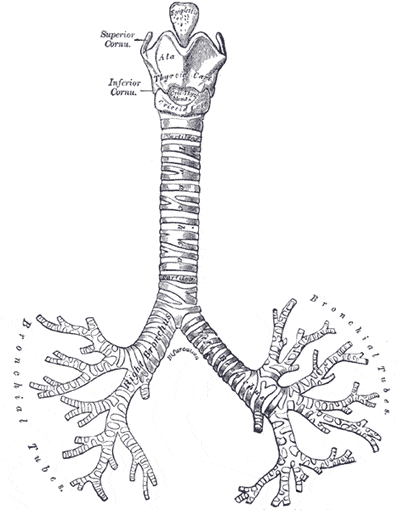
What is the organ "x"
a)
Heart
b)
Lungs
c)
Diaphragm
d)
Trachea
13.

Which tube is also known as your wind pipe?

a)

esophogus

b)

bronchi

c)

trachea

d)

alveoli

14.
Location of gas exchange
a)
alveoli
b)
myocardium
c)
raveoli
d)
pulmonary vent
15.
Air moves into the lungs due to 
a)
decreased air pressure in lungs
b)
pressure of diaphragm on lungs
c)
throat muscles contracting
d)
active transport
16.
What is the main function of the respiratory system?
a)
to provide oxygen and remove carbon dioxide from the body
b)
to bring oxygen to the body
c)
to break down food and absorb nutrients
d)
to remove oxygen from the body and deliver carbon dioxide
17.
What surrounds the alveoli?
a)
oxygen
b)
carbon dioxide
c)
capillaries
d)
bronchioles
18.

Which of the following are features of the alveoli that adapt them to gas exchange?

I. High surface area

II. Thin walls

III. Dry surfaces

a)

I and II

b)

I only

c)

II and III

d)

I, II and III

19.
Which of the following happens during inspiration?
a)
Diaphragm contracts
b)
Abdominal muscles contract
c)
External intercostal muscles relax
d)
Internal intercostal muscles contract
20.

What do healthy lungs look like?

a)

spongy and black

b)

hard and black

c)

hard and pinkish gray

d)

spongy and pinkish

21.

What is asthma?

a)

disease that is easy to catch from others

b)

disease that involves the airways constricting

c)

disease that involves the airways relaxing

d)

disease that always results in going to hospital

22.
Energy produced through respiration using oxygen is called _____ respiration
a)
aerobic
b)
anaerobic
23.
Energy produced through respiration when oxygen is NOT used is called ____ respiration.
a)
aerobic
b)
anaerobic
24.

Which type of organelle is mostly involved with respiration?

a)

chloroplasts

b)

mitochondria

c)

nucleus

d)

ribosomes

25.
All living things do which of the following?
a)
Chemosynthesis
b)
Respiration
c)
photosynthesis
d)
all of the answers
26.
What is one of the reactants of cellular respiration?
a)
energy
b)
glucose
c)
carbon dioxide
d)
water
27.
What happens to your breathing rate when you exercise?
a)
It increases
b)
It decreases
c)
It stays the same
28.
What are the products of aerobic respiration?
a)
Glucose and oxygen
b)
Carbon dioxide and water
c)
Lactic acid
d)
Carbon monoxide
29.
Aerobic respiration is different from anaerobic respiration in that aerobic respiration needs...
a)
chlorophyll
b)
carbon dioxide
c)
glucose
d)
oxygen
30.
Which of the following structure is where cellular respiration occurs in the cell?
a)
nucleus
b)
cytoplasm
c)
mitochondria
d)
vacuoles
31.
What are the products of anaerobic respiration?
a)
Glucose and oxygen
b)
Carbon dioxide and water
c)
Lactic acid
d)
Carbon monoxide
32.
Which equation shows the reaction for anaerobic respiration
a)
carbon dioxide + water --> glucose and oxygen
b)
glucose + Oxygen --> lactic acid and energy
c)
glucose + oxygen --> carbon dioxide and water and energy
d)
glucose --> lactic acid and energy
33.

Vital Capacity is...

a)

The maximum volume of air that your lungs can take

b)

The minimum volume of air that your lungs can take

c)

The volume of air you normally breathe in from day to day

d)

The most food your stomach can contain

34.

How many different types of blood vessels are in our bodies?

a)

1

b)

5

c)

3

d)

2

35.
These have muscular walls:
a)
capillaries
b)
veins
c)
venules
d)
arteries
36.
These have valves that prevent backflow of blood
a)
arteries
b)
veins
c)
arterioles
d)
capillaries
37.

What is the space in the middle of the structure of a blood vessel?

a)

Artery

b)

Lumen

c)

Gap

d)

Loomen

38.

I have a large lumen, I have thin muscular walls.

a)

Artery

b)

Vein

c)

Capillary

d)

Arteriole

39.
What does blood do?
a)
Carries Water to cells
b)
Carries Oxygen to cells
c)
Carries Food to cells
d)
All of the above 
40.

Which of the following is a true statement about asthma?

a)

Asthma attacks can be triggered by weight loss

b)

Asthma is caused by a virus

c)

Asthma is caused by harmful bacteria

d)

Asthma is fairly common condition

41.

What is the direct cause of asthma attacks?

a)

Blood clots in the trachea

b)

Swelling and excess mucous in the airways

c)

Excess fluid in the air sacs

d)

Infection of the lungs

42.

What term best describes what goes on inside the alveoli?

a)

Exchange of gases

b)

Inhalation of oxygen

c)

Circulation of blood

d)

Exhalation of carbon dioxide

43.

What can you infer from the fact that many superstar athletes have asthma?

a)

Asthma helps people excel in sports

b)

Asthma isn't really a serious condition

c)

With proper care, asthmatics can do basically anything

d)

Pro athletes can afford to have to have their asthma cured
44.
Which of these is not a symptom of Asthma?
a)
Shortness of Breath
b)
Coughing blood
c)
Chest tightness 
d)
Wheezing
45.
What is the biggest cause of lung cancer?
a)
Smoking
b)
Second-hand smoke
c)
Eating unhealthy foods
d)
Not exercising
46.
Thick, sticky, dark fluid when tobacco burns is called
a)
Nicotine
b)
Ammonia
c)
Tar
d)
Cilia
47.

What is the name of the two main branches from the trachea (one to each lung)?

a)

bronchi

b)

alveoli

c)

capillaries

d)

bronchioles

48.

Which muscle is involved in breathing?

a)

diaphragm

b)

biceps

c)

abdominal

49.

Which is the correct spelling for the muscle below the lungs which is involved in breathing?

a)

diaphragm

b)

diaphram

c)

diafram

50.

You have 2 bronchi, each one is called a _____________.

a)

bronchiole

b)

bronchus

c)

bronchioley

51.

What do the cilia do?

a)

Catch dust and microbes

b)

Waft mucus and trapped dust and microbes up and out of the lungs

c)

Help the cells lining the windpipe to move about

52.

Why is mucus produced in the lungs?

a)

To help you cough

b)

To trap microbes to reduce the chance of infection

c)

To help the air move in and out

53.

Cigarettes and e-cigarettes both contain:

a)

Nicotine

b)

Tobacco

c)

Formaldehyde

d)

Tar

54.

What effect does tar have on ciliated cells?

a)

Kills the cells

b)

Damages the cilia

c)

Tar doesn't affect these cells

55.

Which chemical in cigarette smoke causes the lung tissue to blacken?

a)

tar

b)

nicotine

c)

carbon monoxide

56.

For respiration to take place glucose needs to react with substance A. Select substance A.

a)

Carbon dioxide

b)

Water

c)

Oxygen

d)

Ozone

57.

When respiration takes place, energy is produced along with another two substances B and C. Select substances B and C.

a)

Carbon dioxide

b)

Water

c)

Oxygen

d)

Ozone

58.

The glucose used during respiration is provided by our

a)

digestive system

b)

respiratory system

c)

circulatory system

59.

The oxygen used during respiration is provided by our

a)

digestive system

b)

respiratory system

c)

circulatory system

60.

Do plant cells carry out respiration

a)

Yes

b)

No