wayground logo

Free Printable Worksheets

NEW

Font size

S
M
L
XL
Worksheets

Physics Spring Final Review 2018

Total questions: 70

Worksheet time: 6hrs 16mins

Name
Class
Date
1.
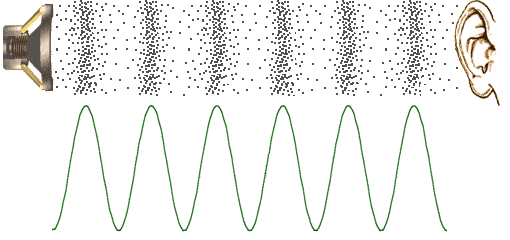
This an example of a 
____ wave
a)
Transverse
b)
Longitudinal
2.
This is an example of a ____ wave
a)
Transverse
b)
Longitudinal 
3.
What frequency does a wave have that has a period of 5 sec?
a)
0.2 Hz
b)
5 Hz
c)
6 Hz
d)
1 Hz
4.
What would be the wavelength of a wave with a frequency of 3 Hz and a speed of 3 m/s
a)
9 m
b)
1 m 
c)
0 m 
d)
6 m
5.
When a wave's amplitude increases it means
a)
it's carrying more energy
b)
its wavelength gets longer
c)
its frequency increases
d)
its wavelength decreases
6.
What is the speed of a sound wave that has a frequency of 340 hertz and a wavelength of 10 meters? 
a)
3400 m/s
b)
34 m/s
c)
320 m/s
d)
350 m/s
7.
What is the measure of how many waves pass a point in a second?
a)
frequency
b)
wavelength
c)
midpoint
d)
crest and trough
8.
A compressional wave is another name for a 
a)
longitudinal wave
b)
electromagnetic wave
c)
radio wave
d)
hair wave
9.
A material in which a mechanical wave travels.
a)
medium 
b)
vacuum 
c)
black holes
d)
chocolate
10.
What is the source of all wave motion?
a)
a wave
b)
vibrations or osciliations
c)
hmmm... aliens
d)
a force applied
11.
 Space is a vacuum without a medium. Which wave can't travel through space? 
a)
mechanical wave 
b)
electromagnetic wave 
12.
 Space is a vacuum without a medium. Which wave can't travel through space? 
a)
mechanical wave 
b)
electromagnetic wave 
13.
Which of the following factors affect the Period of a pendulum? 
a)
mass
b)
length
c)
amplitude
d)
in air
14.
A ____________ wave that moves perpendicular to the motion of the wave.
a)
transverse
b)
compressional
c)
physical 
d)
chemical
15.
What is its period of a pendulum with a length 5.0m at the North Pole where acceleration of gravity is 9.832 m/s 2?
a)
4.831 secs
b)
9.832 secs
c)
2π secs
d)
4.48 secs
16.
All waves carry ________ as they travel from one place to another.
a)
matter
b)
space
c)
energy
d)
water
17.
What is its period of a pendulum with a length 5.0m at the North Pole where acceleration of gravity is 9.832 m/s 2?
a)
4.831 secs
b)
9.832 secs
c)
2π secs
d)
4.48 secs
18.
What is the displacement a spring will stretch if a -600 N student hangs from a spring with a constant of 1200 N/m  
a)
.5 m
b)
360000 m
c)
600 m
19.
A mass is in simple harmonic motion on a spring, solve for the spring constant if the displacement .5 m and the restoring force is -800 N.
a)
39420 N/m
b)
2.5 x 10⁻⁵ N/m
c)
200 N/m
20.
Rank the following waves in order from least to greatest speed:
Wave 1: f= 10 Hz λ= .3 m
Wave 2: f= 5 Hz λ= .2 m
Wave 3: f= 20 Hz λ= .03 m
a)
1, 2, 3
b)
3, 2, 1
c)
2, 3, 1
21.
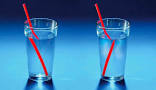
Swimming pools and the ocean look shallower than they really are due to:
a)
reflection 
b)
dispersion
c)
refraction
d)
total internal reflection
22.
What is this called?
a)
refraction
b)
reflection
c)
reconstroction
d)
retraction
23.
According to the Law of reflection, a light ray striking a mirror
a)
continues moving through the mirror in the same direction
b)
moves into the mirror at a slightly different angle
c)
bounces off the mirror toward the direction it came from
d)
bounces off the mirror at the same angle it hits.
24.
A ray of light traveling from air into crown glass strikes the surface at an angle of 30 degrees. What is the angle of refraction? (air n=1, crown glass n=1.532)
a)
39.7 degrees
b)
19.2 degrees
c)
59.1 degrees
d)
12.3 degrees
25.
Glass has a _____________ index of refraction than air.
a)
Equal
b)
Greater
c)
Less
d)
Impossible to say
26.
Light travels through a liquid at 2.25 EE 8 m/s. What is the index of the liquid?
a)
1.33
b)
1.0
c)
1.523
d)
2.45
27.
If the angle of incidence of light traveling through air, and then striking water is 30 degrees what is the angle of refraction? (n=1 air, n=1.33 water)
a)
15 degrees
b)
22 degrees
c)
43 degrees
d)
17 degrees
28.
The point where the rays meet is known as....
a)
Fire
b)
the focal point
c)
refraction
d)
Plane of the lens
29.
A convex lens has a focal length f.  If an object is placed at 2f at what distance will the image appear?
a)
2f
b)
f
c)
between f and 2f
d)
infinity
30.
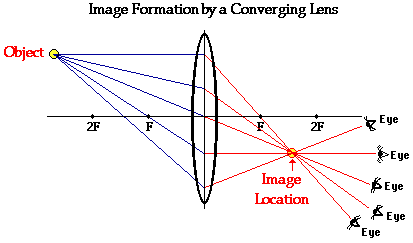
If an object is placed outside 2f of a converging lens describe its image.
a)
reduced, inverted, between f and 2f
b)
reduced, inverted at 2f
c)
reduced, inverted, beyond 2f
31.
This image is.....
a)
inverted and smaller
b)
inverted and larger
c)
not inverted and smaller
d)
not inverted and larger
32.
Which type of mirror magnifies a close up image, like a make-up mirror.
a)
Concave
b)
Convex
c)
Specular
d)
Plane
33.
The following is a picture of what type of mirror? 
a)
Convex Mirror
b)
Concave Mirror
c)
Plane Mirror
d)
Flat Mirror
34.
The following is a picture of what type of mirror? 
a)
Convex Mirror
b)
Concave Mirror
c)
Plane Mirror
d)
Flat Mirror
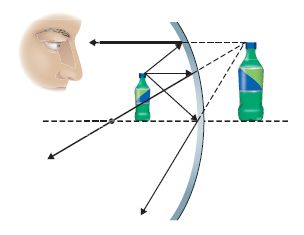
35.
Which terms describe the reflection seen in this image?
a)
virtual, upright
b)
virtual, inverted
c)
real, upright
d)
real, inverted
36.
a)
Real, larger image
b)
virtual, larger image
c)
Real, smaller image
d)
Real, larger image
37.

Calculate the force exerted between two charged objects separated by a distance of 0.6 m. One object has a charge of -5 e -6 C. and the other has a charge of +2.0 e -6 C.

a)

-1.5 E-1 N

b)

-2.5 E-1 N

c)

-2.5 E1 N

d)

-7.5 E-1 N

38.
The Electric Force is strongest when charges are...
a)
close together
b)
far apart
c)
the electric force is constant everywhere
39.
An electric field has both direction and magnitude
a)
True
b)
False
40.
A 2 C charge experiences a force of 40 N when put at a certain location in space.  The electric field at that location is..
a)
2 N/C
b)
20 N/C
c)
80 N/C
d)
42 N/C
41.
Two like charges
a)
 neutralize each other.
b)
repel each other. 
c)
must be neutrons. 
d)
attract each other.
42.
What does it mean when the electric field lines are close together?
a)
the field is positive
b)
the field is negative
c)
The field is strong
d)
the field is weak
43.
What do you call the process of charging a conductor by bringing it near another charged object?
a)
induction
b)
polarization
c)
neutralization
d)
conduction
44.

What direction are the electric field lines around a proton?

a)

towards the charge

b)

away from the charge

45.
Which of the following labeled points is in the region with the strongest force of electric charge
a)
A
b)
B
c)
C
d)
D
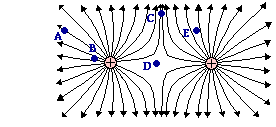
46.
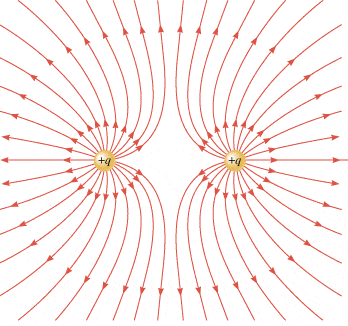
What option best describes this field?
a)
A strong electric field generated by two positive charges. They would attract each other.
b)
A strong electric field generated by two positive charges. They would repel each other.
c)
A weak electric field generated by two opposite charges. They would attract each other.
d)
A weak electric field generated by two positive charges. They would repel each other.
47.
What option best describes this field?
a)
A strong electric field generated by two positive charges. They would attract each other.
b)
A strong electric field generated by two positive charges. They would repel each other.
c)
A weak electric field generated by two opposite charges. They would attract each other.
d)
A weak electric field generated by two positive charges. They would repel each other.
48.
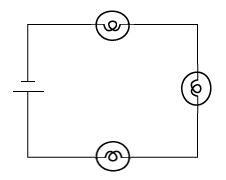
The picture shows an electrical circuit. This circuit is a series circuit because: 
a)
It has 3 light bulbs.
b)
The same current flows through all three light bulbs.
c)
It uses a single battery.
d)
The electrical current has more than one path to flow through
49.
When there is only one path for electrons to move through it is called a _____. When one light goes out, they all go out. 
a)
closed circuit
b)
parallel circuit
c)
series circuit
d)
open circuit
50.
what is magnetic flux 
a)
number of magnetic field lines passing through a surface perpendicular to the lines
b)
wire connected to a circuit and coiled into many spiral loops
c)
magnet whose magnetic field is produced by electric current
d)
 characteristic of magnets that they have two opposite ends called poles
51.
Where is the force of attraction the strongest on a magnet?
a)
at the poles
b)
in the middle
c)
above the magnet
d)
below the magnet
52.
Earth acts like a giant magnet because its center is made up MOSTLY of
a)

granite

b)
limestone
c)
iron
d)
nickel
53.
Breaking a bar magnet in half will produce
a)
A single north magnetic monopole
b)
A single south magnetic monopole
c)
One north and one south monopole
d)
Two bar magnets
54.
A horizontal wire carries a current out of the page.  What direction is the magnetic field?
a)
Out of the page
b)
Left
c)
Clockwise
d)
Counter-clockwise
55.
What kind of magnet can be turned on and off?
a)
refridgerator magnet
b)
electromagnet
c)
ferromagnet
d)
semimagnet
56.
Magnets that are arranged like this will _______. 
a)
move away from each other (repel)
b)
move towards each other (attract)
57.
Region around a magnet in which magnetic force can act.
a)
Magnetic field 
b)
Magnetic force
c)
Domain
d)
Perimeter
58.
Why does each electron in an atom behave like a tiny magnet?
a)
The spinning of an electron produces a magnetic field.
b)
The spinning of an proton produces a magnetic field.
59.
Why do some atoms have strong magnetic properties?
a)
Some atoms contain electrons that are not paired.
b)
Some atoms contain protons that are not paired.
c)
Some atoms contain neutrons that are not paired.
60.
An entire magnetic domain acts like a bar magnet with a north and south pole.
a)
True
b)
False
61.
In a magnetized material, most of the domains are arranged in the same direction. In a material that is not magnetized, the domains point in _________ directions.
a)
same
b)
random
62.

What is the current flowing through this circuit?

a)

6 A

b)

12 A

c)

2A

d)

1 A

63.

Two alpha particles (helium nuclei) each consisting of two protons and two neutrons, have an electrical potential energy of 6.32 x 10⁻¹⁹ J. What is the distance between these particles?


r=(k*q1*q2)/(PE)

a)

1.46 E -9 m

b)

8.99 E 9 m

c)

3.2 E -19 m

d)

1.6 E - 19

64.

A charge moves a distance of 3.0 cm in the direction of a uniform electric field having a magnitude of 300 N/C. The electrical potential energy of the charge decreases by 1.44 x 10⁻¹⁸ J as it moves. Find the magnitude of the charge on the moving particle.


q= PE/(-E*d)

a)

1.44 E -16 J

b)

.03 m

c)

300 N/C

d)

1.6 e -19 C

65.

Find the potential difference between a point infinitely far away and a point 1.0 cm from a proton.


V=kq/r

a)

.01 m

b)

300 V

c)

8.99 E 9 Nm2/C2

d)

1.44 E -7 V

66.

What is the current of a circuit with 12 V and 6 Ω of resistance?

a)

12 A

b)

6 A

c)

2 A

d)

18 A

67.

What is the current of a circuit with 12 V and 6 Ω of resistance?

a)

12 A

b)

6 A

c)

2 A

d)

18 A

68.

What is the total resistance of a series circuit with 12 Ω, 6 Ω, and 4 Ω resistors?

a)

3 Ω

b)

4 Ω

c)

22 Ω

d)

2 Ω

69.

What is the total resistance of a parallel circuit with 12 Ω, 6 Ω, and 4 Ω resistors?

a)

3 Ω

b)

4 Ω

c)

22 Ω

d)

2 Ω

70.

What is the current across resistor 1 of this circuit?

a)

6 A

b)

2 A

c)

4 A

d)

18 A