wayground logo

Free Printable Worksheets

NEW

Font size

S
M
L
XL
Worksheets

Cumulative Spring ACP Review Part 1

Total questions: 50

Worksheet time: 26mins

Name
Class
Date
1.
Which best describes thermal equilibrium?
a)
When the particles of two objects have the same average kinetic energy. 
b)
The process of transferring energy from high to low.
c)
The storage of energy inside an object.
d)
Balancing the weight of two objects.
2.
Describe the transformation of energy required to move a car.
a)
Chemical  → Kinetic → Heat
b)
Heat → Kinetic → Chemical
c)
Kinetic → Heat → Chemical
d)
Chemical → Heat → Kinetic
3.
Rank the following samples from greatest kinetic energy of the molecules to least kinetic energy of the molecules:
a)
A > B > C > D
b)
B > A > C > D
c)
B > A > D > C
d)
D > C > B > A
4.
Using an air pump to compress air in a cylinder does work on the air in the cylinder.  The result is
a)
Air molecules lose kinetic energy, increasing the pressure in the cylinder
b)
Air molecules gain kinetic energy, increasing the pressure in the cylinder
c)
Air molecules lose kinetic energy, decreasing the pressure in the cylinder
d)
Air molecules gain kinetic energy, decreasing the pressure in the cylinder
5.

Is it possible to convert 100% of a given amount of mechanical energy into heat?

a)

Yes

b)

No

c)
6.

Which is an example of decreasing entropy in a closed system?

a)

Boiling water

b)

Freezing water

c)

Cells in a body coming together

d)

Ice melting

7.

A metal spoon is sitting in a cup of coffee. Given their temperatures (in degrees Celsius), what can be said about the heat transfer between the coffee and the spoon?

a)

Heat will be transferred from the spoon to the coffee.

b)

Heat will be transferred from the coffee to the spoon.

c)

No heat will be transferred.

8.
For a system in simple harmonic motion, which of the following is the time required to complete a cycle of motion?
a)
amplitude
b)
period
c)
frequency
d)
revolution
9.
Frieda the fly flaps her wings back and forth 100 times each second.  The period of her wings flapping is:
a)
100 s
b)
0.01 s
c)
0.01 Hz
d)
100 Hz
10.

A pendulum makes 33 complete back and forth cycles of vibration in 11 seconds. Its period is

a)

3.0 s

b)

3.0 Hz

c)

0.33 s

d)

0.33 Hz

11.

How does the frequency of a wave affect its speed and wavelength in a uniform medium?

a)

It affects the speed but not the wavelength.

b)

It affects the wavelength but not the speed.

c)

It affects both the speed and the wavelength.

d)

It affects neither the speed nor the wavelength.
12.
What kind of wave moves at right angles to the direction of the wave?
a)
compressional waves
b)
mechanical waves
c)
transverse waves
d)
ultraviolet rays
13.
When two waves combine to form a new wave with a smaller amplitude, it is called 
a)
Refraction
b)
Constructive Interference
c)
Resonance
d)
Destructive Interference
14.
A ray of light is incident on a plane mirror and the angle of incidence is 25 degrees. What is the angle of reflection?
a)
A. 0 degrees
b)
B. 50 degrees
c)
C. 90 degrees
d)
D. 25 degrees
15.
a)
Diffraction
b)
Interference
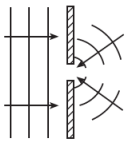
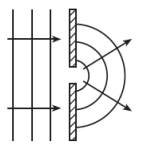
16.
a)

absorption

b)

diffraction

c)

reflection

d)

refraction

e)

interference

17.

A wave is diffracted as it passes through an opening in a barrier. The amount of diffraction that the wave undergoes depends on both the

a)

amplitude and frequency of the incident wave

b)

wavelength and speed of the incident wave

c)

wavelength of the incident wave and the size of the opening

d)

amplitude of the incident wave and the size of the opening

18.

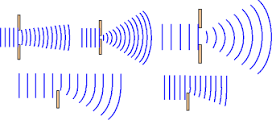
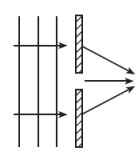
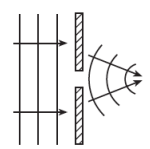
Which diagram best represents the shape and direction of a series of wave fronts after they have passed through a small opening in a barrier?
a)
b)
c)
d)
19.

Why does white light from the sun form a colorful rainbow when it passes through water droplets in the atmosphere?

a)

The droplets of water in the air have different densities

b)

White light diffracts when it encounters water

c)

The colors that make up white light refract at different angles

d)

Different-sized water droplets refract white light at different angles

20.
Refraction is the bending of a wave disturbance as it passes from one _________ into another.
a)
glass
b)
medium
c)
area
d)
boundary
21.

T/F: When sound waves move from one medium into another, their speed changes

a)

True

b)

False

22.
What direction is this object moving?
a)
left
b)
right
c)
up
d)
down
23.
Which scenario would experience the greatest diffraction of sound waves?  Honking your horn in
a)
Downtown Dallas 
b)
On an open highway
c)
in the country side
d)
in the suburbs
24.

Why do you not see an image when light reflects off a rough surface?

a)

because not enough light is not reflected

b)

because the reflection is specular

c)

because the reflection is diffuse

d)

because the law of reflection does not apply

25.

What happens to the image when you move the candle to the focal point F1?

a)

Get smaller and moves toward the lens

b)

Get bigger and moves toward the lens

c)

Get smaller and moves away from the lens

d)

Get bigger and moves away from the lens

e)

No image will appear

26.
Wavelengths on the right side of the Electromagnetic spectrum are ______________.
a)
short
b)
long
c)
average
27.
Which type of lens is shown?
a)
Concave
b)
Convex
c)
Concord
d)
Plane
28.
As wavelength decreases in the electromagnetic spectrum the frequency _____. 
a)
decreases
b)
stays the same
c)
increases
d)
doubles
29.
Waves with the longest wavelength have the ____ frequency. 
a)
lowest
b)
higest
30.
What color (of visible light) has the highest frequency and the shortest wavelength?
a)
Violet
b)
Black
c)
White
d)
Green
31.
The image shows that
a)
Vertical light is blocked, Horizontal light passes through 
b)
Horizontal light is blocked, Vertical light passes through
32.

The Law of Charges mandates that like charges

a)

attract each other

b)

repel each other

c)

don't interact with each other

33.
What is the difference between a conductor and an insulator?
a)
An insulator allows electricity to flow through it easily and a conductor does not
b)
A conductor allows electricity to flow through it easily and an insulator does not.
c)
An insulator is magnetic and a conductor is not
d)
A conductor is magnetic and an insulator is not
34.
Based on the flow of charges is the ball a conductor or insulator?
a)
Conductor 
b)
Insulator
35.
These charged particles can easily move through some materials but not others
a)
electrons
b)
protons
c)
neutrons
d)
neutral
36.
If the Voltage is increased and the resistance stays the same, Current will
a)
Increase
b)
Decrease
c)
Stay the same
d)
X
37.

If the battery produced 12.6 Volts what would be the current flow for a 6 Ohm resistor?

a)

2.1 Amps

b)

2.4 Amps

c)

1.71 Amps

d)

15 Amps

38.
The flow of electricity requires a
a)
complete path
b)
incomplete path
c)
insulated current
d)
complex circuit
39.

A series circuit has ____ path(s) that the electric current can take.

a)

One

b)

Two

c)

Three

d)

Four

40.

What is true about the total resistance in a parallel circuit?

a)

It’s calculated using the formula RT=R1+R2 and increases as you add more resistors

b)

It’s calculated using the formula RT=R1+R2 and decreases as you add more resistors

c)

It’s calculated using the formula 1/RT=1/R1+1/R2 and increases as you add more resistors

d)

It’s calculated using the formula 1/RT=1/R1+1/R2 and decreases as you add more resistors

41.

What would happen if you broke a bar magnet into 8 pieces?

a)

You would have 8 half magnets

b)

You would have 4 complete magnets

c)

You would have 8 complete magnets

d)

They wouldn't be magnets anymore

42.
The transformer shown is what type?
a)
step-up
b)
step-down
c)
current transformer
d)
isolation transformer
43.
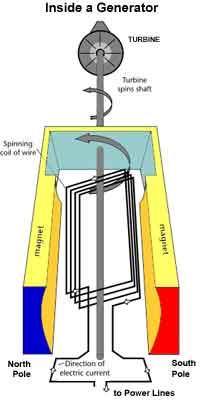
In large generators in power plants, ___________ rotate inside a coil of wire to produce an electric current.
a)
Wind
b)
Water
c)
Magnets
d)
Circuits
44.

An ideal transformer has 12 V input voltage with 10 turns on the primary (input) coil, and 100 turns on the secondary coil has. What is the secondary voltage?

a)

0.12 V

b)

1.20 V

c)

12.0 V

d)

120.0 V

45.
What is the relationship between electrical current and magnetic field strength in an electromagnet?
a)
When current is increased, magnetic field strength increases
b)
When current is increased the strength of magnetic field decreases
c)
When the current is decreased, the strenght of the magnetic field is increased.
d)
There is an "indirect proportion," meaning, if the value of one goes up, the value of the other goes down.
46.

A cart with a velocity of 5 m/s has an inelastic collision with a stationary cart. The carts couple and stay attached. The masses of the carts are shown in the diagram. What is the final velocity of the two carts after the collision?

a)

1 m/s

b)

2 m/s

c)

5 m/s

d)

25 m/s

47.

The figure shows a box on a horizontal, frictionless floor before and after an impulse was applied to it. What impulse caused the box to accelerate from 2 m/s to 5 m/s?

a)

3 kg⋅m/s

b)

6 kg⋅m/s

c)

10 kg⋅m/s

d)

18 kg⋅m/s

48.

When is momentum conserved in a collision?

a)

When the collision is inelastic.

b)

When the collision is elastic.

c)

When the collision is inelastic OR elastic but never an explosion.

d)

All collisions.

49.

A 500 kg cannon fires a 12 kg cannonball at 30 m/sec. If the cannon is on wheels, at what velocity does it move backward?

a)

8 kg

b)

7 m/s

c)

0.72 m/s

d)

0.5 m/s

50.
How much momentum does a stationary battle ship have if it has a mass of 2,575,000 kg?
a)
2,575,000 N
b)
2,575,000 kg m/s
c)
0 Momentum requires mass and velocity
d)
none of the above