
 Worksheets
U4P3 Populations
Total questions: 37
Worksheet time: 23mins
Name
Class
Date
1.
If the number of births in a population is the same as the number of deaths in a population, what will happen to the growth of the population?
a)
It will increase.
b)
It will decrease.
c)
It will stay the same.
d)
It will fluctuate.
2.
If the number of births is greater than the number of deaths in a population, what will happen to the growth of the population?
a)
It will increase.
b)
It will decrease.
c)
It will stay the same.
d)
It will fluctuate.
3.
What growth pattern describes a population whose growth rate slows or stops following a period of exponential growth?
a)
logistic growth
b)
population growth
c)
exponential growth
d)
predator-prey cycle
4.
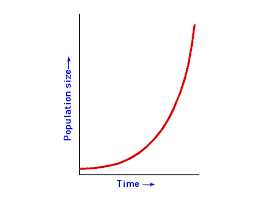
What type of growth is shown in the diagram?
a)
exponential growth
b)
logistic growth
c)
predator-prey cycle
d)
boom-bust curve
5.
Largest number of individuals of a population that the environment can support...
a)
carrying capacity
b)
population crash
c)
lag phase
d)
mutualism
6.

Which type of growth is best illustrated by this rabbit population?
a)
exponential
b)
logistic
c)
S-shaped
d)
predator-prey
7.
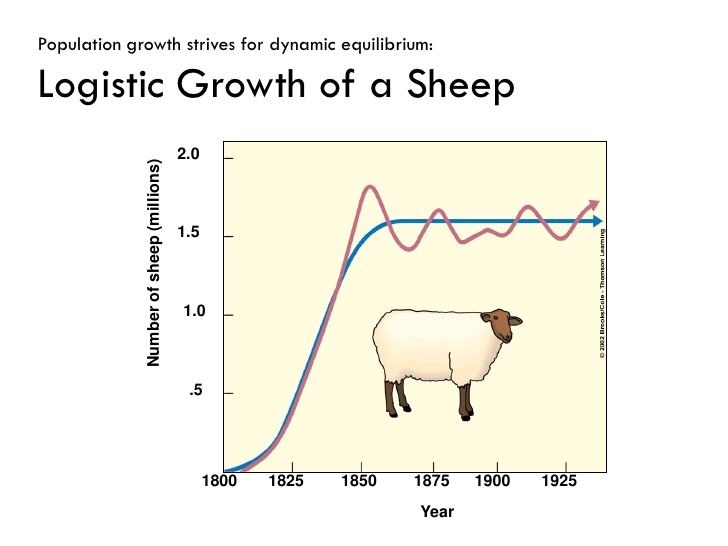
What is the carrying capacity for this sheep population?
a)
1.8 million
b)
1.25 million
c)
1.6 million
d)
1.o million
8.

What point on the graph represents the carrying capacity?
a)
A
b)
B
c)
C
d)
D
9.

When a population grows past the ecosystem's carrying capacity, what happens to the population?
a)
Continues to grow
b)
The population starts to die off to return to carrying capcity
c)
The population will go extinct due to lack of resources
d)
The population grows then finds a new carrying capacity
10.
Food, water, sunlight, shelter, and space are resources that are often __________.
a)
limiting factors
b)
wet
c)
messy
d)
found in rocks
11.
If there is more food than usual in an ecosystem, then the population will mostly likely...
a)
stay the same
b)
decrease
c)
increase
12.
Any thing or organism that regulates the size of a population of another organism is known as __________.
a)
a limiting measure
b)
a limiting factor
c)
factorization
d)
materialization of precipitation
13.

In a forest ecosystem, which of the following is the best example of a limiting factor for a rabbit population?
a)
Squirrel Population
b)
Sunlight
c)
Grass available
14.

Will competition increase/decrease the carrying capacity of an ecosystem for the animal in competition?
a)
Decrease
b)
Increase
15.
Natural disasters can be considered limiting factors.
a)
true
b)
false
16.
Natural disasters and weather patterns like earthquakes, floods, and tornadoes, blizzards, and heatwaves are considered ___________ ____________ limiting factors
a)
Density-dependent
b)
Density-independent
17.
Competition, disease, predation, and parasitism are considered ___________ ____________ limiting factors
a)
Density-dependent
b)
Density-independent
18.
Density-dependent limiting factors have a(n) _______________ affect on populations depending on the density of the population.
a)
similar
b)
different
19.
Density-independent limiting factors have a(n) _______________ affect on populations regardless of population density.
a)
similar
b)
different
20.
Exponential growth is representative of a population in an environment with ________________ resources.
a)
limited
b)
plenty of
21.
Logistic growth is representative of a population in an environment with ________________ resources.
a)
limited
b)
plenty of
22.
Which is a population?
a)
The grass and insects in your yard
b)
all of the geese in the US
c)
A pack of wolves
d)
Sun and plants
23.
A population of squirrels ran out of food in its environment. Food is a _______________.
a)
exponent
b)
limiting factor
c)
unlimiting factor
d)
density independent factor
24.
Which of the following is NOT a limiting factor in a forest?
a)
food
b)
space
c)
predators
d)
oxygen
25.

The point where the leveling off occurs- what is that called?
a)
exponential growth
b)
limiting factor
c)
carrying capacity
d)
constant growth
26.

What is the carrying capacity according to this graph?
a)
2500
b)
5000
c)
7500
d)
10000
27.
All of the populations interacting together is called
a)
ecosystem
b)
populations
c)
community
d)
biome
28.
An individual living thing is a/an __________.
a)
habitat
b)
ecosystem
c)
organism
d)
population
29.
A group of organisms of the same species living in the same area are called a/an ________.
a)
community
b)
habitat
c)
population
d)
ecosystem
30.
All of the living and nonliving things in an area that interact with each other are called a/an ______.
a)
community
b)
habitat
c)
population
d)
ecosystem
31.
A group of different species that live together and interact in an environment are called a/an ________.
a)
community
b)
habitat
c)
population
d)
ecosystem
32.

Which statement is most accurate based on the graph?
a)
The zebra and lions do not affect each other
b)
when lions population increases, so does the zebra population
c)
When the zebra population increases, it causes the lion population to also increase
d)
when zebra populations go down, the zebra population goes up.
33.

What does a food web represent?
a)
All connections of energy flow throughout all organisms in a habitat.
b)
The specific ways that mutualism is carried out.
c)
A single pathway or energy flow between organisms.
d)
How carnivores get their food.
34.
The amount of energy that usually transfers from one trophic level to the next...
a)
10%
b)
20%
c)
80%
d)
50%
35.
An organism at the second trophic level would be considered a...
a)
Top carnivore
b)
Producer
c)
Herbivore
d)
Carnivore
36.
Organisms that can capture energy from inorganic, nonliving sources.
a)
Producers
b)
Consumers
c)
Detritivores
d)
Carnivores
37.
Autotrophs make up the _______ level in all ecosystems.
a)
First
b)
Second
c)
Third
d)
Fourth
100 %

