
 Worksheets
Circuits
Total questions: 45
Worksheet time: 2hrs 32mins
Name
Class
Date
1.

A parallel connection is a type of electrical circuit in which there is a single current pathway.
a)
True
b)
False
2.

A series connection is a type of electric circuit in which there are multiple paths.
a)
True
b)
False
3.

A resistor is a device that controls current in electric circuits.
a)
True
b)
False
4.

If a 75 W light bulb operates at a voltage of 120 V, what is the current in the bulb?
a)
0.63 A
b)
1.6 A
c)
9.0 x 10³ A
d)
1.1 x 10⁻⁴ A
5.

If a 325 W heater has a current of 6.0 A, what is the resistance of the heating element?
a)
88 Ω
b)
54 Ω
c)
9.0 Ω
d)
11 Ω
6.

Three resistors with values of 4.0 Ω, 6.0 Ω and 8.0 Ω respectively, are connected in series. What is their equivalent resistance?
a)
18
b)
8.0
c)
6.0
d)
1.8
7.

Three resistors connected in series carry currents labeled I1, I2 and I3 respectively.
Which of the following expresses the total current, It, in the system made up of the three resistors in series?
Which of the following expresses the total current, It, in the system made up of the three resistors in series?
a)
It =I 1 + I2 + I3
b)
It = (1I1 + 1/I2 + 1/I3
c)
It = I1 = I2 = I3
d)
It = (1I1 + 1/I2 + 1/I3)-1
8.

Three resistors with values of 4.0 Ω, 6.0 Ω and 10.0 Ω are connected in parallel. What is their equivalent resistance?
a)
20.0 Ω
b)
7.3 Ω
c)
6.0 Ω
d)
1.9 Ω
9.

The rate at which electric energy is transferred is:
a)
power
b)
voltage
c)
resistance
d)
current
10.

The current flowing in an electric circuit can be increased by:
a)
increasing voltage or decreasing resistance.
b)
decreasing voltage or increasing resistance.
c)
increasing voltage and increasing resistance.
d)
decreasing voltage and decreasing resistance.
11.

In an electric circuit, charges:
a)
flow around in a closed loop.
b)
get energy from an external source.
c)
flow from higher potential to lower potential.
d)
do all of these answer choices.
12.

Compared to thin wires, electrical resistance in thick wires is:
a)
greater
b)
less
c)
the same
13.

When one bulb in a series circuit containing several light bulbs burns out:
a)
the other bulbs burn brighter.
b)
nothing changes in the rest of the circuit.
c)
none of the other bulbs will light up.
14.

When resistors are put in parallel with each other their overall resistance is:
a)
larger than that of any other resistor.
b)
the same as the resistance of one of the resistors.
c)
smaller than the resistance of any of the resistors.
15.

Current from a battery is:
a)
AC
b)
DC
16.

As the number of resistors in a parallel circuit is increased, what happens to the equivalent resistance of the circuit and total current in the circuit?
a)
Equivalent resistance and total current decrease.
b)
Equivalent resistance and total current increases.
c)
Equivalent resistance increase and current decreases
d)
Equivalent resistance decreases and total current increases.
17.

According to Ohm's Law, if the voltage is increased, what happens to the current across the resistor?
a)
It increases.
b)
It decreases.
c)
It remains the same.
18.

In a series circuit, three loads have a potential difference of 8.0 V, 12.0 V and 3.4 V respectively. The total current in the circuit is 3.00 amps. What is the amount of current through the second load?
a)
21.4 A
b)
3.0 A
c)
4.0 A
d)
7.6 A
19.
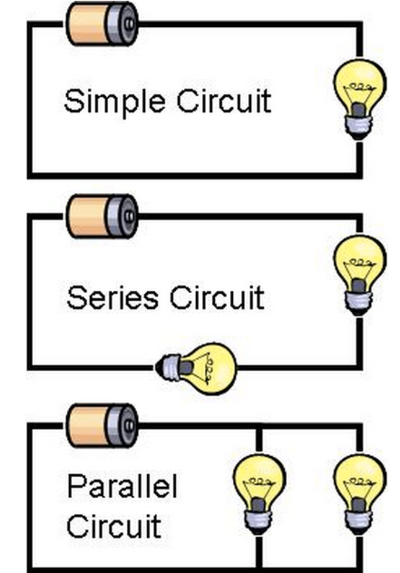
As loads are added in parallel to a circuit, what happens to the total current in the circuit?
a)
It increases.
b)
It remains the same.
c)
It decreases.
20.
What is the effect on the current in a simple circuit when BOTH the voltage and the resistance are multiplied by two?
a)
1/2 I
b)
I
c)
2 I
d)
4 I
21.

A light bulb uses 100W of power when connected across 120V. What is the current drawn by the light bulb?
a)
0.8 A
b)
1.0 A
c)
12.0 A
d)
2.0A
22.

In a simple circuit, a voltage of 5.0 V is applied across a resistance of 10.0 Ω. What is the power dissipated in the resistor?
a)
0.50 W
b)
5.0 W
c)
2.5 W
d)
50 W
23.

Three resistors of 10.0 Ω, 20.0 Ω and 25 Ω are connected in parallel across a 100 V battery. What is the equivalent resistance of the circuit and the current flowing through the 10 Ω resistor?
a)
0.19 Ω, 4 A
b)
6.67 Ω, 5 A
c)
5.26 Ω, 10 A
d)
55.0 Ω, 20 A
24.

A 20.0 Ω and a 40 Ω resistor are connected in series across a battery. If the current is 2.00 A, what is the voltage of the battery?
a)
30.0 V
b)
60.0 V
c)
80.0 V
d)
120 V
25.

A 2.00 Ω and 12.0 Ω resistor are connected in parallel across a 20.0 V battery. What is the current through the 2.0 Ω resistor?
a)
1.40 A
b)
1.67 A
c)
11.6 A
d)
10.0 A
26.
If a branch with a resistor is added to a parallel circuit, the equivalent resistance:
a)
increases.
b)
decreases.
c)
remains the same.
d)
becomes zero.
27.
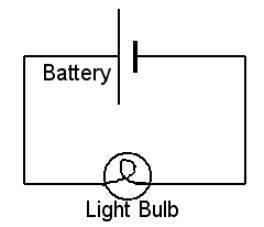
A/An _________ is described as a type of circuit in which there is only a single current path.
a)
parallel circuit.
b)
series circuit.
c)
short circuit.
d)
voltage divider.
28.

Three resistors, 4.0 Ω, 8.0 Ω and 10.0 Ω respectively, are connected in series across an 11 V battery. The total potential difference across the 4.0 Ω resistor is:
a)
2.0 V
b)
4.0 V
c)
5.0 V
d)
11 V
29.

Identify the following as characteristics of either a series circuit or a parallel circuit:
Type of circuit used to wire buildings.
Type of circuit used to wire buildings.
a)
Series circuit
b)
Parallel circuit
30.

Identify the following as characteristics of either a series circuit or a parallel circuit:
When one light bulb burns out, the rest stay lit.
When one light bulb burns out, the rest stay lit.
a)
Series circuit
b)
Parallel circuit
31.
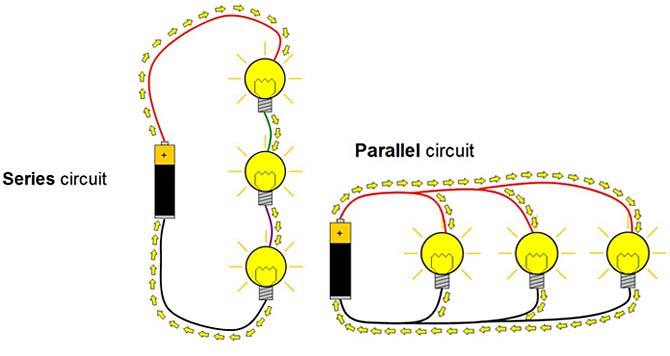
Identify the following as characteristics of either a series circuit or a parallel circuit:
When one light bulb burns out, they all go out.
When one light bulb burns out, they all go out.
a)
Series circuit
b)
Parallel circuit
32.

Identify the following as characteristics of either a series circuit or a parallel circuit:
Current remains the same throughout the entire circuit.
Current remains the same throughout the entire circuit.
a)
Series circuit
b)
Parallel circuit
33.

Identify the following as characteristics of either a series circuit or a parallel circuit:
The total potential difference is the sum of all of the voltage drops.
The total potential difference is the sum of all of the voltage drops.
a)
Series circuit
b)
Parallel circuit
34.

Identify the following as characteristics of either a series circuit or a parallel circuit:
Voltage throughout the circuit remains the same.
Voltage throughout the circuit remains the same.
a)
Series circuit
b)
Parallel circuit
35.

Two resistors of 5 Ω and 7 Ω are connected in series across a 24 V battery.
What is the voltage drop across each of the resistors?
a)
10 V across the 5 Ω resistor, 14 V across the 7Ω resistor
b)
14 V across the 5 Ω resistor, 10 V across the 7Ω resistor
c)
24 V across both
d)
48 V across both
36.

How does the brightness of each identical lightbulb compare?
a)
A is brightest
b)
B is brightest
c)
C is brightest
d)
they all have equal brightness
37.

What happens if bulb A is unscrewed?
a)
Bulb B and C will go out
b)
Bulb B will go out
c)
Bulb C will go out
d)
Bulbs B and C will stay lit
38.

What happens if bulb C is unscrewed?
a)
Bulb A and B will go out
b)
Bulb B will go out
c)
Bulb A will go out
d)
Bulbs A and B will stay lit
39.

Which lightbulb has the most voltage across it?
a)
Bulb A
b)
Bulb B
c)
Bulb C
d)
All bulbs have equal voltage
40.
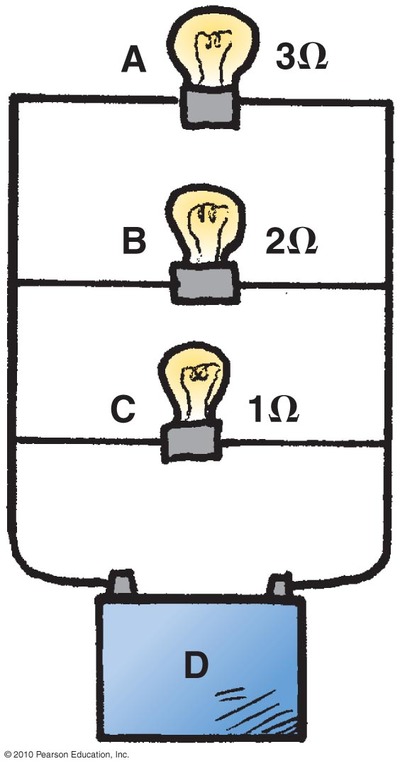
Which bulb has the most current flowing through it?
a)
Bulb A
b)
Bulb B
c)
Bulb C
d)
All bulbs have the same current
41.
Which bulb has the most voltage across it?
a)
Bulb A
b)
Bulb B
c)
Bulb C
d)
All bulbs have the same voltage
42.
How can you decrease the amount of resistance in a wire?
a)
Increase the cross sectional area
b)
Decrease the length
c)
Increase the temperature
d)
Decrease the amount of wires
43.
The capacitance of a parallel-plate capacitor is:
a)
proportional to the plate area
b)
proportional to the charge stored
c)
independent of any material inserted between the plates
d)
proportional to the potential difference of the plates
44.
The capacitance of a parallel-plate capacitor can be increased by:
a)
increasing the charge
b)
decreasing the charge
c)
increasing the plate separation
d)
decreasing the plate separation
45.
If both the plate area and the plate separation of a parallel-plate capacitor are doubled, the capacitance is:
a)
doubled
b)
halved
c)
unchanged
d)
one-fourth the original
100 %

