wayground logo

Free Printable Worksheets

Font size

S
M
L
XL
Worksheets

LED Science

Total questions: 100

Worksheet time: 1hrs 14mins

Name
Class
Date
1.
What is a producer?
a)
an organism that gets energy from eating other organisms
b)
an organisms that uses sunlight to make its own food
c)
an organism that gets energy from eating dead organisms, non-living material or waste
d)
an organism that uses chemical energy to make its own food
2.
A community of living and nonliving things in their natural environment makes up a 
a)
food web
b)
ecosystem
c)
food chain
d)
population
3.
What is a herbivore?
a)
an animal that gets energy from eating other animals
b)
an organism that gets energy from eating only plants
c)
an animal that gets energy by eating both plants and other animals
d)
an animal that eats only herbs
4.
An organism that gets energy from eating other organisms is a ______________
a)
producer
b)
consumer
c)
decomposer
d)
prey
5.
A connection of food chains with many food energy paths in an ecosystem is a ____________
a)
ecosystem
b)
food web
c)
environment
d)
population
6.
An animal that is hunted and eaten for food is a 
a)
predator
b)
prey
c)
population
7.
An organism that gets energy from breaking down dead organisms, non-living material or waste
a)
producer
b)
consumer
c)
decomposer
d)
autotroph
8.
What is a carnivore?
a)
an animal that gets energy by eating other animals
b)
An animal that gets energy by eating only plants
c)
an animal that gets energy by eating both plants and animals
d)
an animal that makes its own energy through photosynthesis
9.
An animal that gets energy from eating both plants and animals is a 
a)
herbivore
b)
carnivore
c)
omnivore
d)
autotroph
10.
Directs all cell activities "Brain or Control Center of cell"
a)
Lysosomes
b)
Nucleus
c)
ribosomes
d)
Mitochondria
11.
Jelly-like substance found inside cell that acts as a medium for chemical reactions within the cell
a)
Nuclear Membrane
b)
Golgi Body
c)
Cytoplasm
d)
Ribosome
12.
"powerhouse of the cell" breaks down sugar molecules to release energy, site of cellular respiration, double membrane, self-replicating, contains own DNA, cristae
a)
Mitochondria
b)
Chloroplast
c)
Cell Wall
d)
Vesicle
13.
"Storage tanks" Can hold food, water or waste for the cell
a)
Ribosomes
b)
Vacuole
c)
Chloroplast
d)
Nucleolus
14.
"Gatekeeper" Separates the cell from the rest of the environment and helps control what passes in and out of the cell.  Semi-permeable: allows some materials to pass through but not all
a)
Cell Wall
b)
Cytoplasm
c)
Mitochondria
d)
Cell Membrane
15.
Rigid outer layer made of cellulose that supports and protects the cell (plant, fungi, and bacterial cells)
a)
Nucleolus
b)
Golgi Body
c)
Cell Wall
d)
Cytoskeleton
16.
The organelle that uses the energy of sunlight to make food for the cell.
a)
Chloroplast
b)
Ribosome
c)
Mitochondria
d)
Nucleus
17.
An organism that cannot adapt to changes in the environment will most likely - 
a)
produce more offspring
b)
die
c)
change its traits to survive
d)
store more food
18.
All of the following are examples of environmental changes that can be caused by humans except - 
a)
clearing land for housing developments
b)
pesticides
c)
volcanic eruption
d)
pollution
19.
The photo shows litter that washed up on the coast of Hawaii. Which of these human activities is a form of pollution that could harm the habitats of living things?


a)
throwing garbage on the ground
b)
planting more trees on land that is bare
c)
making compost of left-over food for your garden
d)
using the landfill for throwing away garbage 
20.
What system provides movement for the body?
a)
Skeletal
b)
Muscular
c)
Digestive I
d)
Excretory
21.
How does the circulatory system and the skeletal system work together?
a)
the circulatory system makes cells while the skeletal system transports the cells where the need to go
b)
the skeletal system makes cells while the circulatory system transports them where the need to go
c)
The circulatory system produces energy for the body and the skeletal system makes cells for the body
d)
The skeletal system digests food and the circulatory system brings air into the body
22.
What system controls voluntary and involuntary life functions?
a)
Nervous System
b)
Skeletal System
c)
Digestive System
d)
Respiratory System
23.
How does the cardiovascular system and the respiratory system work together?
a)
The cardiovascular system transports oxygen around the body while the repiratory system gives the body oxygen
b)
The cardiovascular system makes cells while the respiratory system moves them where they are suppose to go.
c)
The cardiovascular system allows the body to have energy while the repiratory system makes cells
d)
The cardiovascular system transports nutrients around the body while the respiratory system brings oxygen into the body
24.
What cell part is NOT found in all cells?
a)
Cell Wall
b)
Cell Membrane
c)
Cytoplasm
d)
Genetic Material
25.
A special plastid that contains chlorophyll a pigment that captures the sun's energy to produce glucose in a process called photosynthesis
a)
Chloroplast
b)
Cell Membrane
c)
Cell Wall
d)
Nuclear Membrane
26.
The basic unit of structure and function in an organism.
a)
cell
b)
nucleus
c)
cytoplasm
d)
chromosomes
27.
Plant cells and animal cells...
a)
have nothing in common.
b)
are exactly the same.
c)
are a little bit alike and a little bit different.
d)
are both big.
28.
Production of an offspring through the combination of egg and sperm
a)
sexual reproduction
b)
fertilization
c)
diploid cell
d)
haploid cell
29.
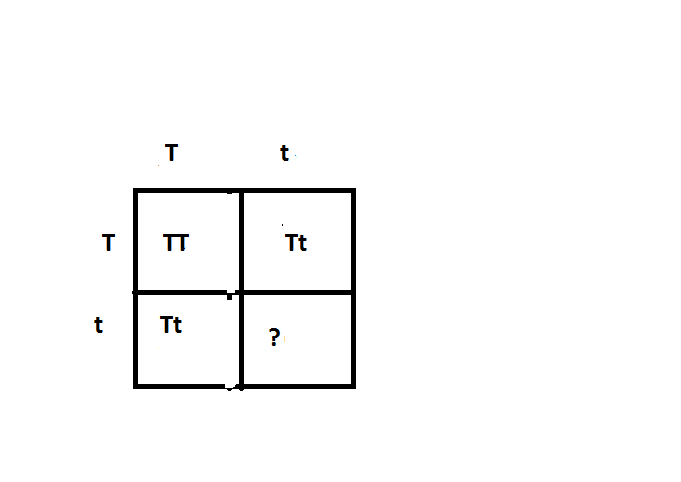
T - tall and t = short
In the punnett square below, what belongs in the missing square
a)
tt
b)
Tt
c)
Bb
d)
TT
30.
What is the definition of Unicellular?
a)
Many cells
b)
One cell
c)
No cells
d)
To many cells
31.
What is the definition on Multi-cellular? 
a)
Many cells
b)
One cell
c)
No cell
d)
Too many cells
32.
What is the definition of Organism?
a)
makes its food
b)
Any living thing
c)
I don't know
d)
gets its food
33.
If we would like to make a chicken lay larger eggs which method would be more apropriate?
a)
Selective breeding
b)
Natural Selection
c)
Invasive
d)
Biome
34.
The land next door just completely burnt down.  What is the likely sucession to occur in the next month
a)
Grass will return
b)
Trees will return
c)
Shrubs will return
d)
Nothing will return
35.
If I spilled oil into the ground 
a)
The water in the ground is protected
b)
the soil in the ground is protected
c)
the organisms in the ground is protected
d)
there is pollution in the ground
36.
Which allows for soil to remain in a region?
a)
weathering of rocks from that region
b)
Erosion of rocks from that region
c)
Deposition of rocks from that region
37.
Which biome has the greatest biodiversity
a)
Rainforest
b)
Forrest
c)
Desert
d)
Mars
38.
Gills are an adaptation of
a)
Dogs
b)
Cats
c)
Dolphins
d)
Sharks
39.
It is the ultimate source of energy of the Earth
a)
Socoteco
b)
Sea
c)
Sun
d)
Sky
40.
What is the pigment in chloroplasts that performs photosynthesis?
a)
Chlorosynthesis
b)
Chlorophyll
c)
ADP
d)
Electron Transport
41.
Which gas is removed from the atmosphere during photosynthesis?
a)
hydrogen
b)
oxygen
c)
nitrogen
d)
carbon dioxide
42.
Leaves look green because.....
a)
they eat their vegetables
b)
to blend into their environment
c)
they contain a molecule named chlorophyll
d)
they are sick
43.
Another name for sugar is 
a)
ATP
b)
Cellular
c)
Glucoes
d)
Fall Out Boy
44.
Particles in an atom that are neutral and have no charge are 
a)
negatrons 
b)
electrons 
c)
neutrons 
d)
protons 
45.
The smallest particle of any particular type of matter is known by which of the following terms?
a)
Compound
b)
Atom
c)
Chemical
d)
Element
46.
all matter is made of what 
a)
energy 
b)
atoms 
c)
electrons 
d)
compounds 
47.
What charge does a proton have?
a)
Negative
b)
Positive
c)
Neutral
d)
Visa
48.
A negatively charged particle that moves around the nucleus is a(n)....
a)
proton
b)
neutron
c)
electron
d)
quark
49.
Vertical (up and down) columns in the periodic table are called _________ of elements and have similar properties. 
a)
groups
b)
periods
50.
_________are not good conductors of heat or electricity.
a)
Metals
b)
Metalloids
c)
Nonmetals
51.
A mixture in which one substance is dissolved in another
a)
chemical reaction
b)
solution
c)
solvent
52.
How many total atoms in H2O?
a)
1
b)
2
c)
3
d)
4
53.
This state of matter has a definite volume and a definite shape
a)
solid
b)
liquid
c)
gas
54.
The pull of gravity on an object
a)
mass
b)
weight
c)
volume
55.
The basic metric unit of measurement for volume.
a)
liter
b)
gram
c)
meter
56.
1,000 millimeters = ______ meters
a)
1
b)
10
c)
100
57.
__________ can be described as a change in position over a period of time.
a)
Energy
b)
Acceleration
c)
Motion
d)
Force
58.
__________ can be measured as the distance traveled in a given amount of time.
a)
Speed
b)
Acceleration
c)
Energy
d)
Force
59.
 _______________ result when two interacting objects are touching each other and exert a push or pull.
a)
Non-contact forces
b)
Contact forces
c)
Motion 
d)
Speed
60.
What is velocity?
a)
the quickness of an object
b)
the location of an object
c)
acceleration
d)
speed in a specific direction
61.
Signs that a chemical change has occurred include
a)
a change in color
b)
the release of bubbles
c)
the production of an odor
d)
all of the above
62.

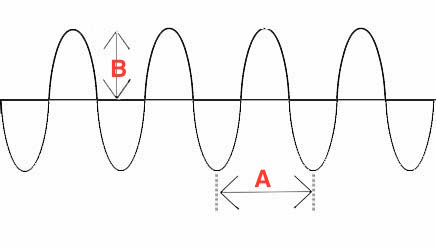
What property of this wave is represented by the letter "A"

a)

amplitude

b)

crest

c)

trough

d)

wavelength

63.
Which type of EM wave has the highest frequency? 
a)
gamma ray
b)
radio waves
c)
microwaves
d)
infrared rays
64.

what is not part of the 5 senses?

a)

sight

b)

smell

c)

hearing

d)

walking

e)

taste

65.

What is not a gas on the periodic table?

a)

Oxygen

b)

Heluim

c)

Nitrogon

d)

Carbon

66.

liquid changes to a gas at.....

a)

frezzing

b)

boiling point

c)

whenever

d)

room temperature

67.

Elements that are usually shiny and can be bent or stretched and conducted by electricity are called what?

a)

Rubber

b)

Plastic

c)

Water

d)

Metals

68.

The middle part, with the blue and red, is called what?

a)

Neutron

b)

Nucleus

c)

proton

d)

Electron

69.

What is a physical change?

a)

The measure of how much of one substance can dissolve in another.

b)

A process where no substances are changed as detected by the senses.

c)

A process where one or more substances are changed as detected by the senses.

d)

A substance made of two or more elements that are chemically joined.

70.

The color of a substance is an example of a ___________.

a)

Physical Property

b)

Mixture

c)

Reactant

d)

Sublimation

71.
__________ can be measured as the distance traveled in a given amount of time.
a)
Speed
b)
Acceleration
c)
Energy
d)
Force
72.
____________ is a push or pull on an object.
a)
Motion
b)
Force 
c)
Speed
d)
Velocity
73.
__________ force opposes the motion of an object and slows the object down.
a)
Applied
b)
Normal
c)
Friction
d)
Gravitational
74.
A magnet will attract to:
a)
Gold
b)
Silver
c)
Iron
d)
Aluminum
75.
Anything that takes up space and has mass is
a)
Matter
b)
Volume
c)
Liquid
d)
Atom
76.
Temperature at which a solid changes to a liquid  is
a)
Volume
b)
Atom
c)
Matter
d)
Melting Point
77.
What is a mixture?
a)
elements chemically combined
b)
a combination of different things
c)
it is found on the Periodic Table 
d)
it is made of chemical
78.
What is happening when my ice cream changes from a solid to a liquid?
a)
freezing
b)
melting
c)
burning
d)
evaporation
79.
The force of friction is caused by:
a)
surfaces rubbing against one another
b)
objects heating or cooling
c)
rough surfaces
d)
smooth surfaces
80.
What does erosion do?
a)
Break down rock
b)
changes rock chemically
c)
changes sediment in rock
d)
moves broken pieces of rock, or sediment, from one place to another
81.
Which feature forms from wind deposition?
a)
flood plains
b)
sand dunes
c)
deltas
d)
moraines
82.
A ________________________ structure is built across a river to control its flow.
a)
dam
b)
transform
c)
fault
d)
storm drain
83.
Erosion helps move ___________ from one place in order to deposit it someplace else.
a)
sediment
b)
transform
c)
erosion
d)
weathering
84.
An earthquake is caused by a crack in the crust called a __________.
a)
fault
b)
dam
c)
plates
d)
transform
85.
What is weathering?
a)
the break down of rock
b)
the transport of sediment
c)
a type of climate
d)
the aging of rock
86.
What is an earthquake?
a)
A sudden movement of the Earth's crust caused by a release of stress accumulated along geological faults or by volcanic activity.
b)
a.  energy that builds up inside a volcanic mountain
c)
a.  energy being released when erosion occurs
d)
a.  molten rock pushing up through Earth's surface.
87.
How do earthquakes form?
a)
a.  energy from a hurricane or tornado
b)
a.  energy that builds up inside a volcanic mountain
c)
a.  energy being released when crustal plates move
d)
a.  the crust expands due to the heat.
88.
what are 3 agents of depostion
a)
water, wind, ice
b)
ice, water, sand
c)
soild, liquid, and gas
d)
wind, ice, glacier
89.
Which landform is created by plates pushing together?
a)
Canyon
b)
Delta
c)
Mountain
d)
Sea arch
90.
Water is a nonrenewable resource.
a)
True 
b)
False
91.
Which type of rock is formed by weathering and erosion, then compaction and cementation?
a)
sedimentary rock
b)
metamorphic rock
c)
igneous rock
92.
What is magma that flows onto the earth's surface called?
a)
magma
b)
lava
c)
sediment
d)
silt
93.
Which of the following processes does NOT relate to the rock cycle?
a)
heat and pressure
b)
photosynthesis and respiration
c)
weathering and erosion
d)
heating and cooling
94.
Heat and Pressure causes which type of rock? 
a)
Sedimentary Rock
b)
Metamorphic Rock
c)
Igneous Rock
95.
Which of the following is NOT an agent of weathering?
a)
water
b)
wind
c)
animals and plants
d)
gravity
96.
How is acid rain formed?
a)
pollution condensates in clouds and rains back down to Earth
b)
rivers carries pollution into our drinking water
c)
super hot weather turns the raindrops acidic
97.
Which of the following is NOT a cause of erosion that affects landforms?
a)
precipitation
b)
wind
c)
water
d)
sun
98.
Which of the following is an agent of erosion?
a)
moving water
b)
glaciers
c)
wind
d)
all of the choices
99.
What process gets water from the ground to the air? 
a)
condensation
b)
melting
c)
freezing
d)
evaporation
100.
What process gets water from clouds to the ground?
a)
condensation
b)
melting
c)
precipitation
d)
evaporation