
 Worksheets
AP Bio Unit 1 Review
Total questions: 105
Worksheet time: 26hrs 15mins
What is the attractive force between two bodies of different substances that are in contact with each other? This is the property of a water molecule that allows it to stick to other substances.
adhesion
cohesion
specific heat
universal solvent
What is the force that holds molecules of a single substance together and its the property of water that allows one water molecule to stick to other water molecules?
cohesion
adhesion
specific heat
universal solvent
What are the unique properties of water? - choose all that apply.
cohesion
adhesion
specific heat
universal solvent
unique temperature
A(n) _________________ is a liquid that dissolves substances or the substance in which the solute dissolves.
solvent
solute
mixture
molecule
The __________________ is a property of a system in which two points have opposite characteristics, such as charges (positive/negative) or magnetic poles.
polarity
opposites
cohesion
adhesion

The dashed lines represent
hydrogen bonds
covalent bonds
ionic bonds
delta

What kind of charge is on hydrogen atoms?
positive
negative
north
south
Nonpolar molecules include
fats only
oils only
both fats and oils
fats, oils and waxes
The building blocks of a macromolecule
amino acid
monomer
polymer
sugar
A metabolic reaction that breaks polymers into smaller parts
anabolism
catabolism
condensation reaction
dehydration synthesis
triglycerides that have all single bonds between carbon atoms
monounsaturated
polyunsaturated
saturated
trans fats
A part of a larger molecule that causes it to behave in a specific way.
functional group
monomer
polymer
ester linkage
Carbohydrates have a higher proportion of this atom than lipids do
carbon
hydrogen
nitrogen
oxygen
Carbohydrates are stored in humans as this compound
amylose
cellulose
chitin
glycogen
Lactose is an example of
a disaccharide
a monosacharide
a polysaccharide
an indigestible sugar
A long-term energy storage molecule
carbohydrate
protein
steroid
triglyceride

A ______________ is a large molecule.
Micromolecule
Polymer
Amino Acid
Macromolecule
Which of the following elements are found in all macromolecules? (Select all that apply).


Which macromolecule is used as our main source of energy?
Lipids/Fats
Nucleic Acids
Proteins
Carbohydrates
Which of the following are examples of carbohydrates? (Select all that apply).
Bread
Pasta
Olive Oil
Cheese
Nucleic acids make up which of the two molecules listed below?
FDA
RNA
DNA
FDR
This is one job proteins do not have in the body.
structure for tissues and organs
transport things through cell membranes
speed up chemical reactions
insulation
This macromolecule breaks down into sugars such as glucose.
Lipids/Fats
Nucleic Acids
Protein
Carbohydrates


Which macromolecule is shown?
lipid
protein
nucleic acid
carbohydrate


Water is necessary to...
give cells/systems energy.
build cell parts.
give cells/systems long term energy storage.
help cells with chemical processes.
Carbon can form _____ bonds with other elements.
1
2
3
4
A _________ reaction removes a molecule of water to bond molecules together to create a polymer.
hydrolysis
water
dehydration synthesis
magical
In order to break apart a polymer ________ must be added.
carbon
water
oxygen
hydrogen
C6H12O6 is the chemical formula for
water
methane
glycogen
glucose

What type of reaction is shown?
Dehydration synthesis
Hydrolysis

Which type of reaction is shown?
Dehydration Synthesis
Hydrolysis
Which of the following atoms is best suited for forming large macromolecules?
Hydrogen
Carbon
Oxygen
Nitrogen
Hydrophobic means...
An attraction to water
To fear/dislike water
To like water
Hydrophilic means
An attraction to water
To fear/dislike water
This carbohydrate is used by animals to store energy in the liver.
chitin
glycogen
glucose
starch


How are DNA and RNA different? (CHECK ALL THAT APPLY)
Only DNA can leave the nucleus
RNA contains Thymine; DNA contains Uracil
DNA is double stranded, RNA is a single stranded
DNA contains Thymine, RNA contains Uracil

When reading DNA, we always start the the ____ end and end at the ____ end.
5’ prime, 3’ prime
3’ prime, 5’ prime
longest end, shortest end
top, bottom
Which level of protein structure is only found in proteins with more than one polypeptide chain?
Primary
Secondary
Tertiary
Quaternary
Which level of protein structure describes a protein's three-dimensional shape?
Primary
Secondary
Tertiary
Quaternary
What is the name of the bond that joins two amino acids together?
Ester bond
Glycosidic bond
Peptide bond
Nucleic bond
What is the name for a chain of amino acids?
Polypeptide chain
Triglycerides
Polysaccharides
Nucleotides
Which of the following functional groups is found in all amino acids?
Amino
Carboxyl
Hydroxyl
Sulfhydryl
Which of the following requires the dehydration reaction of two amino acids?
Carboxyl group of first amino acid binds with carboxyl group of second amino acid
Carboxyl group of first amino acid binds with amino group of second amino acid
R group of first amino acid binds with R group of second amino acid
Amino group of first amino acid binds with amino group of second amino acid
In terms of directionality of the protein, which of the following provides naming for the side with the amino group?
A-terminus
C-terminus
N-terminus
S-terminus
In terms of directionality of the protein, which of the following provides naming for the side with the carboxyl group?
A-terminus
C-terminus
N-terminus
S-terminus
Saturated fats are __________ at room temperature.
liquid
solid
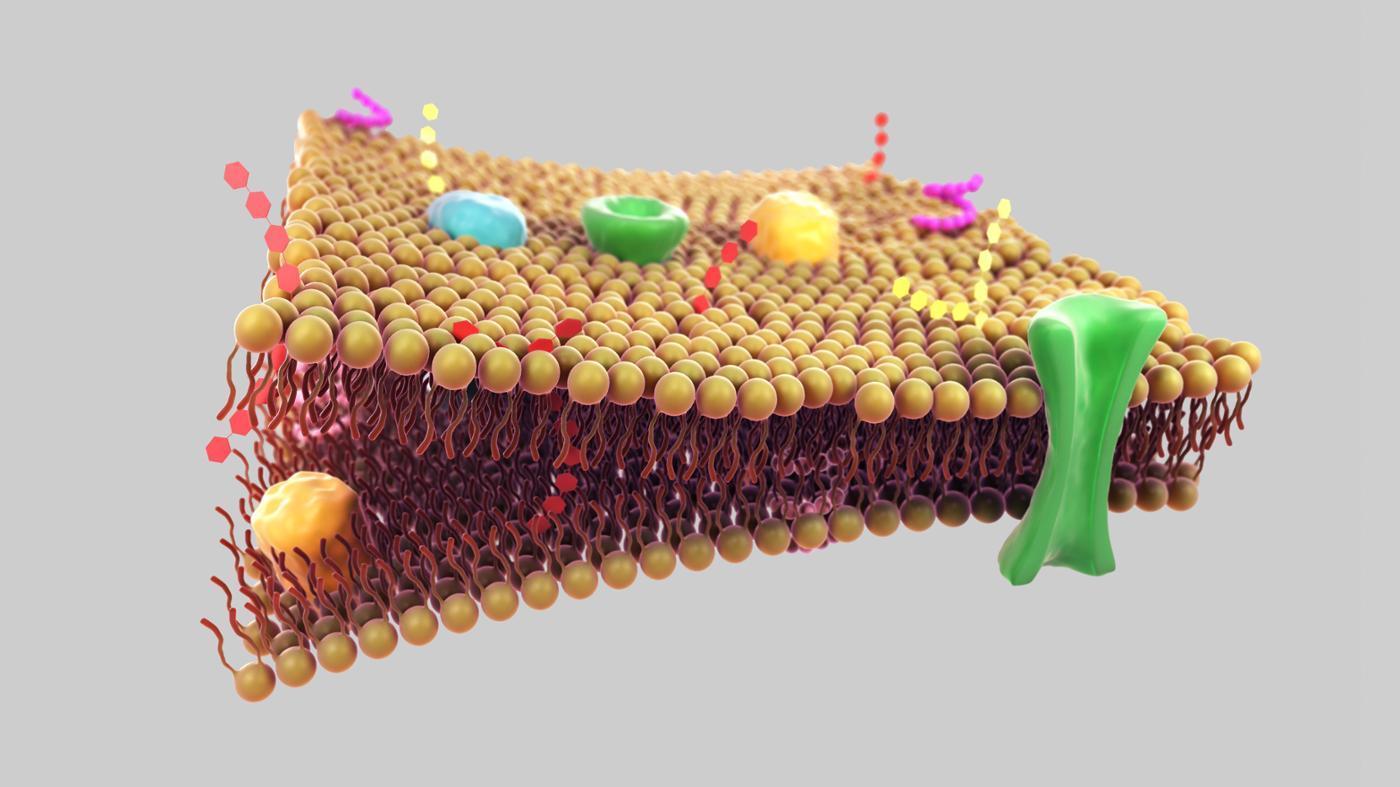
Part of a phospholipid molecule can mix with water, but the other part cannot. This means the molecule is
hydrophobic
hydrophilic
amphipathic
ambidextrous
Fatty Acids differ in there chain length and their
protein carriers
Side chains
energy level
degree of saturation

Identify the macromolecule in the picture
* cholesterol and triglycerides
lipid
protein
nucleic acid
carbohydrate

Which type of molecule is shown?
saturated fatty acid
unsaturated fatty acid
cholesterol
starch

The majority of the plasma membrane is composed of a bilayer of ______.
phospholipids
proteins
carbohydrates
cholesterol

What does A represent?
hydrophilic phosphate heads
hydrophobic phosphate heads
membrane proteins
cholesterol
What does D represent?
hydrophilic fatty acid tails
hydrophobic fatty acid tails
membrane proteins
cholesterol
Phospholipids are made up of two parts. Which of the following correctly describes these two parts?
hydrophobic head, hydrophilic tail
hydrophobic head, hydrophobic tail
hydrophilic head, hydrophobic tail
hydrophilic head, hydrophilic tail

