
 Worksheets
Final Exam Review
Total questions: 108
Worksheet time: 59mins
Name
Class
Date
1.
Which gas in our atmosphere is most abundant?
a)
Argon
b)
Oxygen
c)
Nitrogen
d)
Carbon Dioxide
2.
Temperature in the stratosphere warms as altitude increases.
a)
True
b)
False
3.
In which layer of the atmosphere does weather occur?
a)
Mesosphere
b)
Thermosphere
c)
Stratosphere
d)
Troposphere
4.

Where is the temperature the highest?
a)
1
b)
2
c)
3
d)
4
5.

Air current that brings the weather to North America and Canada
a)
polar easterlies
b)
prevailing westerlies
c)
trade winds
d)
doldrums
6.

Coriolis effect
a)
caused by Earth's rotation
b)
caused by Earth's revolution
c)
caused by Earth's tilt
d)
caused by Earth's winds
7.

These arrows represent what in Earth's atmosphere?
a)
convection
b)
conduction
c)
radiation
d)
winds
8.
What types of air masses form over oceans?
a)
Maritime
b)
Continental
c)
Polar
d)
Tropical
9.
What's the humidity and temperature of a continental tropical air mass?
a)
Wet and cold
b)
Dry and warm
c)
Wet and warm
d)
Dry and cold
10.
A wet and cold air mass would be a...
a)
Maritime polar
b)
Continental polar
c)
Maritime tropical
d)
Continental tropical
11.
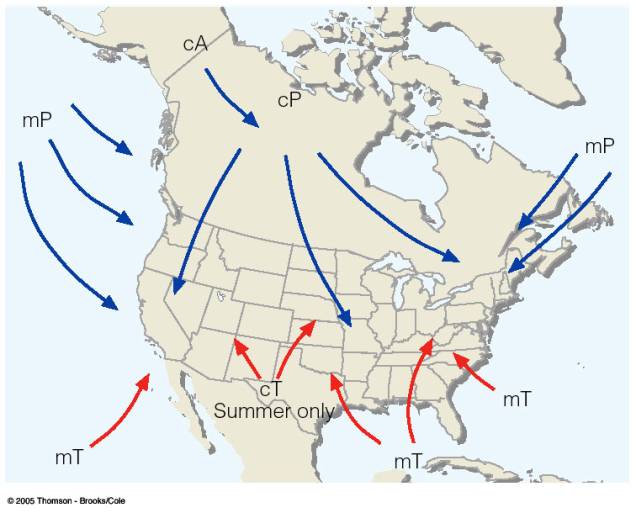
Which abbreviation of an air mass can be identified as dry and hot?
a)
cP
b)
mP
c)
cT
d)
mT
12.
Which abbreviation of an air mass can be identified as cold and moist?
a)
cP
b)
mP
c)
cT
d)
mT
13.
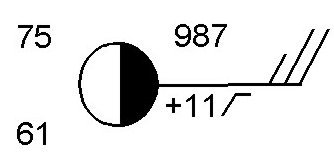
What is the temperature at this station
a)
75 degrees
b)
61 degrees
c)
987 degrees
d)
11 degrees
14.

What is the dew point at this station?
a)
75 degrees
b)
61 degrees
c)
987 degrees
d)
11 degrees
15.

What is the wind direction at this station?
a)
Wind is blowing from the north
b)
Wind is blowing to the East
c)
Wind is blowing from the East
d)
Wind is blowing to the North
16.

Which front does this image represent ?
a)
Cold front
b)
Stationary front
c)
Occluded Front
d)
Warm front
17.
What does studying patterns of extreme weather allow scientists to do?
a)
warn people before a storm happens
b)
predict when a storm will happen
c)
help reduce a storm's damage
d)
all of the above
18.
A hurricane __________
a)
forms when dry soil is picked up by small winds
b)
gets energy from warm, humid air above the ocean
c)
is a long-lasting snowstorm with a lot of blowing snow
d)
forms when warm air flows up while cold air flows down
19.
What is a powerful quickly spinning air mass called?
a)
hurricane
b)
thunderstorm
c)
tornado
d)
drought
20.
What step does every scientific experiment begin with?
a)
hypothesis
b)
question/problem
c)
procedures
d)
conclusion
21.
The summary at the end of an experiment that explains the results.
a)
conclusion
b)
procedures
c)
materials
d)
hypothesis
22.

What is a hypothesis?
a)
an educated guess stating what you believe will be the result of your experiement
b)
a random guess
c)
a statement of the outcome of your experiment
d)
step by step directions for your experiment
23.
The independent variable is the ONE thing you _____.
a)
change on purpose
b)
control or keep constant
c)
measure
24.
The variable that is being measured or observed is called the _______________. Hint: this is the variable that is the result or effect
a)
independent variable
b)
dependent variable
c)
control variable
25.
Dependent variable means
a)
the scientist controls what to test
b)
educated guess
c)
ask a question
d)
what is being measured
26.
A scientist hypothesizes the the temperature at which an alligator's egg is incubated will determine whether the alligator will be male or female. The independent variable is
a)
the male alligators
b)
the incubator
c)
the gender of the alligator
d)
the temperature
27.
A scientist hypothesizes the the temperature at which an alligator's egg is incubated will determine whether the alligator will be male or female. The dependent variable is
a)
the size of the baby alligators
b)
the gender of the baby alligators
c)
the incubator
d)
the temperature
28.

What is the length of this object?
a)
5.0 cm
b)
5.5 cm
c)
5.3 cm
d)
5.1 cm
29.

What is measured with a graduated cylinder?
a)
time
b)
distance
c)
weight
d)
liquid volume
30.

The water often curves down in a graduated cylinder. What is the scientific term for that curve?
a)
polarity
b)
water curve
c)
hypothesis
d)
meniscus
31.
A can of Coke will sink in a bowl of water. A can of Diet Coke will float in a bowl of water. What does this tell you about the density of the Diet Coke?
a)
it is bigger than 1
b)
it is smaller than 1
c)
it is equal to 1
d)
it is equal to -1
32.
Why do ice cubes float in a glass of water?
a)
the ice cubes are more dense than the water
b)
the water is more dense than the ice cubes
c)
the water is more dense than the glass
d)
the ice is more dense than the glass
33.
Will an object with a density of 1.01 g/cm3 float or sink?
a)
float
b)
sink
34.
What is the density of water?
a)
0 g/ml
b)
1 g/ml
c)
10 g/ml
d)
100 g/ml
35.
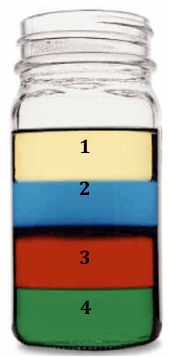
Put the liquids in order from most dense to least dense?
a)
4, 3, 2, 1
b)
1, 2, 3, 4
c)
3, 4, 2, 1,
d)
4, 3, 1, 2
36.
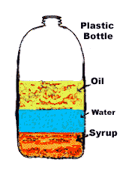
Which liquid is the least dense?
a)
oil
b)
water
c)
syrup
d)
plastic bottle
37.
What is the formula for density?
a)
density = mass x volume
b)
density = mass / volume
c)
density = mass + volume
d)
density = mass - volume
38.
Frank has an eraser. It has a mass of 4g, and a volume of 2cm3. What is its density?
a)
8 g/cm3
b)
2 g/cm3
c)
1/2 g/cm3
d)
24 g/cm3
39.
A place or object used for comparison to determine if another object is in motion is called a
a)
comparison point
b)
reference point
c)
point of view
d)
motion detector
40.
Speed =
a)
distance / time
b)
time / distance
c)
distance * time
41.
Change in speed over a given period of time is
a)
velocity
b)
motion
c)
speed
d)
acceleration
42.
The rate at which velocity changes is called
a)
motion
b)
average speed
c)
instantaneous speed
d)
acceleration
43.
What is the equation to find speed?
a)
s=t/d
b)
s=d x t
c)
s=d/f
d)
s=d/t
44.
What is the SI unit for acceleration?
a)
m/s
b)
m
c)
m/s2
d)
s
45.
When something has speed in a certain direction it is called ___________.
a)
motion
b)
position
c)
velocity
d)
speed
46.
LT1 Which would NOT make a good reference point?
a)
Becker Middle School
b)
A chair
c)
A moving child
47.
Friction is a force that acts in an ___________ direction of movement.
a)
similar
b)
opposite
c)
parallel
d)
west
48.
A type of friction that occurs when air pushes against a moving object causing it to decelerate.
a)
surface area
b)
air resistance
c)
velocity
d)
gravity
49.
Which of the following is an example of friction that is helpful?
a)
Brakes used on a bike
b)
Tires from a car on the road
c)
Tread on the bottom of your shoes
d)
All are examples that are helpful
50.
On which surface will a toy car travel the furthest?
a)
Carpet
b)
Polished Wood
c)
Ice
51.
What type of rock would you most likely find a fossil inside of?
a)
sedimentary
b)
igneous
c)
metamorphic
d)
diamond
52.
What type of rock is formed when magma and lava cools and hardens?
a)
minerals
b)
sedimentary
c)
igneous
d)
metamorphic
53.
What would you use to determine the hardness of a mineral?
a)
color tiles
b)
streak test
c)
Mohs Scale
d)
weight scale
54.
What type of rocks would I most likely see at the top of a volcano?
a)
igneous
b)
metamorphic
c)
sedimentary
d)
minerals
55.
What do we call the scientist who studies rocks?
a)
geologist
b)
rock scientist
c)
rockologist
d)
mineralogist
56.
What is Luster?
a)
The color of a mineral when it is ground into a powder.
b)
A measure of how easily a mineral can be scratched.
c)
The way a mineral shines, or reflects light.
57.
What is metamorphic rock?
a)
Rock that forms when melted, or molten rock from deep below Earth's surface cools and hardens.
b)
A solid material made up of one or more minerals.
c)
Rock that forms when existing rocks are changed by heat, pressure, or chemicals beneath the Earth's surface.
58.
In order for a metamorphic rock to form, _______ is needed.
a)
Pressure
b)
Heat
c)
Heat and Pressure
d)
Weathering
59.
What are 3 properties that are used to identify minerals?
a)
luster, color and sound
b)
smell, color and hardness
c)
luster, color and hardness
d)
luster, smell and hardness
60.

What property of rock is being observed when looking for what color is left after scratching it on a ceramic plate?
a)
hardness
b)
color
c)
cleavage
d)
streak
61.
What is the correct order (starting from the surface) of Earth's layers?
a)
crust, outer core, inner core, mantle
b)
mantle, outer core, inner core, crust
c)
crust, mantle, outer core, inner core
d)
outer core, inner core, crust, mantle
62.
Earth's inner core is...
a)
a dense ball of solid iron and nickel.
b)
a layer of molten iron and nickel.
c)
a layer of hot rock.
d)
a layer of rock that forms Earth's outer skin.
63.
Heat transfer within a fluid takes place by...
a)
convection currents
b)
radiation
c)
conduction
d)
density
64.
Which layer of Earth is LIQUID?
a)
upper mantle
b)
lower mantle
c)
outer core
d)
inner core
65.

P waves move through____
a)
Solids only
b)
Liquids only
c)
Solids and Liquids
d)
None of these
66.

S waves move through
a)
Solids only
b)
Liquids only
c)
Solids and liquids
d)
None of these
67.

The speed of seismic waves _____ through materials that are MORE dense.
a)
increase
b)
decrease
68.
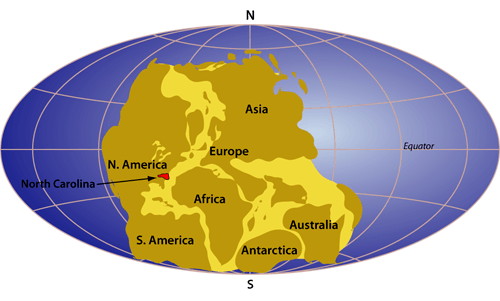
What is this a picture of?
a)
plate tectonics
b)
continental drift
c)
pangea
d)
glacier scaring
69.
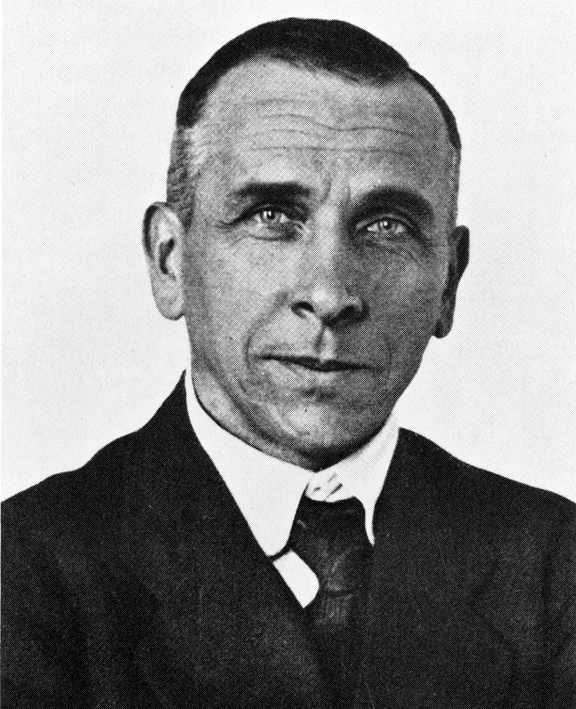
Who is the person credited with developing the theory of continental drift?
a)
Harry Hess
b)
Galileo
c)
Alfred Wegener
d)
Newton
70.
What does the theory of continental drift state?
a)
The continents were once joined in a super-continent and have moved over time
b)
Continents are stationary and do not move
c)
The Earth is broken into lithospheric plates that move due to convection currents
d)
none of the above
71.
The type of plate boundary where two plates come together is a .....
a)
Convergent Boundary
b)
Divergent Boundary
c)
Transform Boundary
d)
Plate Boundary
72.
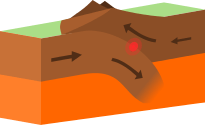
What type of plate boundary is this?
a)
Plate
b)
Divergent
c)
Convergent
d)
Transform
73.

What type of event will occur at this boundary?
a)
Earthquake
b)
Volcano Eruption
c)
Tornado
d)
Mountain Building
74.
A divergent boundary occurs when plates ....
a)
Pull apart
b)
Come together
c)
Slide past each other
d)
subducting
75.
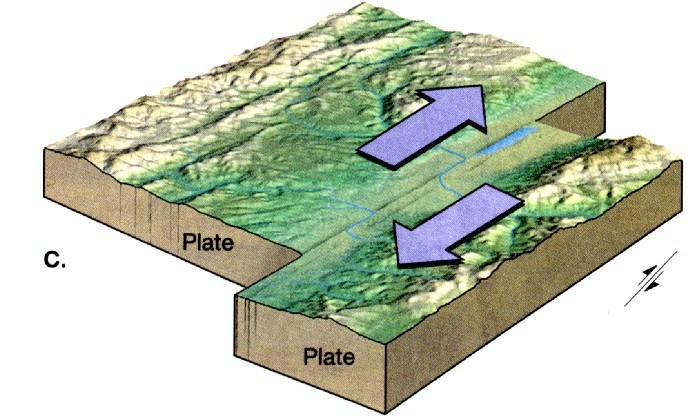
What type of plate boundary is this?
a)
Transform
b)
Convergent
c)
Divergent
d)
Plate
76.
Mountains are created when....
a)
Two continental plates collide
b)
Two oceanic plates pull apart
c)
An Oceanic plate subducts under a Continental Plate
d)
Two continental plates pull apart
77.

The youngest material of the ocean floor is found at mid-ocean _________.
a)
ridges
b)
trenches
c)
basins
d)
rifts
78.

Matching ________ on different continents are evidence for continental drift.
a)
weather systems
b)
river systems
c)
rock structures
d)
wind systems
79.

When plates slide past one another, _________ occur.
a)
divergent boundaries
b)
convection currents
c)
subduction zones
d)
transform faults
80.

The San Andreas Fault in California is an example of a ________.
a)
divergent boundary
b)
convergent boundary
c)
transform fault
d)
subduction zone
81.

What do close contour lines represent on a map?
a)
waterfall
b)
steep area
c)
gradual area
d)
river
82.

Determine the contour interval:
a)
5 m
b)
10 m
c)
15 m
d)
20 m
83.
An area's height above sea level
a)
topography
b)
relief
c)
elevation
d)
GIS
84.
Lines on a topographic map that connect lines of equal elevation:
a)
contour lines
b)
contour interval
c)
index contour
d)
contour loops
85.
The lines on the globe that appear horizontal on your maps and go North or South of the equator are line of ___________
a)
latitude
b)
longitude
c)
prime meridian
d)
meridians
86.
Lines that appear vertical on your maps and show East of West of the Prime Meridian are known as lines of _________
a)
contour intervals
b)
latitude
c)
longitude
d)
parallels
87.
The 0 degree line of latitude is the ___________.
a)
Equator
b)
Prime Meridian
c)
International Date Line
d)
Contour line
88.
A list of symbols and their meanings is a _______________.
a)
scale
b)
compass
c)
legend
d)
magnetic declination
89.
The 0 degree mark of longitude is known as the ___________ ______________ measure from Greenwich England.
a)
Equator
b)
Prime Meridian
c)
International Date Line
d)
Contour Line
90.
major area in the basin of the Pacific Ocean where a large number of earthquakes and volcanic eruptions occur.
a)
Ring of Fire
b)
San Andreas Fault
c)
Circle of Life
91.
The purpose of a compass rose it to ___________________.
a)
identify directions
b)
identify size
c)
identify colors
d)
to smell pretty
92.
Which of the following is not a continent?
a)
Nebraska
b)
Africa
c)
North America
d)
Australia
93.
A scientific name consists of
a)
Genus and Order
b)
Genus and Domain
c)
Genus and species
d)
Kingdon and Phylum
94.
The most general in the order of classification is?
a)
Kingdom
b)
Phylum
c)
Class
d)
Order
95.
The most specific of the classifications is?
a)
class
b)
order
c)
genus
d)
species
96.
The scientific name of Humans is?
a)
Homo Sapiens
b)
Homo Habilus
c)
Canis Latrans
97.
Kingdom, Phylum, Class, _______
a)
Family
b)
Order
c)
Genus
d)
Species
98.
What are the different kingdoms?
a)
Plant, animal, fungi, protist, monera
b)
Plant, animal
c)
Animal, monera, protist, fungi
d)
Monera, plant, fungi, protist
99.
How many levels of taxonomy are there?
a)
9
b)
10
c)
4
d)
7
100.
The passing of traits from parent to offspring
a)
Heredity
b)
Genetics
c)
Hybrid
d)
Probability
101.
Who was the father of genetics
a)
Sagan
b)
Issac Newton
c)
Gregor Mendel
d)
C.jenkins
102.
which is heterozygous ?
a)
Tt
b)
TT
103.
Which is homozygous ?
a)
Zz
b)
SS
104.
what predicts the outcome
a)
genetic engineering
b)
punnet square
c)
probability
105.
What is a phenotype
a)
The genetic make up (code)
b)
The physical trait
106.
One form of a gene is called_______________
a)
a DNA
b)
a Phenotype
c)
a trait
d)
an allele
107.
the condensed form of DNA is called________________
a)
an allele
b)
a gene
c)
a chromosome
d)
a phenotype
108.
Which of the following is a phenotype?
a)
Bb
b)
Black fur
100 %

