wayground logo

Free Printable Worksheets

Font size

S
M
L
XL
Worksheets

Final Review

Total questions: 101

Worksheet time: 1hrs 1mins

Name
Class
Date
1.

Speed is the ratio of the distance an object moves to

a)

amount of time needed to travel the distance

b)

the displacement of the object

c)

the direction the object moves

d)

the motion of the object

2.

The slope of the line on a distance-time graph is

a)

distance

b)

time

c)

displacement

d)

speed

3.

A horizontal line on a distance-time graph means the object is:

a)

moving at a constant speed

b)

slowing down

c)

at rest

d)

moving faster

4.

The slope of a speed-time graph indicates:

a)

direction

b)

acceleration

c)

velocity

d)

speed

5.

An object that is accelerating may be:

a)

slowing down

b)

speeding up

c)

changing direction

d)

all of the above

6.

The SI unit of force is:

a)

joule

b)

watt

c)

newton

d)

m/s

7.

When an unbalanced force acts on an object:

a)

the object's motion does not change

b)

the object accelerates

c)

the weight of the object decreases

d)

the inertia of the object increases

8.

What kind of friction occurs as a fish swims through water?

a)

fluid

b)

rolling

c)

sliding

d)

static

9.

Your weight is defined as:

a)

mass times speed

b)

mass times acceleration due to gravity

c)

mass

d)

momentum

10.

Every action has an equal and opposite reaction describes:

a)

Newton's First Law

b)

Newton's Second Law

c)

Newton's Third Law

d)

None of the above

11.

The sum of all forces acting on an object is called:

a)

net force

b)

momentum

c)

acceleration

d)

gravitational potential energy

12.

The tendency of an object to resist any change in its motion is called:

a)

momentum

b)

inertia

c)

gravity

d)

acceleration

13.

Electromagnetic waves vary in:

a)

the speed they travel in a vaccum

b)

wavelength and frequency

c)

the way they reflect

d)

the orientation of their electric and magnetic fields

14.

Light acts like

a)

a wave

b)

a particle

c)

both a wave and a particle

d)

neither a wave nor a particle

15.

Infrared rays have a shorter wavelength than

a)

UV rays

b)

radio waves

c)

radar waves

d)

gamma rays

16.

Cellular telephones utilize

a)

radar waves

b)

very high frequency waves

c)

very low frequency waves

d)

microwaves

17.

Which of the following occur as a light wave bends when it passes from one medium into another?

a)

constructive interference

b)

refraction

c)

destructive interference

d)

reflection

18.

The SI unit for frequency:

a)

m/s

b)

watts

c)

joules

d)

hertz

19.

A straw looks bent in a glass of water because of:

a)

relfection

b)

polarization

c)

diffraction

d)

refraction

20.

The reason you can hear people talking around a corner of a building is due to:

a)

refraction

b)

polarization

c)

diffraction

d)

interference

21.

When a wave bounces due to not being able to go through a barrier, it is called:

a)

diffraction

b)

refraction

c)

reflection

d)

interference

22.

The SI unit for wavelength is:

a)

mm

b)

m/s

c)

m

d)

cm

23.

The highest part of a wave is called:

a)

trough

b)

wavelength

c)

crest

d)

amplitude

24.

What is the unit for Kinetic Energy?

a)

watts

b)

m/s

c)

newtons

d)

joules

25.

A ball is sitting on the top of a table. What type of energy does it have?

a)

thermal

b)

kinetic

c)

potential

d)

chemical

26.

If a person was burnt touching a hot pan on a stove, what type of heat transfer caused the injury?

a)

convection

b)

conduction

c)

radiation

27.

Which of the following is an example of elastic potential energy?

a)

a book sitting on a table

b)

a rubber band being stretched over fingers

c)

a person sitting on top of a building

d)

a bicyclist pedaling down the street

28.

What type of heat transfer allows the sun to give us light and heat?

a)

convection

b)

conduction

c)

radiation

29.

What type of heat transfer causes the plates to move on Earth? (Motion of Magma)

a)

convection

b)

conduction

c)

radiation

30.

When a ball is thrown upward and caught, when is there the most Kinetic Energy?

a)

at the top of the peak of its path

b)

at the initial release of the ball

c)

in the middle of it ascending to the peak

d)

in the middle of it descending to our hand

31.

Heat always flows from

a)

warmer to colder areas

b)

colder to warmer areas

c)

where there is a small amount of KE to where there is a lot

32.

What are two ways to increase the KE of an object?

a)

increase height and mass

b)

decrease height and mass

c)

increase velocity and mass

d)

decrease velocity and mass

33.

The Law of Conservation of Energy states:

a)

energy cannot be created

b)

energy cannot be destroyed

c)

energy can be converted into different types

d)

all of the above

34.

What energy transformation(s) take(s) place when you strike and light a match?

a)

chemical to nuclear

b)

mechanical to thermal

c)

chemical to thermal to electromagnetic

d)

electromagnetic to potential

35.

Photosynthesis transforms electromagnetic energy from the Sun into:

a)

mechanical energy

b)

thermal energy

c)

chemical energy

d)

electrical energy

36.

When you stretch a rubber band, _________ energy is converted into __________ energy.

a)

mechanical, chemical

b)

mechanical, elastic

c)

elastic, rubber

d)

light, elastic

37.

Answering your cell phone transforms the chemical energy in its battery into:

a)

electromagnetic (light) energy

b)

electrical energy

c)

sound energy

d)

all of the above

38.

An inclined plane wrapped around a cylinder:

a)

wedge

b)

screw

c)

inclined plane

d)

pulley

39.

These two parts act as one simple machine. They are found on cars, bikes, and wheelbarrows

a)

lever

b)

screw

c)

inclined plane

d)

wheel and axle

40.

This simple machine has a pivot point, which can be located in the center, near the end, or at the end:

a)

screw

b)

lever

c)

pulley

d)

inclined plane

41.

Ratio of input and output forces

a)

machine

b)

simple machine

c)

mechanical advantage

d)

efficiency

42.

Force applied by a machine:

a)

input force

b)

mechanical advantage

c)

simple machine

d)

output force

43.

Force applied to a machine:

a)

input force

b)

mechanical advantage

c)

simple machine

d)

output force

44.

This is necessary to get something moving:

a)

resistance

b)

force

c)

wedge

d)

screw

45.

A variation of an inclined plane is a:

a)

wedge

b)

wheel & axle

c)

lever

d)

pulley

46.

A machine is classified as a compound machine if it:

a)

is very efficient

b)

has a mechanical advantage greater than 1

c)

has moving parts

d)

is made up of two or more simple machines that operate together

47.

The mechanical advantage of a pulley system depends upon:

a)

the diameter of the pulley wheels

b)

the length of the rope

c)

the number of sections of rope

d)

the direction of the input force

48.
An object is _____ if its position changes relative to another object.
a)
in motion
b)
at reset
c)
a frame of refence
d)
magical
49.
A place or object used for comparison to determine if another object is in motion is called a
a)
comparison point
b)
reference point
c)
point of view
d)
motion detector
50.
A distance vs. time graph shows an object's
a)
frame of reference
b)
speed
c)
acceleration
d)
favorite food
51.
Speed =
a)
distance / time
b)
time / distance
c)
distance * time
52.
Change in speed over a given period of time is
a)
velocity
b)
motion
c)
speed
d)
acceleration
53.
On a distance vs. time graph, the steeper the slope _____
a)
the slower the speed
b)
the faster the speed
c)
less acceleration
d)
greater acceleration
54.
What is the SI unit for acceleration?
a)
m/s
b)
m
c)
m/s2
d)
s
55.
What is the SI unit for speed
a)
Km
b)
s
c)
m/s
d)
m/s2
56.
When something has speed in a certain direction it is called ___________.
a)
motion
b)
position
c)
velocity
d)
speed
57.
The graph represents
a)
no motion
b)
constant velocity
c)
acceleration
d)
negative acceleration
58.
The graph respresents
a)
No motion
b)
Constant Velocity
c)
Acceleration
d)
Deceleration
59.
The graph represents
a)
no motion
b)
Constant velocity
c)
Acceleration
d)
negative acceleration
60.
How many significant figures does the following number have: 0.002040
a)
6
b)
4
c)
3
d)
2
61.
How many significant figures does the following number have: 0.998005
a)
9
b)
10
c)
6
d)
5
62.
How many significant figures does the following number have: 100.00210
a)
7
b)
5
c)
10
d)
8
63.
Round 0.010229 to four sig figs
a)
1022
b)
1023
c)
0.01023
d)
0.01022
64.
Round 1047.78 to three sig figs
a)
104
b)
105
c)
1050
d)
1050.00
65.
Round 1009 to three sig figs
a)
100
b)
101
c)
1010
d)
1000
66.
How many sig figs are there?
100000000
a)
1
b)
9
c)
10
67.
If there are two forces going in the opposite direction how would you find the net force?
a)
Subtract
b)
Add
c)
Divide
d)
Multiply
68.
Find the net force: 15 N to the right, and another 15 newtons to the right.
a)
0 N Right
b)
0 N Left
c)
30 N Left
d)
30 N Right
69.
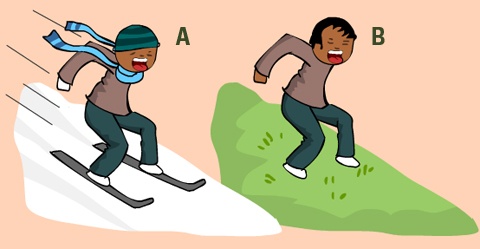
Why is it harder for the boy in Image B to get down the hill?
a)
Motion
b)
Friction
c)
Work
d)
Displacement
70.
Which force produces a change in motion?
a)
unbalanced force
b)
balanced force
71.
Any time the forces are unbalanced, an object will remain at rest. True or false?
a)
true
b)
false
72.
Wheels on a skateboard most likely experiences-
a)
Rolling Friction
b)
Sliding Friction
c)
Fluid Friction
d)
Static Friction
73.
Sally experiences-
a)
Rolling Friction
b)
Sliding Friction
c)
Fluid Friction
d)
Static Friction
74.
How can friction be reduced?
a)
reduce the force acting between the 2 surfaces
b)
reduce the roughness of the 2 surfaces coming in contact
c)
use wax, grease or oil
d)
all of the above are ways of reducing friction
75.
Which of the following is an example of friction that is helpful?
a)
Brakes used on a bike
b)
Tires from a car on the road
c)
Tread on the bottom of your shoes
d)
All are examples that are helpful
76.
How will this object move? 
a)
It won't move. 
b)
It will move to the right. 
c)
It will move to the left. 
d)
It will move in both directions. 
77.
Why does a book on a table not move?
a)
No forces are acting on the book
b)
Gravity is the only force acting on the book
c)
Forces of the table pushing up and gravity pulling down are balanced
78.
Force = Mass x Acceleration
a)
Newton's 1st Law
b)
Newton's 2nd Law
c)
Newton's 3rd Law
d)
Newton's 4th Law
79.
"An object in motion (or at rest) will to stay in motion (or at rest) until an outside force acts upon it."
a)
Newton's 1st Law
b)
Newton's 2nd Law
c)
Newton's 3rd Law
d)
Newton's 4th Law
80.
The tendency of a moving object to resist changes in its motion is...
a)
momentum
b)
force
c)
acceleration
d)
velocity
81.
The force that opposes motion between two surfaces in contact with each other.
a)
inertia
b)
friction
c)
momentum
d)
gravity
82.
Which of the following is the same as a Newton?
a)
kg*m/sec/sec
b)
kg*m/sec
c)
m/sec/sec
d)
m/sec
83.
Which of the following is the units for momentum?
a)
kg*m/sec/sec
b)
kg*m/sec
c)
m/sec/sec
d)
m/sec
84.
An archer pulls the bowstring back, then releases the string and the arrow flies forward. Pulling the string back is the...
a)
action force
b)
reaction force
c)
net force
d)
inertia
85.
An archer pulls the bowstring back, then releases the string and the arrow flies forward. The arrow flying forward is the...
a)
action force
b)
reaction force
c)
net force
d)
inertia
86.
A cannonball with a mass of 10 kg is flying at an acceleration of 5 m/sec/sec. What is it's force?
a)
50 Newtons
b)
5 Newtons
c)
20 Newtons
d)
9.5 Newtons
87.
The net force on a ball thrown in outer space is... (you are no longer touching the ball)
a)
there is none
b)
forward
c)
down and backward
d)
forward and down
88.
When a moving object strikes another object, it will transfer this to the object it hits.
a)
force
b)
momentum
c)
gravity
d)
friction
89.
Density is...
a)
the amount of mass in an object
b)
the amount of space an object takes up
c)
the amount of mass in a given space
d)
the weight of an object
90.
Which liquid is the most dense?  
a)
oil
b)
water
c)
syrup
d)
plastic bottle
91.
What is buoyant force?
a)
An upward force exerted by fluids on an object.
b)
An downward force exerted by fluids on an object.
92.
Archimedes' Principle states that... 
a)
The buoyant force acting on an object equals the volume of the fluid displaced by the object. 
b)
The buoyant force acting on an object equals the weight (force of gravity) of the fluid displaced by the object.
c)
The buoyant force acting on an object will always be equal. 
93.
Which will result in positive buoyancy?
a)
When the buoyant force is greater than the force of gravity
b)
When the buoyant force is equal to the force of gravity
c)
When the buoyant force is less than the force of gravity
94.
What is the formula for pressure?
a)
Pressure = Area / Force
b)
Pressure = Force / Area
c)
Pressure = Force x Area
95.
What are the units for pressure?
a)
pascals
b)
Newtons
c)
kilograms
d)
meters2
96.
What happens to pressure as the atmosphere gets "deeper"?
a)
stays the same
b)
decreases
c)
increases
97.
What happens to water pressure as depth increases?
a)
increases
b)
stays the same
c)
decreases
98.
An object will sink if ____.
a)
the weight of an object is greater than the buoyant force
b)
the weight of an object is less than the buoyant force
c)
the weight of an object is equal to the buoyant force
d)
the weight doesn't affect if an object sinks, only its state of matter
99.
Who stated that a change in pressure at any point in an enclosed fluid will be transmitted equally to all parts of the fluid?
a)
Bernoulli
b)
Boyle
c)
Charles
d)
Pascal
100.
Who stated that as the speed of a moving fluid increases, the pressure of the moving fluid decreases.
a)
Bernoulli
b)
Boyle
c)
Charles
d)
Gay-Lussac
101.
When air passes over an airplane wing, the air _____.
a)
travels faster under the wing
b)
travels faster over the top of the wing
c)
at the same speed above and below the wing so as not to create turbulence
d)
has no affect on the wing