
NEW
Font size
 Worksheets
Action Potentials/ Synaptic Transmission/ Muscle Contraction
Total questions: 35
Worksheet time: 2hrs 43mins


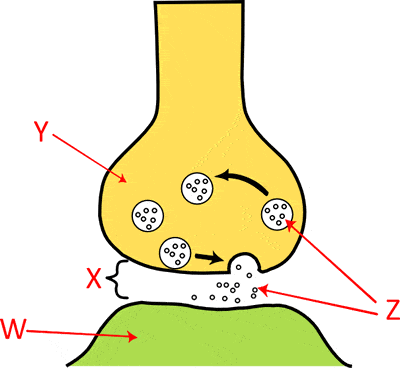
W
Axon terminal
Neurotransmitters
Postsynaptic membrane
Synapse
Neurotransmitters are released from the
Dendrites
Post-synaptic terminal
Presynaptic terminal
Axon


Y
Axon Terminal
Neurotransmitters
Dendrite
Synapse

The neurotransmitter that signals muscle contraction is called...
Acetylcholine
Myosin
Actin
Calcium
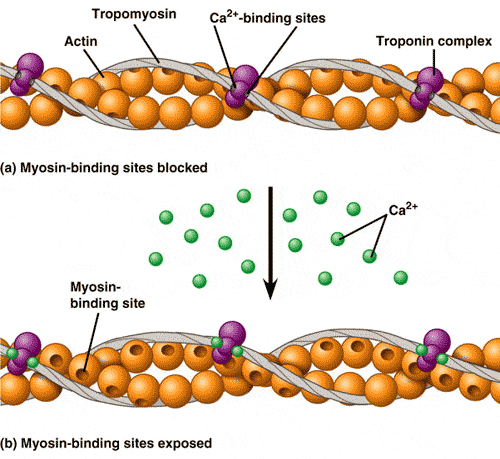
Calcium:
Causes ATP binding to actin and power stroke to occur
Is the best ion EVER!
Binds to proteins on myosin
Binds to troponin, helping expose the active site on actin
What protein is wrapped around actin that covers up it's active sites is called:
Troponin
Tropomyosin
Calcium
None of the above
The Ions that are responsible for activating Troponin and twisting Tropomyosin.
Sodium
Calcium
Potassium
Magnesium
Identify one factor that can cause the first sodium channel to open in a muscle cell.
Calcium ions being released from the sarcoplasmic reticulum.
Acetylcholine from a motor neuron attaching to a receptor on muscle fiber.
Calcium ions binding to troponin
ATP causing the myosin heads to pop up.
This attaches the muscle to the bone:
ligament
aponeurosis
epimysium
tendon
Name for a bundle of muscle fibers:
actin
mysoin
fascicle
sarcomere
Why does hyperpolarization occur during an Action Potential?
Na+ channels open first
K+ channels open second
K+ channels are slow to close
The Na+ / K+ pump is always working
What is the charge inside the axon when the neuron is "at rest"?
-70 mV
-55 mV
40 mV
55 mV
This muscle type is involuntary and lines hollow organs, airways and blood vessels:
Smooth
Cardiac
Skeletal
Synaptic vesicles:
Contain Calcium ions
Contain Neurotransmitters
Contain Receptors
All of the above
Why is a "2nd Messenger" needed?
Because actin is lame
There is no such thing as a 2nd messenger, Mr. Dalton!
Because of reasons beyond human comprehension
Because neurotransmitters cannot cross the membrane of the postsynaptic terminal

