wayground logo

Free Printable Worksheets

Font size

S
M
L
XL
Worksheets

World History Semester 2

Total questions: 145

Worksheet time: 1hrs 29mins

Name
Class
Date
1.
What does it mean for a King to have Divine Right? 
a)
Rules by the power and blessing of God. 
b)
Rules by the suggestions of the people.
c)
Rules by listening to the Church to make decisions.
d)
The King is not really in power at all. 
2.
What is an absolute monarchy? 
a)
A system where the King or Queen rules by listening to what the public has to say.
b)
A King or Queen rules, but laws or ideas must be accepted by the majority of the nation.
c)
A system where the King or Queen has complete authority over the government and people.
d)
The King or Queen has absolutely no power.
3.
Who said this, "Kings are justly called gods, for that they exercise a manner or resemblance of divine power upon earth."
a)
Thomas Hobbes
b)
King James I of England
c)
Thomas Paine
d)
Queen Elizabeth I
4.
God has established a kings authority and they only answer to God.
a)
Absolute Monarchy
b)
"divine right"
c)
Balance of Power
d)
Parliament
5.
Absolute Monarch
a)
All power over finances, religion, laws, army, and land
b)
All power over marriage, church officials and heresy
c)
No Power...Only answered to Parliament
d)
No power unless given by the people
6.

According to John Locke, these are given by God and cannot be taken by the government. The protection of these is the purpose of the government.

a)

divine rights

b)

systemic rights

c)

natural rights

d)

preternatural rights

7.

He was influenced by the ideas of John Locke.

a)

Thomas Hobbes

b)

Thomas Jefferson

c)

Machiavelli

d)

Plato

8.

The influence of John Locke is clear in this document, although he died in 1704 and this document was written in 1776.

a)

The Declaration of Independence

b)

The Communist Manifesto

c)

The U.S. Constitution

d)

The Social Contract

9.
Many French kings considered themselves a Divine Right Monarch but Louis XIV was not one of them.
a)
TRUE
b)
FALSE
10.
A king or queen who holds ALL power within their state / country.
a)
Dictator
b)
Absolute Monarch
c)
Super Monarch
d)
Tyrant
11.
Who was a major threat to King Louis XIV's power? (so much so, that he wanted to keep an eye on them). 
a)
peasants 
b)
other kings
c)
his family 
d)
nobles
12.
Who was taxed in France during the reign of King Louis XIV?
a)
everyone
b)
(only) the peasants
c)
the lower and middle classes
d)
(only) the nobility
13.
During the rule of Louis XIV, Frances Parliamentary body was never called into session.  What was the Parliamentary body of France?
a)
The Estates General
b)
Congress
c)
Zemsky Sabor
d)
Ile de Cite
14.

Who called the meeting of the Estates General in 1789?

a)

King James I

b)

King Henry VIII

c)

Napoleon

d)

King Louis XVI

e)

King George V

15.

Which of the French estates formed the National Assembly and began running the country?

a)

First Estate

b)

Second Estate

c)

Third Estate

d)

Lower Estate

e)

Upper Estate

16.

Where did the National Assembly meet after the king ordered them to disperse?

a)

At a tennis court

b)

At a local pub

c)

At a restaurant

d)

At a member's house

e)

At the market square

17.
What is the name of the document passed by the National Assembly?
a)
The Declaration of the Rights of Man and of the Citizens
b)
US Constituion
c)
Tennis Court Oath
d)
English Bill of Rights
18.
The National Convention declared France a ___________ following the execution of the king.
a)
Absolute monarchy
b)
Constitutional Monarchy
c)
Republic
d)
Dictatorchip
19.
What is the name of the five person council that was set up following the end of the Committee for Public Safety?
a)
The National Assembly
b)
The Directory
c)
The Napoleonic Code
d)
Estates General
20.
The French Revolution was inspired by _______________ thinkers.
a)
Scientific Revolution
b)
Clergy
c)
Enlightenment
d)
Revolutionary
21.
What execution method was most popular during the Reign of Terror?
a)
guillotine
b)
hanging
c)
brazen bull
d)
stoning to death
22.
What event marked the end of the Reign of Terror?
a)
The execution of Marie Antoinette
b)
The execution of Maximilien Robespierre
c)
The execution of King Louis XVI
d)
The execution of Jean Paul Marat
23.
Who served as the ringleader of the Jacobins and the Committee of Public Safety?
a)
Georges Danton
b)
Marie Antoinette
c)
Jean Paul Marat
d)
Maximilien Robespierre
24.
One cause of the French Revolution was the emergence of a new middle class of merchants and professionals called the 
a)
bourgeoisie
b)
aristocracy
c)
sans culottes
d)
denoument
25.
France was deep in debt because
a)
money spent on the American Revolution
b)
Marie Antoinette's lavish spending
c)
the 1st and 2nd estates did not pay taxes
d)
all of the above
26.
The French Revolution began when King Louis XVI
a)
was executed
b)
had his troops attack Paris
c)
called the Estates General together
d)
abdicated
27.
The First Estate in French society was composed of 
a)
the Clergy
b)
people with special courts
c)
people who did not pay taxes
d)
all of the abve
28.
The Second Estate was composed of 
a)
Church leaders
b)
Nobility
c)
Peasants
d)
none of the above
29.
Most of the people of France belonged to the 
a)
1st 
Estate
b)
2nd Estate
c)
3rd Estate
d)
4th Estate
30.
Why was voting in the Estates General unfair
a)
votes were not secret
b)
each estate voted by how many members there were
c)
each estate got the same number of votes
d)
the King got two votes
31.
The radicals who took over the revolution were led by 
a)
Louis XVI
b)
Robespierre
c)
Rousseau
d)
Marquis de Lafayette
32.
In which country did the Industrial Revolution begin?
a)
The United States
b)
England
c)
France
d)
Germany
33.
What product was first made using machines in factories?
a)
Steel
b)
textiles
c)
locomotives
d)
flying shuttles
34.
A place where people and machines join together to mass produce goods.
a)
Cartel
b)
Corporation
c)
Factory
d)
Urbanization
35.
Mass production led to:
a)
Products being more superior in quality
b)
goods became less expensive
c)
laborers received higher wages
d)
industries moved to rural areas
36.
Before the Industrial Revolution all products were created by
a)
Factories
b)
Hand
c)
Slaves
d)
Royalty
37.
What is the movement from rural to urban areas called?
a)
Moving
b)
colonization
c)
inflation
d)
urbanization
38.
Why did people move to the cities during the Industrial revolution?
a)
Jobs in factories
b)
Jobs on the farm
c)
Family
d)
Friends
39.
Which 2 natural resources were the backbone of the Industrial Revolution?
a)
wood and peat
b)
oil and natural gas
c)
coal and iron
d)
cotton and tobacco
40.
England is an island. Why was this an advantage during the Industrial Revolution?
a)
It wasn't an advantage.
b)
It made it more difficult for other countries to steal England's ideas.
c)
England has many ports and rivers which allow easier worldwide trade.
d)
England had tropical weather, which allowed more crops to be grown.
41.
Why did "cottage industry" come to an end?
a)
Too many people moved to the city.
b)
It was replaced by the factory system.
c)
The need for textiles decreased.
d)
Women who worked in cottage industries went on strike.
42.
Which of the following would NOT be associated with mass production?
a)
Interchangeable parts
b)
division of labor
c)
unique, hand made goods
d)
assembly line
43.
The cottage industry system involved manufacturing...
a)
of steam engines.
b)
of luxury goods.
c)
in the home. 
d)
in small factories.
44.
Which of the following was NOT associated with early factory working conditions?
a)
Low wages
b)
Widespread pollution
c)
Dangerous working conditions
d)
Safe working conditions
45.
Which statement is true?
a)
Children were not allowed to work in the mines during the Industrial Revolution
b)
Work conditions were closely regulated
c)
There were no labor laws that prevented children from working
d)
Children were allowed to work but they were treated fairly. 
46.
What were living conditions in the city like during the Industrial Revolution?
a)
Very extravagant
b)
Strict housing regulations
c)
Spacious and luxurious
d)
Crowded and unsanitary
47.
Imperialism is __________.
a)
when a powerful nation uses its resources to help a weaker nation
b)
when a weaker nation invites a powerful nation to help it industrialize
c)
when a powerful nation takes control of the economy and government of a weaker nation
d)
when weak nations join together to fight a strong nation
48.
Economic motives for imperialism include _________.
a)
a desire to spread Christianity
b)
a need for military bases around the world
c)
a need for raw materials to be used in factories
d)
a desire to gain glory
49.
What countries imperialized?  (Did the taking over)
a)
England, France, Japan and the US
b)
Italy, Cuba, India and Australia
c)
Haiti, Cuba, Japan and the Philippines
d)
England, Australia, Europe and Africa
50.
The race for European countries to claim land in Africa was called the _________.
a)
Scramble for Africa
b)
African Marathon
c)
Great Competition
d)
Monopoly
51.
Why were European countries interested in colonizing Africa during the Age of Imperialism?
a)
They wanted Africa's natural resources
b)
They wanted land to develop new types of ships
c)
They wanted to create a perfect society
d)
They wanted to learn new languages
52.
For what reason did the US imperialize?
a)
to gain raw materials for industry
b)
to create military bases around the globe
c)
to develop markets to sell goods
d)
all of these
53.
Why were the Sepoys offended by the new weapons that used animal fat to grease the gun cartridges?
a)
Most Sepoys were Muslim or Hindu and their religions had specific rules about cows and pigs
b)
The grease stained their uniforms, which were expensive to replace
c)
The Sepoys were pacifists and did not believe in war
d)
The Sepoys invented the new weapons and were not paid for their use
54.
What rebellion led to the end of indirect rule and the beginning of direct rule in India?
a)
The Boxer Rebellion
b)
The Zulu War
c)
The Sepoy Rebellion
d)
The Boer Rebellion
55.
This word means pride in one's country; it was a cause of WWI.
a)
Militarism
b)
Alliances
c)
Nationalism
d)
Imperialism
56.
This word means strengthening a country's military; it's a cause of World War I.
a)
Nationalism
b)
Militarism
c)
Alliances
d)
Imperialism
57.
This word means seeking other colonies; it was a cause of World War I.
a)
Militarism
b)
Imperialism
c)
Alliances
d)
Nationalism
58.
This word means support for different sides during war; there were the Allied and Central powers during WWI.
a)
Nationalism
b)
Imperialism
c)
Alliances
d)
Militarism
59.
Germany had to pay $33 billion dollars in _______________.
a)
land
b)
military
c)
reparations
60.
Germany also lost millions of square miles of ______.
a)
money
b)
land
c)
colonies
61.
Germany also had to ______ their military.
a)
disarm
b)
disband
c)
give up
62.
Russia, Great Britain, and France were all ?
a)
Besties 
b)
Alliances 
c)
Enemies 
d)
Entente
63.
What were the causes of WWI?
a)
Militarism, Alliances, Nationalism, Imperialism
b)
Militarism, Alliances, Nationalism, Isolationism
c)
Militarism, Against, Nice, Iguanas
d)
Militarism, Alliances, Nationalism, Impractical
64.
What sparked World War I?
a)
Assassination of Archduke Franz Ferdinand
b)
Assassination of Archduke Marmaduke
c)
Assassination of Archduke Franz Ferdahand
d)
Assassination of Archduke Kaiser Wilhelm
65.
Russia, Great Britain, and France were all part of the
a)
Allied Powers
b)
Central Powers
c)
Axis Powers
d)
Neutral Powers
66.
Germany, Austria-Hungary, and the Ottoman Empire were all a part of the
a)
Central Powers
b)
Allied Powers
c)
Axis Powers
d)
Neutral Powers
67.
What country was neutral at the beginning of the war?
a)
France
b)
United States
c)
Russia
d)
Germany
68.
What type of fighting was used in WWI?
a)
Guerrilla Warfare
b)
Total Warfare
c)
Subwarfare
d)
Trench Warfare
69.
What was the stretch of land between the trenches?
a)
No mans land
b)
La La land
c)
Attack Trenches
d)
Switzerland
70.
What new technology sank allied and neutral supply ships?
a)
Dreadnoughts
b)
U-Boats
c)
Airplanes
71.
What was not a new weapon of WWI? 
a)
Grenades
b)
Tanks
c)
Airplanes
d)
Flamethrowers
72.
Which 14 point did Wilson create to prevent future wars?
a)
League of Nations
b)
No secret alliances
c)
Removal of economic barriers
d)
Absolute freedom of seas
73.
What nation did not sign the Treaty of Versailles?
a)
France
b)
Great Britain
c)
United States 
d)
Germany
74.
How did the Nazis take power in Germany?
a)
by appointment
b)
by force
c)
by Hitler's decree
d)
by parliamentary election 
75.
What book did Hitler write?
a)
Lebensraum
b)
Mein Kampf
c)
Mein coffee
d)
50 Shades of Hitler
76.
Which best represents Fascism?
a)
Extreme nationalism
b)
Extreme democracy
c)
Extreme support of workers
d)
Extreme internationalism
77.
A government that subordinates the individual to the state and strictly controls all aspects of life by coercive measures is a….?
a)
Totalitarian State
b)
Democratic State
c)
Free State
d)
Warrior State
78.
Who was the leader of fascist Italy?
a)
FDR
b)
Hitler
c)
Stalin
d)
Mussolini
79.
Who was the leader of communist Russia?  (During WWII)
a)
FDR
b)
Hitler
c)
Stalin
d)
Mussolini
80.
Adolf Hitler was a member and eventual leader of this political party?
a)
Nazi
b)
Democratic
c)
Republican
d)
Communist
81.
A hatred of the Jewish race is called…?
a)
Anti-Semitism
b)
Anti-Government
c)
Anti-Establishment
d)
Anti-Sensationalism
82.
In order for Germany to become strong Hitler completely ignored the guidelines given to Germany in the…?
a)
Treaty of Trent
b)
Treaty of Venice
c)
Treaty of the German Republic
d)
Treaty of Versailles
83.
Hideki Tojo was the ________________________ of Japan
a)
Emperor
b)
Prime Minister
c)
King
d)
General
84.
The Treaty of Versailles blamed who for the War
a)
Austria
b)
Hungary
c)
Germany
d)
Ottoman Empire
85.
Alliance formed between Germany, Italy and Japan during the 1930s
a)
Aryan League
b)
Triple Alliance
c)
Axis Powers
d)
Central Powers
86.
A time of economic collapse when businesses lose money and people become poor
a)
Depression 
b)
Censorship 
c)
Purge 
d)
Inflation 
87.
Which of the following helped Adolf Hitler gain power in Germany?
a)
The promise of a new democracy
b)
The Great Depression
c)
Big business and labor
d)
The support of the Weimar government
88.

What was the name of Germany during the interwar period?

a)

Weimer Republic

b)

Nazi Germany

c)

Soviet Union of Germany

d)

Germanic Tribes

89.

The two most important qualities for citizens to possess in a fascist government were...

a)

Kindness and compassion

b)

Loyalty and Obedience

c)

Strength and Courage

d)

Dissent and Rage

90.

All of the following countries fell to a totalitarian government in the interwar periods except...

a)

Spain

b)

Italy

c)

France

d)

Germany

91.
What was the Allied strategy in the Pacific known as? 
a)
island-hopping 
b)
island-jumping 
c)
appeasement
d)
rationing 
92.
Where did the largest land-sea-air invasion in world history take place? 
a)
Hiroshima, Japan
b)
Normandy, France
c)
Nagasaki, Japan
d)
Berlin, Germany 
93.
At first, European leaders gave into Hitler's demands using what type of policy? 
a)
aggression
b)
advancement 
c)
internment 
d)
appeasement 
94.
What event led to the start of WWII? 
a)
Germany invaded Poland 
b)
Germany invaded Austria 
c)
Germany formed an alliance with Italy 
d)
Germany formed an alliance with Japan 
95.
How did the use of atomic bombs impact the outcome of WWII? 
a)
Germany was forced to surrender.
b)
Italy was forced to surrender.
c)
The Soviet Union was forced to surrender. 
d)
Japan was forced to surrender.
96.
What was the Holocaust? 
a)
a relocation camp for Japanese Americans after Pearl Harbor
b)
a relocation camp for Muslims after the 9/11 terrorist attacks
c)
the widespread killing of Jews by Nazis
d)
the time period following WWII
97.
What event led to the US joining WWII? 
a)
Germany invaded Poland. 
b)
Germany sent Mexico a secret telegram. 
c)
Japan bombed Pearl Harbor.
d)
Germany bombed Pearl Harbor. 
98.

Who was the leader of U.S.A.?

a)

Churchhill

b)

Hitler

c)

Stalin

d)

Roosevelt

99.

Which of these was the most notorious concentration camp during World War II?

a)

Dachau

b)

Flossenburg

c)

Auschwitz

d)

Belzec

100.

The battle at Normandy is referred to as ___

a)

Manhattan Project

b)

D-Day

c)

VJ Day

d)

Pearl Harbor

101.

Pearl Harbor happened on what day?

a)

December 7,1945

b)

December 25, 1945

c)

December 7, 1941

d)

December 13, 1941

102.

Blitzkrieg means

a)

lightning storm

b)

lightning war

c)

fire fight

d)

bombing war

103.
Which battle was the turning point of the war in the Pacific?
a)
Battle of Singapore
b)
Battle of the Coral Sea
c)
Battle of Guadalcanal
d)
Battle of Midway
104.
The defense of which Russian city marked a turning point on the Eastern Front of World War II?
a)
Leningrad
b)
Moscow
c)
Odessa
d)
Stalingrad
105.
Which two Japanese cities were destroyed by atom bombs?
a)
Hiroshima and Nagasaki
b)
Kyoto and Tokyo
c)
Nagasaki and Kyoto
d)
Tokyo and Hiroshima
106.

The treaty that was supposed to keep Hitler and Stalin at Peace was the:

a)

German-Soviet pact

b)

Treaty of Paris

c)

Treaty of Versailles

d)

Nazi-Soviet Pact

107.
The codename for the German invasion of USSR Was
a)
Operation Torch
b)
Operation Market Garden
c)
Operation Barbarossa
d)
Operation Overlord
108.
The decision to eliminate all European Jews (The Final solution) was made at the .....
a)
Zunyi Conferene
b)
Tehran Conference
c)
Wannsee Conference
d)
Hossbach Conference
109.
What is genocide?
a)
The extermination of a nation's political opponents
b)
the extermination of an entire group of people
c)
The deportation of an entire group of people
110.

When did World War 2 start?

a)

June 6th ,1944

b)

December 7th, 1941

c)

Septemeber 1st, 1939

d)

Septemeber 2nd, 1945

111.

Decemeber 7th, 1941, "A day that shall live in infamy" is what?

a)

D-Day

b)

Black Tuesday

c)

End of the War

d)

Pearl Harbor

112.
What type of economy did the Soviet Union have?
a)
socialist
b)
capitalist
c)
mercantile
d)
feudal
113.
What two nations were in competition with each other during the Cold War?
a)
Spain and Portugal
b)
England and France
c)
Germany and Italy
d)
United States and Soviet Union
114.
What was the term 'iron curtain' used  to describe the division of?
a)
North and South Vietnam
b)
East and West Asia
c)
North and South Korea
d)
East and West Europr
115.
President Truman adopted a new foreign policy during the Cold War know as the Truman Doctrine. What was the main goal of the Truman Doctrine?
a)
To expand trade with Europe
b)
To limit the build up of nuclear weapons
c)
To stop the spread of communism
d)
to send financial aid to Europe
116.
The United States got involved in conflicts like Korea and Vietnam because they were afraid of the domino theory. What is the domino theory?
a)
If one country fell to democracy, others would follow
b)
If one country fell to communism, others would follow
117.
Why was the United States involved in the Berlin Airlift?
a)
to airlift food to the people of West Berlin
b)
to bomb East Berlin
c)
to demolish the Berlin Wall
d)
to transport people out of East Berlin
118.
Why did the United States become involved in the Korean War?
a)
to contain communism
b)
to colonize Korea
c)
to spread communism
d)
to Christianize Koreans
119.
Where was Korea divided?
a)
18 parallel
b)
34 parallel
c)
38 parallel
d)
15 parallel
120.
In 1950, Korea fought a civil war over the spread of communism.  Communists from the north tried to take over the south.  What role did he US play in this war?
a)
The US and its allies went to Vietnam to fight Korean Communists.
b)
The US and its allies join the fight to keep communism from spreading.
c)
The US and its allies did not join the Korean War.
d)
The US and its allies fought to defend the North.
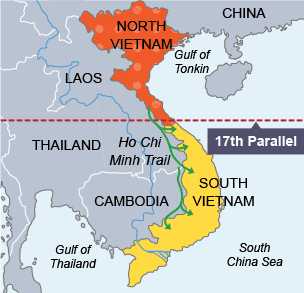
121.
In the 1950s, the United States became involved in the Vietnam War. Why did the United States become involved in this war?
a)
to prevent the collapse of the government of North Vietnam
b)
to stop Vietnam from taking over Hong Kong
c)
to stop the spread of communism to South Vietnam
d)
to prevent attacks against United States shipping
122.
How did the US respond to finding out that the Soviets had missiles in Cuba?
a)
They sent the Air Force to bomb Cuba
b)
They began placing missiles in the Soviet Union.
c)
They placed a naval blockade around Cuba.
d)
They invaded Cuba and the Soviet Union.
123.
Who were the two participants in the Space Race?
a)
The US and Cuba
b)
China and US
c)
The USSR and US
d)
US and North Vietnam
124.
Who was the leader of Russia when the phrase "Iron Curtain" was phrased?
a)
President Roosevelt
b)
President Truman
c)
Joseph Stalin
d)
Joseph McCarthy
125.
What is the purpose of N.A.T.O?
a)
Countries joining together to end democracy
b)
Countries joining together to stop trade between the East and West
c)
Countries joining together to fend off attacks by other communist countries
d)
Countries joining together to create one kind of currency (S)
126.
Which country was the aggressor that started the Korean War?
a)
North Korea
b)
South Korea
c)
Neither - they were forced into war by Germany
d)
Japan
127.
What type of race was the U.S. involved in with Russia in the 1950's?
a)
Naval
b)
Arms
c)
Foreign Aid
d)
Land expansion
128.
What symbolizes the end of the Cold War?
a)
U.S. President Bush worked toward easing tensions
b)
The Soviet Union broke up into 15 independent republics
c)
People in Easter Europe were gaining more freedom
d)
The Berlin Wall was built
129.
Who was the first man to set foot on the moon?
a)
Louis Armstrong
b)
Neil Armstrong
c)
Yuri Gagarin
d)
Charles Lindbergh
130.
The purpose of "containment" was to--
a)
stop the spread of democracy
b)
stop the spread of hate
c)
stop global warming
d)
stop the spread of communism
131.
In this economic system, the government owns all property and means of production.
a)
communism
b)
capitalism
c)
socialism
d)
democracy
132.
Which foreign policy promised to aid countries resisting Communist takeover?
a)
Marshall Plan
b)
Iron Curtain
c)
Truman Doctrine
d)
Massive Retaliation
133.
Which of the following foreign policies gave financial aid to European nations to rebuild after WWII?
a)
Truman Doctrine
b)
Marshall Plan
c)
Warsaw Pact
d)
Domino Theory
134.
Which foreign policy aimed at preventing Communism from spreading?
a)
Containment
b)
NATO
c)
Cuban Missile Crisis
d)
Berlin Airlift
135.
The physical barrier separating Communist East Berlin and Democratic West Berlin--
a)
Berlin Bloackade
b)
Berlin Base
c)
Berlin Wall
d)
Berlin Barrier
136.
The ideology that if one country in Southeast Asia fell to Communism, others would follow--
a)
Domino Theory
b)
Berlin Arilift
c)
Eisenhower Doctrine
d)
Warsaw Pact
137.
The organization whose members agreed to mutually defend other Communist nations is called--
a)
Korean Pact
b)
Warsaw Pact
c)
NATO
d)
Satellite Nations
138.
The Space Race, Arms Race and McCarthyism are characteristics of which era?
a)
Conservative 1980s
b)
Roaring 20s
c)
Cold War
d)
World War II
139.
Which of the following was a failed invasion by the United States under Kennedy in an attempt to overthrow Fidel Castro?
a)
Invasion of Moscow
b)
Cuban Missile Crisis
c)
Bay of Pigs Invasion
d)
Korean Invasion
140.
During the Cold War, the fear of Communism infiltrating the US and McCarthyism both contributed to the--
a)
Red Fever
b)
Domino Theory
c)
Red Scare
d)
Red Army
141.
The United States got involved in conflicts like Korea and Vietnam because they were afraid of the domino theory. What is the domino theory?
a)
If one country fell to democracy, others would follow
b)
If one country fell to communism, others would follow
142.
What was the main reason for the construction of the Berlin Wall?
a)
To embarrass America
b)
To stop East Germans from fleeing to West Germany
c)
To reduce cold war tensions
d)
To demonstrate the success of Communism
143.
Fidel Castro was the leader of which country?
a)
Sweden
b)
Hungary
c)
Cuba
d)
Czechoslavakia
144.

Who was the leader of North Vietnam during the war?

a)

Ho Chi Minh

b)

Ngo Dinh Diem

c)

William C. Westmoreland

d)

Bien Denh Phu

145.
The U.S. got involved in Vietnam because of what foreign policy?
a)
containment
b)
Good Neighbor policy
c)
isolationism
d)
Roosevelt Corollary