
 Worksheets
NC Final Exam Review 1
Total questions: 91
Worksheet time: 1hrs 8mins
Name
Class
Date
1.
Pitch is determined by _____________ which is measured in ______________.
a)
amplitude, hertz
b)
frequency, decibels
c)
amplitude, decibels
d)
frequency, hertz
2.
Why do we see fireworks before we hear the sound of them?
a)
Because light travels faster than sound
b)
Because sound travels faster than light
c)
Because the sound of the fireworks traveled farther than the light
d)
Because the sound of the fireworks originated a few seconds after the light
3.
Sound waves move slowest through _______________.
a)
Solid
b)
Liquid
c)
Gas
d)
Empty Space (Vacuum)
4.
What part of the ear sends signals to the brain?
a)
eardrum
b)
ear canal
c)
auditory nerve
d)
cochlea
5.
Sound waves move fastest through a __________.
a)
Solid
b)
Liquid
c)
Gas
d)
Empty Space (Vacuum)
6.
What parts make up the outer ear?
a)
eardrum, hammer, anvil, stirrup
b)
cochlea and auditory nerve
c)
pinna and ear canal
7.
How do vocal chords create sound?
a)
light
b)
refraction
c)
reflection
d)
vibrations
8.
What parts make up the middle ear?
a)
pinna and ear canal
b)
eardrum, hammer, anvil, stirrup
c)
cochlea and auditory nerve
9.
The human ear can receive sound waves as _____________ and convert them to signals that are processed by the ______________.
a)
signals, auditory nerve
b)
vibrations, auditory nerve
c)
signals, brain
d)
vibrations, brain
10.
What parts make up the inner ear?
a)
pinna and ear canal
b)
eardrum, hammer, anvil, stirrup
c)
cochlea and auditory nerve
11.
Loudness is determined by ________________ and is measured in ________________.
a)
amplitude, decibels
b)
amplitude, hertz
c)
frequency, decibels
d)
frequency, hertz
12.
Why does sound move fastest through solids?
a)
Because particles are more compact (close together)
b)
Because particles are more spread apart
c)
Because particles are moving fast
d)
Because a solid has not particles
13.
Waves transmit _______________ and not _________________.
a)
matter, energy
b)
energy, matter
c)
sound, light
d)
light, sound
14.
A type of wave that moves up and down or back and forth at right angles is called a ________________ wave.
a)
transverse
b)
longitudinal
c)
compressional
d)
sound
15.
The height of the wave from resting line to crest or resting line to trough is called _________________.
a)
frequency
b)
wavelength
c)
amplitude
d)
wave
16.
What type of wave is a sound wave?
a)
Transverse
b)
Light
c)
Amplitude
d)
Longitudinal
17.
How often a wave occurs per second is called _________________.
a)
Amplitude
b)
Loudness
c)
Frequency
d)
Wavelength
18.
The distance from crest to crest or trough to trough is called _______________.
a)
Amplitude
b)
Wave
c)
Wavelength
d)
Frequency
19.
What is the part on a longitudinal wave that is very close together?
a)
Wave
b)
Compression
c)
Rarefaction
d)
Amplitude
20.
What is the part of a longitudinal wave that is spread apart?
a)
Wave
b)
Compression
c)
Rarefaction
d)
Amplitude
21.
What type of wave is a light wave?
a)
transverse
b)
longitudinal
c)
compressional
d)
seismic
22.
What is the only part of the electromagnetic spectrum that the human eye can see?
a)
Ultraviolet Light
b)
Visible Light
c)
Infrared Rays
d)
Microwave Rays
23.
The bending of waves as they move from one medium to another is called ___________.
a)
Reflection
b)
Refraction
c)
Compression
d)
Diffraction
24.
What part of the eye is directly behind the pupil?
a)
Cornea
b)
Lens
c)
Iris
d)
Retina
25.
What is the black hole where light enters the eye called?
a)
Iris
b)
Pupil
c)
Lens
d)
Cornea
26.
What is the clear outer covering of the eye?
a)
Sclera
b)
Lens
c)
Pupil
d)
Cornea
27.
What do we call the colored part of the eye?
a)
Sclera
b)
Cornea
c)
Iris
d)
Pupil
28.
Order how light travels through the eye.
a)
Cornea, Lens, Pupil, Retina
b)
Cornea, Retina, Pupil, Lens
c)
Cornea, Pupil, Lens, Retina, Optic Nerve
d)
Pupil, Lens, Retina, Cornea
29.
Which type of wave moves through the earth?
a)
light
b)
seismic
c)
ocean
d)
water
30.
What is a similarity between sound waves and light waves?
a)
They both can travel through space
b)
They both are described by their crests and troughs
c)
They both move at the same speed
d)
They both are measured by their wavelength
31.
If you have a small tuning fork, then what is the relationship between the pitch and rate of vibration?
a)
it has a high pitch and would vibrate fast
b)
it has a low pitch and would vibrate fast
c)
it has a high pitch and would vibrate slow
d)
it has a low pitch and would vibrate slow
32.
What will occur if a light wave enters a new medium and is refracted?
a)
it will change color
b)
it will change speed
c)
it will change frequency
d)
it will change amplitude
33.
Density, boiling point, melting point, and solubility are all types of _____________ properties.
a)
physical
b)
chemical
34.
When heat is added, a solid can become a liquid.
a)
True
b)
False
35.
When heated, the atoms in a substance:
a)
are destroyed
b)
become invisible
c)
move faster
d)
slow down
36.
Chemical changes:
a)
happen only in labs
b)
make atoms grow
c)
have irregular shapes
d)
are irreversible
37.
All atoms of the same ______________ have the same properties.
a)
mixture
b)
compound
c)
element
d)
solution
38.
Compared to gases, liquids are not easily compressed because particles of a liquid ____________________.
a)
are closer together
b)
are moving faster
c)
have a crystal structure
d)
are smaller and lighter
39.
Matter takes up both _____________________.
a)
space and temperature
b)
mass and space
c)
heat and temperature
d)
space and heat
40.
Solubility is a ___________ property
a)
Chemical
b)
Physical
41.
Flammability and Reactivity are ________________ properties.
a)
Chemical
b)
Physical
42.
Shape, Boiling Point, and Density are ______________ properties.
a)
Chemical
b)
Physical
43.
An example of a property of matter that can be observed without changing the identity of the matter is:
a)
oxidation
b)
rust
c)
combustibility
d)
solubility
44.
Mass is a __________ property.
a)
natural
b)
chemical
c)
physical
d)
irregular
45.
All living and non-living things are made up of a combination of _________________.
a)
liquids
b)
metals
c)
elements
d)
gases
46.
What is the most common solvent?
a)
air
b)
nitrogen
c)
water
d)
fire
47.
Most substances have properties that can be classified as either:
a)
Force or motion properties
b)
hot or cold properties
c)
physical or chemical properties
d)
stable or unstable properties
48.
All substances boil at the same temperature.
a)
True
b)
False
49.
All matter is composed of extremely small particles called __________, which are too small to be seen even with a classroom microscope.
a)
atoms
b)
elements
c)
gases
d)
liquids
50.
What is the mathematical formula for finding density?
a)
Density = mass x volume
b)
Density = mass / volume
c)
Density = mass x temperature
d)
Density = mass / temperature
51.
How does an increase in temperature affect solubility?
a)
It allows less solvent to dissolve in the solute.
b)
It increases the amount of solute needed to dissolve the solvent.
c)
It increases the amount of solute able to be dissolved into the solvent
d)
It does not affect solubility.
52.
Bending a wire is a ___________ change.
a)
chemical
b)
physical
53.
Melting a wax crayon is a ___________ change.
a)
chemical
b)
physical
54.
Burning wood is a _____________ change.
a)
chemical
b)
physical
55.
Breaking glass is a ___________ change.
a)
chemical
b)
physical
56.
A nail rusting is a ___________ change.
a)
chemical
b)
physical
57.
The substance that is being dissolved is called a ____________.
a)
solvent
b)
solute
c)
atom
d)
element
58.
The substance that does the dissolving is called a __________.
a)
solvent
b)
solute
c)
atom
d)
element
59.
Rubber gloves are an example of a(n) __________________.
a)
Conduction
b)
Convection
c)
Conductor
d)
Insulator
60.
A metal frying pan is an example of a(n) _______________________.
a)
Conduction
b)
Convection
c)
Conductor
d)
Insulator
61.
_________________ is heat that moves through a solid (needs to be touching)
a)
Conduction
b)
Convection
c)
Radiation
d)
Insulator
62.
_________________ is when heat is circulated through fluids such as air or water.
a)
Conduction
b)
Convection
c)
Radiation
d)
Insulator
63.
_________________ is heat that is moved or transferred between two objects that are not touching (Transmitted by electromagnetic waves).
a)
Conduction
b)
Convection
c)
Radiation
d)
Insulator
64.
When a warmer object is in direct contact with a cooler one it is called ______________.
a)
Thermal Energy Transfer
b)
Mechanical Energy Transfer
c)
Electrical Energy Transfer
d)
Electromagnetic Waves
65.
When objects pull or push each other it is called ___________________.
a)
Thermal Energy Transfer
b)
Mechanical Energy Transfer
c)
Electrical Energy Transfer
d)
Electromagnetic Waves
66.
When an electrical source such as a battery or a generator is connected in a complete circuit to an electrical device it is called _______________.
a)
Thermal Energy Transfer
b)
Mechanical Energy Transfer
c)
Electrical Energy Transfer
d)
Electromagnetic Waves
67.
_______________ can transmit energy through matter or empty space via radiation.
a)
Thermal Energy Transfer
b)
Mechanical Energy Transfer
c)
Electrical Energy Transfer
d)
Electromagnetic Waves
68.
The _______________ determines the colors of visible light.
a)
Amplitude
b)
Wavelength
c)
Speed
d)
Light
69.
Which type of electromagnetic wave can be seen through thermal imaging cameras?
a)
Radiation
b)
Infrared
c)
Ultraviolet
d)
Visible Light
70.
Which type of radiation can be seen by the human eye?
a)
Infrared
b)
Ultraviolet
c)
Visible Light
d)
Gamma
71.
Which of the following will NOT increase an object's temperature:
a)
Increase the intensity of light shining on it
b)
Increasing the length of time
c)
The amount of light reflected
d)
Amount of light absorbed
72.
When you hold an ice cube, your hand feels cold because
a)
The cold flows from the ice cube to your hand by conduction.
b)
Heat flows from your hand to the ice cube by conduction.
c)
Ice is a poor conductor of heat.
d)
Your hand is a better conductor of heat.
73.
Thermal energy is transferred through a material by the collision of _______________ within the material.
a)
Matter
b)
Atoms
c)
Crystals
d)
Light
74.
What is the primary way energy is transferred when an object is plugged into a wall?
a)
Electrically
b)
Thermally
c)
Electromagnetically
d)
Mechanically
75.
What kind of energy does a moving baseball have?
a)
Electrical
b)
Mechanical
c)
Thermal
d)
Magnetic
76.
Which material is the best conductor of electricity?
a)
Wood
b)
Steel
c)
Stone
d)
Plastic
77.
Energy of motion is which type of energy?
a)
Potential
b)
Kinetic
c)
Sound
d)
Gravitational
78.

What kind of energy is represented in this picture?
a)
Thermal
b)
Potential
c)
Nuclear
d)
Mechanical
79.
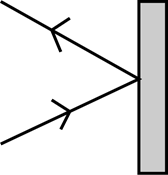
The illustration shows a light ray striking an object.
In the illustration, the light ray striking the object is-
In the illustration, the light ray striking the object is-
a)
absorbed
b)
stopped
c)
reflected
d)
refracted
80.

A student placed a pencil in a cup of water. The pencil appears broken because light-
a)
always travels in a straight line
b)
bends when it passes through water
c)
makes the water in the glass evaporate
d)
reflects the pencil on the water's surface
81.
Which of the following is an example of convection?
a)
A hair dryer is drying up your hair.
b)
When the AC or heater changes the temperature.
c)
When a car engine turns hot after being turned on.
d)
When you are making soup and the water is rising and lowering.
82.
What heat transfer happens when you burn your hand by touching a fire?
a)
Radiation
b)
Conduction
c)
Convectio
d)
I don't know!!!!!!!!!!!
83.
Which of the following is needed for convection to happen?
a)
Fluid/s
b)
Light in the form or rays
c)
Electromagnetic waves
d)
Fire
84.
When a pot is touching a stove that is on, what heat transfer is happening?
a)
I don't know??????
b)
Radiation
c)
Conduction
d)
Convection
85.

The way the heat is moving from the hot coffee is called...
a)
convection
b)
radiation
c)
insulation
d)
conduction
86.
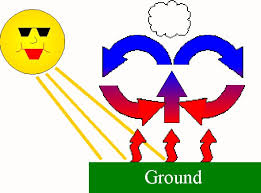
Warm air rises and the cool air sinks demonstrates this type of heat transfer.
a)
conduction
b)
convection
c)
radiation
d)
Insolation
87.

The baby chickens are kept warm from the heat lamps demonstrates this type of heat transfer.
a)
conduction
b)
convection
c)
radiation
88.
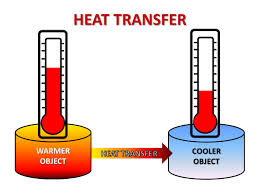
Heat transfers from an area of ____temperature to an area of ___ temperature.
a)
high to low
b)
low to high
c)
high to high
d)
It can travel high to low and low to high.
89.
Warm air is __________ dense than cold air and rises creating convection currents.
a)
more
b)
less
90.
In heat transfer, heat always flows from the _______________ substance to the _______________ substance.
a)
Hotter to colder
b)
Colder to hotter
c)
Hotter to hotter
d)
Colder to colder
91.
Students in a science class performed an experiment with hot and cold water. They dyed the hot water red and the cold water blue. When the students layered the water, they noticed that the hot water rose to the top and the cold water sank. What was this demonstrating?
a)
Radiation
b)
Air Pressure
c)
Evaporation
d)
Density
100 %

