wayground logo

Free Printable Worksheets

Font size

S
M
L
XL
Worksheets

6th grade science review

Total questions: 86

Worksheet time: 1hrs 28mins

Name
Class
Date
1.

Which form of matter has a definite shape and takes up space (has definite volume)?

a)

liquid

b)

solid

c)

gas

d)

clay

2.
Which form of matter take the shape of a container like this juice?
a)
liquid
b)
solid
c)
glass
d)
gas
3.
Which form of matter fills the space like it has in the balloon?
a)
liquid
b)
string
c)
solid
d)
gas
4.
The molecules in the picture are tightly held together with little movement. They have shape and energy.  Therefore, the picture represents _________.
a)
solid
b)
liquid
c)
gas
d)
plasma
5.
Molecules move quickest in which state of matter
a)
solid
b)
liquid
c)
gas
d)
solid, liquid and gas
6.
When the temperature of matter decreases the particles ...
a)
speed up and move farther apart
b)
speed up and move closer together
c)
slow down and move farther apart
d)
slow down and move closer together
7.
When the temperature of matter increases the particles...
a)
speed up and move closer
b)
speed up and move farther apart
c)
slow down and move closer together
d)
slow down and move farther apart
8.
Molecules are closest together in a 
a)
Solid
b)
Liquid
c)
Gas
d)
plasma
9.
If the tops were removed from the cylinders, the following would happen:
a)
The solid would fly out of the container
b)
The liquid would fly out of the container.
c)
The gas would fly out of the container.
d)
They ALL would fly out of the container.
10.
Boiling water was placed in containers made of three different materials.  How could you tell which material was the best insulator?
a)
the one that got cold quicker
b)
the one that stayed warm longer
c)
there is no way to tell
d)
the one that conducts electricity
11.
To find the mass of an object, what tool would you use?
a)
triple beam balance
b)
beaker of water
c)
graduated cylinder
12.
Two objects are placed in water.  One sinks and the other floats.  Which conclusion can be drawn from this data?
a)
one object is magnetic and the other is not
b)
one object is solid and the other is a liquid
c)
one object has a greater density than the other
d)
one object is much larger than the other
13.
A metal spoon was left in a pot of boiling soup.  The cook burned a finger by touching the spoon.  Why did the finger get burned?
a)
The metal spoon chemically reacted with the cook's hand
b)
the metal spoon conducted electricity to the cook's hand
c)
the metal spoon conducted heat to the cook's hand
14.
The thinnest layer of the Earth is the ___________.
a)
mantle
b)
crust
c)
core
15.
Which layer(s) of the Earth make up the asthenosphere?
a)
Part of the mantle
b)
Crust, mantle, Core
c)
Crust and upper mantle
d)
Only the crust
16.
What is the correct order (starting from the surface) of Earth's layers?
a)
crust, outer core, inner core, mantle
b)
mantle, outer core, inner core, crust
c)
crust, mantle, outer core, inner core
d)
outer core, inner core, crust, mantle
17.
What layer is a semisolid and acts like a plastic?
a)
Lithosphere
b)
Mantle
c)
Asthenosphere
d)
crust
18.
Which type of plate boundary would cause mountains to form
a)
Transform
b)
Convergent
c)
Divergent
d)
Reform
19.
California, Japan, Chile, Nepal, and India have all experienced earthquakes before. What type of plate boundary must be near
a)
Reform
b)
Divergent
c)
Convergent
d)
Transform
20.
Scientists think that convection currents that move the plates flow in Earth's
a)
Continental crust
b)
oceanic crust
c)
Asthenosphere
d)
Lithosphere
21.
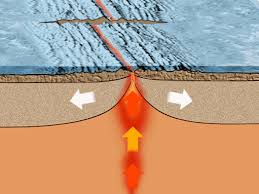
Where does molten material from the mantle rise up during the process of sea-floor spreading?
a)
Along the mid-ocean ridge
b)
At the north and south poles 
c)
Along the edges of all the continents near the shoreline and beaches
d)
at the equator
23.
What is the driving force to plate tectonics occurring when warm magma rises and cooler magma sinks? 
a)
An oceanic current
b)
A conventional current
c)
A convection current
d)
A magnetic current
23.
What is the driving force to plate tectonics occurring when warm magma rises and cooler magma sinks? 
a)
An oceanic current
b)
A conventional current
c)
A convection current
d)
A magnetic current
24.
Evidence to support continental drift included ______________.
a)
remains of human beings on a number of continents
b)
similar fossils found on different continents
c)
how the continents drifted
d)
written records
25.
_____________ came up with the theory of continental drift. 
a)
Alfred Einstein
b)
Alfred Wegener
c)
Harry Hess
d)
Barack Obama
26.
A break or crack in the Earth's crust is called a...
a)
plate
b)
fault
c)
fold
d)
crack
27.
What was the name given to all the continents when they were joined as one super continent
a)
Supreme Continent
b)
United States
c)
Bill Nye's World
d)
Pangea
28.

All the abiotic and biotic factors in an area make up a(n)

a)

habitat

b)

territory

c)

ecosystem

d)

community

29.

Water, sunlight, and soil are

a)

biotic factors

b)

needed for survival

c)

not needed for survival

d)

abiotic factors

30.

A lack of places to build nests is an example of _____________ as a limiting factor.

a)

territory

b)

location

c)

space

d)

habitat

31.

Thick fur on an organism is a(n) _________ that allows it to survive in a specific environment.

a)

niche

b)

behavior trait

c)

factor

d)

adaptation

32.

If an organism is living inside another and causing it harm, it is an example

a)

mutualism

b)

commensalism

c)

parasitism

33.

If two organisms benefit from a relationship, it is called

a)

mutualism

b)

commensalism

c)

parasitism

34.

If two organisms have a relationship in which only one benefits, it is an example of

a)

mutualism

b)

commensalism

c)

parasitism

35.

What are the abiotic factors in the picture?

a)

trees

b)

dirt

c)

animals

d)

fog

36.

The struggle between organisms to survive in a habitat with limited resources is called

a)

competition

b)

predation

c)

symbiosis

d)

parasitism

37.

Which of the following is an example of a population?

a)

rocks in a rock collection

b)

cats and dogs in a neighborhood

c)

bushes and grass in a forest

d)

gray wolves in a forest

38.

The largest population that an environment can support is called

a)

death rate

b)

birth rate

c)

carrying capacity

d)

limiting factor

39.

Mutualism, commensalism, and parasitism are examples of

a)

competition

b)

symbiotic relationships

c)

prey adaptations

d)

predation

40.

An organism's particular role or job is its

a)

ecosystem

b)

limiting factor

c)

niche

d)

adaptation

41.
Which organism do the owl and the weasel compete for in the food web?
a)
Hawk
b)
Spider
c)
Grasshopper
d)
Shrew
42.
Which of the following is a herbivore?
a)
cricket
b)
frog
c)
hawk
d)
shrew
43.
What might happen if you remove a primary consumer from the ecosystem?
a)
There would be more food for secondary consumers.
b)
The number of primary consumers would increase.
c)
The number of plants would increase.
d)
The number of secondary consumers would increase.
44.
Which of the following would be the most likely effect, if there were a sudden increase in the cricket population?
a)
There would be a decrease in the small bird population.
b)
There would be a decrease in the grass/flowers population.
c)
There would be a decrease in the mice population.
d)
There would be an increase in the grass/flowers population.
45.
A consumer that hunts is called:
a)
a producer.
b)
an omnivore.
c)
a predator.
d)
a herbivore.
46.
Which of the following best describes the small bird in the food web above?
a)
primary and secondary consumer
b)
secondary and tertiary consumer
c)
primary consumer only
d)
secondary consumer only
47.
A frog eats a fly. The frog and fly are demonstrating ________.
a)
mutualism
b)
competition
c)
predator/prey
d)
parasitism
48.
A tapeworm inside a dog is
a)
competition
b)
predation
c)
commensalism
d)
parasitism
49.
All of the living AND non-living things in an particular area is called a(n):
a)
ecosystem
b)
house
c)
community
d)
mountain
50.
Which of the following best describes the blue bird's (in the middle) role in this ecosystem?
a)
carnivore
b)
omnivore
c)
herbivore
d)
decomposer
51.
Which of the following best describes the wolf's role in this ecosystem?
a)
herbivore
b)
omnivore
c)
carnivore
d)
decomposer
52.
Which of the following best describes the deer's role in the ecosystem?
a)
herbivore
b)
omnivore
c)
carnivore
d)
decomposer
53.
Bacteria and fungi typically serve what role in an ecosystem?
a)
herbivore
b)
carnivore
c)
omnivore
d)
decomposer
54.
What is a producer?
a)
an organism that gets energy from eating other organisms
b)
an organisms that uses sunlight to make its own food
c)
an organism that gets energy from eating dead organisms, non-living material or waste
d)
an organism that uses chemical energy to make its own food
55.
An organism that gets energy from breaking down dead organisms, non-living material or waste is a(an) ___________.
a)
producer
b)
consumer
c)
decomposer
d)
autotroph
56.
An animal that gets energy from eating both plants and animals is a(an) _____________.
a)
herbivore
b)
carnivore
c)
omnivore
d)
autotroph
57.
A connection of food chains with many food energy paths in an ecosystem is a ____________.
a)
ecosystem
b)
food web
c)
environment
d)
population
58.
The shrew provides energy for the _______.
a)
cricket
b)
grasshopper
c)
frog
d)
snake
59.
What does a food chain represent?
a)
How all living organisms within a habitat are connected.
b)
All of the things that a particular animal eats.
c)
How plants create their own food.
d)
A single path of energy transfer within a habitat.
60.
Conduction is...
a)
The transfer of heat between two objects that are touching.
b)
Transfer of heat through electromagnetic waves.
c)
The transfer of heat through hot air rising and cooler air sinking.
61.
Radiation is....
a)
The transfer of heat between two objects that are touching.
b)
Transfer of heat through electromagnetic waves.
c)
The transfer of heat through hot air rising and cooler air sinking.
62.
Convection is...
a)
The transfer of heat between two objects that are touching.
b)
Transfer of heat through electromagnetic waves.
c)
The transfer of heat through hot air rising and cooler air sinking.
63.
We get __________ energy from the food we eat.
a)
Sound
b)
Mechanical
c)
Thermal
d)
Chemical
64.
Our most important energy resource is/are....
a)
Wind
b)
Sun
c)
Plants
d)
Fossil Fuels
65.
Which of the following is an example of an electromagnetic wave?
a)
Sound Waves
b)
Seismic Waves
c)
Oceanic Waves
d)
Light Waves
66.
Which of the following is not an insulator?
a)
Air
b)
Wood
c)
Copper
d)
Glass
67.
Electricity is produced in a hydroelectric plant when moving water turns a turbine.  Which describes this energy transformation from the turning turbine to electricity?
a)
Chemical energy to electric energy
b)
Thermal energy to electric energy
c)
Nuclear energy to electric energy
d)
Kinetic energy to electric energy
68.
Which of the following are the two types of circuits?
a)
Opened and closed
b)
On and off
c)
Charged and uncharged
d)
Series and parallel
69.
How are all parts of series circuit connected?
a)
In a single loop
b)
In a triple loop
c)
In a double loop
d)
In an open loop
70.
What do all loads in a series circuit share?
a)
The same voltage
b)
The same current
c)
The same wires
d)
The same resistance
71.
An example of a longitudinal wave is
a)
Seismic Wave
b)
Sound Wave
c)
light wave
d)
oceanic wave
72.
In which wave type do the particles move perpendicular to the movement of the wave?
a)
Transverse Wave
b)
Electromagnetic Wave
73.
What form of heat transfer is being shown in the picture?
a)
Radiation
b)
Conduction
c)
Convection
74.
What form of heat transfer is being shown in the picture?
a)
Radiation
b)
Conduction
c)
Convection
75.
A metal spoon that gets warm when used to stir hot soup is an example of:
a)
Conduction
b)
Convection
c)
Radiation
76.
This is a lava lamp. When the light bulb heats the wax, the wax rises. When the wax cools, it falls. This cycle of rising/falling is an example of:
a)
Conduction.
b)
Convection.
c)
Radiation.
77.
A girl’s hands become warm after holding a mug of hot coffee. What process explains this?
a)
Conduction
b)
Convection
c)
Radiation
78.
The Law of Conservation of Energy states;
a)
Energy can be created and destroyed but can be transferred and transformed.
b)
Energy can be created but not destroyed and cannot change.
c)
Energy can be made at any time.
d)
Energy can not be created or destroyed but can be transferred and transformed.
79.
A microwave is used to cook or warm food. Which statement best describes how energy is transformed in this process?
a)
Electrical to Light to Chemical
b)
Chemical to Thermal to Light
c)
Chemical to Electromagnetic to Thermal
d)
Chemical to Electromagnetic to Chemical
80.
A dryer is used to remove moisture from clothing.  This appliance dries clothes by converting energy from
a)
Mechanical to Heat and Electrical
b)
Electromagnetic to Heat
c)
Electrical to Heat and Mechanical
d)
Mechanical to Heat and Vaporiation
81.
At which point is potential energy greatest?
a)
W
b)
X
c)
Y
d)
Z
82.
__________ is stored energy. 
a)
Potential
b)
Kinetic
c)
None of the above 
d)
All of the above 
83.
__________ is stored energy. 
a)
Potential
b)
Kinetic
c)
None of the above 
d)
All of the above 
84.
The faster an object moves, the ________ kinetic energy it has. 
a)
more
b)
less
c)
none of the above
d)
same
85.
Which is the best example that something has kinetic energy?
a)
a. a car parked on a steep hill 
b)
b. a tennis ball rolling across the court
c)
c. a picture hanging on the wall 
d)
d. a piece of coal before it's burned 
86.
Energy can be _____________ or changed from one type to another.
a)
destroyed
b)
transferred
c)
created
d)
ignored