
 Worksheets
Cellular Reproduction
Total questions: 86
Worksheet time: 1hrs 7mins
Which of the following is NOT a characteristics of a hypothesis?
Must be made with background knowledge
Must be testable
Must organizes the IV and DV
Must always be correct
What is the first step in the scientific method?
draw conclusions
ask a question/make an observation
make a hypothesis
test the experiment
To make observations you use your _______.
senses
feet
smile
experience
Performing a test or experiment allows you to test your ___________.
draw conclusions
hypothesis
senses
battery
If you are testing the buoyancy of a cotton ball and you leave one plain, cover one half in oil, and cover the third in oil completely then place each in water, what is the independent variable?
water
cotton ball
amount of oil
time
You take a sample of onion root tips. You found that 89 cells were in interphase and 11 cells were in mitosis. What percentage of your cells are in interphase?
89
11
100
111

The diagram shows cells in the tip of an onion root that are in various stages of the cell cycle. Which stage of the cell cycle is labeled Stage Y?
Anaphase
Interphase
Metaphase
Prophase

The image shows a cell in one of the stages of mitosis. Which of the following statements correctly describes the stage of mitosis shown in the image?
The phase shown is anaphase because the copies of each chromosome are separating.
The phase shown is metaphase because the chromosomes are moving toward the center of the cell.
The phase shown is interphase because the chromosomes are duplicating their genetic information.
The phase shown is prophase because the copies of each chromosome are preparing to divide into two daughter cells.
Which of the following statements correctly describes cytokinesis?
Cytokinesis is the stage of the cell cycle when the cytoplasm of the cell divides, resulting in two daughter cells and takes place at the end of mitosis.
Cytokinesis is the stage of the cycle when the genetic information is replicated, resulting in two daughter cells and takes place after mitosis.
Cytokinesis is the stage of the cell cycle when the cytoplasm of the cell divides, resulting in two daughter cells and takes place in the beginning of mitosis.
Cytokinesis is the stage of the cycle when the genetic information is replicated, resulting in two daughter cells and takes place during mitosis.
Which of the following best describes the difference between meiosis I and meiosis II?
Meiosis I is responsible for creating four genetically unique cells and meiosis II is responsible for creating four cells that are genetically different from the parent cell.
Meiosis I is responsible for creating four genetically unique cells and meiosis II is responsible for creating two cells that are genetically different from the parent cell.
Meiosis I is responsible for creating two cells that are genetically different from the parent cell and meiosis II is responsible for creating four cells that are genetically identical to the parent cell.
Meiosis I is responsible for creating two cells that are genetically different from the parent cell and meiosis II is responsible for creating four genetically unique cells.
During which phase of meiosis are sister chromatids separated and pulled to opposite sides of the cell?
telophase of meiosis I
prophase of meiosis II
anaphase of meiosis II
metaphase of meiosis I
Which stage in the cell cycle occurs only once in both mitosis and meiosis?
Cytokinesis
Interphase
Prophase
Telophase
Chromatin condenses to form discrete, visible chromosomes –
Early in G1
During S
During telophase
During prophase
Which of the following phase of the cell cycle is not a part of interphase?
M
S
G1
G2
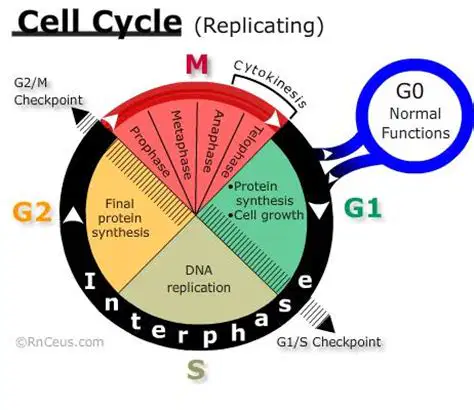
Which is otherwise called quiescent stage for neurons, muscle cells, and red blood cells?
G0
G2
G1
S-phase
Which one is the longest phase?
G1
G2
Interphase
Prophase

Which phase of mitosis is represented in the diagram?
prophase
anaphase
metaphase
telophase

The graphic shows the processes involved in the cell cycle. The cell cycle is necessary for new cells to replace damaged or dead cells. In which part of the cycle are new cells formed?
Growth
DNA synthesis
Preparation for division
Mitosis
Which best explains why DNA replication in the human body is significant?
it is needed for cell division
it is necessary for protein synthesis
it replaces any damaged DNA cells
it produces RNA strands

What happens in interphase (choose 2)
Cell grows and developes
DNA lines up in middle
DNA pulls apart
DNA replicates
What happens in Prophase (choose 3)
DNA condenses (packs up)
Spindle fibers appear
Daughter cells separate
DNA lines up in middle
Nuclear envelope (membrane) dissolves
What happens in anaphase? (choose 1)
DNA replicates
Chromatids pull apart to opposite sides
DNA lines up in middle
Cell divides
What happens in cytokinesis? (choose 1)
Daughter cells separate completely as cytoplasm is split into two
Nuclear envelope dissolves
DNA separates apart to opposite sides of the cell
DNA replicates


Why must DNA replication have to occur before a cell can divide by mitosis?
a. So the two new cells have the same amount of chromosomes as the parent cell
to cause one of the cells produced to have a double the number of chromoomes as the parent cell
to allow crossing over to occur in each of the cells produced
to cause all of the cells produced to have half the number of chromosomes as the parent cell
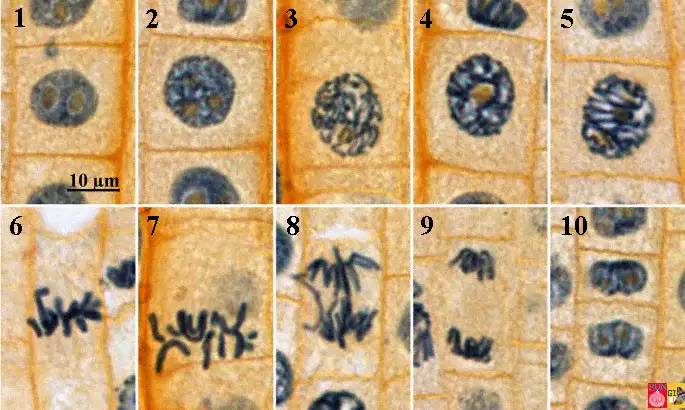
What phase of mitosis is the onion root cell number six in? (click the picture to zoom in)
Prophase
Metaphase
Anaphase
Telophase
Which of these explain why cells do cell division?
Growth
Repair
Asexual Reproduction
ALL of these are correct
While in the womb, the webbed fingers of the embryo undergo programmed cell death, also known as
cytokinesis
apoptosis
interphase
DNA replication
One difference between a cancel cell and a normal cell is that
Cancer cells divide uncontrollably
Cancer cells cannot make copies of DNA
Normal cells divide uncontrollably
Normal cells cannot make copies of DNA
Which of the following shows the correct sequence of the cell cycle?
C-> M-> G1 -> S -> G2
S-> G1 -> G2 -> M -> C
G1 -> S -> G2 -> M -> C
G1-> G2-> M-> S-> C
Which is NOT a phase in interphase?
G1
G2
G3
S
WHAT DOES MEIOSIS CREATE?
CHROMOSOMES
GAMETES
DNA
TRAITS
THE END RESULT OF MEIOSIS IS...
FOUR UNIDENTICAL GAMETES
FOUR IDENTICAL GAMETES
TWO IDENTICAL GAMETES
TWO UNIDENTICAL GAMETES
THE GAMETES ARE CONSIDERED TO HAVE ONE HALF OF THE GENETIC INFO SO IT IS CALL
DIPLOID (2N)
DIPLOID (N)
HAPLOID (2N)
HAPLOID (N)
MALE GAMETE IS KNOWN AS
EGG
SPERM
A FEMALE GAMETE IS KNOWN AS
EGG
SPERM
HOW MANY CHROMOSOMES DO HUMAN GAMETES HAVE?
46
23
47
22
CROSSING OVER ALLOWS FOR WHAT TO HAPPEN?
ALL CELLS TO STAY THE SAME
GENETIC VARIATION
REDUCTION OF CHROMOSOMES
CHROMOSOME NUMBER TO INCREASE
WHEN THE SPERM FERTILIZES THE EGG WHAT IS FORMED
ZYGOTE
EMBRYO
FETUS
FERTILIZATION
FERTILZATION IS ...
THE FUSION OF A HAPLOID EGG AND SPERM
THE FUSION OF A DIPLOID EGG AND SPERM
THE FUSION OF A HAPLOID EGG AND DIPLOID SPERM
THE FUSION OF TWO EGGS
WHY ARE THE CHROMOSOMES EVEN NUMBERED FOR ORGANISIMS?
JUST A COINCIDENCE
BECAUSE 75% OF THE INFO COMES FROM MOM AND 25% COMES FROM DAD
BECAUSE 51% OF THE INFO COMES FROM MOM AND 49% COMES FROM DAD
BECAUSE HALF OF THE GENTIC INFORMATION COMES FROM MOM AND HALF COMES FROM DAD

Name this phase of Meiosis
Anaphase II
Anaphase I
Metaphase I
Metaphase II

Name this phase of Meiosis:
Telophase I
Prophase II
Telophase II
Anaphase II

Name this phase of Meiosis:
Metaphase I
Anaphase I
Prophase II
Telophase I

Match the following for mitosis and meiosis.
PMAT happens once or twice
Mitosis & Meiosis
makes 4 genetically different cells
Meiosis
Sister Chromatids (already crossed over) pull apart
Anaphase 2 of Meiosis
Homologous Chromosomes pulled apart & Independent assortment
Anaphase 1 of Meiosis
makes 2 identical cells
Mitosis
Which part of MEIOSIS is more similar to MITOSIS?
Meiosis I
Meiosis II
Meiosis is the process wherein a somatic cell produces gametes.
True
False
A sister chromatid is attached to a centromere.
True
False
Meiosis I comes after Interphase.
True
False
What is cancer?
Regulated meiosis
Uncontrolled meiosis
Regulated Mitosis
Uncontrolled Mitosis
Which of the following cells would chemotherapy target?
hair follicle cells
muscle cells
skin cells
egg cells
Which of the following is an environmental factors that may lead to cancer?
smoking
viruses
toxins
all of the above
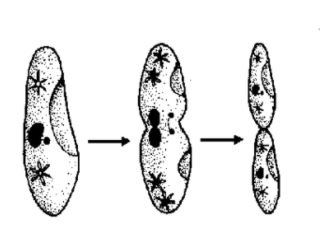
What type of asexual reproduction is illustrated in the diagram?
binary fission
budding
sporulation
regeneration
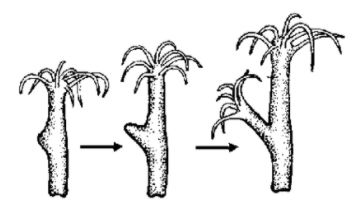
What type of asexual reproduction is illustrated in the diagram?
binary fission
budding
sporulation
regeneration
Asexual reproduction has
1 parent
2 parents
Which results in offspring that are genetically unique and display a combination of traits from each parent?
Sexual
Asexual
Neither
Both
Which type of reproduction tends to be a longer process?
Sexual
Asexual
They occur at the same rate
Both are slow processes
What is one difference between asexual and sexual reproduction?
Asexual (offspring different from parent)
Sexual (offspirng identical to parent)
Asexual (Slow reproduction)
Sexual (Fast reproduction)
Asexual (offspring no variation)
Sexual (offspring variation)
Asexual (more complicated)
Sexual (less complicated)
Why are you not genetically identical to your mom?
You get all your genes from her
You grew and developed in her
You dad has strong genes
You get half DNA from mom and half DNA from dad

Sexual, Asexual, or Both?
Sexual
Asexual
Both
Neither

What type of asexual reproduction is it?
budding
regeneration
sporulation
binary fission
A bee flies from one apple blossom to another and transfers pollen as it goes. Which type results from pollination?
Sexual
Asexual
Neither
Both
There are _____ main types of reproduction
2
3
4
5
Cells that make up the body
sperm
egg
gametes
somatic

Spider plants, like the one shown, produce new plants at the ends of stems that grow from buds on the parent plant. Which of the following describes the process by which the new plants form?
asexual reproduction by meiosis
asexual reproduction by mitosis
sexual reproduction by meiosis
sexual reproduction by mitosis

Jeannie was studying heredity and drew the illustration shown. What is Jeannie showing with the dark lines inside each cell?
the nucleus
the organelles
the chromosomes
the cell membrane

The table describes two types of cell division. Which correctly identifies the type of cell division in Rows 1 and 2?
Row 1: meiosis, Row 2: mitosis
Row 1: mitosis, Row 2: mitosis
Row 1: meiosis, Row 2: meiosis
Row 1: mitosis, Row 2: meiosis

Which statements are TRUE (more than one answer is correct!)
Different species have different chromosome numbers
The cells of larger organisms have more DNA than the cells of smaller organisms
Within a species, individuals will have the same chromosome number but have different genes
Offspring can inherit chromosomes from relatives other than the parent (s)
Meiosis consists of ___ divisions.
1
2
3
4
There are 38 chromosomes in the body cells of cats. The egg cells of a female cat would contain ___ chromosomes.
19
76
38
4

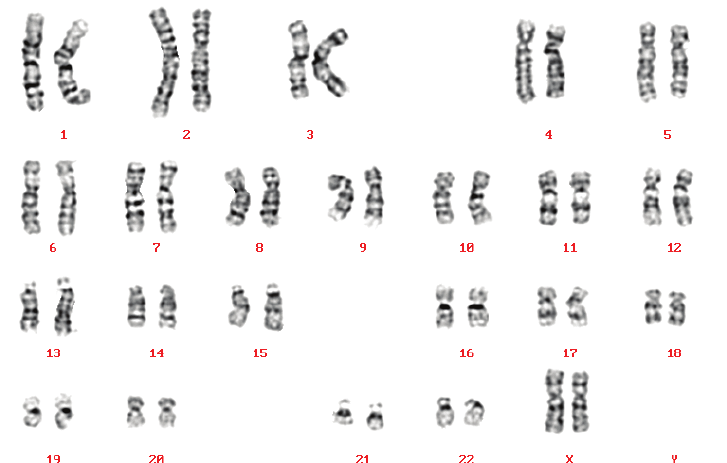
By looking at the chromosomes how can you tell that this person is biologically female?
Because there are two X chromosomes
Because there are more chromosomes than in a male
Two processes that happen during meiosis that increase genetic variation are...
asexual reproduction
crossing over
independent assortment
karyotyping
A structure that consists of a DNA molecule tightly wrapped around packaging proteins.
chromosome
ribosome
mRNA
codon
(a) chromosomes are a pair of chromosomes that are similar in length as well as gene and centromere position.
(a) is a phase in a cell’s life cycle where it grows, replicates DNA, and prepares for cell division.
Female cells that undergo meiosis produce 3 (a) and gametes called egg cells or (b) .

