
 Worksheets
OT-ECOLOGY
Total questions: 81
Worksheet time: 59mins
Name
Class
Date
1.
If the number of births in a population is the same as the number of deaths in a population, what will happen to the growth of the population?
a)
It will increase.
b)
It will decrease.
c)
It will stay the same.
d)
It will fluctuate.
2.
If the number of births is greater than the number of deaths in a population, what will happen to the growth of the population?
a)
It will increase.
b)
It will decrease.
c)
It will stay the same.
d)
It will fluctuate.
3.
What growth pattern describes a population whose growth rate slows or stops following a period of exponential growth?
a)
logistic growth
b)
population growth
c)
exponential growth
d)
predator-prey cycle
4.
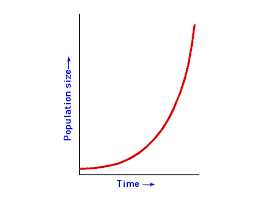
What type of growth is shown in the diagram?
a)
exponential growth
b)
logistic growth
c)
predator-prey cycle
d)
boom-bust curve
5.
Largest number of individuals of a population that the environment can support...
a)
carrying capacity
b)
population crash
c)
lag phase
d)
mutualism
6.

Which type of growth is best illustrated by this rabbit population?
a)
exponential
b)
logistic
c)
S-shaped
d)
predator-prey
7.
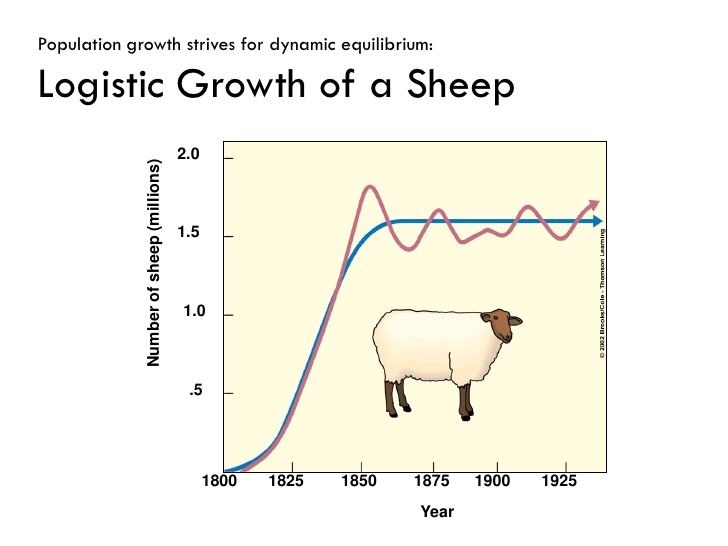
What is the carrying capacity for this sheep population?
a)
1.8 million
b)
1.25 million
c)
1.6 million
d)
1.o million
8.

What point on the graph represents the carrying capacity?
a)
A
b)
B
c)
C
d)
D
9.
Food, water, sunlight, shelter, and space are resources that are often __________.
a)
limiting factors
b)
wet
c)
messy
d)
found in rocks
10.
If there is more food than usual in an ecosystem, then the population will mostly likely...
a)
stay the same
b)
decrease
c)
increase
11.

In a forest ecosystem, which of the following is the best example of a limiting factor for a rabbit population?
a)
Squirrel Population
b)
Sunlight
c)
Grass available
12.

Will competition increase/decrease the carrying capacity of an ecosystem for the animal in competition?
a)
Decrease
b)
Increase
13.
Natural disasters can be considered limiting factors.
a)
true
b)
false
14.
Natural disasters and weather patterns like earthquakes, floods, and tornadoes, blizzards, and heatwaves are considered ___________ ____________ limiting factors
a)
Density-dependent
b)
Density-independent
15.
Competition, disease, predation, and parasitism are considered ___________ ____________ limiting factors
a)
Density-dependent
b)
Density-independent
16.
Density-dependent limiting factors have a(n) _______________ affect on populations depending on the density of the population.
a)
similar
b)
different
17.
Density-independent limiting factors have a(n) _______________ affect on populations regardless of population density.
a)
similar
b)
different
18.
Exponential growth is representative of a population in an environment with ________________ resources.
a)
limited
b)
plenty of
19.
Logistic growth is representative of a population in an environment with ________________ resources.
a)
limited
b)
plenty of
20.
What is the term for each step in the transfer of energy and matter within a biological community?
a)
energy path
b)
food web
c)
trophic level
d)
food pyramid
21.

What does a food web represent?
a)
All connections of energy flow throughout all organisms in a habitat.
b)
The specific ways that mutualism is carried out.
c)
A single pathway or energy flow between organisms.
d)
How carnivores get their food.
22.
The amount of energy that usually transfers from one trophic level to the next...
a)
10%
b)
20%
c)
80%
d)
50%
23.
A collection of organisms that make up a community as well as all of the nonliving aspects of the environment.
a)
Population
b)
Community
c)
Habitat
d)
Ecosystem
24.
An organism at the second trophic level would be considered a...
a)
Top carnivore
b)
Producer
c)
Herbivore
d)
Carnivore
25.

Different populations living and interacting with each other in the same area
a)
Biome
b)
Ecosystem
c)
Community
d)
Niche
26.

Which best describes what a food chain shows you?
a)
Energy flow through an ecosystem
b)
Food flowing through an ecosystem
c)
Consumers going into other consumers
d)
Who eats who
27.
Organisms that can capture energy from inorganic, nonliving sources.
a)
Producers
b)
Consumers
c)
Detritivores
d)
Carnivores
28.
Autotrophs make up the _______ level in all ecosystems.
a)
First
b)
Second
c)
Third
d)
Fourth
29.

Food, water, sunlight, shelter, and space are resources that are often __________.
a)
limiting factors
b)
not found in ecosystems
c)
non-limiting factors
d)
Biotic
30.

Natural disasters and weather patterns like earthquakes, floods, and tornadoes, blizzards, and heatwaves are considered ___________ ____________ limiting factors
a)
Density-dependent
b)
Density-independent
31.

Which statement is most accurate based on the graph?
a)
The zebra and lions do not affect each other
b)
when lions population increases, so does the zebra population
c)
When the zebra population increases, it causes the lion population to also increase
d)
when zebra populations go down, the zebra population goes up.
32.
number of organisms per certain area
a)
carrying capacity
b)
limiting factor
c)
total population
d)
population density
33.
Group of organisms of one species that interbreed and live in the same place at the same time
a)
population
b)
species
c)
community
d)
biome
34.
Which of the following is NOT a density-dependent limiting factor?
a)
flood
b)
disease
c)
predation
d)
competition
35.
When organisms move out of the population, this is known as
a)
emigration
b)
abandonment
c)
immigration
d)
succession
36.
All of the following are limiting factors EXCEPT
a)
immigration
b)
competition
c)
drought
d)
predation
37.
If a population grows larger than the carrying capacity of the environment, the
a)
death rate may rise
b)
birth rate may rise
c)
death rate must fall
d)
birth rate must fall
38.
Which of the following is NOT one of the factors that play a role in population growth rate?
a)
immigration
b)
death rate
c)
demography
d)
emigration
39.

What type of graph is this?
a)
exponential growth
b)
logistical growth
40.
Temperature, light, air, water, and soil are all _____ parts of the environment
a)
alive
b)
biotic
c)
abiotic
d)
living
41.
Is a deer an abiotic or biotic factor?
a)
abiotic
b)
biotic
42.
Is a fern an abiotic or biotic factor?
a)
abiotic
b)
biotic
43.
Is a weather an abiotic or biotic factor?
a)
abiotic
b)
biotic
44.
Is sunlight an abiotic or biotic factor?
a)
abiotic
b)
biotic
45.
A living or once-living organisms in an ecosystem is a
a)
population
b)
biotic factor
c)
abiotic factor
d)
community
46.
Which of the following is not an abiotic factor?
a)
sun
b)
temperature
c)
soil
d)
grass
47.
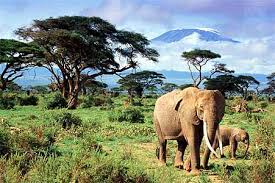
What are the biotic factors in this image?
a)
sunlight, elephants, and grasses
b)
sunlight, water, and air
c)
elephants, plants, trees
48.
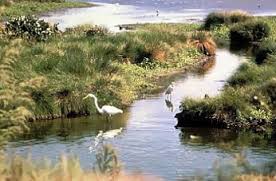
What are the abiotic factors in this image?
a)
water, sunlight, dirt, air
b)
birds and plants
c)
water, plants, and birds
49.
The study of relationships between biotic and abiotic factors interacting in the same area.
a)
Ecology
b)
Biology
c)
Zoology
d)
Botany
50.
Mushrooms often grow around dead plants such as decomposing trees. They break down these dead organisms and put energy that stores in the plant back into the ground for other plants to use. What type of consumer are mushrooms?
a)
decomposer
b)
herbivore
c)
carnivore
d)
omnivore
51.
Giraffes have long necks that help them reach leaves high up in trees. They get all the energy they need from plants such as this. What type of consumer are giraffes.
a)
decomposer
b)
herbivore
c)
omnivore
d)
carnivore
52.
Sharks are fish that eat many other types of fish as well as animals such as seals. What type of consumer are sharks?
a)
decomposer
b)
herbivore
c)
omnivore
d)
carnivore
53.
A monkey eats bamboo, small bugs, and vegetables such as lettuce. Which type of consumer is a monkey?
a)
decomposer
b)
herbivore
c)
omnivore
d)
carnivore
54.
Scientists found a fossil of an animal with flat teeth that were used for grinding plants, and sharp teeth that are used for tearing meat. What type of consumer does the fossil belong to?
a)
decomposer
b)
herbivore
c)
omnivore
d)
carnivore
55.
A producer?
a)
Eats other plants and animals
b)
Makes its own food
c)
Eats dead plants or animals
d)
Makes toys for kids
56.
Which type of organism creates its own food?
a)
Autotrophes
b)
Heterotrophs
57.
Which type of organism obtains the energy it needs by feeding on other organisms?
a)
Autotroph
b)
Heterotroph
58.
Which type of organism breaks down dead organisms and waste, returning important nutrients to the environment?
a)
Detritivore
b)
Herbivore
c)
Omnivore
d)
Carnivore
59.

In the food chain shown, the small fish are best classified as which of the following tropic levels?
a)
Primary Consumers
b)
Secondary Consumers
c)
Tertiary Consumers
d)
Quaternary Consumers
60.

Approximately what percentage of the chemical energy found in the population of phytoplankton is passed on the the krill population?
a)
1%
b)
10%
c)
25%
d)
100%
61.
Only a small portion of the energy available in the plant population is passed on to the primary consumers. What happens to most of the energy that is consumed by the primary consumers?
a)
It is eventually returned to the plant population.
b)
It is lost to the environment in the form of heat.
c)
It is used to convert carbon dioxide gas into sugars.
d)
It is converted back into its original form of solar energy.
62.
The diagram shows an energy pyramid for a wetland in Mississippi. Which conclusion is supported by this diagram?
a)
River otters are tertiary consumers and have the least energy available to them.
b)
Crayfish are secondary consumers and have the most energy available to them.
c)
Phytoplankton are primary consumers with the least energy available to them.
d)
Zooplankton are secondary consumers with the most energy available to them.
63.

Why does each trophic level shown in the energy pyramid above contain less energy than the previous trophic level?
a)
Individual animals are incapable of storing more energy than any single plant.
b)
Most of the energy consumed by a population is lost in the form of heat.
c)
Carbohydrate molecules lose energy as they travel from one organism to another.
d)
Animals that live around water do not need as much energy to survive.
64.

Which organism in the food chain shown would be considered a secondary consumer?
a)
Grass
b)
Gazelle
c)
Lion
d)
Bacteria
65.
Fly larva consume the flesh of dead birds. Because of this, they are best classified as which of the following?
a)
Omnivores
b)
Detritivores
c)
Herbivores
d)
Producers
66.

A food chain shows the transfer of ___ from one organism to another.
a)
matter
b)
consumers
c)
energy
d)
habitat
67.

Plants are the first organisms in EVERY food chain. Plants are known as the ___ because they can make their own food.
a)
consumers
b)
producers
c)
decomposers
d)
predators
68.

These organisms can not make their own food. Therefore, they must eat other living organisms.
a)
decomposers
b)
producers
c)
photosynthesis
d)
consumers
69.

In this food chain, what will happen if the frogs become extinct?
a)
The snakes will increase.
b)
The grasshoppers will decrease.
c)
The eagles will remain the same.
d)
The grasshoppers will increase.
70.

In the energy pyramid here, which organisms have the most energy available?
a)
Producers
b)
Carnivores
c)
Herbivores
d)
Top Predator
71.

In the energy pyramid below, which organism has the least amount of energy available?
a)
Producers
b)
Herbivores
c)
Carnivores
d)
Top Predator
72.

If there is 1000 Kcal available in the producers in trophic level 1, how much energy is available in the herbivores in trophic level 2?
a)
10 Kcal
b)
1 Kcal
c)
100 Kcal
d)
1000 Kcal
73.
All food webs and food chains begin with _________________.
a)
primary consumer
b)
producers
c)
secondary consumers
d)
predators
74.
Which of the following equations summarizes population growth?
a)
immigration - emigration
b)
(immigration + births) + (emigration + deaths)
c)
births - deaths
d)
(immigration + births) - (emigration + deaths)
75.

If all other factors were constant, what would make a population increase in size?
a)
An increase in natality
b)
An increase in mortality
c)
An increase in emigration
d)
A decrease in immigration
76.

Why do the bars in a pyramid of energy also get narrower moving up the trophic levels?
a)
Because there are fewer organisms in the higher trophic levels
b)
Because there is less biomass in the higher trophic levels
c)
Because energy is lost from every trophic level
d)
Because energy is gained at the beginning of the food chain
77.

What is indicated by the length of each bar in a pyramid of numbers?
a)
The population density
b)
The length of a food chain
c)
The number of trophic levels in the food chain
d)
The number of individuals in each trophic level
78.
What is indicated by the arrows in a food chain?
a)
The direction of the flow of matter
b)
The direction of the flow of energy
c)
The direction of the flow of energy and matter
d)
The food source for each organism
79.
Which combination below both add individuals to a population?
a)
Immigration & Mortality
b)
Natality & Emigration
c)
Natality & Immigration
d)
Natality & Mortality
80.
A manatee population experiences natality of 4, mortality of 3, immigration of 2 and emigration of 1. After 10 years, by how many individuals with this population have changed?
a)
20
b)
10
c)
100
d)
27
81.
Population A has a population density of 652 people per square mile. Population B has a population density of 17 people per square mile. Which population is at higher risk of a disease outbreak?
a)
A
b)
B
c)
Equal chances
d)
No way to know
100 %

