wayground logo

Free Printable Worksheets

Font size

S
M
L
XL
Worksheets

Physical Science Final Exam Review Part 1

Total questions: 108

Worksheet time: 2hrs 58mins

Name
Class
Date
1.
The correct equation to calculate speed is
a)
distance/time
b)
time/distance
c)
distance x time
d)
distance/time2
2.
How far will a person go if they jog for 2 hours at a speed of 12 km/hr?
a)
6 km
b)
0.5 km
c)
10 km
d)
24 km
3.
If a cheetah runs 180 miles in 3 hours, what is its average speed?
a)
60 hours
b)
60 miles
c)
60 miles/hour
d)
60 miles/second/second
4.
How long does it take to go 340 meters if you are travelling at 23 m/s?
a)
363 s
b)
.068 s
c)
7820 s
d)
14.78 s
5.

Which of the following shows the greatest resolution?

a)

0.0004

b)

0.04

c)

0.4

d)

4

6.
A ball of clay is thrown at a wall at a velocity of 28.0 m/s.  After it hits the wall, it takes 0.020 s to stop.  What is the acceleration of the clay when it hits the wall?
a)
1400 m/s2
b)
-1400 m/s2
c)
0.56 m/s2
d)
-0.56 m/s2
7.
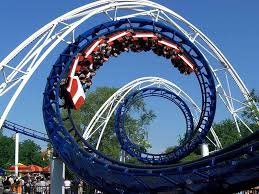
A roller coasters accelerates from an initial velocity of of 6.0 m/s to a final velocity of 70 m/s over 4 seconds.  What's the acceleration?
a)
24 m/s2
b)
18 m/s2
c)
16 m/s2
d)
16 m/s
8.
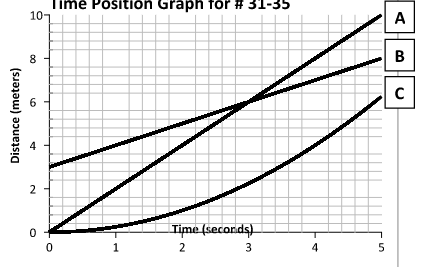
Which runner had a head start?
a)
A
b)
B
c)
C
9.
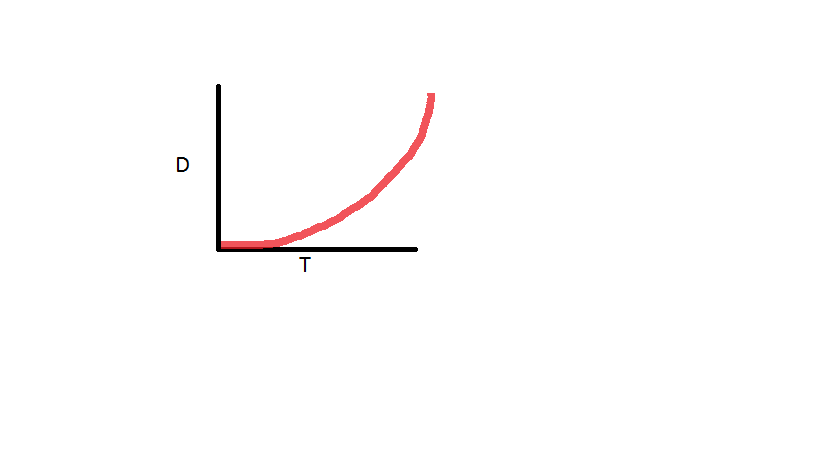
What is this graph showing?
a)
Constant Speed
b)
Acceleration (speeding up)
c)
Deceleration (slowing down)
d)
No motion
10.
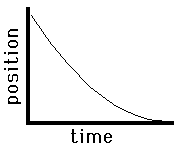
Describe the motion
a)
Slow to fast;   Negative direction
b)
Fast to slow;   Negative direction
c)
Fast to slow;   Positive direction
d)
Slow to fast;   Positive direction
11.
What is this object doing?
a)
speeding up
b)
slowing down
c)
not moving
d)
moving at a constant velocity
12.
What does this graph represent?
a)
Constant speed
b)
Acceleration
c)
Not moving
13.
What does this graph represent?
a)
Constant speed
b)
Acceleration
c)
Not moving
14.
Describe the speed of the object from 4-6 seconds using the distance vs. time graph.
a)
Increasing speed
b)
Decreasing speed
c)
Not moving
d)
Constant speed
15.
Which graph is would represent a decrease in speed?
a)
Graph A
b)
Graph B
c)
Graph C
d)
The object is not decreasing in speed in any of these graphs
16.
On a distance vs. time graph, the steeper the slope _____
a)
the slower the speed
b)
the faster the speed
c)
less acceleration
d)
greater acceleration
17.
In the distance vs. time graph, what type of motion does the line represent? 
a)
Speed
b)
Velocity
c)
Acceleration
d)
Deceleration
18.
The slope of a position vs. time graph is equal to:
a)
distance.
b)
speed.
c)
time.
d)
position.
19.
Which time section is the object moving the fastest?
a)
0-10 seconds
b)
10-20 seconds
c)
20-30 seconds
d)
30-40 seconds
20.
What is happening between 4 and 5 seconds?
a)
The object is slowing down in a negative direction.
b)
The object is slowing down in a positive direction.
c)
The object is slowing down in a negative direction.
d)
The object is speeding up in a negative direction.
21.
which line shows a negative acceleration ?
a)
A
b)
B and C
c)
D
d)
A, B, and 
A, B, and D
22.
During which interval is the object slowing down?
a)
A to B
b)
D to E
c)
E to F
d)
G to H
23.
What kind of acceleration is shown here?
a)
positive
b)
negative
c)
none
d)
varies
24.
What kind of acceleration is shown here?
a)
positive
b)
negative
c)
none
d)
varies
25.
What is the velocity?
a)
not moving
b)
increasing
c)
positive
d)
negative
26.
Velocity is 
a)
speed
b)
direction
c)
speed with a direction
27.
Acceleration of an object happens when things ________
a)
slow down
b)
go faster
c)
change direction (turn)
d)
All of the above
28.
On a graph, which axis shows the independent variable?
a)
x-axis
b)
y-axis
c)
neither
d)
it changes
29.
Total distance divided by total time is
a)
average speed
b)
constant speed
c)
instantaneous speed
d)
acceleration
30.

The speed you have at a specific point in your journey, measured with one photogate is called...

a)

average speed

b)

acceleration

c)

instantaneous speed

d)

slope

31.
Does the speedometer of a car read average speed or instantaneous speed?
a)
average speed
b)
instantaneous speed
32.
The slope of a speed vs. time graph tells you
a)
acceleration
b)
distance traveled
c)
velocity
d)
All of these
33.
the ratio of the rise (vertical change) to the run (horizontal change) of a line on a graph.
a)
origin
b)
slope
c)
Acceleration
d)
Position
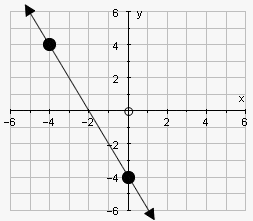
34.
Find the slope:
a)
2
b)
-2
c)
1/2
d)
-1/2
35.
Find the slope:
a)
3/4
b)
4/3
c)
-3/4
d)
-4/3
36.
The Law of Inertia
a)
Newton's
1st
Law of Motion
b)
Newton's
2nd
Law of Motion
c)
Newton's
3rd
Law of Motion
37.
F=ma
a)
Newton's
1st
Law of Motion
b)
Newton's
2nd
Law of Motion
c)
Newton's
3rd
Law of Motion
38.
For every action, there is an equal and opposite reaction.
a)
Newton's
1st
Law of Motion
b)
Newton's
2nd
Law of Motion
c)
Newton's
3rd
Law of Motion
39.
A ____________ is a push or a pull on an object.
a)
friction
b)
force
c)
magnet
d)
gravity
40.
the tendency of an object to resist a change in its motion
a)
acceleration
b)
inertia
c)
mass
d)
frame of reference
41.
If an object in mechanical equilibrium is stable, then it is without __________
a)
changes in motion
b)
rest or relaxation
c)
inconsistency
d)
the force being used by Darth Vadar
42.
Equilibrium means _________
a)
being at rest
b)
traveling at light speed
c)
balance
d)
pushing or pulling
43.
Gravity attracts all objects towards one another.
a)
False
b)
True
c)
It depends
44.
The force of gravity acting on an object is the object's ______.
a)
mass
b)
matter
c)
weight 
d)
friction 
45.
a force that opposes motion between any surfaces that are touching
a)
velocity
b)
friction
c)
inertia
d)
position
46.
What is the SI unit used to measure force? 
a)
pounds 
b)
grams 
c)
newtons 
d)
friction
47.
What unit does the United States use to measure force?
a)
Ounces
b)
Newtons
c)
Grams
d)
Pounds
48.
F = mass x ____
a)
force
b)
velocity
c)
acceleration
49.
given 20 N,  2 Kg, you can know a (acceleration) is 
a)
20N/2 kg=10N/kg
b)
20Nx2kg=40N/kg
c)
2kg/20N=0.1kg/N
d)
none of the above
50.
given 10 m/s2, 5 kg, and 50N, what is the mass
a)
50 N
b)
5 kg
c)
2 kg
d)
5 N/kg
51.
If an object mass =30 Kg on the Earth, what would be it's weight on Earth?
a)
30 N
b)
300 kg
c)
3000N
d)
300 N
52.

50 lbs is how many Newtons?

a)

222 N

b)

11 N

c)

490 N

d)

5 N

53.

The acceleration of objects falling on Earth due to gravity is

a)

9.8 m/s

b)

9.8 m/s2

c)

9.8 g/mL

d)

9.8 g/m/m

54.
What is the net force
a)
10 N
b)
0 N
c)
25 N
d)
1 N
55.
What is the net force?
a)
40 N left
b)
0 N Balalnced
c)
400 N right
d)
40 N right
56.
What is the net force?
a)
400 N Up
b)
400 N Down
c)
- 400 N Down
d)
800 N Down
57.
Which way is the force  moving?
a)
it's not , it is balanced or moving at a constant
b)
to the right
c)
to the bottom
d)
up
58.
True or false
You do work only when you exert a force on an object and move it
a)
true
b)
false
59.
Two factors that determine work are
a)
size of the force, and distance
b)
size of the force, and type of force
c)
mass, and distance
60.
The amount of work done in a certain amount of time is known as 
a)
work
b)
effort force
c)
resistance force 
d)
power
61.

What would 419W be a unit for?

a)

Force

b)

Power

c)

Work

d)

Time

62.
The unit used to measure work is the 
a)
Watt
b)
Newton
c)
Joule
d)
meter
63.
The unit used to measure power is the 
a)
Watt
b)
Newton
c)
Joule
d)
Newton*meter
64.
Energy causes ___________ to occur.
a)
change
b)
motion
c)
age
65.
the ability to do work
a)
energy
b)
Matter
c)
photons
d)
potential energy
66.
Energy due to motion is ____________ energy. 
a)
Potential 
b)
Energy
c)
Kinetic
d)
Friction
67.
The faster an object moves, the ________ kinetic energy it has. 
a)
more
b)
less
c)
none of the above
d)
all of the above 
68.
__________ is stored energy. 
a)
Potential
b)
Kinetic
c)
None of the above 
d)
All of the above 
69.
Gravitational potential energy depends on the ________ and ________ of the object. 
a)
Height and mass
b)
Friction and movement
c)
Mass and Movement
d)
Height and Friction 
70.
The Law of Conservation of Energy states:
a)
Energy can created or destroyed but not transformed 
b)
Energy cannot be created or destroyed, it can only transformed
c)
Energy can't be created, destroyed or transformed
71.
The world record for pole vaulting is 6.15 m. If the pole vaulter's gravitational potential is 4942 J, what is his mass? 
a)
82 kg
b)
7875 kg
c)
803 kg
d)
.0012 kg
72.
With an elevation of 5334m above sea level, the village of Aucanquilca, Chile is the highest inhabited town in the world.  What would be the gravitational potential energy associated with a 64kg person in Aucanquilca?
a)
3345484 J
b)
5407.8 J
c)
816.76 J
d)
72.31 J
73.
A cheetah can run briefly with a speed of 31m/s.  Suppose a cheetah with a mass of 47 kg runs at this speed.  What is the cheetah’s kinetic energy?
a)
22583.5 J
b)
728.5 J
c)
1457 J
d)
0.75 J
74.
At which point is potential energy greatest?
a)
W
b)
X
c)
Y
d)
Z
75.
which point has the most potential energy
a)
G
b)
f
c)
b
d)
a
76.
Which 2 letters have the most kinetic energy
a)
W & Y
b)
X & Z
77.
What are the two types of Mechanical Energy? (ME)
a)
Kinetic and Potential Energy
b)
Kinetic and Nuclear Energy
c)
Potential and Chemical Energy
d)
Thermal and Kinetic Energy
78.

Energy that is transmitted by electromagnetic waves

a)

electrical energy

b)

radiant energy

c)

sound energy

d)

refraction

79.

What is chemical energy?

a)

Energy of motion

b)

Energy of gravity

c)

Energy that is released and transformed into other types of energy when a chemical reaction occurs.

d)

Energy of particles moving fast when heated or slower when cooled.

80.

Which of the following is NOT an example of chemical energy?

a)

A glow stick.

b)

A battery

c)

a rock about to fall off a cliff

d)

A burning match

81.
Thermal energy is referring to:
a)
Temperature
b)
Heat
c)
Movement
d)
Matter
82.
What are the two major forces involved with nuclear energy? 
a)
Fission and Fusion
b)
Alpha and Beta particles
c)
Gamma and Fission
d)
Radioactivity and Alpha Decay
83.
What are the three (3) types of radiation that exist in nuclear chemistry?
a)
Alpha, Beta, and Gamma
b)
Fission, Fusion, and Friction
c)
Protons, Neutrons, and Electrons
d)
Atomic Mass, Isotopes, and Ions
84.
Which form of energy is being used by the toaster?
a)
chemical
b)
electrical
c)
solar
d)
nuclear
85.
W = 500 Joules 
t = 25 seconds
P = ???
a)
0.05 W
b)
20 W
c)
12500 W
d)
2000 W
86.
How far does a car that weighs 5,000 N go if 18,000 J of work is done on it?
a)
3.8 m
b)
3.7 m
c)
3.2 m
d)
3.6 m
87.
An Xbox consumes 15.7 watts while in standby mode. If you leave it in standby mode for 86,400 seconds (one day), how much work was done?
a)
1,356,490 J
b)
1,356,480 J
c)
1,356,470 J
d)
1,356,460 J
88.
Calculate the amount of work done when a force of 10 N displaces a body by 4 m in the direction of force.
a)
0.4 joule
b)
40 joule
c)
40 kilo joule
d)
400 joule
89.
Rahul does a work of 600 joule to displaces a body by 12 m. how much force did he apply?
a)
50 N
b)
500 N
c)
0.5 N
d)
0.005 N
90.
Energy and work are measured in ________.
a)
Newtons
b)
Joules
c)
Kilograms
d)
Meters/second
91.

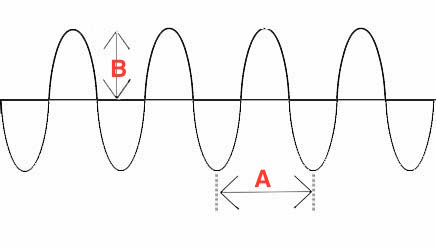
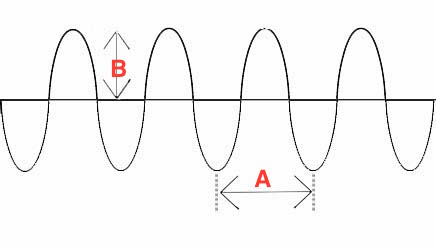
What property of this wave is represented by the letter "A"

a)

amplitude

b)

crest

c)

trough

d)

wavelength

92.
What property of the wave is represented by the letter "B"?
a)
amplitude
b)
crest
c)
trough
d)
wavelength
93.
The angle between the string of a pendulum at its equilibrium position and at its maximum displacement is the pendulum’s
a)
period.
b)
frequency.
c)
vibration.
d)
amplitude.
94.
The highest point on a wave is:
a)
the crest
b)
the trough
c)
the top
d)
the coast 
95.
The lowest point on a wave is the:
a)
Amplitude
b)
Crest
c)
Trough
d)
Wavelength
96.
What is the measure of how many waves pass a point in a certain amount of time?
a)
frequency
b)
wavelength
c)
midpoint
d)
crest and trough
97.

Which of the following is not an example of harmonic motion?

a)

A simple pendulum

b)

A vibrating spring

c)

A marble on a concave surface

d)

Bouncing on a trampoline

98.
For a system in simple harmonic motion, which of the following is the time required to complete a cycle of motion?
a)
amplitude
b)
period
c)
frequency
d)
revolution
99.
The SI unit for frequency is ________.
a)
m
b)
m/s
c)
hertz
d)
s
100.
when something moves backwards and forwards it is called ______
a)
oscillation
b)
reflection
c)
refraction
d)
wavelength
101.

Are these waves in phase or out of phase?

a)

In phase.

b)

Out of phase.

102.
A pendulum has a period of 2 seconds. What is its frequency?
a)
2 Hertz
b)
1/2 Hertz
c)
4 Hertz
d)
1/4 Hertz
103.
A pendulum has a frequency of 4 Hertz (Hz). Find its period.
a)
4 sec
b)
2 sec
c)
1/2 sec
d)
1/4 sec
104.
An object is _____ if its position changes relative to another object.
a)
in motion
b)
at reset
c)
a frame of refence
d)
magical
105.

What is the period?

a)

0.2 seconds

b)

10 seconds

c)

4 seconds

d)

12 seconds

106.

What is the frequency?

a)

0.083 Hz

b)

2 Hz

c)

1 Hz

d)

12 Hz

107.

What is the amplitude?

a)

0.3 m

b)

0.25 m

c)

0.2 m

d)

12 m

108.
What variable affects the period of the pendulum?  
a)
Amplitude
b)
Mass
c)
String length
d)
All variables (amplitude, mass, and string length)