
 Worksheets
03 Projectile Motion Bank
Total questions: 106
Worksheet time: 2hrs 4mins


A way of finding the resultant vector by lining up the vectors tail-to-tail.
Triangle method
Circle method
Rectangular method
Parallelogram method

A vector is a quantity that has both _______ and _________.
Select all that apply.
direction
amplitude
acceleration
magnitude
velocity

Magnitude 139.0N
Magnitude 195N
Magnitude 139.0N
Magnitude 139.0N


What is the resultant of the two vectors shown above?
+5
-5
+15
-15

Which of the following describes the vector above?
45 cm
45 cm at 30 degrees North of East
45 cm at 30 degrees East of North
45 cm North East
30 m/sec, East. Scalar or Vector?
Scalar
Vector
Neither

Vector A is directed northward and vector B is directed eastward. Which of the following vector addition diagrams best represent the addition of vectors A and B and the subsequent resultant?
A
B
C
D
E


If vector A has an x component of 12 units and a y component of 7 units, what is the magnitude of vector A?
19 units
13 units
14 units
193 units


Adding which two vectors would give the resultant vector with the greatest magnitude?
A + B
B + D
C + D
D + E
E + F

Adding which two vectors would give a resultant of zero magnitude?
A + B
A + E
B + E
C + F
A + D
A resultant vector is
equal to the sum of one vector.
equal to the sum of two or more vectors.
equal to the difference of one vector.

Vectors are added visually using the
tail to tail method.
tail to head method.
tip to tail method.
head to head method.

What vector gives the sum of these two vectors?


In a projectile motion we always have...
1 component (x)
3 components (x,y, and z)
2 components (x and y)
0 components
What is the direction of the acceleration for any projectile?
The direction the projectile is traveling.
Down
Up
Sideways
The fact that an apple and a watermelon, dropped simultaneously from the same height, would hit the ground at the same time indicates that
you don't like apples or watermelons.
greater masses have greater acceleration.
lesser masses have greater acceleration.
acceleration is independent of mass.
The initial horizontal velocity of a projectile is ____ its final horizontal velocity.
less than
equal to
greater than
The path followed by a projectile is also known as its
trajectory
range
height
vertical displacement
Once a projectile is launched, what is the only force that affects its motion?
mass
friction
inertia
gravity


Which best describes the horizontal motion of a projectile, assuming no air resistance?
Acceleration of -10 m/s2
Acceleration of -5 m/s2
An increasing acceleration every second
Constant velocity

Which best describes the vertical motion of a projectile, assuming no air resistance?
Acceleration of -10 m/s2
Accelerations of -5 m/s2
An increasing acceleration every second
Constant velocity

A marble traveling at 3 m/s rolls off the edge of a 1 m high table. What is its initial vertical speed?
-10 m/s
0 m/s
-3 m/s
-15 m/s

A soccer ball is kicked horizontally off a cliff. What information is needed to find the time to fall?
The height of the cliff
The initial speed of the ball
The mass of the ball
All of these

A cannon is fired horizontally from a 5.0 m tall tower. How much time will it take until the projectile hits the ground?
0.5 s
1.0 s
2.0 s
5.0 s

If a ball is launched horizontally at 40 m/s from a bridge, what will be the magnitude of its velocity after 3 seconds?
30 m/s
40 m/s
50 m/s
70 m/s

What is the relationship between motion in the x and y-dimensions?
If x is greater, then y is greater
If x is greater, then y is less
There is no relationship; independent

A cannonball is launched horizontally at 50 m/s from an 80 m tall cliff. How far will it go (horizontally) before hitting the ground?
100 m
200 m
400 m
800 m
A ball is thrown horizontally off a bridge at 15 m/s. Where will it be (x and y) in 1 second?
x = 15 m
y = -5 m
x = 15 m
y = -10 m
x = 10 m
y = -15 m
x = 10 m
y = -7.5 m
A Macaque monkey sitting 12 m up in a tree throws a nut horizontally at 11 m/s.
What is the final x velocity?
can't tell
11 m/s
9.8 m/s
-11 m/s
-9.8 m/s
A Macaque monkey sitting 12 m up in a tree throws a nut horizontally at 11 m/s.
What is the initial y velocity?
9.8 m/s
-9.8 m/s
11 m/s
0 m/s
A Macaque monkey sitting 12 m up in a tree throws a nut horizontally. How long will it take the nut to hit the ground?
2.45 s
4.32 s
1.56 s
not enough information
The final requirement for a degree in geology is Field Camp, an 8 week field experience in which budding geologists must complete rigorous real-world mapping projects. To celebrate the end of field camp, one student threw his rock hammer off of a 78 m cliff with a horizontal velocity of 34 m/s. He was then reminded that he had one more day of field work, so he needed to go get his hammer. How far away from the cliff did he have to walk in order to find his hammer?
221.78 m
153.23 m
135.65 m
78.98 m

Billy-Joe stands on the High Street Bridge in Hamilton Ohio kicking stones into the water below. If the stone had been kicked faster, how would this affect the time it would take to fall?
More time
Less time
Same time

Tad drops a cherry pit out the car window 1.0 m above the ground while traveling down the road at 18 m/s. If the car continues to travel at the same speed, where will the window be in relation to the pit when it lands?
Right above the pit still.
Behind the pit.
In front of the pit.
Which equations will help you determine the time it takes for an object to drop?
t = 2(g2dy)
t = dyv
t = vdx
dx=2gt2

A ball is tossed upward and caught at the same position of throw. In the absence of air resistance, the speed of the ball when it is caught would be
less than the speed it had when tossed upwards
the same as the speed it had when tossed upwards
more than the speed it had when tossed upwards

An object is tossed upward at 20m/s and is in the air for 4 seconds total time. Which of the following is TRUE?
Speed at A is the same as speed at E
Speed at B is the same as speed at D
The object is stopped at letter C (v=0m/s)
All answers are true
A baseball catcher throws a ball vertically upward and catches it in the same spot as it returns to the mitt. At what point in the ball’s path does it experience zero velocity and but is still accelerating at the same time?
the instant it leaves the catcher’s hand
midway on the way up
at the top of its path
the instant before it arrives in the catcher’s mitt
Nowhere in its flight

An object experiences an upward launch. Which is TRUE?
It slows down going upward while speeding up going downward
It travels at a constant speed its entire flight
It speeds up going upward, slows down going downward

Which letter(s) show the object with a positive (+) velocity?
A only
B only
A, B, and C
A and B only

Why is the velocity arrow of B smaller/shorter than the size of velocity arrow A?
Velocities are the same magnitude
Gravity has decreased the speed as the object travels upward
Gravity has increased the speed as the object travels upward
The object has reached terminal velocity so it is traveling at a constant velocity
Which letter(s) show the object with a negative (-) velocity?
D and E only
E only
C, D and E
All of the letters (A-E)
Why is the velocity arrow of E longer/larger than the size of velocity arrow D?
Velocities are the same magnitude
Gravity has decreased the speed as the object travels upward
Gravity has increased the speed as the object travels upward
The object has reached terminal velocity so it is traveling at a constant velocity

The diagram shows parabolic projectile motion. The object is launched at A. The object impacts the ground at G.
At which position is the projectile moving with the fastest upward velocity?
Position A
Position B
Position C
At Positions A, B, and C. The upward velocity is equally fast.
The diagram shows parabolic projectile motion. The object is launched at A. The object impacts the ground at G.
At which position is the projectile moving with the fastest downward velocity?
Position E
Position F
Position G
At Positions E, F, and G. The downward velocity is equally fast.
The diagram shows parabolic projectile motion. The object is launched at A. The object impacts the ground at G.
At which position or positions is the projectile accelerated in the down direction?
Position A
Position D
Position G
At all positions (A, B, C, D, E, F, & G.)
The diagram shows parabolic projectile motion. The object is launched at A. The object impacts the ground at G.
At which position or positions is the projectile slowing in the up direction?
Position A
Position B & C
Position C
Positions A, B, & C
The diagram shows parabolic projectile motion. The object is launched at A. The object impacts the ground at G.
At which position or positions is the projectile slowing in the down direction?
Position G
Position E & F
Positions E, F, & G.
At no positions.
The diagram shows parabolic projectile motion. The object is launched at A. The object impacts the ground at G.
At which position or positions is the projectile moving with the fastest horizontal velocity through its range?
Position A
Position D
Positions G
At all positions (A, B, C, D, E, F, & G).
The diagram shows parabolic projectile motion. The object is launched at A. The object impacts the ground at G.
Which statement accurately describes what happens at Position D?
The projectile stops for an instant, changes direction.
The projectile stops for an instant, immediately falls to the ground.
The projectile continues to move, but changes direction.
The projectile continues to move, but immediately falls to the ground.
The diagram shows parabolic projectile motion. The object is launched at A. The object impacts the ground at G.
Which statement accurately describes what happens at Position D?
The projectile moves with only horizontal motion.
The projectile is instantaneously motionless (not moving).
The projectile moves with both up and down motion at the same time.
The projectile has zero acceleration.

The diagram shows horizontal projectile motion. The object is launched at A. The object impacts the ground at E.
Which statement accurately describes what happens at Position A?
The projectile moves with only horizontal motion.
The projectile is instantaneously motionless (not moving).
The projectile moves with both up and down motion at the same time.
The projectile has zero acceleration.
The diagram shows horizontal projectile motion. The object is launched at A. The object impacts the ground at E.
At which position or positions is the projectile being accelerated in the down direction?
Position E
Positions B, C, & D
Position A
At all positions (A, B, C, D, & E)
The diagram shows horizontal projectile motion. The object is launched at A. The object impacts the ground at E.
At which position or positions is the projectile's downward velocity getting faster?
Position E
Positions B, C, & D
Position A
At all positions (A, B, C, D, & E)
The diagram shows horizontal projectile motion. The object is launched at A. The object impacts the ground at E.
At which position or positions is the projectile's downward velocity the fastest?
Position E
Positions B, C, & D
Position A
At all positions (A, B, C, D, & E)
The diagram shows horizontal projectile motion. The object is launched at A. The object impacts the ground at E.
At which position or positions is the projectile's horizontal velocity the fastest?
Position E
Positions B, C, & D
Position A
At all positions (A, B, C, D, & E)

The diagram shows vertical projectile motion. The object is launched at A. The object impacts the ground at G.
At which position is the projectile moving with the fastest upward velocity?
Position A
Position B
Position C
At Positions A, B, and C. The upward velocity is equally fast.
The diagram shows vertical projectile motion. The object is launched at A. The object impacts the ground at G.
At which position is the projectile moving with the fastest downward velocity?
Position G
Position E & F
Position F
At Positions E, F and G. The downward velocity is equally fast.
The diagram shows vertical projectile motion. The object is launched at A. The object impacts the ground at G.
At which position or positions is the projectile getting faster in the downward direction?
Position G
Position E & F
Position F
At Positions E, F and G. The downward velocity is equally fast.
The diagram shows vertical projectile motion. The object is launched at A. The object impacts the ground at G.
At which position or positions is the projectile getting faster in the upward direction?
Position A
Position B & C
Position C
None of the positions.

The diagram shows parabolic projectile motion. The object is launched at A. The object impacts the ground at G.
Which statement accurately describes what happens at Position D?
The projectile stops for an instant, changes direction.
The projectile stops for an instant, immediately falls to the ground.
The projectile continues to move, but changes direction.
The projectile continues to move, but immediately falls to the ground.
What is "how far" the projectile moves horizontally from its launch position? The horizontal displacement.
Range, x
Height, ∆y
Time of flight, t
Trajectory
What is "how much time" the projectile is airborne from launch to impact?
Range, x
Height, ∆y
Time of flight, t
Trajectory
What is the "path" of the projectile as it flies through the air?
Range, x
Height, ∆y
Time of flight, t
Trajectory
A vertical projectile has zero ____.
Range, x
Height, ∆y
Time of flight, t
Trajectory
The time of flight of a projectile depends ONLY upon which variable?
Range, x
Height, ∆y
Initial launch velocity
Initial launch angle
You launch three identical parabolic projectiles from the same cannon. The initial launch velocity for all three projectiles was the same at 30 m/s. The launch angles were different.
Projectile #1 was launched at an angle of 20∘.
Projectile #2 was launched at an angle of 30∘.
Projectile #3 was launched at an angle of 60∘.
Which projectile had the longest time of flight?
Projectile #1
Projectile #2
Projectile #3
All had equal times of flight.
You launch three identical parabolic projectiles from the same cannon. The launch angle for all three projectiles was 30∘. The initial launch velocities were different.
Projectile #1 was launched at 30 m/s
Projectile #2 was launched at 20 m/s.
Projectile #3 was launched at 10 m/s.
Which projectile had the longest time of flight?
Projectile #1
Projectile #2
Projectile #3
All had equal times of flight.
You launch three identical horizontal projectiles from the same cannon. The launch angle for all three projectiles was 0∘. The initial launch velocities were different.
Projectile #1 was launched at 30 m/s
Projectile #2 was launched at 20 m/s.
Projectile #3 was launched at 10 m/s.
Which projectile had the longest time of flight?
Projectile #1
Projectile #2
Projectile #3
All had equal times of flight.
You launch three identical horizontal projectiles from the same cannon. The launch angle for all three projectiles was 0∘. The initial launch velocities were different.
Projectile #1 was launched at 30 m/s
Projectile #2 was launched at 20 m/s.
Projectile #3 was launched at 10 m/s.
Which projectile had the longest range?
Projectile #1
Projectile #2
Projectile #3
All had equal range.

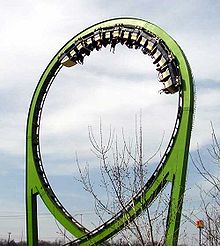
moving or tending to move toward a center...
centripetal force
centrifugal force
Tangent
Curvature

the process or act of turning or circling around something
Curvature
Rotation
Radius
Orbit
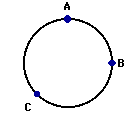

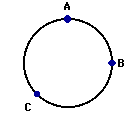



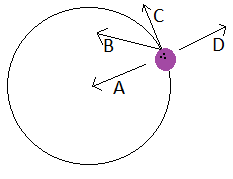
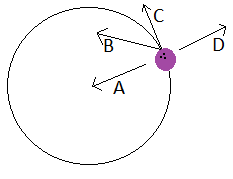
A ball is moving at constant speed around the circle. Which letter represents the acceleration of the ball?
A
B
C
D
Nonsense. The ball can't be accelerating while moving at a constant speed.

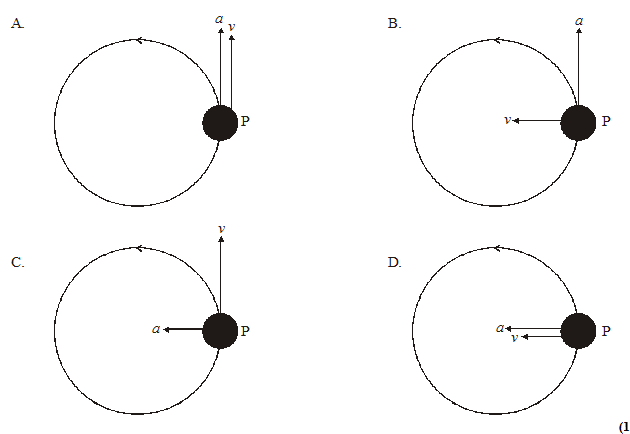
A 10kg car travels at a constant speed of 20.0 m/s around a horizontal circular track. Which diagram correctly represent the direction of the car's velocity (v) and the direction of the centripetal force (Fc) acting on the car at a particular moment?


What is the primary purpose of Newton's Mountain thought experiment?
To demonstrate the existence of a vacuum.
To explain the concept of inertia.
To illustrate the law of universal gravitation.
To prove that Earth is round.
If the cannonball fired from Newton's Mountain is given a sufficiently high horizontal velocity, what will its path eventually be?
A straight line.
A parabola.
A circle.
An ellipse.
If the cannonball from Newton's Mountain were fired at a speed greater than the escape velocity of Earth, what would happen to it?
It would fall back to Earth.
It would orbit Earth.
It would travel in a straight line forever.
It would be pulled into the Sun.

