
 Worksheets
Sound and Mechanical Waves
Total questions: 104
Worksheet time: 1hrs 25mins
If you double the frequency, what happens to the wavelength?
it decreases by a factor of 2
it increases by a factor of 2
it does not change
it decreases by a factor of 4
How is amplitude related to wave speed?
They are directly related. If wave speed increases, so does amplitude
They are inversely related. If wave speed increases, amplitude decreases
There is no relationship. Amplitude and wave speed are not dependent on each other.
With sound waves, amplitude is measured by
pitch
loudness/volume
wavelength
wave speed
the time it takes for one complete wave cycle is called the ________
wavelength
period
frequency
wave speed
electromagnetic waves are what type of wave?
mechanical
longitudinal
transverse
water
You get stuck at a train stop. A train sounds its horn as it drives by you. How will the pitch change as the train moves away from you?
the train horn will not change in pitch as it moves away from you
the train horn will sound higher in pitch as it moves away from you
the train horn will increase in pitch as it moves away from you
the train horn will sound lower in pitch as it moves away from you
How is pitch related to frequency?
the higher the pitch, the higher the frequency of the sound wave
the lower the pitch, the higher the frequency of the sound wave
they are not related
the higher the pitch, the louder the sound
Two girls shout in the bathroom together. One has a deeper voice than the other. What is true about the speed of the sound waves they produce?
the girl with the higher pitched voice will produce faster sound waves
the girl with the lower pitched voice will have faster sound waves
the girl with the lower pitched voice will have slower sound waves
the speed of the waves will be equal since the medium is the same
Sound is what type of wave?
mechanical and longitudinal
mechanical and transverse
a wave has a wavelength of 2 m.
3 waves pass every second. What is the wave speed?
v = 5 m/s
v = 6 m/s
v = 0.67 m/s
v = 1.5 m/s
True or false. Electromagnetic waves require a medium
true
false
sound travels fastest in what type of medium?
hot solid medium
hot gas medium
hot liquid medium
cold solid medium
True or False. The speed of the wave stays constant unless you change the medium.
true
false
You are at the pool with your friends. A child jumps into the pool 10 m away from you and creates ripples in the water. You feel the waves 5 seconds later. How fast are the waves moving?
50 m/s
0.5 m/s
2 m/s
15 m/s

B and D refer to which parts of standing waves?
the antinodes
the nodes
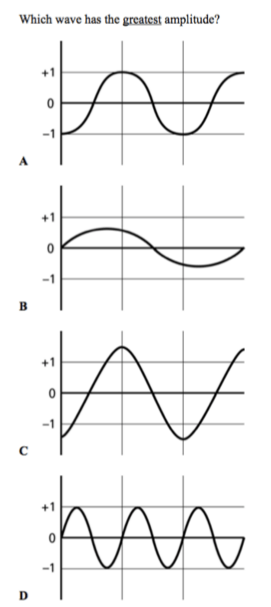
amplitude
wavelength
if the frequency of a wave if 0.1 Hz, what is the period?
0.1 s
10 s
100 s
0.2 s

What causes the antinodes of standing waves?
constructive interference
destructive interference
resonance
Two waves with an amplitude of 2 m arrive at exactly the same place at the same time. What will the resulting amplitude be?
0 m
4 m
2 m
1 m
two waves are out of step with each other. A crest of one wave overlaps with the trough of another. They each have an amplitude of 2 m. What is the resulting amplitude?
0 m
4 m
2 m
1 m
What happens to the speed of sound if temperature increases?
vsound increases
vsound decreases
vsound does not change
vsound increases exponentially
You yell to your friend outside. The temperature is 23 degrees Celsius. Calculate vsound
vsound=331 + 0.6T
vsound=344.8 m/s
vsound=317.2 m/s
vsound=13.8 m/s
vsound=354 m/s
A sound produces a frequency of 500 Hz. The speed of the wave is 345 m/s. Calculate the wavelength.
λ = 1.4 m
λ = 172,500 m
λ = 0.69 m
ω = 0.62 m

What type of wave is shown here?
transverse
longitudinal
mechanical
electromagnetic

Which sound wave is louder?
the top one
the bottom one
They have equal loudness

What causes the nodes of standing waves?
destructive interference
constructive interference
echo
resonance
A reflection of a sound wave is called ________
resonance
echo
constructive interference
destructive interference
When a sound wave is prolonged or amplified by an echo or another vibrating object
resonance caused by constructive interference
resonance caused by destructive interference
beats
medium
the material that carries the wave (solid, liquid, or gas)
pitch
medium
amplitude
mechanical wave

Wave A and Wave B interfere to produce the bottom pattern. What type of interference is shown?
constructive interference
destructive interference
amplification
harmonic motion

Which of the following is true about the doppler effect?
The person will hear a lower pitch when the ambulance is approaching her than when it is moving away from her
the person will hear a constant pitch when the ambulance approaches and moves away from her
the person will hear a higher pitch when the ambulance is approaching her than when it is moving away from her
waves are more spread out when the ambulance approaches her than when it is moving away from her

A wave machine generated waves with a wavelength of 0.080 m at a constant wave speed of 17 m/s. Calculate the frequency of the waves.
212 Hz
1.36 Hz
0.00470 Hz
16.92 Hz
1.36
The speed of sound in air is 340 m/s. The frequency of the sound waves generated by my voice is 720 Hz. Calculate the wavelength of sound of my voice.
380 m
0.472 m
2.11 m
244,800
none of these are correct

Tuning fork ‘A’ has a frequency of 256 Hz.
A student strikes Tuning fork 'A' and Tuning fork 'B' with a mallet and they hear 4 beats every 2 seconds. What are the two possible frequencies for Tuning fork 'B'?
260 Hz and 252 Hz
258 Hz and 254 Hz
264 Hz and 248 Hz
256.5 Hz and 255.5 Hz

What is "Beats"?
The regular pulsing of pitch of a sound which is heard when 2 sources produce sounds of slightly different frequency.
The regular pulsing of loudness of a sound which is heard when 2 sources produce sounds of slightly different frequency.
The regular pulsing of a sound giving a characteristic tone / timbre which is heard when 2 sources produce sounds of slightly different frequency.
The regular pulsing of loudness of a sound which is heard when 2 sources produce sounds of the same frequency.
Calculate the beat frequency if a 400 Hz and a 397 Hz sound are heard by Quinn.
1 Hz
2 Hz
3 Hz
4 Hz
A string with nodes at both ends is oscillating at the fundamental frequency. if the frequency of the string doubles, the wavelength will
double
get cut in half
remain the same
quadruple

The pictured tube is 1.2 meters long. What is the wavelength of the wave inside?
0.6 m
1.2 m
1.6 m

A pendulum swinging with a maximum amplitude of π/6 has a period of T. If the maximum amplitude is increased to π/3, what is the new period of the pendulum?
T/4
T/2
T
2T

A pendulum's period is initially t. Changes are made to the system so that the new period is 2t. What may have been changed?
The length of the pendulum was increased by a factor of 2.
The pendulum was moved to a planet with 2 times the mass of Earth.
The length of the pendulum was increased by a factor of 4.
The pendulum was moved to a planet with 4 times the mass of earth.
The energy contained in a pendulum depends on its
I. period
II. amplitude
III. mass
I only
II only
II and III only
I, II, and III
Sound waves travel 10 times as fast through steel as they do through air. What happens to the wavelength of a 200 Hz sound wave as it enters steel from the air?
It decreases by a factor of 10.
The wavelength remains the same.
It increases by a factor of 10.
It increases by a factor of 100.

A pipe in a calliope is closed at one end and is 0.5 m long. The calliope uses hot air so that the speed of sound in the tube is 400 m/s. What is the fundamental frequency of the calliope tube?
100 Hz
200 Hz
300 Hz
400 Hz
I. period
II. amplitude
III. mass
A wave carries...?
energy only
matter only
nothing. The matter carries the energy
neither
True or False: Mechanical waves need a medium in order to propagate.
True
False


What is the wavelength of a 1400 Hz wave that travels at a speed of 340 m/s?
A) 24.5 cm
B) 48.6 cm
C) 4.11 m
D) 4.76 m
E) 3.42x 10^6 m
A rope of length 12 m is stretched to a tension of 200 N. If its mass is 500 g, at what speed would a 300 Hz transverse wave travel down the string?
A) 45.3 m/s
B) 48.6 m/s
C) 4803 m/s
D) 69.3 m/s
E) 3600 m/s
A string fixed at both ends, supports standing wave with a total of 4 nodes. If the length of the string is 12 m, what is the wavelength of the wave?
A) 4 m
B) 6 m
C) 6.67 m
D) 8 m
E) 12 m
A string fixed at both ends, has a length of 6m and supports a standing wave with a total of 3 nodes. If a transverse wave can travel at 40 m/s down the rope, what is the frequency of this standing wave?
A) 4.33 Hz
B) 6.00 Hz
C) 6.67 Hz
D) 8.00 Hz
E) 1.33 Hz
An observer is 4 m from the source of sound waves. By how much will the sound level decrease if the observer moves to a distance of 400 m.
A) 10 dB
B) 20 dB
C) 30 dB
D) 40 dB
E) 50 dB
A car is traveling 20 m/s away from a stationary observer. If the car's horn emits a frequency of 800 Hz, what frequency will the observer hear? (use v = 340 m/s for the speed of sound.)
A) 516 Hz
B) 567 Hz
C) 617 Hz
D) 675 Hz
E) 756 Hz
An organ pipe that's closed at one end has a length of 30 cm. If the speed of sound through the air inside is 340 m/s, what is the pipe's fundamental frequency?
A) 283 Hz
B) 313 Hz
C) 500 Hz
D) 567 Hz
E) 617 Hz
A bat emits a 40kHz “chirp” with a wavelength of 8.75mm towards a tree and receives an echo 0.4s later. How far is the bat from the tree?
A) 35 m
B) 70 m
C) 105 m
D) 140 m
E) 210 m
A rope is stretched between two vertical supports. The points where it is attached (P and Q) are fixed. The linear density of the rope, μ is 0.4 Kg/m, and the speed of the transverse wave on the rope is 12 m/s
What is the tension on the rope?
50.0 N
54.3 N
57.6 N
62.3 N
64.7 N
A rope is stretched between two vertical supports. The points where it is attached (P and Q) are fixed. The linear density of the rope, μ is 0.4 Kg/m, and the speed of the transverse wave on the rope is 12 m/s.
With what frequency must the rope vibrate to create a travelling wave with a wavelength of 2 m?
A) 2 m/s
B) 4 m/s
C) 6 m/s
D) 8 m/s
E) 10 m/s
The rope can support standing waves of length 4 m and 3.2 m, whose harmonic numbers are consecutive integers. The linear density of the rope is 0.4Kg/m
Find the length of the rope
2m
4m
6m
8m
12m
The rope can support standing waves of length 4 m and 3.2 m, whose harmonic numbers are consecutive integers. The linear density of the rope is 0.4Kg/m
Find the mass of the rope
0.8Kg
1.6Kg
2.4Kg
3.2Kg
4.0Kg
The rope can support standing waves of length 4 m and 3.2 m, whose harmonic numbers are consecutive integers. The linear density of the rope is 0.4Kg/m
What is the harmonic number of the 4m standing wave?
1
2
3
4
5
What is a blue-shift?
The apparent bunching-up of waves as they move toward you.
The apparent spreading out of waves as they move away from you.
What is any spot on a wave where there is no amplitude called?
node
antinode
trough
crest

