
 Worksheets
T3_PHY
Total questions: 110
Worksheet time: 2hrs 50mins

1 Pa = 1N/m2
Which one is the correct formula relating force, pressure and area?
F = P / A
A = F x P
P = F / A
P = A /F
Which of the following is NOT a unit for pressure?
Pa
N/cm2
Nm2
N/m2

Wearing skis on snow spreads out the skier's weight, this
increases pressure by increasing contact area
increases pressure by decreasing contact area
decreases pressure by increasing contact area
decreases pressure by decreasing contact area

A sharp knife has
a large contact area and a large pressure
a small contact area and a large pressure
a small contact area and a small pressure
a large contact area and a small pressure

A piece of glass can withstand a pressure of 2.1 N/cm², what is the minimum force needed to break the glass with a special hammer of surface 3cm by 4cm?
9.3 N
16.8 N
8.4 N
25.2 N

Ice cracks if the pressure on it is more than 3000 N/m². A man of weight 900 N wants to safely walk over the ice. What should be the area of each of his snowboots?
0.15 m2
0.30 m2
1.67 m2
3.33 m2

Sam of weight 450 N sits on a chair with 4 legs. Each leg has a contact area of 3 cm by 6 cm with the ground. What is the pressure exerted on the ground?
6.25 Pa
25 Pa
6.25 N/cm2
25 N/cm2
Which would be the least likely to sink into soft ground?
A loaded lorry with 4 wheels.
An empty lorry with 4 wheels.
A loaded lorry with 6 wheels.
An empty lorry with 6 wheels.

A brick of weight 80 N rests on the ground. What is the maximum pressure it can exert on the ground?
0.08 N/cm2
0.8 N/cm2
0.4 N/cm2
1.6 N/cm2
A person weighs 700N and their feet have a surface area of 0.1m2. How much pressure is exerted?
7000N/m2
70N/cm2
100N/m2
What pressure does a 4000N horse exert on the ground if each foot is 10cm2?
40 N/cm2
100 N/cm2
400 N/cm2
10 N/cm2

Pressure depends on depth

In the image which hole will allow the water to travel furthest?
A
B
C
What happens to liquid pressure as you go deeper under water?
it increases
it decreases
it stays the some
no soup for you!
What happens to atmospheric pressure as you move further away from the surface of the earth (i.e. as you go higher in the sky) ?
it increases
it decreases
it stays the same
I don't know


The diagrams show, to the same scale, the vertical sections of a set of circular vessels, each containing the same depth of water.
The water exerts the same pressure on the base of each vessel.
The water exerts the greatest pressure on the base of vessel S.
The water exerts the greatest pressure on the base of vessel P.
The water exerts the same force on the base of each vessel.
When a diver dives deeper into the ocean, he will experience ...................... liquid pressure
greater
less
no

Recall that Liquid pressure depends on the depth below the surface and also depends on the density of the fluid.
Sea water is denser than Lake water.
Fish X is above Fish Y in the Lake water.
Fish Z is at the same depth as Fish Y but Fish Z is in the Sea water.
The pressure of water exerted on the fishes is PX, PY and PZ respectively.
Which comparison is correct about the pressure of water exerted on the fishes?
PZ > PY > PX
PZ = PY
PX > PY
PZ < PX < PY

Calculate the pressure exerted by the water on the fish.
[Density of water = 1 000 kg m−3 and g = 10N/kg]
5 × 10⁴ Pa
5 × 10⁷ Pa
5 × 10⁶ Pa
5 × 10⁻¹ Pa

Water is stored in a large tank as shown by the the shaded rectangle in the diagram. This water tank is 3m tall and elevated at a height of 22m above the ground.
M is, a smaller storage tank, located inside the house at a height of 15m above the ground.
Calculate the pressure of the water at position M inside the house.
[Density of water = 1 000 kg m−3 and g = 10N/kg]
1.0 × 10⁵ N m−2
1.5 × 10⁵ N m−2
2.2 × 10⁵ N m−2
2.5 × 10⁵ N m−2

Two identical containers containing liquid M and liquid N with 28 cm height and 20 cm height respectively. Both containers produce the same water spurt at the bottom.
If the density of liquid M is 2.0 g cm−3, find the density of liquid N.
(g = 10N/kg)
Hint: since both containers produce the same water spurt then the both containers have the SAME pressure at the bottom.
0.70 g cm−3
1.40 g cm−3
1.43 g cm−3
2.80 g cm−3
Given that the pressure of sea water at the bottom of an ocean is 7.65 × 10⁷ N m−2, calculate the depth of the ocean.
[Density of sea water = 1.02 × 10³ kg m−3 and g = 10N/kg]
7.5 × 10⁸ m
7.5 × 10⁴ m
7.5 × 10³ m
7.5 × 10² m
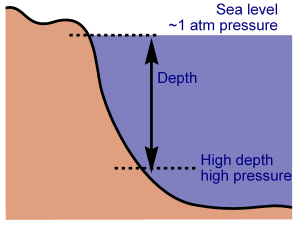
When you increase your depth under water, the water pressure on your body
increases
decreases
stays the same

The diagram shows a cross-section of a pool. The density of water in the pool is 1000 kg m-3.
What is the pressure exerted by the water at X?
2.5 x 10² Pa
2.5 x 10⁻³ Pa
4.0 x 10³ Pa
4.0 x 10⁴ Pa

Diagram 6 shows a container filled with water.
Which is the correct comparison of the pressure at P and Q?
Pressure at P > pressure at Q
Pressure at P = pressure at Q
Pressure at P < pressure at Q

Diagram 8 shows two divers in a lake and a diver in a sea. The pressure of water at T, S and U is PT, PS and PU respectively.
PU > PT > PS
PU < PT < PS
PU = PT > PS
PU = PT < PS

Diagram 7 shows two identical containers containing liquid P and Q.
When the height of liquid P is 15 cm and the height of liquid Q is 20 cm, water spurts is the same.
The density of liquid P is 2.0 g cm-3.
What is the density of liquid Q?
0.67 g cm-3
1.30 g cm-3
1.50 g cm-3
2.70 g cm-3

Diagram 11 shows the process of supplying water from a water tank on a hill to a water tank X on a tall building.
Calculate the pressure of the water at X?
[Density of water: 1000 kg m-3]
1.0 x 10⁵ Nm‑2
1.4 x 10⁵ Nm‑2
1.6 x 10⁵ Nm‑2
2.6 x 10⁵ Nm‑2

Diagram 9 shows water spurting out from a container at different depths. Which graph shows the correct relationship between the pressure exerted by the water, p and the depth of the water, h?


Kumar and Abu are fishing in a lake. The bait used sinks 7.0 m into the lake. What is the water pressure exerted on the bait?
[Density of water = 1000 kgm-3]
7.0 x 10⁴ Pa
7.0 x 10³ Pa
1.4 x 10³ Pa
1.4 x 101 Pa

Diagram 11 shows a submarine in a sea.
What is the depth, h, of the submarine when the total pressure is 2.06 x 10⁷ Pa?
[Density of water = 1.03 x 10³ kgm-3]
2.00 x 10³ m
2.00 x 10⁴ m
2.12 x 10⁹ m
2.12 x 10¹¹ m

Diagram 10 shows a water container being tilted to increase the outflow of the speed of water.
Which factor increases the speed of water?
Gravity
Depth of water
Volume of water
Density of water

What is the pressure difference, in cm of water, shown by the manometer?
9
16
20
25

A
B
C
D

Pressure can be measure in cm of water.
What is the pressure of the gas?
8 cm of water more than atmospheric pressure
12 cm of water more than atmospheric pressure
8 cm of water less than atmospheric pressure
12 cm of water less than atmospheric pressure

A
B
C
D

What is the pressure of the sample of gas trapped in the open-tube mercury manometer shown below if atmospheric pressure is 736 mmHg and h = 9.2 cm?
92 mm Hg
736 mm Hg
745.2 mm Hg
828 mm Hg

What will happen to the height (h) of the mercury column in the manometer shown below if the stopcock is opened, given that the atmospheric pressure is 755 mmHg?
h will decrease
h will not change
h will increase
not enough information given to answer the question

Which gas has a greater pressure?
air
methane
The gas pressures are equal

If the air pressure is 750 mmHg, what is the pressure of Gas B?
695 mmHg
805 mmHg
750 mmHg
55 mmHg

What is the pressure of gas C if the air pressure is 760?
1405 mmHg
645 mmHg
115 mmHg

A manometer is used to measure the pressure of an unknown gas. What is the Pressure of the unknown gas? (atmospheric pressure = 100 kPa, density of mercury = 13,600 kg/m3)
121.8 kPa
128.6 kPa
106.8 kPa
93.2 kPa
If the atmospheric pressure is 740 mmHg, what is the pressure of the methane gas?
740 mmHg
770 mmHg
710 mmHg
30 mmHg
Which gas has a greater pressure?
Gas C
Air
The gas pressures are equal

The pressure inside the toy is
more than the air pressure
less than the air pressure
equal to the air pressure
equal to the gauge pressure

The height difference (here in the picture) between the levels of the u tube manometer is equal to the
atmospheric pressure
the difference between air pressure and gas pressure
none
gas pressure

The air pushes equally on both sides so, gauge pressure is zero
True
False

A simple U-tube or manometer has a side filled with water and another with an unknown blue fluid. Which side has the larger absolute pressure at the bottom of its column?
left
right
equal
In the same system, which fluid has the greater density?
water
unknown fluid
both have the same density

The figure shows a glass tube filled with 50 cm height of liquid M and 30 cm height of liquid N.
The densities of liquid M and N are 1000 kgm-3 and 2500 kgm-3 respectively. Given that g = 10 ms-2, what is the pressure of liquid M and N at point y?
5,000 Pa
7,500 Pa
12,500 Pa
1250 kPa

Water with density of 1 g cm-3 and oil are
filled into a U-tube. What is the density of the oil ?
0.83 g cm-3
1.20 g cm-3
8.30 g cm-3
0.90 g cm-3
A student walks 3 blocks south, 4 blocks west, and 3 blocks north. What is the displacement of the
student?
4 blocks east
4 blocks west
10 blocks west
10 blocks east
What is the average speed of an object that travels 6.00 meters north in 2.00 seconds and then travels 3.00 meters east in 1.00 second?
9.00 m/s
4.24 m/s
3.00 m/s
0.333 m/s
If an object is traveling north with a decreasing speed, the direction of the object's acceleration is
west
north
south
east
The speedometer in a car does not measure the car’s velocity because velocity is a
vector quantity and has a direction associated with it
vector quantity and does not have a direction associated with it
scalar quantity and has a direction associated with it
scalar quantity and does not have a direction associated with it
Velocity is to speed as displacement is to
acceleration
mass
time
distance
A toy car moves 8 m in 4 s at the constant velocity. What is the car’s velocity?
1 m/s
2 m/s
3 m/s
4 m/s
A train moves at a constant velocity of 50 km/h. How far will it move in 0.5 h?
10 km
20 km
25 km
45 km
A boat can move at a constant velocity of 8 km/h in still water. How long will it take for the boat to move 24 km?
2 h
3 h
4 h
6 h
Which of the following is a vector quantity?
time
velocity
speed
distance
A car at accelerates from 0 m/s to 25 m/s in 5 seconds. What is the average acceleration of the car?
30 m/s2
50 m/s2
125 m/s2
5 m/s2
What is the unit of measurement used in physics for speed?
seconds
seconds per meter
meters
meters per second
Velocity is a vector measurement because it has both a magnitude and a ________.
Time
Distance
Direction
Temperature
If a person runs 100 meters in 10 seconds, what is their average speed?
1 m/s
2 m/s
5 m/s
10 m/s
The velocity of a plane is 500 miles per hour west. What is the speed of the plane?
West
500 miles per hour
250 miles per hour
500 miles per hour west
500 miles per hour east
Which one of the following quantities is NOT a vector?
10 mi/hr, east
10 mi/hr/sec, west
35 m/s, north
20 m/s
Which one of the following quantities is NOT a speed?
10 mi/hr
10 mi/hr/sec
35 m/s
20 m/s
How far would you travel moving at 12 m/s for 3.00 minutes?
36.0 m
2160 m
40.0 m
36.0 miles
Find the distance a hiker walks if he travels 3.50 mi north, and then turns around and walks 3.00 mi south.
0.50 mi
3.00 mi
1.50 mi
6.50 mi
Find the displacement for a hiker who walks 3.50 mi north, and then turns around and walks 3.00 mi south.
0.50 mi
6.50 mi
0.50 mi north
6.50 mi north
Determine the displacement for a car that travels 25 mi east and 25 mi north.
50 mi northeast
35 mi northeast
50 mi north
35 mi east


Which diagram best shows person pushing a couch (accelerating) across the floor?


Which free body diagram is correct for a car being pulled at a constant velocity?
A
B
C
D
E


What is another name for Newton’s 1st law?
Law of Inertia
Law of Acceleration
Law of Action/Reaction
An object in motion will stay in motion and an object at rest will stay at rest unless acted upon by an outside force. Which law does this describe
2nd law
1st law
3rd law

