wayground logo

Free Printable Worksheets

Font size

S
M
L
XL
Worksheets

Physics Final

Total questions: 115

Worksheet time: 3hrs 41mins

Name
Class
Date
1.
What is the total distance of the object represented in this motion graph?
a)
0 meters
b)
10 meters
c)
11 meters
d)
20 meters
2.
What is the total displacement of the object represented in this motion graph?
a)
0 meters
b)
10 meters
c)
11 meters
d)
20 meters
3.
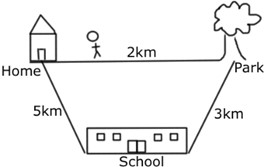
Jerry walked from home to school, then from the school to the park.  What is his total displacement?
a)
2 km
b)
5 km
c)
8 km
d)
10 km
4.
 Jermaine runs exactly 2 laps around a 400 meter track. What is the displacement?
a)
800
b)
400
c)
0
d)
200
5.
A person walks 50 meters directly north, stops, and then travels 32 meters directly south.  What is their displacement?
a)
82 meters
b)
18 meters
c)
28 meters
6.

A cat walks 3 meters toward a laser, then jumps 5 meters due south of the laser when it sees a thing. What is the displacement of the cat (to the nearest tenth)?

a)

3.0m

b)

5.0m

c)

8.0m

d)

5.8m

7.
What is the net force
a)
10 N
b)
0 N
c)
25 N
d)
1 N
8.
What is the net force?
a)
400 N Up
b)
400 N Down
c)
- 400 N Down
d)
800 N Down
9.
Students are playing tug-of-war. If group B pulls the rope to the right with a force of 400 N and group A pulls the rope to the left with a force of 250 N, what will happen to the ribbon in the middle of the rope?
a)
The ribbon will move to the left and group A will win the tug-of-war.
b)
The ribbon will move to the left and group B will win the tug-of-war.
c)
The ribbon will move to the right and group B will win the tug-of-war.
d)
The ribbon will move to the right and group A will win the tug-of-war.
10.
Which of these is not a vector quantity? 
a)
displacement 
b)
time
c)
velocity 
d)
acceleration
11.
2.0 milligrams is
a)
2.0 x 10⁻³ grams
b)
2.0 x 10⁻⁶ grams
c)
2.0 x 10⁻² grams
d)
2.0 x 10⁻⁹ grams
12.
convert 0.036 km to cm
a)
3600
b)
3.6
c)
360
d)
36
13.

The 2nd motion diagram shows...

a)

constant speed

b)

acceleration

c)

deceleration

d)

no motion (at rest)

14.

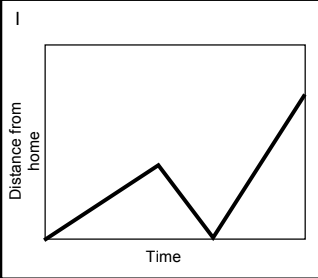
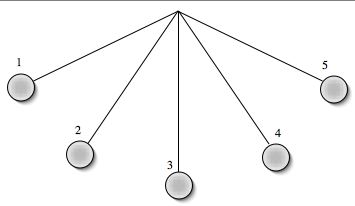
Which motion diagram shows negative acceleration followed by positive acceleration?

a)

1

b)

2

c)

4

d)

5

15.
a)
b)
c)
d)
16.
How long did it take this object to travel 10 m?
a)
0 s
b)
10 s
c)
15 s
d)
20 s
17.
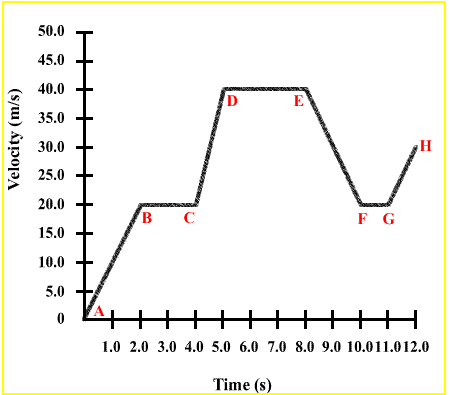
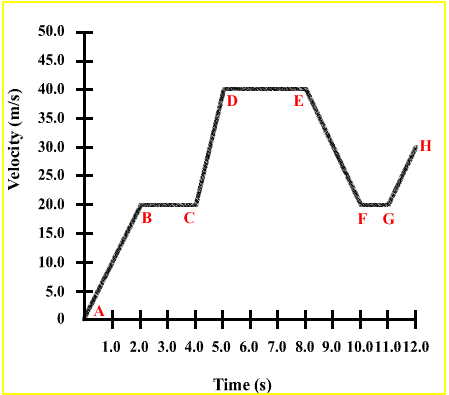
What is happening at D?
a)
Stationary
b)
Accelerating
c)
Fast steady speed; moving away from the starting position
d)
Slower steady speed; moving away from the starting position
18.
What is happening at C?
a)
Stationary
b)
Accelerating
c)
Fast steady speed; moving away from the starting position
d)
Slower steady speed; moving away from the starting position
19.
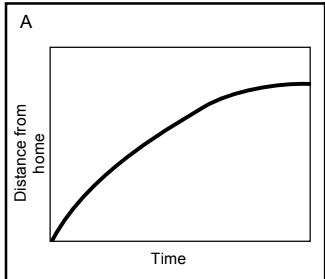
At what rate did the rain fall?
a)
2 cm per hour
b)
1/4 cm per hour
c)
1/2 cm per hour
d)
4 cm per hour
20.

What is the speed of segment A?

a)

0.5 m/s

b)

2 m/s

c)

3 m/s

d)

45 m/s

21.

A helicopter travels 250 miles in 2 hours. What is its speed?

a)

125 miles

b)

125 mph

c)

500 hours

d)

500 mph

22.

A family left for the museum at 7 in the morning. They arrived at 10 and they traveled at 60 miles per hour. How far away was the museum?

a)

420 miles

b)

180 miles

c)

8.57 mph

d)

420 miles per hour

23.

A speed boat travels 200 m at a speed of 20 m/s. How much time will it take to travel the 200 m?

a)

10 s

b)

10 m

c)

400 s

d)

40 m/s

24.
Billy was driving his car and when he reached the tollbooth he slowed from 190m/s to 12m/s in 20 second.
a)
-8.9m/s²
b)
8.9m/s²
c)
9.8m/s²
d)
-9.8m/s²
25.

A wagon parked on the sidewalk goes accelerates to 60 m/s in 5 seconds. What was the wagon’s acceleration?

a)

There is not enough information to calculate the acceleration.

b)

12 m/s

c)

-12 m/s²

d)

12 m/s²

26.

A race car is racing at a speed of 13 km/h up to 17 km/h in 9 seconds.

a)

-.45 mi/hr2

b)

30 km/hr

c)

.44 km/hr/s

d)

.45 km/s

27.

A fighter plane was trying to break the sound barrier. Every 9 seconds the plane increased the speed 72 more km/hr. Unfortunately they couldn’t go fast enough. Although they didn’t break the sound barrier, they wanted to know their acceleration. What is is?

a)

8 km/hr/s

b)

72 km/hr/s

c)

45 km/hr/s

d)

288 km/hr/s

28.
What is this graph representing?
a)
Constant Speed
b)
Acceleration (speeding up)
c)
Deceleration (slowing down)
d)
No motion
29.
Which section of the graph shows increasing velocity?
a)
AB
b)
BC
c)
DE
d)
EF
30.
Which section of the graph shows constant velocity?
a)
AB
b)
BC
c)
EF
d)
GH
31.

Which section of the graph shows at rest?

a)

A

b)

B

c)

F

d)

FG

32.
Which section of the graph shows deceleration?
a)
AB
b)
BC
c)
EF
d)
GH
33.
Ms. S set up an experiment to see how the mass of a ball affects the distance it rolls off a ramp. Identify the independent variable.
a)
Distance traveled by the ball
b)
Height of the ramp
c)
Mass of the ball
d)
Who set up the experiment (Ms. S, etc)
34.
a)
The dependent variable is total cost
b)
The dependent variable is weight
c)
The independent variable is total cost
d)
The independent variable is cost of a package
35.
Mr. McNiece wanted to see how different types of music affected students' pulse rates. She played different types of music: heavy metal, rap, R&B, alternative, pop, country, and classical music. What constant should be considered when doing this experiment?
a)
types of music
b)
use all dead people
c)
using a different student for each music type
d)
amount of time the music was played
36.
A comprehension test was given to students after they had studied textbook material either in silence or working together.
What is a possible control variable?
a)
Comprehension Test Results
b)
The thickness of the text book
c)
All students working in Silence
d)
Number of students working together and in Silence
37.
How would you write 4.3756 x 10in standard form?
a)
437,560,000
b)
0.00043756
c)
43,756
d)
4,3756
38.
How would you write -5.6 x 10⁻³ in standard form?
a)
0.0056
b)
-5,600
c)
0.00056
d)
-0.0056
39.
Express the following in scientific notation:
0.0000002203
a)
.02203 x 107
b)
22.03 x 10⁻⁶
c)
2.203 x 10⁻⁷
d)
22.03 x 10⁶
40.
How many significant figures does the following number have: 0.002040
a)
6
b)
4
c)
3
d)
2
41.
Round 0.010229 to four sig figs
a)
1022
b)
1023
c)
0.01023
d)
0.01022
42.
Round 1047.78 to three sig figs
a)
104
b)
105
c)
1050
d)
1050.00
43.

Determine the number of Significant Figures in 1000-L.

a)

4

b)

3

c)

2

d)

1

44.

If 1 foot is 30.28 centimeters. How many cm is 130 feet? (HINT: There are 2.54 cm in an inch)

a)

4.29 cm

b)

3,936.4 cm

c)

3,482.3 cm

d)

3,900 cm

45.

If 1 kg is 2.205 pounds, how many pounds is 4 kg? (1 pound = 454 grams; 1 kg = 1000 g)

a)

8.82 lbs

b)

10.52 lbs

c)

12.71 lbs

d)

7.36 lbs

46.
Is 4,000 mg greater than, less than, or equal to 4 g?
a)
greater than
b)
less than
c)
equal to
47.
Is 55,000 mg greater than, less than, or equal to 5 kg?
a)
greater than
b)
equal to
c)
less than
48.
Is 20 g greater than, less than, or equal to 2 kg?
a)
greater than
b)
less than
c)
equal to
49.
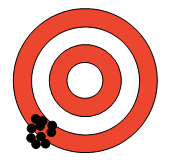
This bullseye demonstrates...
a)
High Accuracy & High Precision
b)
High Accuracy & Low Precision
c)
Low Accuracy & High Precision
d)
Low Accuracy & Low Precision
50.

Calculate the precision of the following numbers.

Number 1 = 2

Number 2 = 3

Number 3 = 5

a)

3.33 + 1.5

b)

3.33 + 1.5

c)

3.3 + 3

d)

3.67 + 3

51.
The students measured length during a science experiement, they got 12 cm. But the actual measurement was 14.25 cm. What was the percent error?
a)
15.79%
b)
18.75%
c)
2.25%
d)
18%
52.

Calculate the precision of the following numbers.

Trial 1 = 13.4 in

Trial 2 = 5.2 in

Trial 3 = 10 in

Trial 4 = 7.7 in

a)

36.3 + 4.1

b)

36.3 + 8.2

c)

9.075 + 8.2

d)

9.075 + 4.1

53.
The deer population is estimated to be 17,600 in northern Illinois, but an actual count was 21,300. What is the percent error?
a)
21%
b)
17.37%
c)
17.4%
d)
21.02%
54.

A skydiver jumps out of a helicopter. What is happening in terms of energy?

a)

He is gaining potential energy as he falls, and losing kinetic energy.

b)

He is gaining kinetic energy as he falls and losing potential energy.

c)

His kinetic and potential energy is always the same.

d)

He is gaining kinetic and potential energy at the same time.

55.

How much work does gravity do on your 63 kg teacher when she trips and falls from a height of 1.5 m?

a)

94.5 J

b)

926.1 J

c)

42 J

d)

411.6 J

56.

Kinley hit the softball with a force of 3000 N and applied 100 kJ of work. How far did the ball go?

a)

30 m

b)

0.03 m

c)

33.33 m

d)

30000 m

57.

How much time does it take a machine with 1200 W power rating to do 42 kJ of work?

a)

12 s

b)

35 s

c)

23 s

d)

44 s

58.
Ms. Hubnik's and Mrs. Stone's classes competed in a game of tug of war. Ms. Hubnik's class pulled to the right with a force of 4,000 N. Mrs. Stone's class pulled to the left with a force of 5,000 N. As a result the rope moved 5.1 m to the left. How much work was done by the net force?
a)
4100 J
b)
3100 J
c)
5100 J
d)
8100 J
59.
When a pendulum swings, at which point is kinetic energy highest?
a)
1
b)
2
c)
3
d)
4
60.

Lilly's cat ran through your yard. The cat has a mass of 5 kg. He is running at a speed of 3 m/s. What is the kinetic energy of the cat as he runs?

a)

8.5 J

b)

45 J

c)

7.5 J

d)

22.5 J

61.
If a crane lifts a small car 15 meters using 25,000 joules of work in 5 seconds, how much power was generated by the crane?
a)
5, 000 Watts
b)
1,667 Watts
c)
75 Watts
d)
375,000 Watts
62.
At which point is kinetic energy greatest? (Click the question to view the picture)
a)
W
b)
X
c)
Y
d)
Z
63.
At which point is potential energy greatest (Click the question to view the picture)
a)
W
b)
X
c)
Y
d)
Z
64.
How high will a 1-kilogram ball go if it is thrown straight up into the air with an initial velocity of 30 m/sec? _
a)
30 m
b)
45.9 m
c)
20 m
d)
9.8 m
65.
A 4.00 kg ball is on a 5.00 m ledge. If it is pushed off the ledge, how much kinetic energy will it have just before hitting the ground?
a)
196 Joules
b)
20 Joules 
c)
100 Joules 
d)
49 Joules
66.
A 0.250 kg cart moving at 0.500 m/s has how much momentum?
a)
0.5 kg*m/s
b)
.125 kg*m/s
c)
12.5 kg*m/s
d)
10 kg*m/s
67.

An explosion of gas from a Hawaiian volcano blows a rock into the sky. the rock has 2000J of kinetic energy. What was its mass if the rock had a velocity of 20km/h

a)

50 Kg

b)

20,000Kg

c)

10Kg

d)

200Kg

68.
A moving 10 kilogram object has 20 Joules of kinetic energy. What is its velocity?
a)
2 m/s
b)
4 m/s
c)
200 m/s
d)
10 m/s
69.

You throw a ball into the air as shown in the diagram. At what point does the ball have the most potential energy?

a)

W

b)

X

c)

Y

d)

Z

70.

At which position does the child on the swing have the most gravitational potential energy?

a)

W

b)

X

c)

Y

d)

Z

71.
If the Total Mechanical Energy is 50J, Potential Energy is 40 J, what is the Kinetic Energy?
a)
1 J
b)
10 J
c)
90 J
72.
Which of the following is NOT true about Potential Energy?
a)
An object's position affects its potential energy
b)
Potential energy is Stored energy
c)
Potential energy only occurs when an object is in motion
d)
All objects have potential energy
73.
At point C, the TME= 500 J, and its PE= 100 J, what is its KE?
a)
600 J
b)
400 J
c)
200 J
d)
100 J
74.
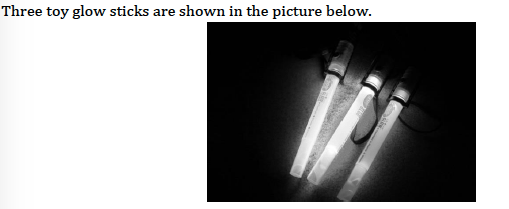
The glow sticks produce light for a short amount of time. The light from the glow stick is a conversion from what to what?
a)
thermal to light
b)
gravitational to potential
c)
radiant to electrical
d)
chemical to light
75.
Wind turbines and windmills convert what energy to another?
a)
Kinetic to electric
b)
Gravitational potential to electric
c)
Mechanical to potential
d)
Thermal to sound
76.
Which of the following best describes the energy transfer that takes place when you use a battery?
a)
Chemical PE -> Electrical
b)
Electrical -> Chemical PE
c)
Nuclear PE -> Electrical
d)
Electrical -> Nuclear PE
77.

How much work is being done in the above picture if she pushes on the stationary wall for 25 seconds with a force of 50 Newtons?

a)

1250 J

b)

2 J

c)

0.5 J

d)

0 J

78.
If you throw a baseball straight up, what is its velocity at the highest point?
a)
9.8 m/s2
b)
9.8 m/s
c)
0 m/s2
d)
0 m/s
79.

If a bullet is horizontally shot at the same moment another bullet is dropped from the same height, which will hit the ground first?

a)

Shot Bullet

b)

Dropped Bullet

c)

Hit at Same Time

d)

It's directly proportional to v2

80.
A ball is thrown horizontally at a height of 2.2 meters at a velocity of 65 m/s. Assume no air resistance. How long until the ball reaches the ground?
a)
0.45 s
b)
0.67 s
c)
0.22 s
d)
0.47 s
81.
A ball is thrown horizontally at a height of 2.2 meters at a velocity of 65 m/s. Assume no air resistance. How far did the ball travel horizontally when it hit the ground?
a)
14.3 m
b)
30.55 m
c)
65 m
d)
43.55 m
82.
A cannonball is fired at a 45.0° angle and an initial velocity of 625 m/s. Assume no air resistance. What is the vertical component of the cannonball’s velocity? What is the horizontal component of the cannonball’s velocity?
a)
-625 m/s; 625 m/s
b)
441.9 m/s; 441.9 m/s
c)
-441.9 m/s; 441.9 m/s
d)
0 m/s; 625 m/s
83.
A cannonball is fired at a 45.0° angle and an initial velocity of 625 m/s. Assume no air resistance. How long until the cannonball hits the ground?
a)
75.4 s
b)
45.2 s
c)
62.3 s
d)
90.2 s
84.
Two objects of the same mass are launched from the ground. Object A has a launch angle of 45, while Object B has a launch angle of 65. Which object has the greatest maximum height height?
a)
A
b)
B
c)
Both objects reach the maximum height
d)
unable to determine with the given information
85.
An object with an initial velocity of 3.50 m/s moves east along a straight and level path. The object then undergoes a constant acceleration of 1.80 m/s2 east for a period of 5.00 s. How far does the object move while it is accelerating?
a)
6.30 m
b)
17.5 m
c)
27.2 m
d)
40.0 m
86.
A boat travels 12.0 m while it reduces its velocity from 9.5 m/s to 5.5 m/s. What is the magnitude of the boat’s acceleration while it travels the 12.0 m?
a)
1.3 m/s2
b)
2.5 m/s2
c)
3.0 m/s2
d)
7.5 m/s2
87.
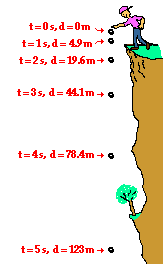
What happens to the velocity of a ball as it is dropped off a cliff? 
a)
It decreases at a uniform rate 
b)
It increases at a uniform rate 
c)
It is constant 
d)
It increases at a non-uniform rate
88.
An airplane accelerates down a runway at 3.20 m/s2 for 32.8 s until is finally lifts off the ground. Determine the distance traveled before takeoff.
Which equation is appropriate?
a)
v=vo+at
b)
Δx=vot+1/2at2
c)
v2=vo2+2aΔX
d)
Δx=((v+vo)/2)t
89.
A car is traveling to the right with a speed of 29​​m/s when the rider slams on the accelerator to pass another car. The car passes in 110 m with constant acceleration and reaches a speed of 34m/s. We want to find the acceleration of the car as it sped up. What equation should you choose?
a)
v=vo+at
b)
Δx=vot+1/2at2
c)
v2=vo2+2aΔX
d)
Δx=((v+vo)/2)t
90.
Which has more momentum: a car stopped at a red light or a bike moving at 15 mph?
a)
car
b)
bike
c)
they are equal
d)
cannot determine using the info provided
91.
A 2.5 kg ball moving at 5 m/s collides with a 2.5 kg stationary ball in a perfectly elastic collision.  What is the velocity of the second ball after the collision? 
a)
5 m/s
b)
2.5 m/s
c)
10 m/s
d)
7.5 m/s
92.
A boy kicks a football with a force of 20 N, the time the force acts for is 0.3 s.
Calculate the impulse on the ball.
a)
1 N*s
b)
6 N*s
c)
33.3 N*s 
d)
None of these
93.
While playing pool, the white cue ball strikes the 8 ball. Before the collision, the cue ball's velocity was 10 m/s and the 8 ball was at rest. If both ball's have a mass of 0.15 kg and the cue ball's velocity after the collision is 2 m/s, what is the 8 ball's velocity?
a)
2 m/s
b)
8 m/s
c)
-2 m/s
d)
1.5 m/s
94.
In a physics experiment, two carts of mass 1.5 kg each are rolled towards each other.  The orange cart has a velocity of 2 m/s and the blue cart has a velocity of -1m/s.  The carts stick together when they collide.  Calculate their final speed.
a)
0.5 m/s
b)
1.0 m/s
c)
0.33 m/s
d)
0.67 m/s
95.
A 120 kg lineman moving at -2 m/s tackles an 80 kg fullback moving at +8 m/s. If the fullback's velocity after they collide is +2 m/s, what is the lineman's velocity?
a)
2 m/s
b)
8.7 m/s
c)
4.7 m/s
d)
6 m/s
96.

A baseball bat applies a force of 500 N to a ball for 0.1s. What was the impulse on the ball?

a)

5 N . s

b)

500 N .s

c)

500 N/s

d)

50 N.s

97.
The forces represented by the arrows in the diagrams are applied to the four objects that are at rest on a table. Which object is most likely to move to the right?
a)
Object W
b)
Object X
c)
Object Y
d)
Object Z
98.

The equation F=ma relates to one of Newton's Three Laws of Gravity. Which law of gravity does it relate to?

a)

Newton's First Law

b)

Newton's Second Law

c)

Newton's Thirds Law

99.
Newtons 1st law of motion states:
a)
An object in motion will stay in motion and an object in rest will stay in rest unless acted upon by and unbalance force.
b)
For every action there is an equal and opposite reaction. 
c)
Acceleration is produced when a force. acts on a mass. 
d)
The greater the mass  the greater the amount of force needed to change its motion. 
100.
A 50 kg skater pushed by a friend accelerates 5 m/sec2.  How much force did the friend apply?
a)
45 N
b)
15 N 
c)
10 N
d)
250 N
101.
A force of 250 N is applied to an object that accelerates at a rate of 5 m/sec2.  What is the mass of the object?
a)
100kg 
b)
1,250kg
c)
50kg
d)
5kg
102.
Determine the accelerations that result when a 12-N net force is applied to a 3-kg object and then to a 6-kg object.
a)
A 3-kg object experiences an acceleration of 2 m/s/s. A 6-kg object experiences an acceleration of 2m/s/s.  
b)
A 3-kg object experiences an acceleration of 4 m/s/s. A 6-kg object experiences an acceleration of 2 m/s/s.  
c)
A 3-kg object experiences an acceleration of 2 m/s/s. A 6-kg object experiences an acceleration of 4 m/s/s.  
d)
A 3-kg object experiences an acceleration of 4 m/s/s. A 6-kg object experiences an acceleration of 4 m/s/s.  
103.
The force of gravity on Jupiter is a little more than 2 times the gravitational force on Earth. If an object has a mass of 50 kg and a weight of 490 N on Earth, what would be the object's approximate mass and weight on Jupiter?
a)
50 kg and 490 N
b)
100 kg and 490 N
c)
50 kg and 980 N
d)
100 kg and 980 N
104.
If a bowling ball and a feather were dropped at the same time, in a room with no air resistance (vacuum), which object will hit the ground first?
a)
Bowling Ball
b)
Feather
c)
Both would hit at the same time
d)
Neither one would hit the ground because air is what pushing things down.
105.
A magician pulls a tablecloth out from under dishes and glasses on a table without disturbing them.
a)
Newton's 1st Law
b)
Newton's 2nd Law
c)
Newton's 3rd Law
106.

The picture is an example of Newton's...

a)

1st Law

b)

2nd Law

c)

3rd Law

107.
Two examples of a pulley...
a)
knife & axe blade
b)
lightbulb & screw
c)
flagpole hoist & window blinds
d)
catapult & teeter totter
108.
A simple machine is a device that helps to reduce the amount of _____ required to work.
a)
force
b)
energy
c)
work
109.
Stairs
a)
wedge
b)
pulley
c)
inclined plane
d)
wheel and axle
110.
a)
1st Class
b)
2nd Class
c)
3rd Class
d)
It is not a lever
111.
a)
1st Class
b)
2nd Class
c)
3rd Class
d)
It is not a lever
112.
a)
1st Class
b)
2nd Class
c)
3rd Class
d)
It is not a lever
113.
A fishing pole is an example of a compound machine. What simple machines are used to make up this compound machine?
a)
lever, wheel and axle, pulley
b)
wheel and axle, inclined plane, pulley
c)
wheel and axle, pulley, inclined plane
114.

A box of weight W is lifted by a force F using a lever as shown below.

What is the mechanical advantage of the lever (MA=Input Distance/Output Distance)?

a)

0.5

b)

2

c)

3

d)

6

115.

Using a lever, Joe is able to lift a 10,000 N car off of the ground with a force of 1000 N. What is the mechanical advantage of the lever (MA=Output Force/Input Force)?

a)

1

b)

10

c)

100

d)

1000