wayground logo

Free Printable Worksheets

Font size

S
M
L
XL
Worksheets

Term 4 - Final - Review Game

Total questions: 119

Worksheet time: 2hrs 59mins

Name
Class
Date
1.
The momentum of an object depends upon the object's ___________&_____________.  
a)
size and shape
b)
mass and speed
c)
mass and veloctiy
d)
mass and energy
2.
The equation to calculate momentum is
a)
p=mv
b)
p=1/2mv2
c)
p=mgh
d)
p=mg
3.
Which has more momentum: a car stopped at a red light or a bike moving at 15 mph?
a)
car
b)
bike
c)
they are equal
d)
cannot determine using the info provided
4.
Determine the momentum of 1000-kg car moving southward at 20 m/s......... 
a)
20000 N
b)
20000 Joules
c)
20000 Kg * m/s south
d)
10000 kg * m/s south
5.
A 2.5 kg ball moving at 5 m/s collides with a 2.5 kg stationary ball in a perfectly elastic collision.  What is the velocity of the second ball after the collision? 
a)
5 m/s
b)
2.5 m/s
c)
10 m/s
d)
7.5 m/s
6.
A 9300 kg railroad car traveling at a velocity of 5 m/s strikes a second boxcar that weighs 5000 kg at rest. At what speed will the second boxcar move?
a)
18.6 m/s
b)
9.3 m/s
c)
7.5 m/s
d)
1.86 m/s
7.
Momentum is a ____________________ quantity
a)
science
b)
scalar
c)
vector
d)
energy
8.
A boy kicks a football with a force of 20 N, the time the force acts for is 0.3 s.
Calculate the impulse on the ball.
a)
1 N*s
b)
6 N*s
c)
33.3 N*s 
d)
None of these
9.
The impulse is ______ the change in momentum
a)
Greater than
b)
Equal to
c)
less than
d)
always double
10.
In any collision (crash) the ______ is ALWAYS constant
a)
Total Momentum
b)
total speed
c)
total Velocity
d)
Energy
11.
When two objects collide, the Pbefore is ____________ the Pafter.
a)
more than 
b)
less than 
c)
equal to
d)
unrelated to
12.
Which of the following has the greatest momentum? 
a)
a scurrying cockroach
b)
a parked semi-truck
c)
more information is needed
13.
When the speed of an object is doubled, its momentum
a)
remains unchanged in accord with the conservation of momentum.
b)
doubles
c)
quadruples
d)
decreases
14.
Which object listed below has the greatest momentum?
a)
A 0.05 kg object rolling at 0.2 m/s.
b)
A 0.15 kg object rolling at 2 m/s.
c)
A 0.15 kg object rolling at 1 m/s
d)
A 0.4 kg object rolling at 2 m/s.
15.
Which of the following has the least amount of momentum?
a)
An ant walking along the ground
b)
An ant at rest
c)
An elephant walking
d)
An elephant running
16.
What is the unit for momentum?
a)
m/sec
b)
kg/sec
c)
kg/m
d)
kg m/sec
17.
What is the unit for velocity?
a)
m/sec
b)
kg/sec
c)
kg/m
d)
kg m/sec
18.
What is the unit for mass?
a)
m/sec
b)
kg/sec
c)
kg
d)
kg m/sec
19.
A 0.250 kg cart moving at 0.400 m/s has how much momentum?
a)
0.1 kg-m/s
b)
1 kg-m/s
c)
10 kg-m/s
d)
100 kg-m/s
20.
Determine the momentum of 1000-kg car moving northward at 20 m/s......... 
a)
20000 N
b)
20000 Joules
c)
20000 Kg * m/s
d)
20000 kg * m/s north
21.

An impulse depends on

a)

weight and force

b)

force and time

c)

electric charge and time

d)

none of these

22.

An object having a pi of 30kg m/s has ended with a pf of 40 kg m/s. What impulse caused this?

a)

2kg m/s

b)

10kg m/s

c)

70kg m/s

d)

5kg m/s

23.

If the change of momentum of an object is 50kg m/s, we can say the impulse is equal to:

a)

0 kg m/s

b)

25 kg m/s

c)

50 kg m/s

d)

100 kg m/s

24.

An object has pi of 20 kgm/s and then pf of 30 kgm/s. If it took 2s, what is the force?

a)

10N

b)

4N

c)

5N

d)

50N

25.

An object has Pi of 20 kgm/s ends with a Pf of 40 kgm/s. How long would a 5N force need to act?

a)

3s

b)

8s

c)

7s

d)

4s

26.

An object with 20kgm/s is stopped by a force of -20N, how long does it take to do this?

a)

2s

b)

1s

c)

4s

d)

5s

27.

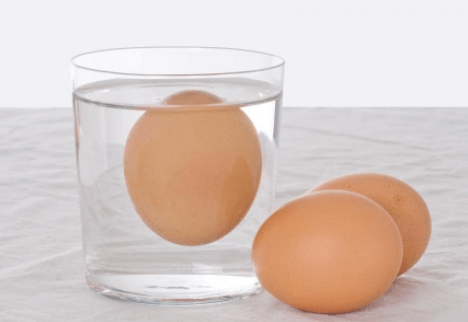
An egg gets dropped from a height of 0.1 meters and cracks. A second egg gets dropped from the same height but this time it lands on a glass of water and does not break. In terms of impulse.

a)

1st egg experienced more impulse

b)

2nd egg experienced more impulse

c)

both experienced the same impulse

28.

An egg gets dropped from a height of 0.1 meters and cracks. A second egg gets dropped from the same height but this time it lands on a glass of water and does not break. In terms of force and time, the second egg must have experienced...

a)

more force, but less time

b)

less force, but more time

c)

more force, and more time

d)

less force, and less time

29.

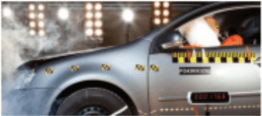
The air bag on a car reduces the force experienced by the driver, by extending the time of impact.

a)

True

b)

False

30.

Impulse is equal to the variables shown in the equation below.

a)

True

b)

False

31.

In an equation Impulse is represented with the letter...

a)

I

b)

M

c)

J

d)

P

32.

You find that an objects final momentum is 45kg m/s, and the impulse that caused this was 45kg m/s, what must have been the objects initial momentum?

a)

45kg m/s

b)

0 kg m/s

c)

22.5kg m/s

d)

need more information

33.
Energy of a rock perched on a cliff is an example of...
a)
gravitational
b)
elastic
c)
chemical
d)
kinetic
34.
Energy from a compressed spring would be an example of...
a)
kinetic
b)
elastic
c)
gravitational
d)
chemical
35.
How do you calculate power?
a)
P = W/t
b)

P = E/W

c)
P = w * t
d)
P = bbq/chicken
36.
The energy of movement is...? 
a)
Kinetic
b)
Potential
37.
Energy that is stored is called...
a)
Kinetic
b)
Potential 
38.
The SI unit of work is?
a)
Joules
b)
Watts
c)
Newtons
d)
meters
39.
The SI unit for power is...?
a)
Watts
b)
Joules
c)
Newtons
d)
Meters
40.
What is the formula for Kinetic Energy?
a)
PE = m*g*h
b)
KE = 1/2m*v2
c)
W = F*d
d)
P = W/t
41.
A force exerted over a distance to move an object is ______________________.
a)
power
b)
work
c)
momentum
d)
Watt
42.
The faster an object moves, the ________ kinetic energy it has. 
a)
more
b)
less
c)
none of the above
d)
all of the above 
43.
Gravitational potential energy depends on the ________ and ________ of the object. 
a)
Height and mass
b)
Friction and movement
c)
Mass and Movement
d)
Height and Friction 
44.
What is the formula for calculating the total amount of mechanical energy?
a)
ME = KE + PE
b)
KE = ME + PE
c)
PE = KE + ME
d)
ME = 1/2 mv2
45.
Why does the total amount of mechanical energy stay constant in a system?
a)
energy is not created or destroyed
b)
energy leaves
c)
energy enters
d)
energy is not converted from one form into another
46.

A 10 gram ball is rolling at 3 m/s. How much energy does it have?

a)

30 J

b)

15 J

c)

4.5J

d)

.045J

47.

A 10 gram ball is held 2 meters from the ground. How much energy does it have?

a)

0 J

b)

.2 J

c)

2 J

d)

20 J

48.

A 10 gram ball is held 2 meters from the ground. What type of energy does the ball have?

a)

Kinetic Energy

b)

Elastic Potential Energy

c)

Gravitational Potential Energy

49.

You serve a volleyball with a mass of 2100 g. The ball leaves your hand with a velocity of 30 m/s. How much kinetic energy does the volleyball have?

a)

945 J

b)

1890 J

c)

94500 J

d)

189000 J

50.

A toy baby carriage is sitting at the top of a hill that is 21 m high. The carriage with the baby has a mass of 200 grams. How much potential energy does the baby carriage+ baby system have?

a)

.42 J

b)

4.2 J

c)

42 J

d)

42000 J

51.

A toy car is traveling with a velocity of 4 m/s and has a mass of 1120 g. How much kinetic energy does the toy car have?

a)

8.96J

b)

8960 J

c)

17.92 J

d)

17920 J

52.

Two objects were lifted by a machine. Object A had a mass of 2000 grams, and was lifted at a speed of 2 m/sec. Object B had a mass of 4000 grams and was lifted at a rate of 3 m/sec. Which object had a higher amount of kinetic energy when lifted?

a)

Object A

b)

Object B

c)

Both are the same since they travelled the same distance

d)

Not enough information

53.

A ball is thrown into the air and gains 25 J of GPE. If it has a mass of 0.5 kg, How high up into the air did it travel?

a)

.02 m

b)

.2 m

c)

2 m

d)

20 m

54.

A 45N girl sits on a 8N bench that is .5 m tall. How much work is done on the bench?

a)

0 J

b)

22.5 J

c)

18.5 J

d)

26.5 J

55.

A boy lifts a 30N dragon 2 meters above the ground.  How much work did the boy do on the dragon?

a)

60 J

b)

600 J

c)

15 J

d)

150 J

56.

Suppose you want to calculate how much work it takes to lift a 160 N barbell. Besides the mass of the barbell, what other information do you need to know?

a)

the shape of the weights

b)

how high the barbell is being lifted

c)

the strength of the person diong the lifting

d)

how quickly the lifts are being done

57.

If you are in a car that is being pulled down a 56.0 m path with a force of 12.5 Newton’s (N), what is the “work” done on the car?

a)

70 J

b)

700 J

c)

350 J

d)

7000 J

e)

3500 J

58.

A crane does work of 13,500 J with a force of 5200 N to lift a beam. How far can the beam be lifted (in meters)?

a)

702 M

b)

70200000 m

c)

2.6 m

d)

26 M

59.

A 600 kg great white shark is lurking below an observation cage. His movement is being studied from a series of motion sensors below the boat. The shark leisurely charges the cage, strikes it and makes the cage rattle. Later, the shark returns for another run at the cage. The shark strikes the cage with 12,800 N of force.  The shark traveled for 10 m in making its run. The cage is designed to withstand 124,500 N-m of “work” before it breaks.  Should the man in the cage be worried? 

a)

Yes, because the shark is doing more work on the cage than it can withstand

b)

No, because the shark is not doing enough work on the cage to get it to break

60.

A person weighing 600 N gets on an elevator.  The elevator lifts the person 6 m in 10 seconds.  How much power was used?

a)

60 W

b)

600 W

c)

36 W

d)

360 W

61.

How much time is needed to produce 720 Joules of work if 90 watts of power is used?

a)

64800 sec

b)

6 sec

c)

7 sec

d)

8 sec

62.

If 68 W of power is produced in 18 seconds, how much work is done?

a)

1080 J

b)

180 J

c)

3.33 J

d)

0 J

63.

A set of pulleys lifts an 800 N crate 4 meters in 7 seconds. What power was used?

a)

457.1 W

b)

1400 W

c)

.035 W

d)

28.6 W

64.

If a runner exerts 350 J of work to make 125 W of power, then how long did it take the runner to do the work?

a)

2.4 sec

b)

2.8 sec

c)

8.2 sec

d)

1.1 sec

65.

If 360 Joules of work are needed to move a crate a distance of 4 meters in 5 sec, what is the power used?

a)

72 W

b)

144 W

c)

60 W

d)

36 W

66.

A 4357-kg roller coaster car starts from rest at the top of a 36.5 m high track. Determine the speed of the car at the top of a loop that is 10.8 m high.

a)

22.4 m/s

b)

2.24 m/s

c)

27.01 m/s

d)

2.7 m/s

67.

A 4.00 kg ball is on a 5.00 m ledge. If it is pushed off the ledge, how much kinetic energy will it have just before hitting the ground?

a)

20 J

b)

200 J

c)

2000 J

d)

50 J

68.

How fast must a 1000 kg car be moving to have a kinetic energy of 400 000 J?

a)

22.7 m/s

b)

28.28 m/s

c)

800 m/s

69.
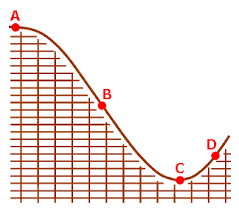
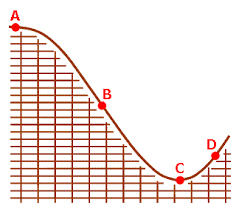
At which point(s) on the roller coaster is the gravitational potential energy at its maximum?
a)
A
b)
B
c)
C
d)
D
70.
At which point(s) on the roller coaster is the kinetic energy at its maximum?
a)
A
b)
B
c)
C
d)
D
71.

Select all: Work is equal to...

a)

KE + PE

b)

Change in energy

c)

mg

d)

Fd

72.
What is the difference between calculating power and work?
a)
Power takes into account the time it takes to complete a task
b)
Work takes into account the time it takes to complete a task
c)
Power is force/area
d)
Work is force/area
73.
Gravitational potential energy depends on the ________ and ________ of the object. 
a)
Height and mass
b)
Friction and movement
c)
Mass and Movement
d)
Height and Friction 
74.

Bobby lifts a book to the second floor in 20 seconds. Carol lifts the same book to the second floor in 10 seconds. Who did more work?

a)

Bobby

b)

Carol

c)

They did the same amount of work

d)

Not enough information

75.

A girl weighs 400 N. She runs up a flight of stairs of height 5 m in 4 seconds. Her power is:

a)

320 W

b)

400 W

c)

500 W

d)

2 000 W

76.
Groot rescues Rocket from the bottom of a deep pit. Groot expends 1000 J of energy lifting Rocket who has a mass of 50 kg out of the pit. How deep is the pit?
a)
0.5 m
b)
2 m
c)
4 m
d)
10 m
e)

20 m

77.

When an object is carried at a constant

velocity by a force,

a)

no work is done on the

object.

b)

the work done is maximum on the

object.

c)

the work is done minimum on the

object.

d)

the work done is 100 % on the

object.

78.
What type of energy is in this picture?
a)
Kinetic
b)
Potential
c)
Chemical
d)
Sound
79.
A battery converts what type of energy to another?
a)
sound to kinetic
b)
light to heat
c)
mechanical to electrical
d)
chemical to electrical
80.

The SI Unit for Energy is

a)

Joule

b)

Newton

c)

Calorie

d)

Watt

81.

Which of the following is defined as an energy transfer?

a)

kinetic energy

b)

work

c)

potential energy

d)

chemical energy

82.

A light plastic cart and a heavy steel cart are both pushed with the same force for a distance of 1.0 m, starting from rest. After the force is removed, the kinetic energy of the light plastic cart is ________ that of the heavy steel cart.

a)

greater than

b)

equal to

c)

less than

d)

can't say unless we know how big the force is

83.

Each of the boxes shown is pulled for 10 m across a level, frictionless floor by the force given. Which box experiences the greatest change in its kinetic energy?

a)

A

b)

B

c)

C

d)

D

e)

E

84.

Rank in order, from largest to smallest, the gravitational potential energies of the balls.

a)

1 > 2 = 4 > 3

b)

1 > 2 > 3 > 4

c)

3 > 2 = 4 > 1

d)

3 > 2 > 4 > 1

85.

A small child slides down the four frictionless slides A–D. Rank in order, from largest to smallest, her speeds at the bottom.

a)

vD > vA > vB > vC

b)

vD > vA = vB > vC

c)

vC > vA > vB > vD

d)

vA = vB = vC = vD

86.

If a charging elephant has kinetic energy, it must also have

a)

potential energy

b)

momentum

c)

work

d)

all of these

87.

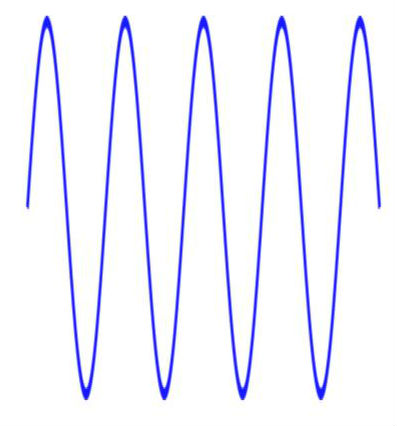
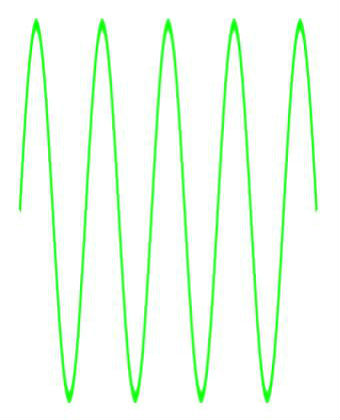
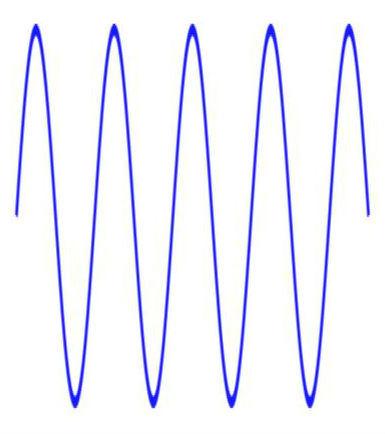
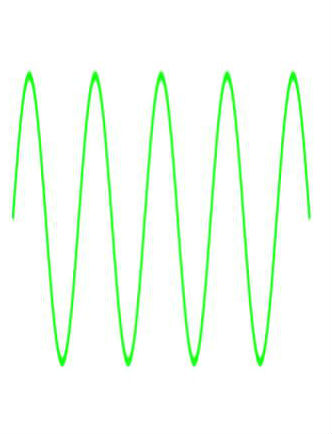
Which sound wave shows the sound with the highest pitch?
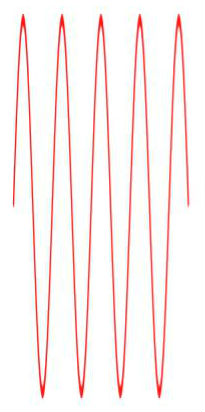
a)
b)
c)
88.

Which sound wave shows the loudest sound?
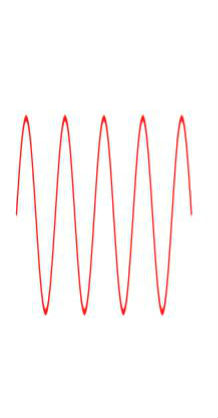
a)
b)
c)
89.
Which choice below correctly explain frequency?
a)
The frequency is based on how many times per second a wave passes a given point.
b)
The frequency is based on how many seconds it takes for a wave to pass a single point.
c)
The frequency is how many times a wave crests before forming a trough.
d)
The frequency is the wavelength times the speed ofthe wave.
90.
Which three of the following choices are correct units for measuring a frequency? (Choose 3)
a)
Cycles/ Second
b)
Hertz
c)
Wavelengths/Second
d)
Meters/Second
e)
Decibels
91.
What is the period of a wave?
a)
The time of day that the wave is most active.
b)
The time it takes for the wave to pass a single point.
c)
The end of a wave.
d)
The number of waes that pass a single spot in 1 second.
92.
Which three of the following descriptions are true of wave motion? (Choose 3)
a)
Waves involve the movement of matter from one location to another.
b)
Waves involve the transport of energy from on location to another.
c)
As waves pass through a medium, particles of the medium undergo a back-and-forth vibration about a fixed position.
d)
Waves involve periodic and repeated disturbances of the medium.
93.
To be a wave, what 3 properties need to be true? (choose 3)
a)
Energy is traveling
b)
Particles are Oscillating (vibrating)
c)
Energy is being transferred between the particles
d)
The energy is causing the material to permanently deform
94.
Which picture below is showing a transverse wave?
a)
.
b)
..
c)
...
95.
Which picture below is showing a longitudinal wave?
a)
...
b)
..
c)
.
96.
Olive Udadi accompanies her father to the park for an afternoon of fun. While there, she hops on the swing and begins a motion characterized by a complete back-and-forth cycle every 5.0 seconds. This statement provides info about the child's _____.
a)
speed
b)
frequency
c)
period
97.
The speed of a wave refers to
a)
how often it vibrates to and fro.
b)
how high it vibrates
c)
how much time it takes to vibrate to and fro.
d)
how far a given point on a wave (e.g. a crest) travels per unit time
98.
What is a standing wave?
a)
A transverse wave where the energy is moving vertically and the medium is moving horizontally.
b)
A wave pattern that happens when a wave reflects back on itself causing positions of the wave to look stationary.
c)
What you do at a sporting event
d)
A wave frozen in time
99.
What is A pointing at in the diagram below?
a)
Node
b)
Antinode
c)
Wavelength
d)
Harmonic
100.
What is B pointing at in the diagram below?
a)
Node
b)
Antinode
c)
Wavelength
d)
Harmonic
101.
Which picture below is sowing the fundamental harmonic of the standing wave?
a)
...
b)
..
c)
.
102.
When a wave hits a boundary between two different materials, what will happen if the wave is transmitted into the new material?
a)

The wave's path will either bend towards or away from the boundary.

b)

The wave will bounce off the boundary

c)

The wave will split into two different waves and continue traveling through both media

d)

The wave will scatter

103.
The two waves pictured are about to interfere with each other. Which choice below shows what the interference will look like?
a)
.
b)
..
c)
...
d)
....
104.
The two waves pictured are about to interfere with each other. Which choice below shows what the interference will look like?
a)
.
b)
..
c)
...
d)
....
105.
When two waves of the same wavelength meet their amplitudes, for a single wavelength, combine and the resulting wave can have a larger or smaller amplitude. This describes which of the 4 properties of waves?
a)
Reflection
b)
Transmission/Refraction
c)
Diffraction
d)
Interference
106.
When a wave is partially blocked, part of the unblocked wave will continue in a straight line, while the other part of the unblocked wave will bend around the corner of whatever is blocking part of the wave. This describes which of the 4 properties of waves?
a)
Reflection
b)
Transmission/Refraction
c)
Diffraction
d)
Interference
107.
When a wave refracts, the wave will bend towards (imitates) the boundary if what is true?
a)
The wave is leaving a material that it can move fast in into a material that it moves slower in.
b)
The wave leaves a less dense material into a move dense material.
c)
The wave leaves a material that it moves slowly through into a material that it can move faster through
d)
The wave leaves a more dense material into a less dense material.
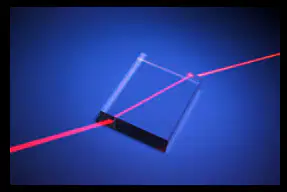
108.
Which property of waves is being demonstrated in the image?
a)
Reflection
b)
Transmission/Refraction
c)
Diffraction
d)
Interference
109.
When a wave hits a surface and changes direction (bounces) back away from the surface which property of a wave is it demonstrating?
a)
Reflection
b)
Transmission/Refraction
c)
Diffraction
d)
Interference
110.
An echo is an example of which of the 4 properties of a sound wave?
a)
Reflection
b)
Transmission/Refraction
c)
Diffraction
d)
Interference
111.
Musicians do their best to sing, play, produce sound waves that are in tune. When in tune, the sound sounds significantly louder than when it is not in tune. Which choice below best explains why this happens?
a)
When musicians are in tune, they are all producing the coherent (in phase) waves that constructively interfere with each other, resulting in a louder sound than if the musicians were playing individually.
b)
When the musicians are in tune, they aer making sure the beat frequency of the tones they are playing are countering each other, resulting in a smoother, louder sound.
c)
When playing in tune, the musicians are effectively interfering with the outside sound and causing the outside wavelngths to be destroyed, which makes what they are playing louder.
d)
It has nothing to do with what they are playing, and everything to do with the listener's ears perfering in tune sound. The listener's brain amplifies the pleasant sounds, while actively dampening the unpleasant, dissonant sounds.
112.
When listening to a musical group, sometimes the sound you hear sounds wavy, or wobbly, making a wah wah sound even though the musicians aren't actually changing note or pitch. What is going on?
a)
The musicians are in tune, and so the frequencies of sound you are hearing a resonating with your body, making you feel the sound waves.
b)
The individual musicians are playing just slightly different frequencies. these frequencies are interfering with each other resulting in loud and soft spots that we experience as beats or a wah wah sound.
c)
The local movements and temperatures of the air are causing the sound waves to diffract before they reach your ear. the different diffracted waves hit your ear and slightly different times, resulting in louder and softer spot or the wah wah sound.
113.
Which image below is showing and example of Light reflecting?
a)
Rainbow Disc
b)
Lovely Landscape
c)
Eau de Canard
d)
Don't open that DOOR!
114.
Which image below is showing and example of Light transmitting and refracting?
a)
Rainbow Disc
b)
Lovely Landscape
c)
Eau de Canard
d)
Don't open that DOOR!
115.
Which image below is showing and example of Light diffracting?
a)
Rainbow Disc
b)
Lovely Landscape
c)
Eau de Canard
d)
Don't open that DOOR!
116.
What type of wave's particles undergo compression and rarefaction?
a)
Transverse
b)
Longitudinal
c)
Ocean
d)
Surface
117.
What is the frequency of the wave if 30 wavelengths pass by a spot in 1 minute?
a)
2 Hz
b)
1.5 Hz
c)
1 Hz
d)
0.5 hz
e)
0.25 Hz
118.
The lowest frequency the average human can hear is 20 Hz. How long would it take for one wavelength to pass by you art this frequency?
a)
20 seconds
b)
5 seconds
c)
2 seconds
d)
0.05 seconds
e)
0.02 seconds
119.
What is the velocity of a wave with a frequency of 50 Hz and a wavelength 0.2 m? v = λf
a)
1
b)
5
c)
10
d)
15
e)
20