
 Worksheets
LIGHT
Total questions: 105
Worksheet time: 1hrs 21mins
No matter how far you stand from a spherical mirror, your image appears erect. The mirror may be
only plane
only concave
either plane or convex
only convex
Power of’ a lens is the (a) of its focal length
A ………. lens will always give a virtual, erect and diminished image, irrespective of the position of the object.
(a)
A positive sign in the value of magnification indicates that the image is
real
virtual
enlarged
near
The SI unit of power is (a)
A ray of light is travelling from a rarer medium to a denser medium. While entering the denser medium at the point of incidence, it
goes straight into the second medium
bends towards the normal
bends away from the normal
does not enter at all
If the image is formed in front of the mirror, then the image distance will be
positive or negative depending on the size of the object
neither positive nor negative
positive
negative
A ray of light coming parallel to the principal axis after passing through a convex lens, has passed through its
optical centre
focus
center of curvature
mid point
A spherical mirror and a thin spherical lens have focal length of −20 cm. The mirror and lens will be:
both concave
mirror is concave and lens is convex
both convex
mirror is convex and lens is concave
A small air bubble in a glass block when seen from above appears to be raised because of
refraction of light
reflection of light
reflection and refraction of light
none of the above
To get real magnified image in convex lens, the object position is
in between lens and F
in between F and 2F
at 2F
beyond 2F
A ray of light is travelling in a direction perpendicular to the boundary of a parallel glass slab. The ray of light
Is refracted towards the normal
Is refracted away from the normal
Is reflected along the same path
Does not get refracted
. A ray of light passes from a medium X to another medium Y. No refraction of light occurs if the ray of light hits the boundary of medium Y at an angle of:
120o
0o
90o
45o
Centre point of a lens is called (a)
A point object is placed at a distance of 20 cm from a convex mirror of focal length 20 cm. The image will form at
at infinity
at focus
at the pole
behind the mirror
flint glass n=1.70
barium glass n=1.60
crown glass n=1.523
water n=1.33
diamond n=2.45
flint glass n=1.70
barium glass n=1.60
crown glass n=1.523
water n=1.33
diamond n=2.45


diamond n=2.45
flint glass n=1.70
barium glass n=1.60
crown glass n=1.523
When light falls on a smooth polished surface, most of it
is reflected in the same direction
is reflected in different directions
is scattered
is refracted into the second medium

A student does the experiment on tracing the path of a ray of light passing through a rectangular glass slab for different angles of incidence. He can get a correct measure of the angle of incidence and the angle of emergence by following the labelling indicated in figure:
I
II
III
IV
If the image is formed in front of the mirror, then the image distance will be
positive or negative depending on the size of the object
positive
negative
neither positive nor negative
When the object is placed between f and 2f of a convex lens, the image formed is
at f
at 2f
beyond 2f
between O and f
A spherical mirror and a spherical lens each have a focal length of -10 cm. The mirror and the lens are likely to be
the mirror is convex and the lens is concave
the mirror is concave and the lens is convex
both convex
both concave
Focal length of a concave mirror is
negative
positive
depends on the position of object
depends on the position of image
The image formed by a convex lens can be
virtual image is not formed
virtual and of same size
virtual and diminished
virtual and magnified
If an incident ray passes through the focus, the reflected ray will
pass through the pole
be parallel to the principal axis
retrace its path
pass through the center of curvature
The speed of light in vacuum is
3×10⁸m/s
2.8×10⁸m/s
3×10⁷m/s
3×10⁹m/s
Power of a lens is the ………. of its focal length.
value
reciprocal
2 times
half
Image formed by reflection from a plane mirror is
real and inverted
virtual and erect
real and erect
virtual and inverted
Magnifying power of a concave lens is
can have any value
always = 1
always < 1
always > 1
A point object is placed at a distance of 20 cm from a convex mirror of focal length 20 cm. The image will form at:
at infinity
at focus
at the pole
behind the mirror
If the power of a lens is – 2 D, what is its focal length?
+50 cm
-50 cm
-100 cm
+100 cm
If the magnification produced by a lens has a negative value, the image will be
real and inverted
real and erect
virtual and erect
virtual and inverted
Which mirror can produce a virtual, erect and magnified image of an object?
Both concave and convex mirrors
Plane mirror
Convex mirror
Concave mirror
A ray of light is travelling from a rarer medium to a denser medium. While entering the denser medium at the point of incidence, it
does not enter at all
goes straight into the second medium
bends away from the normal
bends towards the normal
A ………. mirror is used as a head mirror by the doctors to concentrate light on the body parts to be examined.
concave
convex
No matter how far you stand from a spherical mirror, your image appears erect. The mirror may be plane or convex mirror.
True
False
The optical phenomena, twinkling of stars, is due to
Atmospheric reflection
Total reflection
Atmospheric refraction
Total refraction
When a ray of light entering from air is incident on the surface of a glass slab at an angle of 90°, the measure of angle of refraction=
(a)
The type of mirror used in reflector in automobile lights is
Plane mirror
Concave mirror
Convex mirror
None of the above
A mirror having focal length –15 cm is _________________
Plane mirror
Concave mirror
Convex mirror
None of these
Assertion: For observing the traffic at the hairpin bend in the mountains a plane mirror is preferred over convex or concave mirror.
Reason: A convex mirror has a much larger field view than a plane mirror or a concave mirror.
Both Assertion and Reason are true and Reason is the correct explanation of Assertion.
Both Assertion and Reason are true but Reason is not the correct explanation of Assertion.
Assertion is true but Reason is false.
Assertion is false but Reason is true.
Which of the following characteristics are correct for the image formed in a plane mirror?
I. Upright
II. Inverted
III. Real
IV. Same size as the object
V. Virtual
I, II, III
I, III, IV
I, IV, V
III, IV, V
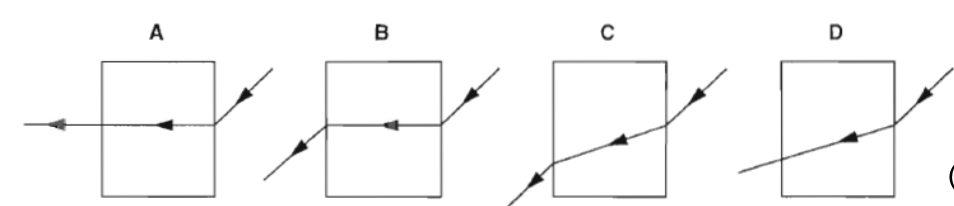
A ray of light travels from air into a glass block.
Which diagram correctly shows the path of the ray through the glass block?
A
B
C
D
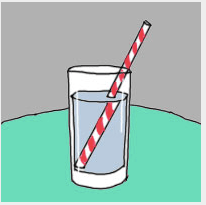
Why does the straw appear to be bent?
light is reflected
light is absorbed
light is turned
light is refracted
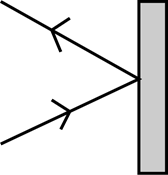
In the illustration, the light ray striking the object is-

When light hits an area and bounces back it is called:
echo
refraction
reflection
absorbing
When light goes from one material(medium) to another it becomes bent, what term means bent?
reflected
refracted
absorbed
turned
Why does the straw appear to be bent?
light is reflected
light is absorbed
light is turned
light is refracted
When light passes from air to water, what happens to the speed of the light?
speeds up
slows down
stays the same

What is the best explanation for Mickey seeing himself in the mirror?
refraction
absorbed
reflection
flipped

What is happening in this picture?
Reflection
Refraction

What is the angle of reflection (θr) in the image?
56o
90o
124o
34o

Which of the following characteristics are correct for the image formed in a plane mirror?
I. Upright
II. Inverted
III. Real
IV. Same size as the object
V. Virtual
I, II, III
I, III, IV
I, IV, V
III, IV, V
Which of the following factors contributes to the bending of light?
Change of speed of light
Change of density of light
Change of colour of light
Change of energy of light
flint glass n=1.70
barium glass n=1.60
crown glass n=1.523
water n=1.33
diamond n=2.45
When the light passes out of the glass, back into the air
It bends away from the normal
It does not bend
It bends towards the normal
It continues to be the normal
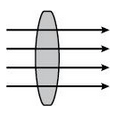
Which figure represents the path light takes through a converging lens?
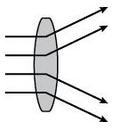
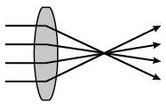
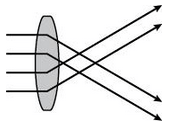
The type of mirror used in reflector in automobile lights is
Plane mirror
Concave mirror
Convex mirror
None of the above

What can you use to see all the different colors in white light?
A flashlight
A shadow
A camera
A prism

What is it called when light bends as it moves from one substance to another?
Absorption
Reflection
Refraction
Incidence


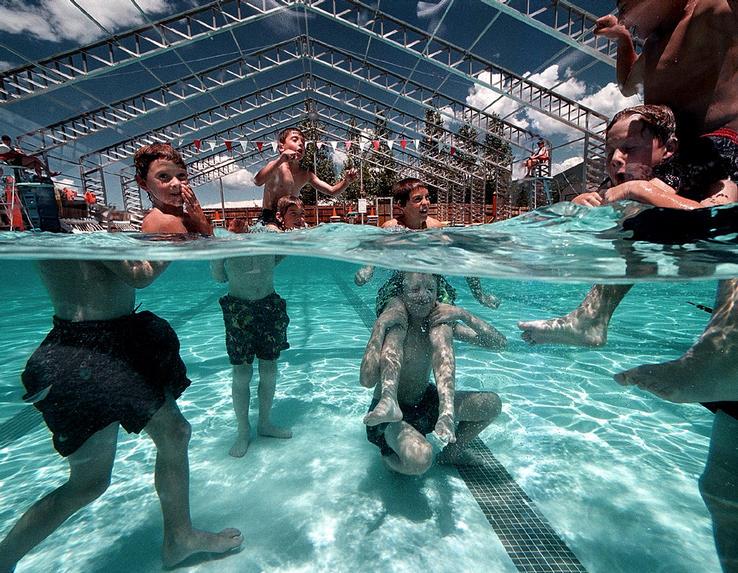


Light travels through air, water, glass and many other materials. What path does it travel to get from one place to another?
sideways
back and forth
straight
up and down
Name the subjective property of light related to its wavelength.
refractive index
frequency
colour
velocity

Jyothi puts a pencil into a glass container having water and is surprised to see the pencil bend.Name the phenomenon responsible for the change.
Reflection of light
Refraction of light
total internal reflection of light
partial reflection and partial refraction
As the ray of light passes from air to glass, state how the wavelength of light changes.
wavelength increases
wavelength decreases
wavelength remains constant
wavelength decreases and then increases
A boy uses blue colour of light to find the refractive index of glass. He then repeats the experiment using red colour of light .How will the refractive index of glass be ?
the same
μ decreases
μ increases
same as speed of light
When a ray of light enters from one medium to another having different optical densities it bends. beacuse
of different optical densities
speed of light changes
obstruction of light changes
frequency of light changes
choose the conditions where light does not bend when entering a medium of different optical density,
incident ray is normal to the refracting surface
any obliquely incident ray
angle of incidence is 90°
angle of incidence is 0°
Which colour of light travels fastest in any medium except air ?
yellow
red
violet
white
flint glass n=1.70
barium glass n=1.60
crown glass n=1.523
water n=1.33
diamond n=2.45
What happens to the light rays in a convex lens?
Converge
Diverge
Surge
Reflect
In a lens diagram, what does "u" mean?
Object distance
Image distance
Focal Point
Focal Length

Looking at the diagram, describe the object distance.
u>2f
u=2f
u=f
f<u<2f
This happens when the eyeballs are too long or the eye lenses are too thick
Hypermetropia
Myopia
Utopia
Hyperion
A ____ is formed when the sky is refracted on the road during hot sunny weather.
Rainbow
Halo
Mirage
Green flash

As a hunter you see a fish in a river. Where should you aim your spear?
Exactly at the fish
Below the fish
Above the fish
Nevermind, you will miss anyway.
What happens to the light when it travels from less dense to more dense medium?
speed up
slows down
breaks
parks

