
 Worksheets
Work, Energy and Power
Total questions: 103
Worksheet time: 5hrs 9mins
The ability to do work or cause change:
work
energy
momentum
power
Energy in the form of motion.
mechanical energy
potential energy
kinetic energy
momentum
Stored energy in the form of position or condition.
potential energy
kinetic energy
momentum
mechanical energy
A soccer player kicks a ball with 20 Newtons of force causing it to travel 100 meters. How much work is done on the ball?
200 J
80 J
5 J
2000 J
A worker climbs a ladder and does 8 J of work on a 2 N object. What is the distance they lift the object?
18 m
4 m
10 m
6 m
Where is the kinetic energy of pendulum at its highest?
at the top of the swing
at the bottom of the swing
at 1/4 of the swing
at 3/4 of the swing

At which point of this roller coaster is the energy 1/2 kinetic and 1/2 potential?
A
B
C
D
Two workers use 100 N of force to move a sofa 2 meters in 2 seconds. How much power is required?
100 watts
400 watts
104 watts
50 watts
The SI unit for power is...?
Watts
Joules
Newtons
Metres


Suppose a cart has a kinetic energy of 0.5 J. If you add enough mass to double the mass and make the cart go three times as fast, its kinetic energy is now ---.
6 J
3 J
18 J
9 J

Two equal mass marbles are at the top of a ramp. One marble falls to the ground off the back while the other rolls down the ramp. What is true about the marbles when they reach the ground?
The marble that rolled down the ramp is moving faster than the marble that fell.
The marble that fell down the back of the ramp is moving faster than the marble that rolled.
The marble that rolled down the ramp is not moving when it reaches the ground.
The two marbles are moving with the same speed.

A block starts at rest at point P at the top of a ramp which is height h above the ground. The block slides down one side and up the other, stopping at a point less than h above the ground.
The block did not go as high on the other side because gravity pulls down.
The block did not go as high on the other side because potential energy always has to decrease.
The block did not go as high on the other side because work from friction made the mechanical energy less.
The situation as described is impossible to happen.

If there is no friction on this track, at which point would the coaster have the most kinetic energy?
A
B
C
D
A 40-kg person is climbing 3 m up a flight of stairs in 6 seconds. How much power did they exert climbing the stairs?
400 W
1200 W
200 W
120 W
What effect do external forces like an applied force, friction force, or drag force have?
They have no effect on a system's mechanical energy.
They convert kinetic energy into potential energy.
They convert potential energy into kinetic energy.
They convert between mechanical energy and other forms of energy to change the total mechanical energy of the system.
How does conservation of energy explain why something that is falling should speed up?
It gains kinetic energy because it gains potential energy.
It loses kinetic energy because no work was done on it.
It gains kinetic energy because it loses potential energy.
It loses kinetic energy because the Earth gains potential energy.
A boy pushes on a parked car with a force of 250N. The car does not move. How much work does the boy do?
250J
250N
0J
2500J
_______ is defined as the rate at which work is done.
Efficiency
Power
Work
Kinetic Energy
A boy exerts an average force of 68N when he lifts a box 1.1m. How much work does he do?
74.8J
733.79J
61.82J
7.62J
The law of conservation of energy states that energy
can only be converted into heat
cannot be created or destroyed
is created from motion.
is always opposite.
In which of the situations is NO work being done?
pushing a box across the floor
lifting a box from the ground to a table top
holding a box overhead
carrying a box up a flight of stairs
A 2 kg object is held 5 meters above the ground. What is the gravitational potential energy of the object?
5 J
10 J
20 J
100 J
A weightlifter presses a 400N weight 0.6m over his head in 2s. What is the power of the weightlifter?
120W
1200W
200W
240W
A man pushes a crate along a factory floor by exerting a force of 55N. If the crate moves a distance of 4m, how much work does the man perform?
550J
2200J
220N
220J
If a work done by a crane is 1000 J to lift up a load in 2 minutes.
Calculate the power of the crane.
500 W
8.33 W
A crane lift up a load with weight 2500 N to a 4m height.
Calculate the work done.
1000 J
10 000 J
100 000 J
What is the SI unit for power?
J s-¹
W

What type of energy posses by the spring?
Gravitational potential energy
Elastic potential energy
Kinetic energy
If Ali push a sack of rice with a force 15N along 2m distance. Calculate the work done.
3J
30J
300J
Which of the following is a unit for work?
J
Nm
W
name 2 things needed to calculate power
TIME
WORK
FORCE
NAME 2 THINGS THAT ARE NECESSARY IN CALCULATING WORK
TIME
FORCE
DISPLACEMENT
A 40-kg person is climbing 3 m up a flight of stairs in 6 seconds. How much power did they exert climbing the stairs?
400 W
1200 W
200 W
120 W
Two workers use 100 N of force to move a sofa 2 meters in 2 seconds. How much power is required?
100 watts
400 watts
104 watts
50 watts
A man of mass 50 kg jumps to a height of 1 m. His potential energy at the highest point is(g = 10 m/s2)
(a) 500 J
(b) 50 J
(c) 5 J
(d) 5000 J
what is defined as the product of the magnitudes of displacement and the
component of the force parallel to the displacement ?
work
energy
momentum
power
A soccer player kicks a ball with 20 Newtons of force causing it to travel 100 meters. How much work is done on the ball?
200 J
80 J
5 J
2000 J
On a force versus change in position graph, the area under the curve is a representation of:
force
position
KE
PE
Work
What are the two necessary conditions for work to be done?
Force and Velocity
Force and Displacement
Force and Time
What is the unit for work?
Joules
Newton
Watts
Which of the given pictures shows that work can not done?


A worker climbs a ladder and does 8 J of work on a 2 N object. What is the distance they lift the object?
18 m
4 m
10 m
6 m
Potential energy is associated with ---.
speed
position
direction
temperature
Kinetic energy is associated with ---.
speed
position
direction
temperature
A block starts at rest at point P at the top of a ramp which is height h above the ground. The block slides down one side and up the other, stopping at a point less than h above the ground.
The block did not go as high on the other side because gravity pulls down.
The block did not go as high on the other side because potential energy always has to decrease.
The block did not go as high on the other side because work from friction made the mechanical energy less.
The situation as described is impossible to happen.
At which point of this roller coaster is the energy 1/2 kinetic and 1/2 potential?
A
B
C
D
Two workers use 100 N of force to move a sofa 2 meters in 2 seconds. How much power is required?
100 watts
400 watts
104 watts
50 watts
A weightlifter holds a 100 kg barbell above her head. Is work done?
Yes because there is a force applied to the barbell and the force causes a displacement of the barbell.
Yes because there is an upward force applied to the barbell and the barbell moves vertically.
No because no displacement occurred.
No because there is no force applied.
Which requires more work – a person walking up stairs or a person running up stairs?
walking
running
they require equal work
no work is required for either because the movement is vertical

The roller coaster car has a mass of 500 kg. It is pulled from position 1 to 2 (30 m) by a motor. At the top of the ride the vertical distance top to bottom is 20 m. The motor pulls the car with a 4000 N force. Calculate the work done getting the car to the top of the ride.
100 000J
120 000J
800 000J
90 000J

Bob (80 kg) uses 180 N of force to get him up the slope. The vertical distance is 2 m and the diagonal is 10 m. Calculate the work he does.
1600 J
160 J
3600 J
1800 J
On a force versus change in position graph, the area under the curve is a representation of:
force
position
KE
PE
Work
A waiter carries a tray full of meals above his head by one arm straight across the room at constant speed.
An 80 N rope tension force is used to slowly pull a wagon 50 m up a hill. Calculate the work done by the rope if it pulls parallel to the hill
-4000 J
4000 J


What type of energy transformation takes place when you plug in a lamp and turn it on?
electrical to radiant
electrical to mechanical
chemical to radiant
mechanical to thermal
Energy Efficiency is calculated by useful energy (Energy Out) divided by energy consumed (Energy In) , expressed as a percentage
False
True
The SI Unit for Energy is
Joule
Newton
Calorie
Watt
What percent energy is wasted by a machine if the energy input is 262 J and the energy output is 131 J?
5%
50%
100 J
What is the work output of a machine that has a work input of 2,800 Joules and an efficiency of 90%?
25200 J
2520 J
0.0082J
A weight-lifter raises a 2000N weight through a vertical height of 2.0m in 0.80s. What useful power does he develop in doing this?
800 W
700W
4000W
5000W
Gravitational potential energy depends on which of the following factors?
Mass and speed
Height and mass
Speed and time
Distance and direction
If an object has a gravitational potential energy of 200 J and is raised to twice its original height, what will be its new potential energy?
100 J
200 J
400 J
800 J
A 2 kg object is held 5 meters above the ground. What is the gravitational potential energy of the object?
5 J
10 J
20 J
100 J
If you want to double the gravitational potential energy of an object near the Earth's surface, what should you do?
Double the object's mass.
Double the object's height.
Double the acceleration due to gravity.
Double the object's speed.
The gravitational potential energy of an object is at its maximum when:
The object is at rest.
The object is at the lowest point.
The object is at the highest point.
The object is in motion.
If a 10 kg object falls freely from a height of 20 meters, what is its final kinetic energy just before it hits the ground?
100 J
200 J
400 J
2000 J
Elastic potential energy is stored in objects like springs when they are:
At rest
Compressed or stretched
In motion
Subjected to friction
In the formula for kinetic energy, what does "m" represent?
Spring constant
Acceleration due to gravity
Mass of the object
Height of the object
The kinetic energy of an object depends on which of the following factors?
Its height above the ground
Its mass and velocity
Its volume
Its color
Which unit is used to measure kinetic energy in the International System of Units (SI)?
Joules
Watts
Newtons
Volts
The kinetic energy of an object is at its maximum when:
The object is at rest.
The object is at the lowest point.
The object is in motion.
The object is in free fall.
According to the Principle of Conservation of Energy, what happens to the total energy in a closed system?
It increases over time
It decreases over time
It remains constant
It varies randomly
In a roller coaster ride, where is the potential energy at its maximum and kinetic energy at its minimum?
At the bottom of a hill
At the top of a hill
On a straight track
In a loop
When an object falls freely under the influence of gravity, what happens to its potential energy and kinetic energy as it descends?
Potential energy decreases, kinetic energy increases
Potential energy increases, kinetic energy increases
Potential energy decreases, kinetic energy remains constant
Potential energy remains constant, kinetic energy decreases
In a swinging pendulum, at what point is the kinetic energy at its maximum and potential energy at its minimum?
At the highest point of the swing
At the lowest point of the swing
At the midpoint of the swing
It remains constant throughout the swing
When an object is raised to a certain height, what happens to its potential energy?
It decreases
It remains constant
It increases
It depends on the mass of the object
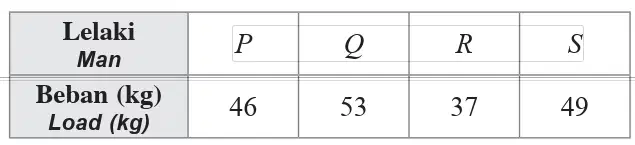
Four men, each carrying different load, walk up a flight of stairs of 10 m high.
Who does the most work?
P
Q
R
S
A crane carries a 500 N load to a height of 10 m in 2 minutes. What is the power generated by the crane?
41.7 W
417 W
4171 W
41700 W
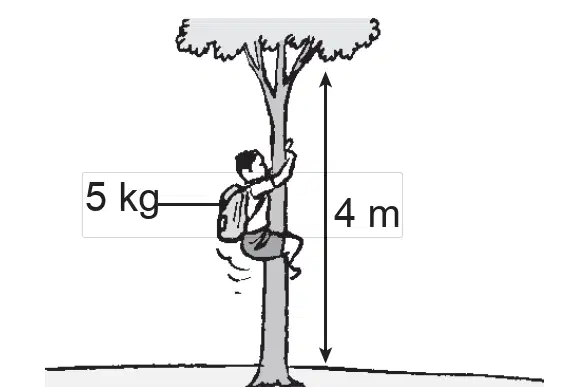
The following diagram shows a boy with a mass of 45 kg, carrying a 5 kg bag, climbing up a tree in 25 seconds. What is the power generated by the boy?
(1 kg = 10 N)
12 W
63 W
80 W
800 W
Amir picks his school bag from the floor and put it on the table.
What is the gravitational potential energy gained by the bag if the bag has the mass of 1.5 kg and the height of the table is 0.5 m?
(Gravity acceleration is assumed as 10 m s-2)
0.75 J
7.5 J
75 J
750 J
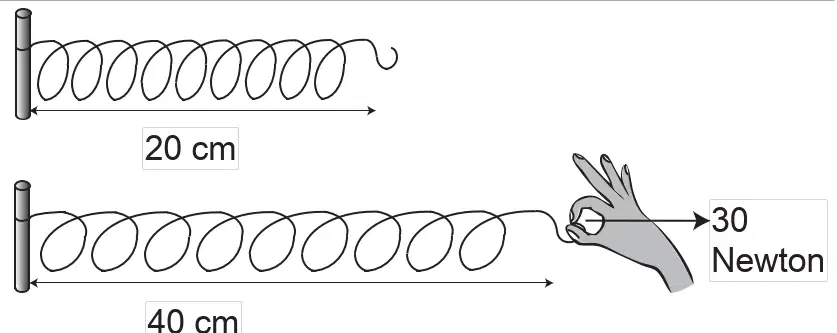
A spring is stretched as shown in the diagram, What is the elastic potential energy possessed by the spring when it is stretched?
1.5 J
3 J
6 J
300 J
Which of the following statements about the Principle of Conservation of Energy is true?
Energy can be created.
Energy can be finished when used.
Energy becomes weaker when used.
Energy cannot be created or destroyed.
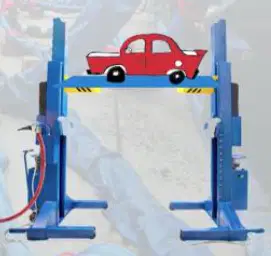
Name the type of energy possessed when the car is lifted from the ground.
Gravitational potential energy
kinetic energy
Elastic potential energy
Heat energy
What is the S.I. unit for work?
Calorie
Newton
Joule
Watt
Which of the following activities has shown that work has been done?
Pushing a lawn-mower
Pushing a room’s wall
Pressing the top of the dining table
Sitting on chair
What is the definition of work?
Product of force (F) and displacement (s) in perpendicular direction with the force.
Product of force (F) and displacement in the same direction as the force.
The amount of force acting on the object but the object does not move.
The amount of energy used to stop the moving object.
What is the kinetic energy of a 210 kg motor while traveling at a speed of 90 km/h?
850.50 kJ
65.63 kJ
9.45 kJ
2.63 kJ
What is the total energy of a mass of 1.5 kg on a table 100 cm high?
1 500 J
150 J
15 J
1.5 J

According to the standard operating procedure of the workshop, a car needs to be lifted to 2.0 m height at constant speed in 5 seconds. This can reduce the waiting time of the car owner. Calculate the power that is needed to lift up a car with the mass of 800 kg.
16000 J
16000 W
3200J
3200W

