
 Worksheets
Science 7th grade review
Total questions: 50
Worksheet time: 33mins
Name
Class
Date
1.

What part of the illustration shows Evaporation?
a)
1
b)
2
c)
3
d)
4
2.

Which number illustrates Condensation?
a)
1
b)
2
c)
3
d)
4
3.

What does this symbol on a weather map indicate?
a)
High pressure system
b)
Low pressure system
c)
Cold front
d)
Warm front
4.
What kind of weather is usually associated with a high pressure system?
a)
Sunny weather
b)
Precipitation (rain, snow, etc.)
5.
The boundary between two air masses is known as a:
a)
front
b)
storm
c)
climate
d)
flood
6.
Which condition usually means cloudy, stormy weather?
a)
high pressure
b)
low pressure
7.

A _____ is a large, swirling, low-pressure system that forms over the Atlantic Ocean.
a)
blizzard
b)
cold front
c)
tornado
d)
hurricane
8.

The amount of water vapor present in the air is called ________________.
a)
weather
b)
humidity
c)
air mass
d)
dew point
9.
When a warm air mass gently slides on top of a cold air mass, and you have drizzly rain and then warmer weather, what type of front is it?
a)
warm front
b)
cold front
c)
occluded front
d)
stationary front
10.

What type of storm front is this?
a)
warm front
b)
cold front
c)
stationary front
d)
occluded front
11.
Air pressure is greatest:
a)
closer to Earth
b)
farther from Earth
12.
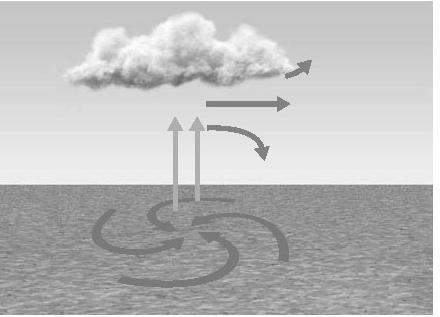
Which type of pressure system is pictured?
a)
high
b)
low
c)
medium
d)
none
13.
The temperature at which air is saturated and condensation forms is the:
a)
dew point
b)
rain point
c)
wind point
d)
relative humidity
14.

Which option pictured shows how sleet forms?
a)
A
b)
B
c)
C
d)
D
15.
What body system produces blood cells for the body?
a)
Nervous System
b)
Digestive System
c)
Respiratory System
d)
Skeletal System
16.
What system controls voluntary and involuntary life functions?
a)
Nervous System
b)
Skeletal System
c)
Digestive System
d)
Respiratory System
17.
Why is the blood that flows from the lungs to the heart bright red?
a)
It has oxygen in it
b)
It has carbon dioxide in it
c)
It has food coloring in it
d)
It has waste in it
18.
The blood vessels that carry blood away from the heart are called what?
a)
Veins
b)
Stomach
c)
Arteries
d)
Lungs
19.
Which of the following is in the correct order from smallest to largest?
a)
tissue-organ-system-cell
b)
cell-organ-tissue-system
c)
System-tissue-cell-organ
d)
cell-tissue-organ-system
20.
How does the circulatory system and the skeletal system work together?
a)
the circulatory system makes cells while the skeletal system transports the cells where the need to go
b)
the skeletal system makes cells while the circulatory system transports them where the need to go
c)
The circulatory system produces energy for the body and the skeletal system makes cells for the body
d)
The skeletal system digests food and the circulatory system brings air into the body
21.
How does the digestive system work with all other systems?
a)
The digestvie system transports blood to all the other systems
b)
The digestive system puts oxygen into the body
c)
The digestive system gives the body energy and nutrients
d)
The digestive system allows the body to move
22.
How does the muscular system and the skeletal system work together?
a)
The muscular system allows the body to stand up while the skeletal system allows the body to move
b)
The muscular system allows the body to move and the skeletal system gives the body a structure
c)
The muscular system gives the body nutrients while the skeletal system gives the body blood
d)
The skeletal system makes cells whilte the muscular system eats them.
23.
How does the cardiovascular system and the respiratory system work together?
a)
The cardiovascular system transports oxygen around the body while the repiratory system gives the body oxygen
b)
The cardiovascular system makes cells while the respiratory system moves them where they are suppose to go.
c)
The cardiovascular system allows the body to have energy while the repiratory system makes cells
d)
The cardiovascular system transports nutrients around the body while the respiratory system brings oxygen into the body
24.
Animal and Plant cells are both this type of cell.
a)
Eukaryote
b)
Prokaryote
25.
Bacteria cells are this type of cell.
a)
Eukaryote
b)
Prokaryote
26.
This organelle is in all eukaryotic cells. It is the control center of the cell because it holds the DNA.
a)
Mitochondria
b)
Nucleus
c)
Chloroplasts
d)
Ribosomes
27.
Plants perform photosynthesis through this organelle. It captures energy from the sun and uses it to produce food for the cell.
a)
Chlorophyll
b)
Chloroplasts
c)
Mitochondria
d)
Nucleus
28.

How are eukaryotes different from prokaryotes?
a)
They aren't different, except the spelling.
b)
Eukaryotes are only single celled organisms.
c)
Eukaryotes have a NUCLEUS, prokaryotes do NOT!
d)
Prokaryotes have a NUCLEUS, eukaryotes do NOT!
29.
How many parents are needed for sexual reproduction?
a)
1 parent
b)
2 parents
c)
3 parents
d)
no parents
30.
How many parents are needed for asexual reproduction?
a)
0
b)
3
c)
2
d)
1
31.
How much DNA does a parent give to its offspring during sexual reproduction?
a)
all
b)
none
c)
half
d)
one-fourth
32.
How much DNA does a parent give to offspring in asexual reproduction?
a)
half
b)
all
c)
none
d)
one-fourth
33.
What is the job of mitochondria in a cell?
a)
make ribosomes
b)
control the cell
c)
produce energy
d)
make protien
34.
W=white hair
w= non-white hair
If you cross a horse with WW and a horse with ww what fraction of the offspring would be expected to have white hair?
w= non-white hair
If you cross a horse with WW and a horse with ww what fraction of the offspring would be expected to have white hair?
a)
none
b)
3/4
c)
1/2
d)
all
35.
Two brown eyed parents (Bb) have a baby. What is the chance the baby is blue eyed?
a)
0 %
b)
25%
c)
50%
d)
75%
36.
A strand of DNA that carries genes in the nucleus of a cell is called a _________________.
a)
chromosome
b)
allele
c)
copy
d)
chloroplast
37.
A line on a speed-time graph with a steep slope indicates a greater speed.
a)
TRUE
b)
FALSE
38.
When you run around a track at 5 km/h, your velocity is constant.
a)
TRUE
b)
FALSE
39.
Balanced forces acting on an object cause the object to accelerate.
a)
TRUE
b)
FALSE
40.
Force is equal to mass divided by acceleration.
a)
TRUE
b)
FALSE
41.
A speed-time graph has _______ on the vertical axis and _________ on the horizontal axis.
a)
speed, time
b)
distance, time
c)
time, speed
d)
time, distance
42.
If your speed changes from 10 km/h to 6 km/h, you have a(n) _________ acceleration.
a)
positive
b)
negative
c)
constant
d)
average
43.
If the distance between two objects increases, the gravitational force between them __________.
a)
decreases
b)
increases
c)
stays the same
d)
equals
44.
A tablecloth can be pulled out from under a plate because of ________.
a)
inertia
b)
acceleration
c)
friction
d)
velocity
45.
A fish swimming through the water pushes water backwards with its fin. The water pushes back to propel the fish forward. Which law of motion best fits this example?
a)
Newton's 1st law
b)
Newton's 2nd law
c)
Newton's 3rd law
46.
A jockey rides her horse to the final hurdle of a competition. At the last minute the horse stops in front of the hurdle instead of jumping over it. The jockey flies off the horse and into the air. Which law of motion is best described by this example?
a)
Newton's 1st law
b)
Newton's 2nd law
c)
Newton's 3rd law
47.
Jenna's balloon car covers a distance of 4 meters in 2 seconds. What is the balloon car's speed?
a)
2 m/s
b)
.5 m/s
c)
2 m/h
d)
.5 m/h
48.
Andrew starts a race, and at the 10 second mark he is running at a speed of 20 m/s. What is his acceleration?
a)
2 m/s2
b)
.5 m/s2
c)
10 m/s2
d)
20 m/s
49.

Bella's change in velocity is 30 m/s, and Hazel has the same change in velocity. Which best explains why they would have different accelerations?
a)
Bella went a farther distance than Hazel.
b)
Bella had negative acceleration, and Hazel had positive.
c)
Bella had a different time than Hazel.
d)
Bella had positive acceleration, and Hazel had negative.
50.

Which best defines the relationship between speed and velocity?
a)
Speed is velocity with direction.
b)
Velocity is speed with direction.
c)
Speed is based on a specific direction.
d)
Velocity is based on distance.
100 %

