wayground logo

Free Printable Worksheets

Font size

S
M
L
XL
Worksheets

7th Grade CBA 4 Review

Total questions: 100

Worksheet time: 1hrs 19mins

Name
Class
Date
1.
What organelle is called the "powerhouse" of a cell?

a)
Endoplasmic Reticulum
b)
Nucleus
c)
Mitochondria
d)
Nucleolus
2.
Using this image, what organelle is C?
a)
Cell Wall
b)
Mitochondria
c)
Large Cell Vacuole
d)
Chloroplast
3.
What is the function of the vacuole?
a)
Sac that stores water, nutrients, and waste products
b)
Sac filled with digestive chemicals
c)
Jelly-like substance within the plasma membrane
d)
stack of membranes that packages chemicals
4.
What is the function of nucleus?
a)
Structure that organizes motion of chromosomes. 
b)
Structure that contains DNA and directs the cell 
c)
Membrane that surrounds and protects the cell 
d)
Stack of membranes that packages chemicals
5.
Where does photosynthesis occur?
a)
mitochondria
b)
stomata
c)
xylem
d)
chloroplast
6.
I store water in both plant and animal cells. What am I?
a)
cytoplasm
b)
ribosomes
c)
vacuole
d)
lysosomes
7.
What cell part is NOT found in all cells?
a)
Cell Wall
b)
Cell Membrane
c)
Cytoplasm
d)
Genetic Material
8.
The two kinds of cells are Prokaryotes and Eukaryotes. How are they different?
a)
Prokaryotes have a nucleus.
b)
Eukaryotes have a nucleus.
c)
Prokaryotes are plant cells.
d)
There is no difference.
9.
Which part of the cell is often called "the brain of the cell"?
a)
nuclear membrane
b)
endoplasmic reticulum
c)
nucleus
d)
mitochondria
10.
The ______________ is the brain of the cell.
a)
Vacuole
b)
Nucleus
c)
Chromosomes
d)
60 W light bulb
11.
Directs all cell activities through the DNA located there.
a)
Lysosomes
b)
Nucleus
c)
ribosomes
d)
Mitochondria
12.
What is the function of nucleus?
a)
Structure that organizes motion of chromosomes. 
b)
Structure that contains DNA and directs the cell 
c)
Membrane that surrounds and protects the cell 
d)
Stack of membranes that packages chemicals
13.
Which of the following is NOT found in all cells?
a)
Cell Wall
b)
Cell Membrane
c)
Cytoplasm
d)
Genetic Material
14.
What organelle surrounds and supports plant cells?

a)
Cell Membrane
b)
Cell Wall
c)
Nucleus
d)
Golgi Complex
15.
What is the difference between biotic and abiotic?
a)
Biotic are non-living things
b)
Abiotic are living organisms
c)
Biotic is life,
Abiotic is non-living
d)
Biotic is non-living, Abiotic is living
16.
What does biodiversity mean?
a)
Only one species in an area.
b)
The different amount of species in an area
c)
All abiotic life
d)
Nitrogen fixation
17.
A drought has hit this grassland biome. How will this effect the rabbit population?
a)
The rabbits will increase in number.
b)
The rabbit population will stay the same.
c)
The rabbit population will decrease.
d)
The rabbit population will become extinct immediately.
18.
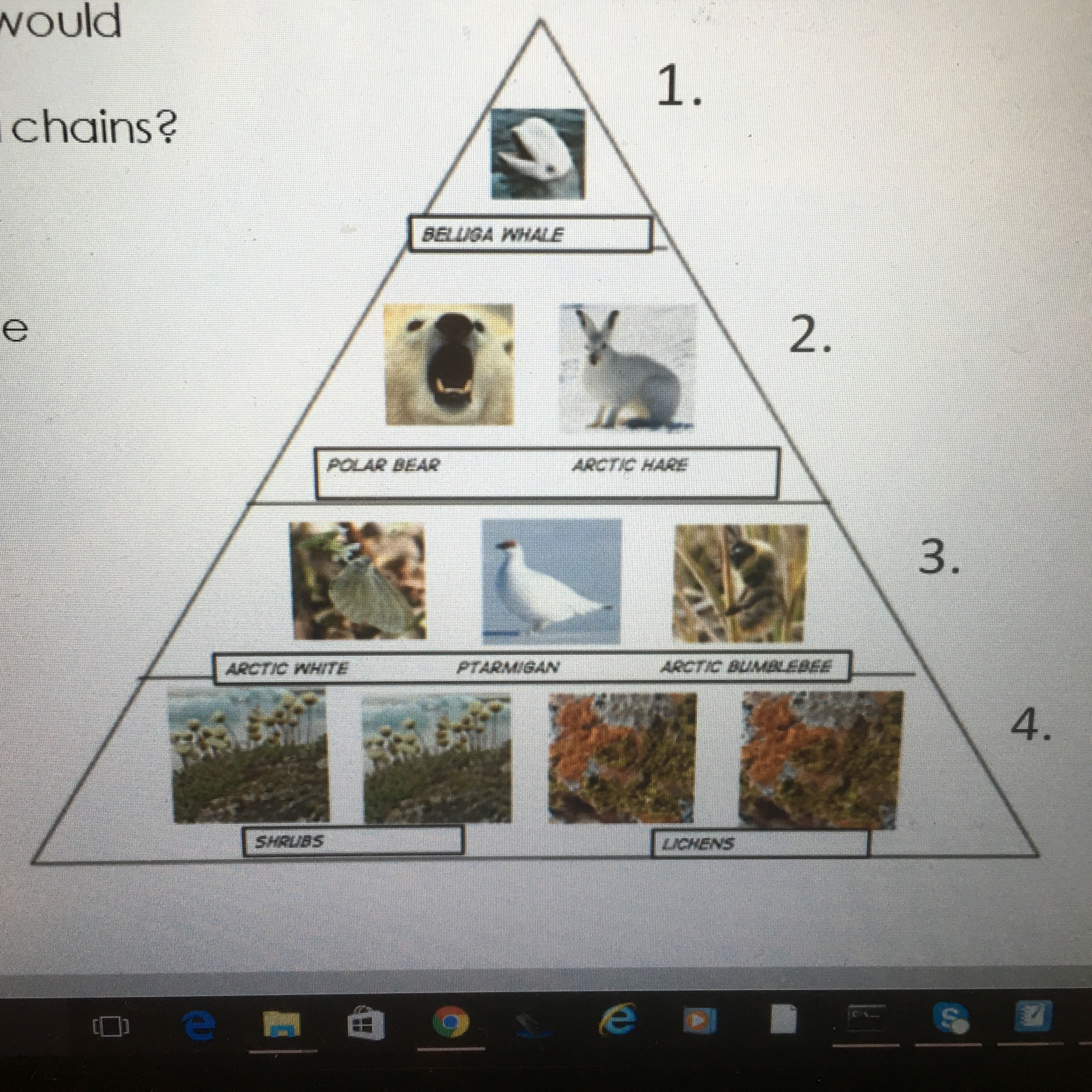
In this tundra food web, if grasses were removed what would happen to the sustainability of the ecosystem?
a)
There would be an overpopulation of arctic hares and lemmings.
b)
Polar bears would move to a new ecosystem
c)
The ecosystem would collapse because it lost its main producer
d)
Wildflowers would die out from the ecosystem
19.

What does most every living thing need to survive?

a)

Steam

b)

Ice

c)

Plasma

d)

Liquid water

20.

What happens if a planet is too hot?

a)

The water will be nice and warm

b)

The water will boil away

c)

The water will be too cold

d)

The water will freeze and make ice

21.

What happens if a planet is too cold?

a)

The water will be nice and warm

b)

The water will be cold

c)

The water will boils away

d)

It will be like a giant snowball

22.

What determines where the habitable zone is located for each star?

a)

The star's distance from Earth

b)

The size of the star

c)

How many planets the star has

d)

The size of the planet

23.

If a planet is discovered to be in the habitable zone does that mean it has life?

a)

Yes

b)

No

24.
Ripping up paper ...
a)
Chemical Change
b)
Physical Change
25.
Digestion
a)
Physical Change
b)
Chemical Change
26.
Which statement reflects one of the major components of the cell theory?
a)
All living things are multi-cellular.
b)
Organs are the basic unit of structure and function for all living things.
c)
All cells come from previously existing cells.
d)
Every organism has a reproductive system to ensure survival of the species.
27.
What structures distinguish a plant cell from an animal cell?
a)
Plant cells have cell walls and ribosomes.
b)
Plant cells have cell walls and chloroplasts.
c)
Plant cells have chloroplasts and ribosomes.
d)
Plant cells have chloroplasts and mitochondria.
28.
When cells are damaged, new cells are created by cell division. How does the cell theory support this fact?
a)
It states that all cells have a nucleus which divides.
b)
It states that all living things are made up of one or more cells.
c)
It states that cells come from previously existing cells.
d)
 It states that the basic units of structure and function are cells.
29.
The ___ is the basic unit of sturucture and function of organisms
a)
atom
b)
cell
c)
matter
d)
all other answers are correct
30.
Which statement is a part of the cell theory?
a)
all cells come from preexisting cells
b)
bacteria are prokaryotic cells
c)
eukaryotic cells are complex
d)
humans are multicellular
31.
Organic compounds are always based on what element?
a)
hydrogen
b)
water
c)
carbon
d)
arsenic
32.
Is this an example of an organic or inorganic compound?
a)
Organic
b)
Inorganic
33.
Is this an example of an organic or inorganic compound?
a)
Organic
b)
Inorganic
34.
Is this an example of an organic or inorganic compound?
a)
Organic
b)
Inorganic
35.
What best describes this image shown?
a)
Inorganic molecule
b)
Organic molecule
36.
Organic or Inorganic? 
a)
Organic
b)
Inorganic
37.
The main purpose of the ____________ system is to break food particles into pieces that can be used.
a)
circulatory
b)
respiratory
c)
digestive
d)
skeletal
38.
What is responsible for delivering oxygen and removing carbon dioxide from the body?
a)
cell nucleus
b)
excretory system
c)
nervous tissue
d)
respiratory system
39.
When tissues come together, they form ___________.
a)
cells
b)
atoms
c)
organs
d)
systems
40.
Which of the following body systems work together for support, protection, and movement?
a)
respiratory and cardiovascular
b)
skeletal and muscular
c)
skeletal and integumentary
d)
digestive and respiratory
41.
This system protects the body's organs, provides support for the body.
a)
Nervous System
b)
Skeletal System
c)
Respiratory System
42.
This system helps the body respond to signals and information from both inside and outside the body.
a)
Nervous System
b)
Muscular System
c)
Skeletal System
43.
What body system makes your body move? 
a)
Circulatory
b)
Respiratory
c)
Skeletal
d)
Muscular
44.
What body system removes the waste from your body? 
a)
Circulatory
b)
Excretory
c)
Digestive
d)
Respiratory
45.
Which body system transports oxygen and nutrients through out the body?
a)
Muscular System
b)
Nervous System
c)
Digestive System
d)
Circulatory System
46.
What is the body system that sends and recieves electrical signals from the brain?
a)
Skeletal System
b)
Nervous System
c)
Muscular System
d)
Digestive System
47.
What system breaks food down into energy for the body?
a)
Stomach
b)
Digestive System
c)
Respiratory system
d)
Lungs
48.
The main purpose of the _______ system is to ensure the continuation of the species.
a)
respiratory
b)
reproductive
c)
circulatory
d)
endocrine
49.
The main purpose of the ________ system is to produce hormones for the body.
a)
excretory
b)
digestive
c)
reproductive
d)
endocrine
50.
The use of pesticides and fertilizers must be carefully monitored 
because of the effect they can have on the environment. 
Which of the following is a possible negative effect of the use 
of these chemicals on the environment?
a)
Runoff carries these chemicals into lakes and streams.
b)
Theses chemicals cannot be purchased in large bulk.
c)

These chemicals are expensive to produce.
d)
Storage space for these chemicals is limited.
51.
What is a watershed?
a)
Land that collects and channels water froma small body of water to a larger body of water
b)
the shape of the land determined by elevation
c)
A natural stream of water of considerable  volume
d)
a river and all its tributaries
52.
Why is gravity a factor in watersheds? 
a)
it causes the water to flow away from a watershed
b)
it causes the water to flow down towards a watershed
53.
Rain washing away soil from a hillside
a)
Weathering
b)
Erosion
c)
Deposition
54.
Flood water pounding against a canyon wall and wearing it down
a)
Weathering
b)
Erosion
c)
Deposition
55.
Waves dropping sand on the beach
a)
Weathering 
b)
Erosion
c)
Deposition
56.
Why would there be less erosion in this ecoregion of Texas?
a)
not enough rain
b)
Tree and plant roots holds onto the soil
57.
Deltas forming at the mouths of rivers is called?
a)
Weathering
b)
Erosion
c)
Deposition
58.
This is a picture of what ecoregion in Texas?
a)
High Plains
b)
Piney Woods
c)
Gulf Coast Plains and Marshes
d)
Trans Pecos/Chihuahuan Desert
59.
The Brazos River is the longest river in Texas, emptying into the Gulf of Mexico. What type of land formation would you expect to find where the river deposits sediments as it
reaches the Gulf?
a)
A cave
b)
A mountain
c)
A delta
d)
A valley
60.
How can a city help prevent water pollution in nearby lakes and rivers?
a)
Remove weeds growing near the lakes and rivers.
b)
Prevent runoff of waste materials into lakes and rivers.
c)
Use solar cells as a source of energy.
d)
Recycle paper and cardboard.
61.
In Galveston, the beaches are often exposed to hurricanes originating in the Gulf of Mexico. It is reasonable to predict that hurricane activity may...
a)
create new rivers near Galveston
b)
move sand from the beach to offshore sand bars
c)
cause local earthquakes after the storm
d)
create new river deltas along the beaches
62.
This is a picture of the _________ ecoregion of Texas.
a)
Hill Country/Edwards Plateau
b)
Piney Woods
c)
Gulf Coast Plains and Marshes
d)
High Plains
63.
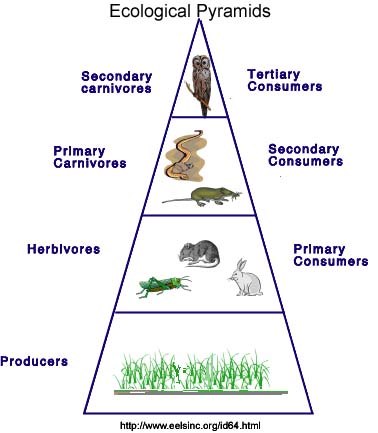
The diagram represents a pyramid of energy in an ecosystem.  Which level would most likely contain members of the plant kingdom?
a)
A
b)
B
c)
C
d)
D
64.
Which organism recieves the least amount of energy from the producer?
a)
Owl
b)
Grasshopper
c)
Lilypad
d)
Mouse
65.
Which level will contain plants?
a)
A
b)
B
c)
C
d)
D
66.
The largest group of organisms found in a food web would be:
a)
Primary Consumers
b)
Producers
c)
Decomposers
d)
Tertiary Consumers
67.
Which of this energy roles is always located at the bottom of an energy pyramid?
a)
Producer
b)
Second-Level Carnivores
c)
Herbivores.
d)
First-Level Consumers.
68.
A food pyramid represent the relative amount of energy in trophic levels. Which of the following correctly shows a food pyramid?
a)
A
b)
B
c)
C
d)
D
69.
A third-level consumer has to be which type?
a)
Carnivore.
b)
Decomposer.
c)
Producer.
d)
Herbivore.
70.
Which group are the producers? 
a)
1 and 2
b)
3 and 4
c)
4
d)
3
71.
Which one is NOT an example of a decomposer?
a)
mushroom
b)
leaves
c)
mold
d)
worm
72.
Examples of a producer
a)
frog
b)
algae
c)
worm
d)
mouse
73.
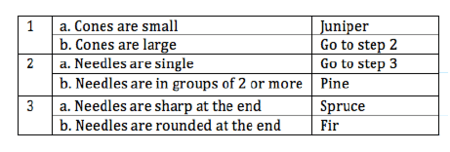
A dichotomous key for trees is provided. Hikers found a tree that has large brown cones and single sharp needles. What species of tree have the hikers found?
a)
Juniper
b)
Pine
c)
Spruce
d)
Fir
74.
A dichotomous key for insects is given. To what order does an insect with two pairs of scaly wings belong?
a)
Coleoptera
b)
Heteroptera
c)
Diptera
d)
Lepidoptera
75.
What step do we always start with when using dichotomous keys?
a)
1
b)
2
c)
3
d)
4
76.
Using this dichotomous key, identity the name of the circled fish.
a)
band-tail puffer
b)
spotted goat fish
c)
peacock flounder
d)
trumpet fish
77.

Which of the following accommodations on the space station is used by astronauts to combat the effects of microgravity on their bones?

a)

special handles

b)

velcro straps

c)

exercise equipment

d)

oxygen system

78.

Spacesuits have layers that have high capacity for thermal insulation in order to -

a)

regulate body temperature in the extremes of space

b)

prevent the spread of bacteria that thrive in space

c)

allow communication with the space station

d)

prevent the astronaut from sweating inside the suit

79.

When deciding if a place beyond Earth holds any possibility for life, the two things that are most looked for by astrobiologists are –

a)

nitrogen and sodium

b)

oxygen and nitrogen

c)

carbon and water

d)

carbon and hydrogen

80.
In asexual reproduction, all of the offspring are:
a)
Physically Identical
b)
Genetically Identical
c)
Physically and Genetically Identical
d)
Not Identical
81.
Which statement best describes the process of asexual reproduction?
a)
new organisms are usually genetically identical to the parent
b)
the reproductive cycle involves the production of games
c)
nuclei of sex cells fuse to form a zygote
d)
it involves the production of genetic copies 
82.
How many parent(s)are needed for asexual?
a)
4
b)
1
c)
9
d)
100
83.
Where is all the genetic material inside a cell?
a)
nucleus
b)
vacuole
c)
cell membrane
d)
ribosome
84.
Both parents in this Punnet square
a)
are homozygous dominant
b)
are homozygous recessive
c)
are heterozygous
d)
have blue eyes
85.
The genotypic ratio here is
a)
25% blue eye 75 % brown eye 
b)
BB = 25% Bb = 50% bb = 25%
c)
BB= 50 % bb = 50%
d)
All brown eye
86.
How many boxes would say BB?
a)
1
b)
2
c)
4
d)
0
87.

Brown is dominant to green. What is the probability of these parents having green offspring?

a)

1/4

b)

2/4

c)

3/4

d)

4/4

88.
The dominant trait is
a)
yellow pea seeds
b)
green pea seeds
c)
there is no dominant seed
d)
Jolly green giant
89.
To express the recessive trait you must be
a)
homozygous dominant
b)
heterozygous
c)
alleleerific
d)
homozygous recessive
90.
How do two purple flowers produce white flower offspring? 
a)
They cant have white flowered offspring
b)
Both flowers are heterozygous and can pass on the white allele
c)
They are both homozygous Dominant
d)
They do not have the recessive allele in their genotype
91.
The purpose of selective breeding is to 
a)
Get bigger animals
b)
get smaller animals
c)
create animals with desirable traits
d)
create animals with bad traits
92.
A farmer has bred his pineapple plants from the sweetest pineapples from his last harvest to get even sweeter pineapple plants. What is this an example of?
a)
Selective breeding
b)
Natural selection
c)
Extinction
d)
Mutagenesis
93.
Use the following table to answer the next question. A farmer wants to grow extra-large, sweet oranges.  Which plants should the farmer select to cross to get the desired set of characteristics?
a)
1 and 2
b)
2 and 4
c)
1 and 3 
d)
4 and 5
94.
Use the following table to answer the next question. A family wanted a cat but, due to allergies, they wanted a cat that shed the least amount of hair.  They also wanted a cat with a calm personality.  Which cats should the breeder select to be the parents of the requested cat?
a)
2 and 4
b)
2 and 3
c)
1 and 4
d)
1 and 3
95.
Use the following table to answer the next question. A farmer wants to create a watermelon that is sweet tasting but has a low quantity of seeds.  Which plants should the farmer select to cross to get the desired set of characteristics?
a)
1 and 2
b)
2 and 4
c)
1 and 4
d)
2 and 4
96.
What is the order of succession shown in this figure?
a)
A, B, C, D
b)
B, A, D, C
c)
C, D, A, B
d)
D, A, B, C
97.
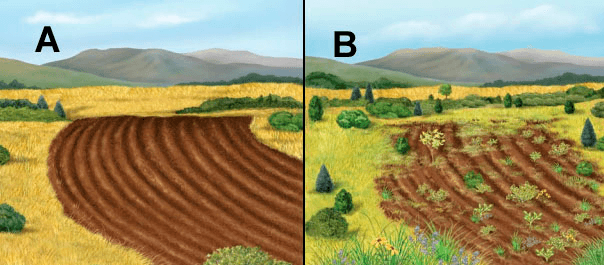
What type of succession is shown going from figure A to figure B?
a)
primary succession
b)
ecological succession
c)
secondary succession
d)
intermediate
98.
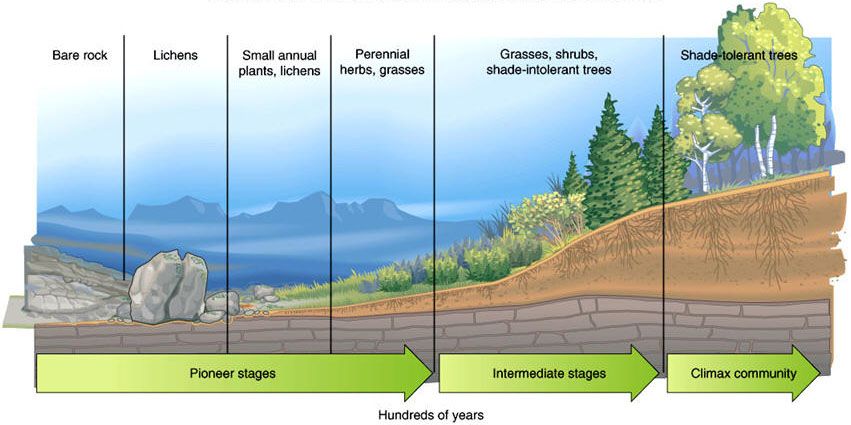
The picture shows what type of succession?
a)
primary
b)
secondary
c)
tertiary
d)
quadanary
99.
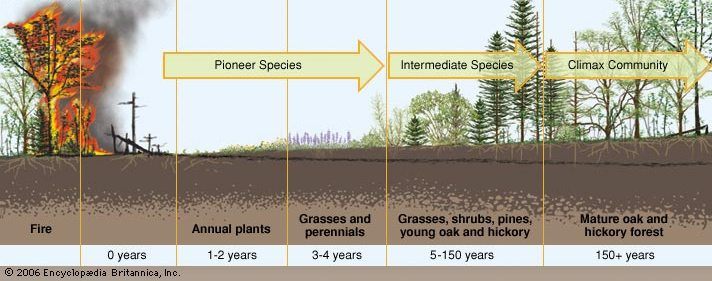
The picture shows what type of succession?
a)
primary
b)
secondary
c)
tertiary
d)
quadanary
100.
After a volcanic eruption, lava covers the land. What is the order that plants grow to repopulate the area?
a)
Lichens → Shrubs → Grasses → Trees
b)
Lichens → tree → shrubs→Grasses
c)
Grasses → Lichens → Shrubs → Trees
d)
Lichens → Grasses → Shrubs → Trees