wayground logo

Free Printable Worksheets

NEW

Font size

S
M
L
XL
Worksheets

equilibrium thermo phase diagrams nuclear

Total questions: 80

Worksheet time: 1hrs 1mins

Name
Class
Date
1.
For the reaction...
SO2 + O2  <−>  SO3
If the concentration of SOis increased, the equilibrium of the reaction will shift ___________.
a)
left
b)
right
c)
left and right 
d)
neither left nor right
2.
For the reaction...
SO2 + O2 <−>  SO3
If the equilibrium shifts to the right, the concentration of O2 will ___________.
a)
increase
b)
decrease
c)
remain the same
d)
double
3.
For the reaction...
SO2 + O2 <−>  SO3
If the concentration of Ois decreased, the equilibrium of the reaction will shift ___________.
a)
left
b)
right
c)
left and right
d)
neither left nor right
4.
For the reaction...
heat  +  N2  +  O2  <−>  2NO
If  O2 is removed, the  concentration of N2 will _______.
a)
increase
b)
decrease
c)
remain the same
d)
double
5.
For the reaction...
heat  +  N2  +  O2  <−>  2NO
If  NO is removed  from the system, the concentration of N2 will _______.
a)
increase
b)
decrease
c)
remain the same
d)
double
6.
For the reaction...
heat  +  N2  +  O2  <−>  2NO
If the heat is added to the chemical system, the equilibrium will shift _______.
a)
left
b)
right
c)
left and right
d)
neither left nor right
7.
For the reaction...
heat  +  N2  +  O2  <−>  2NO
If the heat is removed to the chemical system, the equilibrium will shift _______.
a)
left
b)
right
c)
both left and right
d)
neither left nor right
8.
For the reaction...
H2 (g)  + Cl2 (g) <−>  2HCl (g)  +  heat
If the pressure in the system is increased, the equilibrium will _______.
a)
shift left
b)
shift right
c)
not shift
9.
For the reaction...
N2 (g) +  3 H2 (g) <−> 2 NH3 (g)

If the pressure in the system is increased,  _______ reaction will be favored.
a)
 the forward
b)
the reverse
c)
neither
10.
Define chemical equilibrium.
a)
A reaction is reversible.
b)
The concentration of the reactants is equal to the concentration of the products.
c)
The rate of a forward reaction is equal to the rate of the reverse reaction.
d)
The reaction stops and no further change in concentration occurs.
11.
This symbol indicates that a reaction is ____________
a)
reversible
b)
irreversible
12.

What is the equilibrium constant expression (Keq) for:

Fe3O4(s) + 4H2(g) <--> 3Fe(s) + 4H2O(g)

a)

([Fe]3[H2O]4 ) / ([Fe3O4][H2]4)

b)

([Fe3O4][H2]4)/ ([Fe]3[H2O]4)

c)

[H2O]4 / [H2]4

d)

([Fe][H2O]) / ([Fe3O4][H2])

13.
When Keq > 1, 
a)
There are more products than reactants when the reaction reached equilibrium.
b)
There are more reactant than products when the reaction reached equilibrium.
c)
The amount of reactants is equal to the amount of products.
14.
Keq < 1
a)
There are more products than reactants when the reaction reached equilibrium.
b)
There are more reactant than products when the reaction reached equilibrium.
c)
The amount of reactants is equal to the amount of products.
15.

What is the proper Keq expression for the following reaction?

2 NO(g) + O2(g) ↔ 2 NO2(g)

a)

K = [NO2]2 / [NO]2[O2]

b)

K = [NO]2[O2] / [NO2]2

c)

K = [NO]2[O2][NO2]2

d)

K = 2[NO][O2] / 2[NO2]

16.
What is the equilibrium-constant expression for 
CO2(g) + H2(g) ↔ CO(g) + H2O(l)
a)
Kc= [CO][H2O] / [CO2][H2]  
b)
Kc= [CO2][H2] / [CO]
c)
Kc= [CO2][H2] / [CO][H2O]
d)
Kc= [CO] / [CO2][H2]  
17.
CH4 + 2 O2 ↔ CO2 + 2 H2O + 30 kJ
If CHwas removed, what happens to the [O2]
a)
Increase
b)
Decrease
c)
Left
d)
Right
18.
Changes in pressure will only affect substances that are in the __________ state.
a)
gaseous
b)
liquid
c)
solid
19.
How do catalysts increase the rate of reaction?
a)
The frequency of collisions is the increased
b)
The activation energy is lowered
c)
The energy of collisions is increased
d)
Both the frequency and energy of collisions is increased
20.
Increasing the temperature of the reactants can do one of the following
a)
Slow collision frequency
b)
Allow less effective collision between the particles
c)
Neutralize the reaction
d)
Increase collision between the particles thus increasing the rate.
21.
For the reaction...
H2 (g)  + Cl2 (g) <=>  2HCl (g)  +  heat
If the pressure in the system is increased, the equilibrium position will _______.
a)
shift to the left
b)
shift to the right
c)
not shift position at all as 2 mol gas <=> 2 mol gas
22.
This type of reaction occurs when light nuclei combine to form a larger, single nucleus.
a)
Fission
b)
Fusion
c)
single displacement
d)
double displacement
23.
This type of reaction occurs on the sun and in stars.
a)
Fission
b)
Fusion
c)
synthesis
d)
decomposition
24.
Nuclear reactions involve the particles in the ____.
a)
electron cloud
b)
neutrons
c)
nucleus
d)
half-life
25.
This type of  reaction occurs when a heavy nucleus, such as U-235, splits into two or more parts.
a)
Fission
b)
Fusion
c)
Chain reaction
d)
synthesis
26.
The least penetrating type of radiation
a)
Alpha particle
b)
Beta particle
c)
gamma ray
27.
a)
Fission  reaction
b)
Fusion reaction
c)
Decomposition reaction
d)
Combustion
28.

Nuclear _______________ is when a large unstable nucleus breaks into two smaller nuclei.

a)

Fusion

b)

Fission

29.

Which particle of nuclear radiation penetrates the most material (making it the most harmful)?

a)

alpha particle

b)

beta particle

c)

gamma particle

d)

omega particle

30.

A particle made up of two protons and two neutrons, identical to a helium atom, ejected from a nucleus during a nuclear reaction:

a)

alpha particle

b)

beta particle

c)

gamma particle

d)

omega particle

31.
What is a beta particle?
a)
proton
b)
positron
c)
electron
d)
neutrino
32.
Carbon-14 decays by emitting a beta particle, producing
a)
boron-14
b)
carbon-12
c)
nitrogen-14
d)
beryllium-10
33.
One disadvantage of nuclear energy is ___.
a)
it is a fossil fuel
b)
it leaves behind radioactive waste
c)
it emits large amounts of pollution into the atmosphere
d)
there are no disadvantages
34.

Which of the following is the nuclear symbol for a beta particle?

a)

4 He

2

b)

0 e

-1

c)

0 Y

0

d)

2 H

4

35.

What element is left when Rn-226 decays by an alpha particle?

a)

Fr-222

b)

Ra-222

c)

Pb-222

d)

Po-222

36.

What is an alpha particle?

a)

a charged electron that is emitted during certain types of radioactive decay

b)

particles released during electromagnetic radition

c)

positively charged particle composed of two neutrons and two protons

d)

negatively charged particle that orbits the nucleus

37.

What is a beta particle?

a)

created when a neutron changes into a proton and an electron

b)

created when a proton changes into a neutron and an electron

c)

composed of two protons and two neutrons

d)

negatively charged nucleus

38.

1. The type of nuclear decay resulting in no change in mass, and is pure energy is _____________________________.

a)

alpha radiation

b)

beta radiation

c)

gamma radiation

d)

solar radiation

39.

1. Isotopes are atoms of the same element but with differing numbers of ________________.

a)

protons

b)

neutrons

c)

electrons

d)

nucleons

40.

What happens to the atomic number if an alpha particle is released?

a)

it decreases by 1

b)

it decreases by 2

c)

it increases by 1

d)

it increases by 2

41.

What happens to the atomic mass when an alpha particle is released?

a)

it increases by 2

b)

it increases by 4

c)

it decreases by 2

d)

it decreaeses by 4

42.
Has a mass of 4 and a charge of +2
a)
Alpha
b)
Beta
c)
Gamma
d)
neutron
43.
Which process produces beta particles?
a)
Alpha decay
b)
Beta decay
c)
Gamma decay
d)
Nuclear fusion
44.
Water exists as a _____________ at 700 mmHg and 50 °C.
a)
solid
b)
liquid
c)
gas
d)
supercritical fluid
45.
What state of matter is X?
a)
solid 
b)
liquid
c)
gas
d)
supercritical fluid
46.
What state of matter is Y?
a)
solid 
b)
liquid
c)
gas
d)
supercritical fluid
47.
What state of matter is Z?
a)
solid 
b)
liquid
c)
gas
d)
supercritical fluid
48.
What change occurs from E to C?
a)
sublimation
b)
freezing
c)
melting
d)
boiling
49.
What change occurs from C to D?
a)
condensation
b)
vaporization
c)
melting
d)
sublimation
50.
At 0.10 atm, what phase(s) can exist?
a)
solid, liquid or gas
b)
liquid or gas
c)
solid only
d)
gas only
51.
Water exists as a _____________ at 3 mmHg and 50 °C.
a)
solid
b)
liquid
c)
gas
d)
supercritical fluid
52.
Which statement is true for carbon dioxide at -60 °C?
a)
All three phases are possible.
b)
It can exist as a solid or a gas, depending on pressure.
c)
It is a solid.
d)
With enough pressure it can be melted.
53.
A phase change from a liquid to a solid is ____________.
a)
Freezing
b)
Melting
c)
Evaporation
54.
What change occurs from E to C?
a)
sublimation
b)
freezing
c)
melting
d)
boiling
55.
What change occurs from C to D?
a)
condensation
b)
vaporization
c)
melting
d)
sublimation
56.
What is the normal boiling point of this substance?
a)
150 °C
b)
100 °C
c)
-50 °C
d)
0 °C
57.
What is the normal melting point of this substance?
a)
150 °C
b)
100 °C
c)
-50 °C
d)
0 °C
58.

Which represents the LIQUID phase?

a)

A

b)

B

c)

C

59.

Which number best represents the point where solid, liquid, & gas coexist in equilibrium?

a)

1

b)

2

c)

3

d)

4

60.

The change in phase represented from point A to point B is...

a)

boiling

b)

melting

c)

condensation

d)

sublimation

61.

The change in phase represented from point A to point B is...

a)

melting

b)

freezing

c)

condensation

d)

boiling

e)

sublimation

62.

The change in phase represented from point A to point B is...

a)

condensation

b)

boiling

c)

sublimation

d)

deposition

e)

melting

63.

From point M to point N at constant pressure, how many phase changes are occurring?

a)

one phase change

b)

two phase changes

c)

three phase changes

d)

no phase change occurs

64.
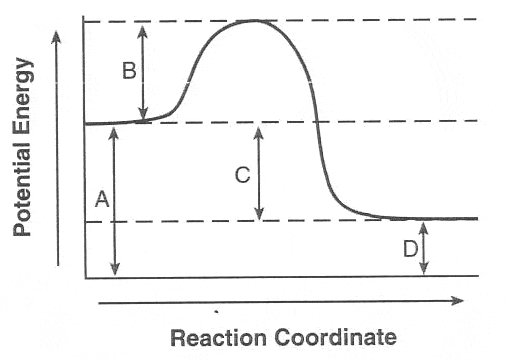
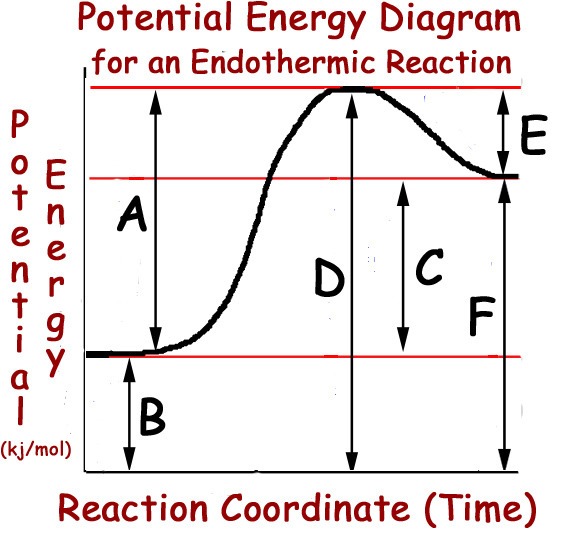
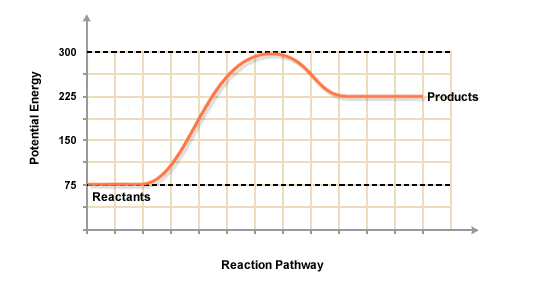
What type of reaction is this?
a)
Endothermic
b)
Exothermic
65.
What letter represents the activation energy?
a)
A
b)
B
c)
C
d)
D
66.
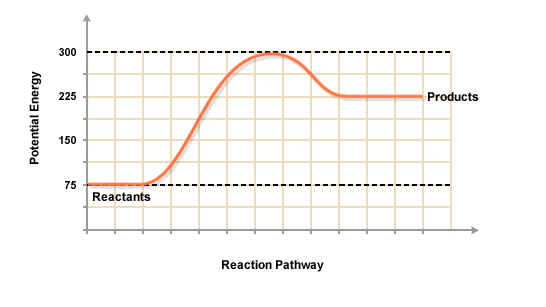
What is the energy of the activated complex?
a)
75 kJ
b)
225 kJ
c)
300 kJ
d)
225 kJ
67.
Activation energy is required to start a chemical reaction. What is activation energy?
a)
The energy needed for a reaction to occur
b)
The minimum amount of energy needed for a reaction to potentially occur
c)
The energy added by a catalyst
d)
The energy possessed by the products
68.
Increase in temperature of the reactants can do one of the following
a)
Slow collision frequency
b)
Allow less effective collision between the particles
c)
Cause particles to lose speed
d)
Increase collision between the particles thus increasing the rate.
69.
Grinding a seltzer tablet into powder increases the rate of reaction due to increased
a)
concentration
b)
surface area
c)
temperature
d)
reactants
70.
What is the activation energy of the reverse reaction?
a)
75 kJ
b)
300 kJ
c)
150 kJ
d)
225 kJ
71.
Which factors increase the rate of a reaction.
a)
increasing temperature
b)
increasing concentration
c)
increasing surface area
d)
all of these
72.
A ______________ is a substance that increases the rate of a reaction without being used up during the reaction. 
a)
catalyst
b)
product
c)
reactant
d)
solute
73.
Smaller particle size allows for a _________ surface area to be exposed for the reaction.
a)
larger
b)
smaller
74.
Exothermic reactions release heat to the surroundings.
a)
true
b)
false
75.
Increasing the concentration of the reactants will slow down the reaction.
a)
false 
b)
true
76.
In an endothermic reaction the products have 
a)
more energy than the reactants
b)
less energy than the reactants
c)
the same energy as the reactants
d)
no energy
77.
In an exothermic reaction the products have
a)
more energy than the reactants
b)
the same energy as the reactants
c)
less energy than the reactants
d)
no energy
78.
C represents
a)
energy absorbed
b)
energy released
c)
activation energy
79.
Products will form faster if____________
a)
the particle size of the reactants are larger.
b)
temperature is decreased.
c)
concentration of the reactants are increased.
d)
the reaction is not stirred.
80.
Exothermic reactions...
a)
Absorb energy
b)
Release energy
c)
Release Color
d)
Absorb Color