wayground logo

Free Printable Worksheets

Font size

S
M
L
XL
Worksheets

Unit 3 Benchmark

Total questions: 81

Worksheet time: 49mins

Name
Class
Date
1.

The order of the planets is:

a)

Mars, Venus, Earth,

Mercury, Saturn

Jupiter, Uranus, Neptune

b)

Earth, Venus, Mars

Jupiter, Neptune,

Mercury, Saturn,

Uranus

c)

Mercury, Venus, Earth

Mars, Jupiter,

Saturn, Uranus

Neptune

2.

About how many times larger is the diameter of the Sun compared to the Earth?

a)

15

b)

109

c)

150

d)

400

3.

About how many times larger is the diameter of the Earth compared to the Moon?

a)

100

b)

4

c)

50

d)

16

4.

The Earth takes one full year to complete _____.

a)

one day on Venus

b)

one phase of the Moon

c)

one rotation on its axis

d)

one revolution around the Sun

5.

This force that attracts all objects toward Earth.

a)

inertia

b)

gravity

c)

weight

d)

mass

6.

Why do we experience the changing of the season on the earth?

a)

distance from the sun

b)

rotation of the earth

c)

change in solar output

d)

tilt of the earth's axis
7.
In spring/summer, the axis of the earth is pointed away or toward the sun?
a)
towards
b)
Neither away or toward
c)
away
8.
The spinning of an object on its axis is called______
a)
orbit
b)
rotation
c)
revolution
d)
tide
9.
Day and night is caused by the _____________ of earth on its axis.
a)
revolution
b)
orbit
c)
rotation
10.
The earth orbits around...
a)
the sun.
b)
the moon
c)
other planets
d)
the Milky Way
11.
What are the reasons for the seasons?
a)
Earth's tilt and rotation.
b)
Earth's rotation and revolution.
c)
Earth's tilt and revolution.
d)
Earth's tilt and resolution
12.
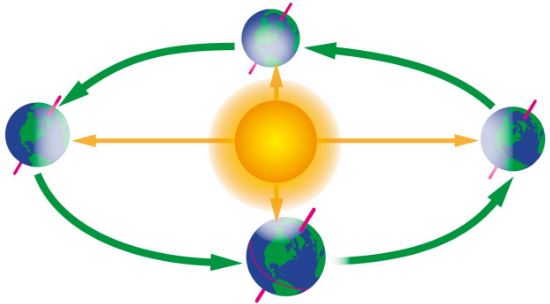
At position A, which hemisphere would have summer?
a)
Northern hemisphere
b)
Southern hemisphere
13.
What happens when the area in which you live tilts away from the sun?
a)
It is summer.
b)
It is spring.
c)
It is winter.
d)
It is fall.
14.
In spring/summer, the axis of the earth is pointed away or toward the sun?
a)
towards
b)
Neither away or toward
c)
away
15.
Which season is taking place in the Southern Hemisphere in Position 1?
a)
Winter
b)
Spring
c)
Summer
d)
Fall
16.
Which season is taking place in the Northern Hemisphere in Position 1?
a)
Winter
b)
Spring
c)
Summer
d)
Fall
17.
Which season is taking place in the Northern Hemisphere in Position 2?
a)
Winter
b)
Spring
c)
Summer
d)
Fall
18.
Which season is taking place in the Northern Hemisphere in Position 3?
a)
Winter
b)
Spring
c)
Summer
d)
Fall
19.
Which season is taking place in the Northern Hemisphere in Position 3?
a)
Winter
b)
Spring
c)
Summer
d)
Fall
20.
Which season is taking place in the Northern Hemisphere in Position 4?
a)
Winter
b)
Spring
c)
Summer
d)
Fall
21.
In order to have an eclipse, the Moon, Sun and Earth have to be?
a)
Below each other
b)
Above each other
c)
In alignment
22.
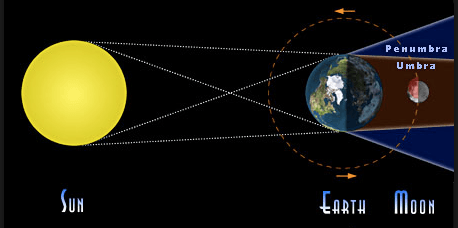
What is the darkest inner part of the shadow cone called, where a total eclipse can be viewed.
a)
Total
b)
Umbra
c)
Penumbra
23.
a)
solar eclipse
b)
lunar eclipse
24.
A solar eclipse only occurs during which moon phase?
a)
1st Quarter
b)
New Moon
c)
Full Moon
d)
3rd Quarter
25.
What is the central, darker part of a shadow called?
a)
the umbra
b)
the penumbra
26.
Which type of eclipse is shown in this picture?
a)
Solar Eclipse
b)
Orbit
c)
Lunar Eclipse
d)
Total Eclipse
27.
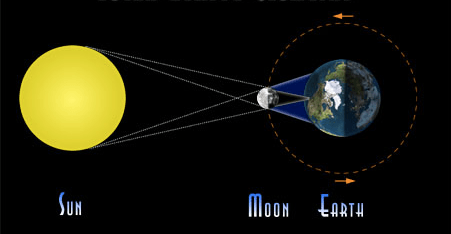
Which type of eclipse is shown in the diagram?
a)
Solar Eclipse
b)
Lunar Eclipse
c)
Total Eclipse
d)
Partial Eclipse
28.
A[n] ______________ tide occurs when the sun is at right angles to the line between Earth and the moon. 
a)
high
b)
neap
c)
low
d)
spring
29.
Differences in the moon's and sun's pull on different sides of the Earth cause _________.
a)
gravity
b)
lunar phases
c)
tides
d)
dabbing
30.
A[n] ___________ tide occurs when the sun, Earth, and the moon are nearly in a line. 
a)
spring
b)
high
c)
low
d)
neap
31.
The bulge of water on the side of the Earth closest to the moon produces ___________.
a)
high tide
b)
low tide
c)
neap tide
d)
spring tide
32.
Water flows toward the high tides, halfway between them causing ____________.
a)
neap tide
b)
high tide
c)
spring tide
d)
low tides
33.
Tides are caused mainly by the differences in how much gravity from the moon and the sun pulls on different parts of the Earth. 
a)
True
b)
False
34.
Changes in the positions of Earth, the moon, and the sun affect the height of high tides during a month. 
a)
True
b)
False
35.
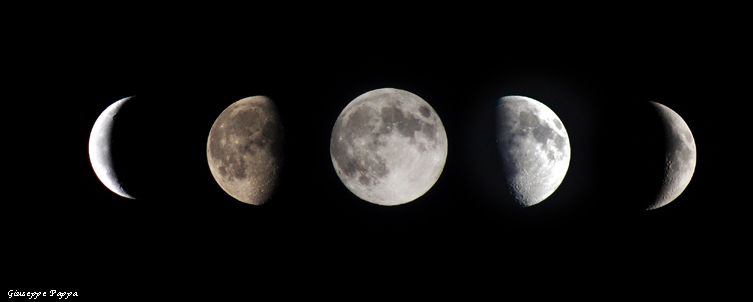
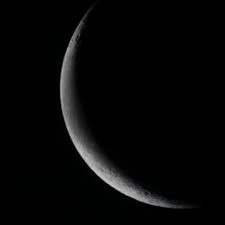
Name the moon phase
a)
waning crescent
b)
waxing crescent
c)
waning gibbous
d)
waxing gibbous
36.
Name the moon phase
a)
waning crescent
b)
waxing crescent
c)
waning gibbous
d)
waxing gibbous
37.
Name the moon phase
a)
waning crescent
b)
waxing crescent
c)
waning gibbous
d)
waxing gibbous
38.
Name the moon phase
a)
waning crescent
b)
waxing crescent
c)
waning gibbous
d)
waxing gibbous
39.
Name the moon phase
a)
waning crescent
b)
waxing crescent
c)
waning gibbous
d)
waxing gibbous
40.
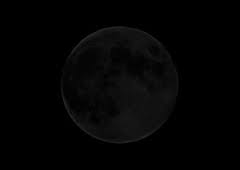
Name the moon phase
a)
First Quarter
b)
Last Quarter
c)
New Moon
d)
Full Moon
41.
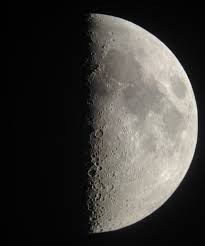
Name the moon phase
a)
First Quarter
b)
Last Quarter
c)
New Moon
d)
Full Moon
42.
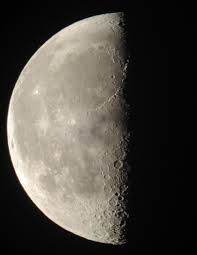
Name the moon phase
a)
First Quarter
b)
Last Quarter or (third quarter)
c)
New Moon
d)
Full Moon
43.
Name the moon phase
a)
First Quarter
b)
Last Quarter
c)
New Moon
d)
Full Moon
44.
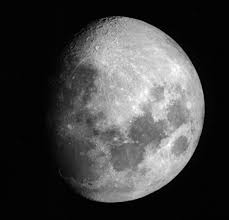
Name the moon phase that would come AFTER this moon.
a)
waning crescent
b)
waxing crescent
c)
waning gibbous
d)
waxing gibbous
45.
What moon phase came right BEFORE this one?
a)
First Quarter
b)
Last Quarter
c)
New Moon
d)
Full Moon
46.
What is the difference between a gibbous moon and a crescent moon?
a)
The gibbous shows more than half of the bright side of the moon.
b)
The crescent shows more than half of the bright side of the moon.
c)
The gibbous shows less than half of the bright side of the moon. 
47.
How many phases does the moon go through?
a)
4
b)
8
c)
10
d)
16
48.
As the moon's shape appears to get smaller, we say that the moon is _.
a)
swelling
b)
waxing
c)
waning
d)
disappearing
49.
Phases of the moon in which the moon appears to be getting larger are referred to as _.
a)
waxing
b)
waning
c)
new
d)
eclipse
50.
The cycle of the moon lasts about a _.
a)
day
b)
year
c)
week
d)
month
51.

What two forces affect gravity?

a)

mass and inertia

b)

mass and distance

c)

mass and force

d)

mass and weight

52.
What forces cause a planet to orbit?
a)
gravity and orbit
b)
gravity and inertia
c)
gravity and mass
d)
gravity and weight
53.
Your mass increases on a large planet with more gravity.
a)
True
b)
False
54.
On Earth, which has a greater gravitational force acting on it?
a)
an iPhone
b)
a laptop
c)
a dog
d)
a car
55.
Gravity on the moon is about 1/6 the gravity felt on the earth. This is because
a)
the moon is much less massive than the earth
b)
the earth has a molten core and the moon doesn't
c)
the moon is so much further from the sun than the earth.
d)
the moon is so far away from the earth
56.
An astronaut's mass ______ in space.
a)
changes
b)
increases
c)
decreases
d)
stays the same
57.
What would happen to the planets in the solar system if the sun’s gravitational force were to suddenly disappear?
a)
They will stop moving and become static.
b)
They will stop spinning.
c)
They will fly away in straight lines.
d)
They will start moving toward the Sun
58.
Which of these best describes why your weight (on Earth) would change on another planet?
a)
Dehydration effects on different planets change weight.
b)
In general, the smaller the planet, the greater weight
c)
Different planets have different gravitational pulls
d)
Weight does not change, no matter where you are.
59.
An astronaut weighs ____ in space.
a)
less
b)
more
c)
the same
d)
100 Newtons
60.
If mass increases and distance stays the same then the gravity between the two objects
a)
stays the same
b)
decreases
c)
increases
61.
If mass stays the same and distance increases then the gravity between two objects
a)
decreases
b)
increases
c)
stays the same
62.
This is the amount of matter in an object
a)
weight
b)
gravity
c)
mass
d)
inertia
63.
On Saturn, you would weigh more because 
a)
Saturn has more mass and less gravity
b)
Saturn has more mass and gravity
c)
Saturn has less mass and more gravity
d)
Saturn has less mass and less gravity
64.
What do we call small space rocks that successfully enters Earth's atmosphere and reach the ground?
a)
Meteorites
b)
Meteoroids
c)
Meteors
65.
What do we call small space rocks that burn up in Earth's atmosphere, creating a streak of light (shooting star)?
a)
Meteorites
b)
Meteors
c)
Meteoroids
66.
A small object that enters Earth's atmosphere from space and burns due to friction, emitting light.
a)
meteor
b)
comet
c)
asteroid
d)
star
67.
Large and small rocks or metallic masses orbiting the Sun; made up of materials similar to those that formed the planets.
a)
asteroid
b)
comet
c)
meteor
d)
meteroid
68.
A chunk of rock or dust in space is called a __.
a)
meteroite
b)
asteroid
c)
comet
d)
meteoroid
69.
What object is made of ice?
a)
meteor
b)
comet
c)
asteroid
d)
meteorite
70.

A solid copy of the shape of an organism is

a)

cast fossil

b)

mold fossil

c)

carbon film

d)

fossil record

71.

What type of fossils provide evidence of the activities of ancient organisms

a)

trace fossils

b)

molds and casts

c)

carbon films

d)

petrified fossils

72.

Which of the following substances is not able to preserve entire organisms

a)

sticky tar

b)

amber

c)

water

d)

ice

73.

Most fossils form when living things die and are buried by __________ that hardens into rock over time.

a)

sediment

b)

ice

c)

water

d)

wind

74.

Scientists study the ____________ to learn about the history of life, past environments on Earth,and how different groups of organisms have changed over time.

a)

history

b)

fossil record

c)

rock

d)

timeline

75.

The term ______________________ is used to identify a scientist who studies fossils

a)

biologist

b)

paleontologist

c)

zoologist

d)

botanist

76.

____________________ is a gradual change in living things over long periods.

a)

adaptation

b)

natural selection

c)

evolution

77.

An organism is ________________ if it no longer exists and will never live again on Earth.

a)

hibernating

b)

extinct

c)

dying

78.

Which of the following is NOT something you could learn from a fossil?

a)

size of the animal

b)

what the animal ate

c)

what color the animal was

d)

where the animal lived

79.

In which rock type do we usually find fossils?

a)

igneous

b)

metamorphic

c)

sedimentary

80.

Why don't we know what many ancient plants looked like?

a)

they had too many soft parts

b)

they were all eaten by dinosaurs

c)

there weren't any ancient plants

81.

Ellie sees a skeleton of a dinosaur at a museum. What is true about the bones that make up that skeleton?

a)

the bones are made up of minerals

b)

the bones were formed from mud that hardened

c)

the bones are those of the dinosaur itself

d)

the bones are made of amber