
 Worksheets
Cells Unit Review
Total questions: 87
Worksheet time: 1hrs 27mins
Which of the following is NOT a characteristic of all living things?
growth and development
ability to move
response to the environment
ability to reproduce
Which of the following characteristics of living things best explains why birds fly south for the winter?
Living things respond to their environment.
Living things maintain internal balance.
Living things are made up of units called cells
Living things are based on a universal genetic code.
A beech tree uses photosynthesis to change light energy into sugar and convert this into usable energy. This is an example of how all living things:______________________________.
respond to the environment
grow and develop
are made up of one or more cells
need energy
Both a fast-moving stream and a dog respond to the environment and grow and develop, but this characteristic of life is why a dog is considered alive and a stream isn’t.
The ability to move
The ability to grow and develop
Being made of cells
The ability to change over time

Which image below represents the highest level of magnification?
A
B
C
Which image above represents the largest field of view?
A
B
C
If your compound microscope has a 4X ocular lens and objective lenses of 4X, 10X and 40X, what is its highest possible magnification?
160X
400X
6400X
1600X

What is part number 3 in the photograph of a compound microscope?
lamp
objectives lens
stage
eyepiece
What is the function of part number 2 in the photograph of a compound microscope?
switch between low, medium and high power objectives lenses
focus on the image under low power
focus on the image at high power
adjust the amount of light entering the slide

The image shows the millimeter lines of a ruler in focus under low power. What is the best estimate of the diameter of the field of view in millimeters?
4.0 mm
5.0 mm
4.5 mm
5.5 mm

The image shows the millimeter lines of a ruler in focus under low power. What is the best estimate of the diameter of the field of view in micrometers?
3.5 µm
3000 µm
4000 µm
3500 µm
Which characteristic do unicellular organisms and multicellular organisms have in common?
Both have cells with specialized functions for each life process.
Both have a way to get rid of waste materials.
Both perform all life processes within one cell.
Both are able to make food from sunlight.
Which of the following is a disadvantage of unicellular organisms?
Can grow larger than multicellular organisms.
Does not perform some specialized functions because all tasks must be performed by one cell.
More efficient than multicellular organisms.
Can live in a wider variety of environments than multicellular organisms.
Which statement is not a basic assumption about living things?
The cell is the smallest living organism that shows the characteristics of living things
An organism can be made up of a single cell or as many as trillions of cells
Cells are created from existing cells through cell division
All cells are microscopic and are therefore considered to be abiotic
Which is NOT a part of the cell theory?
All organisms are composed of one or more cells.
The cell is the basic unit of structure and organization in organisms.
All cells come from preexisting cells.
The invention of the microscope allowed scientist to investigate plant and animal cells.
While we have always been made of cells, it took us a long time to see them. What innovation below was critical to the discovery of cells, showing the relationship of science and technology?
Dissatisfaction with the theory of spontaneous generation.
Electricity, to power the microscope.
Glass lenses, to magnify tiny things clearly.
The light bulb, to provide light for the microscope.

Which structure is the cytoplasm?
1
2
5
12
Which structure stores food and waste?
1
2
5
12

Which of the following part(s) of cell city best matches the role of the mitochondria?
1 and 2 - large wooden fence
5 - storage tanks
6 - power plant
7 - municipal government

The cell uses structure 3 to
transport material from one part of the cell to another.
package proteins so they can be stored by the cell.
use light energy to make sugar.
use energy from organic compounds(food) to make energy for the cell

Match the description with the organelles. Write your answer as a four digit number (no spaces)
(a)
Which statement about plant versus animal cells is true?
Only plant cells contain vacuoles because they must store sugars
Both plant and animal cells have mitochondria
Only unicellular animal cells make their own food
Chloroplasts are located in the nucleus in animal cells
Which organelle is like a chain-link fence? It's a flexible, protective barrier and filters what enters or leaves a cell.
Cell membrane
Cell wall
Cytoplasm
Nucleus
Which organelle is like the factory manager's office? It's the 'room' that the manager is inside of.
Lysosome
Mitochondria
Nucleus
Ribosome
Which organelle is like a factory's water storage tanks? It's where water and nutrients are stored.
Centrosome / Centrioles
Lysosome
Vacuole
Vesicle

Where will the water go in the diagram?
into the cell
out of the cell
nowhere
everywhere
A student noticed that placing wilted lettuce in a bowl of cool water caused the lettuce to become more crisp and firm. What is the best explanation for his observation?
Water moved into the lettuce cells by osmosis. because there is a higher concehtration of salt outside the cell than inside
Water moved into the lettuce cells by osmosis. because there is a higher concehtration of water outside the cell than inside
Water moved into the lettuce cells by osmosis. because there is a higher concehtration of salt outside the cell than inside
Water moved out of the lettuce cells by osmosis because there is a higher concehtration of water outside the cell than inside

What conclusion can you make from the graph?
the higher the salt concentration, the more the cantaloupe loses mass
the higher the salt concentration, the more the cantaloupe gains mass
cantaloupe pieces will not change in mass if placed in a 0% salt solution
cantaloupe pieces will not change in mass if placed in a 10% salt solution

What would you likely find next morning?
The tube will be inside out
The tube will have burst open
The tube will have shrunken with nothing inside it
The tube will look the same as it did last night

What was the manipulated variable in this experiment?
concentration of sugar in solution
appearance of plant cells after 30 minutes
amount of sugar solution
type of cells
Which solution likely had the highest sugar concentration?
Solution A
Solution B
Solution C
All are equally likely
A(n) ______ is the lowest level of biological organization to have the characteristics of life
Organ
Cell
Tissue
Organ system
organism

Function of the cell shown here
send and receive signals
move parts of the body
nerve cell
bone cell
Which type of cell forms a protective layer for your body?
muscle cell
epithelial cell
nerve cell
bone cell
Groups of similar cells that all do the same sort of work are called _________
organs
tissues
organ systems
organelles
If a group of organs work together to perform a specific job, what are they called?
an organism
an organ system
tissue
organelle

Which one of the following correctly identifies substances P and Q and systems Z, Y and Z?
Substance P: Carbon dioxide; Substance Q: Oxygen; System X: Circulatory System; System Y; Digestive System; System Z: Respiratory System
Substance P: Carbon dioxide; Substance Q: Oxygen; System X: Digestive System; System Y; Circulatory System; System Z: Respiratory System
Substance P: Oxygen; Substance Q: Carbon dioxide; System X: Digestive System; System Y; Respiratory System; System Z: Circulatory System
Substance P: Oxygen; Substance Q: Carbon dioxide; System X: Respiratory System; System Y; Circulatory System; System Z: Digestive System
Which body system is responsible for generating electrical impulses that run the muscular system?
Excretory system
Nervous system
Respiratory system
Circulatory system

Which organ system does the table represent?
nervous
digestive
circulatory
respiratory
The circulatory system works with the ___________ system to provide our body with oxygen.
respiratory
digestive
muscular
skeletal
The circulatory system works with the __________ system to obtain energy from nutrients that we eat.
respiratory
digestive
skeletal
nervous

What is the responding variable in this experiment?
rate of heartbeat
rate of breathing
Alex
Simon
Based on the graph, what pattern can be observed between the rate of heartbeat and breathing?
As his rate of heartbeat increases, his breathing rate also increases
As his rate of heartbeat decreases, his breathing rate also increases
As his rate of heartbeat increases, his breathing rate also decreases
As his rate of heartbeat decreases, his breathing rate also decreases
What do Red-Blood cells do?
Carry oxygen from the lungs to the body cells and transport carbon dioxide from the cells back to the lungs
keeps blood flowing in one direction to the heart and prevent blood from flowing backwards
Collects blood from the capillaries and drain it into the veins
Bring nutrients to the cells and carries away waste materials.

Which of the following pairs of blood vessels are called arteries?
A and B
A and C
B and C
B and D

Which 1 of the diagrams correctly shows the direction in which blood flows in our body?


Which of the following graphs shows the correct relationship between our heartbeat and the intensity of exercise?


What function does the heart do?
Protects organs and produces red blood cells.
Generates heat.
Breaks down food into nutrients.
Acts as pump, which moves the blood.

Which type of blood enters the blood capillary at A?
blood high in oxygen and low in carbon dioxide
blood high in oxygen and high in carbon dioxide
blood low in oxygen and low in carbon dioxide
blood low in oxygen and high in carbon dioxide

The structure labelled 8 is called
trachea
bronchi
diaphragm
alveoli

Which of the following shows the correct representation of the parts of the human respiratory system by the glass tube, balloon and rubber sheet respectively?
Glass tube: Q; Balloon: R; Rubber Sheet: S
Glass tube: P; Balloon: R; Rubber Sheet: S
Glass tube: P; Balloon: Q; Rubber Sheet: R
Glass tube: Q; Balloon: S; Rubber Sheet: R

In which part does gaseous exchange take place?
A
B
C
D

The manipulated variable in the above experiment is
lung capacity
age
height
lung capacity compared to height
A conclusion that you could make from the data is
A large lung capacity increases the height of a student
Taller individuals have larger lung capacities
Shorter pupils will eventually grow larger lungs
lung capacity is caused by height

Put these parts in the order in which oxygenated air would pass through the respiratory system with 1 being the first place and 4 being the last place. Record your answer as a four digit number (no spaces)
(a)

Why did Gerald's breathing rate decrease gradually?
There is an excess storage of air in the lungs.
He does not need any energy when he is resting.
He returns to his normal breathing rate as less oxygen is needed.
Less oxygen is taken in since the cells in his body have been overworked.
The chewing and grinding of food into smaller pieces is an example of…
mechanical digestion
chemical digestion
peristalsis
absorption

The organ labelled “1” is called the
trachea
bronchi
esophagus
small intestine
What is the purpose or importance of peristalsis?
The function of structure 3 is
absorption of water
mechanical digestion
storage of nutrients
peristalsis
Reorder the following steps of the digestive system
esophagus
stomach
small intestine
large intestine

What is the responding variable in this experiment?
time after meal has been ingested
type of food ingested
person being tested
amount of nutrients in the blood
What structure in the digestive system is located at point B?
mouth
esophagus
stomach
small intestine
The villi is where the digestive system connects with the __________________ system.
circulatory
respiratory
nervous
excretory
If I step on a nail...what type of neuron takes that signal to the brain and spinal cord?
interneurons
motor
sensory
receptors
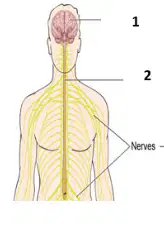
Match the following
Brain
Name of structure 1
coordinate and control body activities
Function of structure 1
spinal cord
Name of structure 2
coordinate reflexes
Function of structure 2
When you react to catch a dropped ruler your body reacts in this order:
1) muscles contract 2) eyes sense ruler move 3) message sent to brain 4) message sent to the muscles
1) message sent to muscles 2) muscles contract 3) message sent to brain 4) eyes sense ruler move
1) eyes contract 2) muscles sent to brain 3) message sense moves 4) ruler is sent to muscles
1) eyes sense ruler move 2) message sent to brain 3) message sent to muscles 4) muscles contract
Neurons that send information from the brain TO THE MUSCLES.
sensory neurons
arteries
veins
motor neurons
What is NOT true about a REFLEX?
It is a QUICK, automatic response to a stimulus.
They are mostly controlled by the spinal cord.
An example is blinking.
They are controlled by the heart.

What structure is labelled #1?
motor neuron
interneuron
reflex
sensory neuron
A diet high in saturated fat can lead to high blood pressure. Which of the following treatments would be most effective for treating high blood pressure?
prescribing blood thinners to help the blood move move easily through the blood vessels
practicing breathing exercises to strengthen the diaphragm muscles
reducing the amount of gluten in the diet to reduce irritation of the villi
playing video games to strengthen hand-eye coordination
People who are lactose intolerant are missing the enzyme that breaks down the sugar in dairy products such as milk. When they eat dairy, they suffer from bloating, cramps and diarrhea. LACTAID pills contain this missing enzyme and can be eaten alongside dairy products to help reduce these symptoms. How do LACTAID pills help sufferers of this disorder?
they increase absorption of nutrients in the stomach
they increase chemical digestion of dairy products into nutrients
they increase absorption of water in the small intestine
they slow down the digestion of nutrients in the stomach
Pneumonia is a lung inflammation caused by bacterial or viral infection, in which the air sacs fill with pus and may become solid. Which of the following describes possible effects of pneumonia?
shallow breathing caused by damage to the diaphragm
general tiredness and weakness from poor gas exchange in alveoli
wheezing from narrowed bronchi which reduces air flow to lungs
loss of voice from swelling of larynx
A brain tumor occurs when a mass of cells grow uncontrolled within the brain. How will a brain tumor affect the transmission of nerve impulses?
the body cannot receive information from stimuli
muscles cannot contract and expand
motor neurons cannot stimulate muscles
interneurons cannot interpret the message properly
Which of the following describes how genetics can affect human health?
Type I diabetes tends to run in family's, passed down from parent to child
Type II diabetes can develop in part because of poor nutritional choices
Rates of asthma tend to be higher in more polluted areas
Influenza spreads quickly where populations of people are concentrated

Match the descriptions with the medical research or technology. Record your answer as a three digit number (no spaces)
(a)

Use the information above to match the claim, evidence and reasoning. Record your answer as a three digit number.
(a)
The medicine wheel is a symbolic representation of
The history of indigenous peoples
Health and cycles of life
Mother Earth
Cleansing ceremony
Which of the four elements does the burning of sacred plants symbolize?
Air
Water
Fire
Mother Earth
Which of the four elements does the four sacred plants (sage, cedar, sweetgrass, tobacco) symbolize?
Air
Water
Fire
Mother Earth
Which of the following are the four life stages?
birth, youth, adult, death
spring, summer, winter, fall
fire/sun, air, water, earth
eagle, bear, wolf, buffalo
Which of the following is a way we can strengthen our neural connections?
learning a new language
practicing a sport
studying for a science test
All of the above
Someone with brain damage to the Broca's area may no longer be able to speak. According to neuroplasticity theory, why might the person recover their speech?
Broca's areas grows back
More white matter develops around the neurons in this area
new neurons develop linking together the already established neural network
there is an increase in the grey matter in the Broca's compared to before the accident
Your grandfather decides to learn how to play Fifa 19. You tell him:
this is impossible because your brain, as you grow older, only loses its ability to function at full capacity.
sure lets practice and play together, the brain continues to change and learn even as grown ups, he will be an awesome play partner since he is on retirement now.
Are you sure you can handle it?
even if we practice over and over, I will still beat you grandpa, you are too old for me!
What is neuroplasticity?
The brain's ability to heal from injuries
The brain's ability to reorganize itself by forming new neural connections
The brain's ability to store memories
The brain's ability to control emotions

