wayground logo

Free Printable Worksheets

Font size

S
M
L
XL
Worksheets

Spring Semester Review '18

Total questions: 153

Worksheet time: 2hrs 29mins

Name
Class
Date
1.

Water is absorbed by the plant through the roots, and transpiration takes place as the water exits the ________.

a)

Leaves

b)

Roots

c)

Stem

d)

Flower

2.
Which part of a plant is responsible for the majority of photosynthesis?
a)
leaves
b)
stem
c)
roots
d)
stomata
3.
An organism that utilizes light energy to create chemical energy to fuel itself is a(n)
a)
autotroph
b)
heterotroph
c)
chlorophyll
d)
human
4.

What are the reactants (what is needed) for photosynthesis?

a)

glucose and oxygen

b)

water and carbon dioxide

c)

glucose and carbon dioxide

d)

water and oxygen

5.
What gas is released by plants from the process of photosynthesis?
a)
air
b)
carbon dioxide
c)
oxygen
d)
hydrogen
6.
What PIGMENT absorbs sunlight for photosynthesis?
a)
chloroplast
b)
thylakoid
c)
grana
d)
chlorophyll
7.
Where does carbon dioxide enter plants?
a)
The leaves (in the holes called Stomata)
b)
Flowers
c)
Roots
d)
Stem
8.

Where does photosynthesis happen?

a)

all parts of the plant

b)

chloroplasts

c)

mitochondria

d)

chlorophyll

9.
What are the products  (what is made)  of photosynthesis?
a)
Glucose and oxygen
b)
sunlight energy
c)
carbon dioxide and water
d)
chlorophyll 
10.
Which gas enters a stomata?
a)
Oxygen 
b)
Nitrogen
c)
Helium
d)
Carbon Dioxide 
11.
Which gas leaves a stomata?
a)
Oxygen
b)
Nitrogen
c)
Helium
d)
Carbon Dioxide
12.
What tubes transport water from the roots to the leaves?
a)
xylem
b)
phloem
c)
stems
d)
roots
13.
Which part of a plant is responsible for transpiration?
a)
leaves
b)
stem
c)
roots
d)
flower
14.
Which of the following is an example of an AUTOTROPH?
a)
Appletree
b)
Dog
c)
Mushroom
d)
Human
15.
Which of the following is an example of a HETEROTROPH?
a)
Grass
b)
Algae
c)
Lemon Tree
d)
Bear
16.
Chloroplasts are...
a)
Structures of animal cells to produce ATP
b)
Organelles where lipids are elaborated
c)
Specialized structures of plants where food is made
d)
Waste organelle of plants
17.
If all four plants were watered daily but placed in a closet, receiving no sunlight, what process would NOT occur?
a)
Ingestion of carbon dioxide
b)
Filtration of water through the soil
c)
Photosynthesis
d)
Water absorbtion
18.
What gas is released from the plant during RESPIRATION?
a)
carbon dioxide
b)
oxygen
c)
nitrogen
d)
argon
19.
Which tubes transport the sugar from the leaves throughout the plant?
a)
phloem
b)
xylem
c)
stem
d)
roots
20.

What is cellular respiration?

a)

The way a plant grows

b)

The way a plant releases excess waste

c)

The way a plant makes its food

d)

When way a plant uses sugar for energy

21.
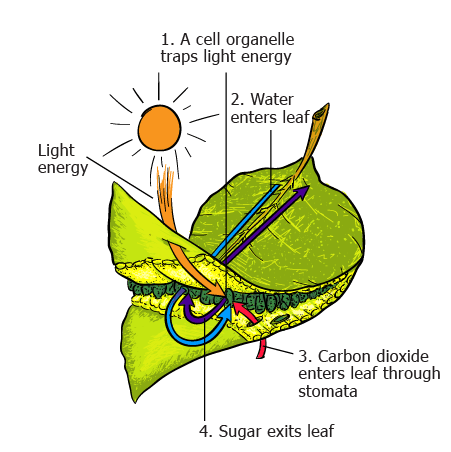
How is the water exiting this leaf?
a)
xylem tubes
b)
phloem tubes
c)
stomata
22.
What can be inferred as a result of this experiment?
a)
Plants need sunlight to grow.
b)
Plants need sunlight to obtain chlorophyll.
c)
Plants need water for photosynthesis.
d)
This plant is really a fungus
23.

Plants transform energy when they make their own food. Which type of energy is used by plants for making food?

a)

electrical

b)

heat

c)

radiant

d)

mechanical

24.
Which is a process that converts sunlight energy into a compound that stores chemical energy?
a)
phototropism
b)
photosynthesis
c)
respiration
d)
transpiration
25.
Which stimulus causes a responding plant to demonstrate phototropism?
a)
intensity of light
b)
direction of light
c)
length of day
d)
time of day
26.
In which direction do the roots of plants grow?
a)
In the direction of moisture only
b)
in the direction of the pull of gravity only
c)
in the direction of water and the pull of gravity
d)
in the direction of water and away from the pull of gravity
27.
How are plant cells different from animal cells?
a)
Only plant cells can grow
b)
Only animal cells can reproduce
c)
Only animal cells can store energy
d)
Only plant cells can perform photosynthesis
28.
What is the ultimate ORIGINAL source of energy for living things
a)
Sugar
b)
Sun
c)
Moon
d)
Carbon Dioxide
29.
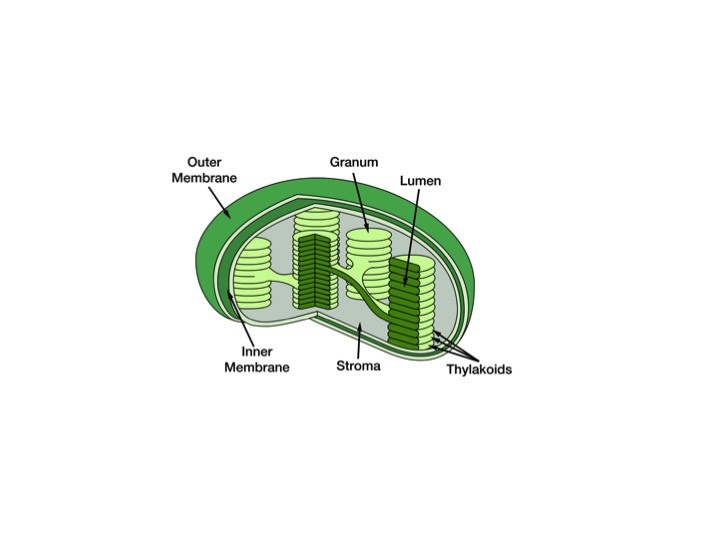
Look at the image
What substances and organelle work together to absorb sunlight to perform photosynthesis in this example?
a)
cell wall and chloroplast
b)
mitochondria and water
c)
vacuole and carbon dioxide
d)
chloroplast and chlorophyll
30.
Which of the following is the correct equation for PHOTOSYNTHESIS?
a)
6CO2 + 6H2O --> 6O+ C6H12O6
b)
6CO+ C6H12O6 + 6H2O --> O
c)
6O2 + 6H2O --> 6CO+ C6H12O6
d)
C6H12O6 + 6O2 ---> 6H2O + 6CO2 
31.
Which of the following best describes photosynthesis?
a)
Photosynthesis converts radiant energy into chemical energy.
b)
Photosynthesis produces carbohydrates.
c)
Plants need sunlight, carbon dioxide, water, nutrients, and chlorophyll to complete photosynthesis.
d)
Plants use chlorophyll, water, and carbon dioxide to make sugar.
32.
Why does water move from the roots to the leaves of plants?
a)
Water is pushed by solutes.
b)
Capillary action pulls the water molecules like a chain.
c)
Water is pulled by gravity.
d)
Water’s cohesion causes it to “pull” towards the leaves.
33.
What is the property of water that allows it to stick to other surfaces?
a)
Surface tension
b)
Cohesion
c)
Adhesion
d)
Solubility
34.
What is the property of water that allows it to stick to other water molecules?
a)
Capillary Action
b)
Solubility
c)
Adhesion
d)
Cohesion
35.
What is the function of the mitochondria?
a)
Pack and ship proteins
b)
Make proteins
c)
Make energy (ATP)
d)
Removes waste
36.
I am the control center of the cell and house the DNA. Who am I?
a)
Cytoplasm
b)
Nucleus
c)
Ribosome
d)
Golgi Apparatus
37.

What is the function of the cell membrane?

a)

Produces ATP

b)

Produces proteins and lipids

c)

Keep the organelles in place

d)

Control what enters and leaves the cell

38.
I am the tough exterior that protects plant cells and gives them their shape. Who am I?
a)
Cell wall
b)
Cell membrane
c)
Cytoplasm
d)
Mitochondria
39.
I am way bigger in plant cells than I am in animal cells. What am I?
a)
Golgi Apparatus
b)
Nucleus
c)
Vacuole
d)
Ribosomes
40.
What is the function of chloroplasts?
a)
Helps plants make food from the sun
b)
Protects plant cells
c)
Store food and water
d)
Make energy for the cell
41.
I am the structure that holds all the organelles in place within the cell. Who am I?
a)
Cell membrane
b)
Cell wall
c)
Cytoplasm
d)
Centriole
42.

Which of the following organelles will you NOT find in an animal cell?

a)

Cell membrane

b)

Cell wall

c)

Nucleus

d)

Cytoplasm

43.

I am very present in muscles in order to provide massive amounts of energy for movement and exercise. Who am I?

a)

Nucleus

b)

chloroplasts

c)

Mitochondria

d)

Ribosomes

44.
I am located in the leaves of plants, but NOT the roots. Who am I?
a)
Lysosomes
b)
Chloroplasts
c)
Vacuole
d)
Mitochondria
45.
What is the main difference between prokaryotic and eukaryotic cells?
a)
Prokaryotic cells have a nucleus and Eukaryotic cells do not
b)
Prokaryotic cells are unicellular and Eukaryotic cells are multicellular.
c)
Prokaryotic cells do not have a nucleus, Eukaryotic cells do have a nucleus.
d)
Prokaryotic cells are plant cells and Eukaryotic cells are animal cells.
46.
The cytoplasm
a)
Is  the gel-like fluid that holds other organelles in place.
b)
Breaks down food to produce energy for the cell.
c)
Is known as the "brain" of the cell.
d)
Is where photosynthesis takes place.
47.
Which statement is NOT part of the Cell Theory?
a)
Only animals are made of cells.
b)
Cells are the basic unit of structure and function in all living things.
c)
All living things are made of cells.
d)
New cells come from existing cells.
48.
Identify which of these is NOT a major difference between plant and animal cells.
a)
Only plant cells have a cell wall.
b)
Only animal cells have mitochondria.
c)
Animal cells do NOT contain chloroplasts.
d)
Plant cells have a large central vacuole.
49.
Which types of organisms are Prokaryotes?
a)
Animals
b)
Plants
c)
Fungi
d)
Bacteria
50.
What is the correct order of organization
a)
tissues-cells-organs-organ systems-organism
b)
cell-tissue-organs-organ systems-organism
c)
organism-cells-tissues-organ systems-organism
d)
tissues-cells-organs-organ sytems-organism
51.
What is diffusion?
a)
when molecules move 
b)
when molecules move from a high concentration to a low.
c)
no movement 
d)
molecules move everywhere
52.
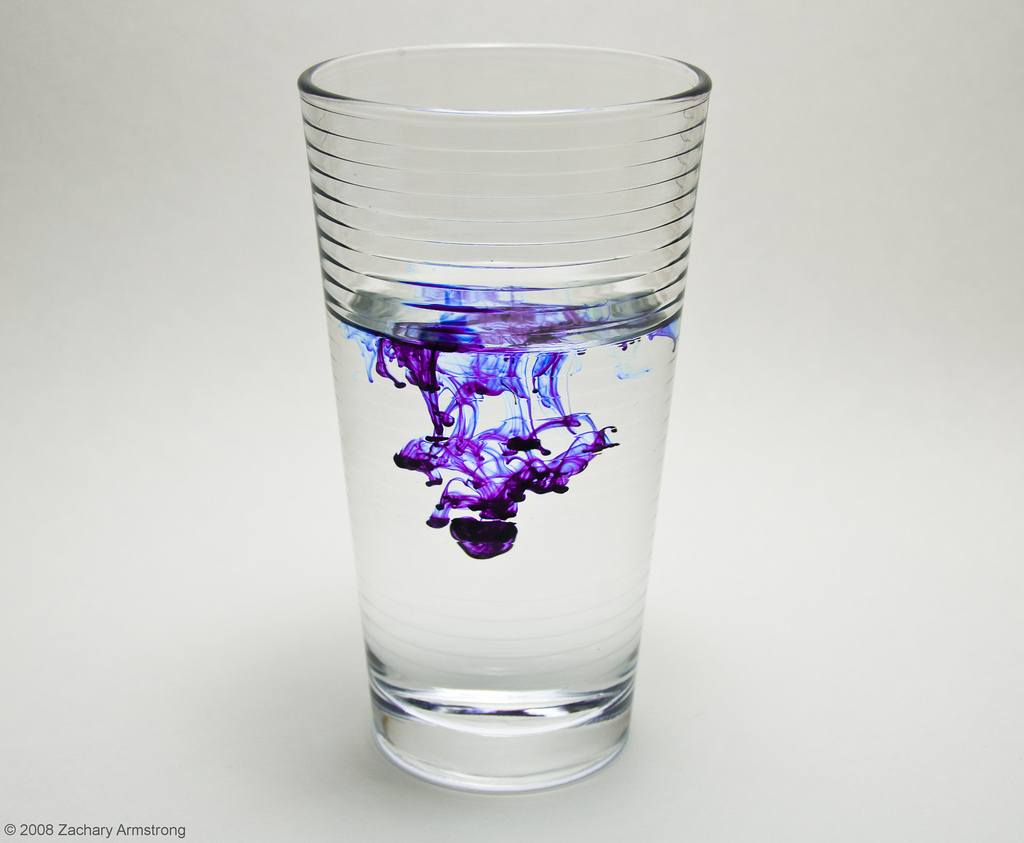
Where is there a low concentration of dye?
a)
at the bottom of cup
b)
in the color
c)
at the top of cup 
d)
no concenteraion gradient
53.
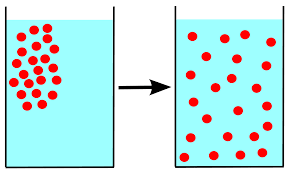
The picture below is an example of _________________.
a)
osmosis
b)
isotonic
c)
diffusion
d)
active transport
54.
Osmosis is the movement of _____ across a membrane.
a)
food
b)
energy
c)
oxygen
d)
water
55.
During osmosis
a)
water moves from high to low concentration
b)
large or oddly shaped molecules move across a cell membrane
c)
water moves when energy is used
d)
proteins are built
56.
Permeable means
a)
things can pass through
b)
the concentration levels are different
c)
it is permanent
d)
things are stuck
57.
The diffusion of water through a semi-permeable membrane is called?
a)
Osmosis
b)
Cell wall
c)
Diffusion
d)
Respiration
58.
What is the definition of  Selective Permeability?
a)
The movement of materials across the cell membrane that requires NO ENERGY from the cell.
b)
The movement of materials through (or across) the cell membrane
c)
The ability of the cell membrane to allow some things to pass through while preventing other things from passing through.
d)
The movement of molecules from an area of high concentration to a area of low concentration 
59.
When both inside and outside of a cell have the same amount of water it is said that the cell has reached a state of
a)
Osmosis
b)
Diffusion
c)
Equilibrium
60.
A person should never drink salty water because their cells would
a)
shrink
b)
expand
61.
Which diagram best shows the end result of diffusion?
a)
F
b)
G
c)
H
d)
J
62.
The picture  is an example of _________________.
a)
isotonic
b)
diffusion
c)
osmosis
d)
active transport
63.
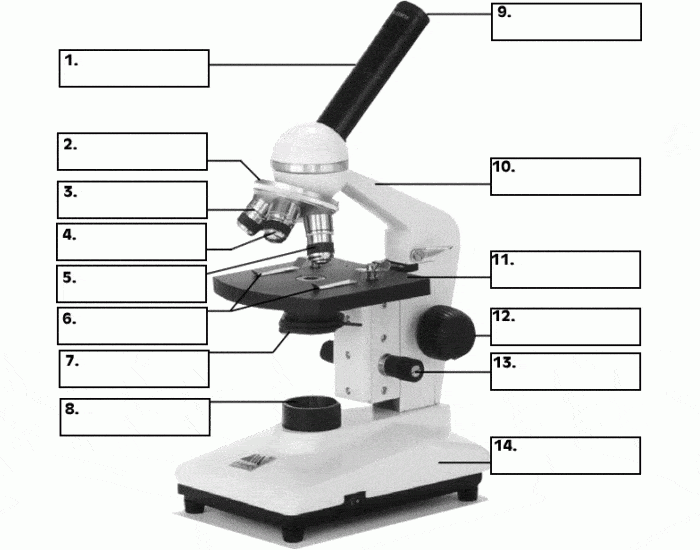
Part 12
a)
Fine Adjustment Knob
b)
Coarse Adjustment Knob
c)
Diaphragm
d)
Objective
64.
Part 13
a)
Fine Adjustment Knob
b)
Course Adjustment Knob
c)
Stage
d)
Diaphragm
65.
Used to control the amount of light reaching the specimen
a)
Illuminator
b)
Stage
c)
Eyepiece
d)
Diaphragm
66.
Used to hold the slides in place
a)
Stage
b)
Stage Clips
c)
Diaphragm
d)
Arm
67.
Part that holds two or more objectives
a)
Stage
b)
Stage Clip
c)
Revolving Nosepiece
d)
Body Tube
68.
The skin is the major organ in which system?
a)
Integumentary
b)
Muscular
c)
Endocrine
d)
Immune
69.
Which system uses hormones to regulate body activities?
a)
Integumentary
b)
Urinary
c)
Endocrine
d)
Immune
70.
Which system maintains posture, produces heat and moves the body?
a)
Skeletal
b)
Nervous
c)
Integumentary
d)
Muscular
71.
Which system detects changes in the environment and sends electrical signals in response to these changes?
a)
Nervous
b)
Endocrine
c)
Lymphatic
d)
Reproductive
72.
What body system consists of the kidneys?
a)
Circulatory
b)
Excretory
c)
Digestive
d)
Muscular
73.
Which system produces sperm and egg cells?  In females, it also nourishes the fetus.
a)
reproductive
b)
endocrine
c)
nervous
d)
lymphatic
74.
The brain and spinal cord belong to what system?
a)
Lymphatic System
b)
Circulatory System
c)
Nervous System
d)
Reproductive System
75.
Glands, Pituitary and thyroid belong to what system?
a)
Endocrine System
b)
Excretory System
c)
Reproductive System
d)
Skeletal System
76.

Which system provides shape and support, enables you to move, and protects your internal organs?

a)

skeletal

b)

muscular

c)

digestive

d)

nervous

77.
Which system is made of the smooth, skeletal, and cardiac muscles?
a)
skeletal
b)
muscular
c)
nervous
d)
excretory
78.
Which system includes the kidneys, ureters, urinary bladder, urethra, lungs and skin?
a)
digestive
b)
excretory
c)
circulatory
d)
muscular
79.

Which three body systems allow you to move?

a)

muscular, skeletal, digestive

b)

nervous, respiratory, digestive

c)

nervous, muscular, skeletal

d)

Muscular, skeletal, circulatory

80.
If the environment gets cold, we will often shiver in order to:
a)
keep body temperature the same as the external temperature
b)
decrease body temperature
c)
increase body temperature
d)
regulate blood pressure
81.
The "cause" for something to happen is the
a)
response
b)
effect
c)
stimulus
d)
homeostasis
82.
The "effect" of a given stimulus is the...
a)
response
b)
stimulus
c)
cause
d)
result
83.
The maintenance of an organism’s internal environment is called:
a)
compensating
b)
homeostasis
c)
balancing
d)
routine
84.
The ovary releases an egg after getting a hormonal signal from a gland. What systems are working together?
a)
endocrine and reproductive
b)
reproductive and respiratory
c)
digestive and integumentary
d)
endocrine and muscular
85.

After a run your heart beats quickly and you bring in lots of oxygen. What systems are working together to move oxygen?

a)

circulatory and respiratory

b)

respiratory and endocrine

c)

nervous and excretory

d)

muscular and reproductive

86.

Jamie runs two miles every day. After a run his face is flushed, breathing is heavy and he is sweating. What systems are interacting after the run?

a)

respiratory, integumentary, and circulatory

b)

muscular, digestive, and circulatory

c)

respiratory, nervous, and immune

d)

circulatory, nervous, and endocrine

87.

It is April in Texas and a cold front has unexpectedly blown in. You are wearing a t shirt and shorts and begin to shiver and get goosebumps. What systems are interacting to try to keep you warm?

a)

integumentary and muscular

b)

circulatory and nervous

c)

respiratory and circulatory

d)

muscular and respiratory

88.

This organ filters waste products from the blood and maintains water balance for homeostasis.

a)

lungs

b)

skin

c)

pancreas

d)

kidney

89.
What system acts as a barrier and regulates body temperature?
a)
Integumentary
b)
Muscular
c)
Reproductive
d)
Excretory
90.
What is NOT an examples of how your body maintains homeostasis
a)
eating or drinking when hungry or thirsty
b)
body temperature changing; sweating on a hot day
c)
doing daily exercise
91.
The passing of traits from parent to offspring 
a)
Heredity 
b)
Genetics 
c)
Hybrid 
d)
Probability 
92.
Who was the father of genetics 
a)
Sagan 
b)
Issac Newton 
c)
Gregor Mendel 
d)
C.jenkins 
93.
 which is heterozygous ?  
a)
Tt
b)
TT
94.
Which is homozygous ?
a)
Zz
b)
SS
95.

the genetic makeup of an organism

a)

heterozygous

b)

punnet square

c)

genotype

d)

phenotype

96.
A homozygous dominant dog with brown fur is crossed with a heterozygous dog with brown fur. What are the percentages of the possible genotypes?
a)
100% BB
b)
75% BB and 25%Bb
c)
50 % BB and 50% Bb
d)
50% Bb and 50% bb
97.
Squidward has light blue skin, and his genotype for this trait is Bb. Would Squidward be considered a purebred or hybrid for light blue skin?
a)
Purebred
b)
Hybrid
98.
An offspring will receive how many alleles from each parent to determine a specific trait?
a)
one
b)
two
c)
three
d)
five
99.
Which of the following is a phenotype?
a)
BB
b)
Bb
c)
bb
d)
Blue eyes
100.
What is a phenotype
a)
The genetic make up (code)
b)
The physical trait
101.
Two brown eyed parents (Bb) have a baby. What is the chance the baby is blue eyed?
a)
0 %
b)
25%
c)
50%
d)
75%
102.
G = green, g = yellow
The genotype for a yellow plant is...
a)
GG
b)
Gg
c)
gg
d)
all of the choices result in yellow
103.
Two heterozygous (Tt) tall pea plants are crossed. Which describes their offspring?
a)
50% tall and 50% short
b)
75%tall and 25% short
c)
100%short
104.

Which of the following is the largest group of animals?

a)

sponges

b)

humans

c)

arthropods

d)

mollusks

105.

Where is an exoskeleton located?

a)

in the head

b)

inside the body

c)

inside the bones

d)

outside the body

106.

An animal with six legs and two antennae is called a(n)

a)

insect

b)

myriapod

c)

arachnid

d)

crustacean

107.

How many pair(s) of antennae do insects have?

a)

one

b)

two

c)

none

d)

four

108.

How many stages does incomplete metamorphosis have?

a)

one

b)

three

c)

13

d)

seven

109.

Which letter represents the caterpillar becomes a pupa?

a)

A

b)

B

c)

C

d)

D

e)

E

110.

Which letter represents the larva hatches from an egg?

a)

A

b)

B

c)

C

d)

D

e)

E

111.
What is molting?
a)
The process in which arthropods reproduce
b)
The process in which arthropods shed their outer covering and grow a larger one.
c)
The process in which larval forms develop into adult forms
d)
The process in which arthropods breathe
112.
Spiders, ticks, scorpions all belong to...
a)
Crustacean
b)
Arachanids
c)
Chilopoda
d)
Insecta
113.
Which group of arthropods have 3 body segments: head, thorax, and abdomen?
a)
Diplopoda
b)
Chilopoda
c)
Arachnids
d)
Insecta
114.
What two characteristics do all Arthropods have?
a)
two legs per body segment
b)
jointed legs and a cephalothorax
c)
three body segments and metamorphosis
d)
jointed legs and segmented bodies
115.
Lobster, shrimp, and crabs are examples of what group of Arthropods?
a)
Chilopoda
b)
Diplopoda
c)
Crustaceans
d)
Arachnida
116.
All arthropods have segmented bodies, jointed appendages, and ________________. 
a)
tails
b)
lungs
c)
wings
d)
an exoskelton
117.
?
a)
Crustacea
b)
Arachnida
c)
Insecta
d)
Myriapoda
118.
?
a)
Arachnida
b)
Insecta
c)
Crustacea
d)
Myriapoda
119.
?
a)
Myriapoda
b)
Insecta
c)
Arachnida
d)
Crustacea
120.
The stages of complete metamorphosis are
a)
egg, larva, pupa, adult
b)
egg, larva, nymph, adult
c)
egg, nymph, adult
d)
egg, larva, adult
121.

The foot secretes a layer of ________ to help it glide along.

a)

water

b)

mucus

c)

leaves

122.

Which part of the snail is the tissue covering the body and secretes the shell?

a)

Mantle

b)

Radula

c)

Foot

d)

Tentacles

123.
What is the meaning of Gastropod?
a)
Soft-bodied
b)
Stomach foot
c)
Head-footed
d)
Two-shelled
124.
How do Gastropods eat?
a)
Tentacles
b)
Radula
c)
Mantle
d)
Filter feeder
125.
Behavioral changes of individuals of a species that allow for better survival. (Acquired traits)
a)
Variation
b)
Adaptation
c)
Behavior
d)
Environment
126.
Where the better adapted organisms survive to pass traits along to offspring.
a)
Evolution
b)
Natural Selection
c)
Extinction
d)
Artifical Selection
127.

What is the advantage of the finches on the Galapagos Islands having different shaped beaks?

a)

To look different from other species.

b)

To be able to eat the food readily available in the environment.

c)

To protect itself against predators.

d)

To protect itself against prey.

128.
Why are advantageous traits more likely to be passed onto offspring?
a)
Because they are more likely to survive and reproduce.
b)
Because they come from dominant alleles.
c)
Because they come from recessive alleles.
d)
Because the trait is an acquired phenotype.
129.
Mutations are a change in what?
a)
DNA
b)
tRNA
c)
genotype
d)
phenotype
130.
What is the LARGEST of the 3 parts of your brain?
a)
cerebellum
b)
cerebrum
c)
spinal cord
d)
medulla
131.
Which part of the brain controls balance and body position?
a)
cerebrum
b)
medulla
c)
cerebellum
d)
impluses
132.
The spinal cord is protected by the _____?
a)
vertebrae 
b)
skull
c)
lungs
d)
rib cage
133.
Where in your body can you find nerve cells?
a)
brain
b)
spinal cord
c)
neurons
d)
everywhere
134.
When levels go above or below a set point a hormone is released to return the body to set point. When the body is restored to set point no more hormone is released. This is an example of...
a)
a positive feedback loop
b)
a negative feedback loop
c)
a neutral feedback loop
135.
Endocrine glands produce __________ which maintain the body in homeostasis
a)
oils
b)
neurotransmitters 
c)
tears
d)
hormones
136.

What two hormones pancreas produced

a)

glucagon and cortisol

b)

glucose and insulin

c)

glucagon and insulin

d)

glucose and aldosterone

137.
What is the name for the connector that attaches bone to bone?
a)
ligament
b)
tendon
c)
patella
d)
string
138.
Tissue found in some bones that makes blood cells
a)
red marrow
b)
yellow marrow
c)
canaliculi
d)
lamellae
139.
Which muscle type is found in your stomach, bladder, and intestines?
a)
Skeletal
b)
Smooth
c)
Cardiac
d)
Straight
140.
Which type of muscle is found in your heart?
a)
Skeletal
b)
Smooth
c)
Cardiac
d)
Straight
141.
Which types of muscle tissue are voluntary?
a)
Cardiac
b)
Skeletal
c)
Smooth
d)
Cardiac and Smooth
142.
Skeletal muscles are attached to the _________.
a)
Stomach
b)
Lungs
c)
Bones
d)
Involuntary Muscles
143.

Urine is produced by the

a)

Urethra

b)

Urinary bladder

c)

Kidney

d)

Ureter

144.

Urine is carried to the bladder by

a)

Blood vessels

b)

The urethra

c)

The calyxes

d)

The ureter

145.
A mode of reproduction by which an organism arises from a single organism and inherit the identical genes of that parent
a)
Asexual Reproduction
b)
Sexual Reproduction
c)
Genetic Variation
d)
Alleles
146.
A mode of reproduction in which an organism arises from two organisms and inherits half of its DNA from each parent
a)
Sexual Reproduction
b)
Asexual Reproduction
c)
Cloning
d)
Fragmentation
147.
This domain contains organisms that have a true nucleus in each of their cells. T
a)
Eukarya
b)
Archaea
c)
Bacteria
148.
This domain is characterized by ancient bacteria that can live in extreme environments, such as volcanoes.
a)
Archaea
b)
Bacteria
c)
Eukarya
d)
Prokarya
149.
What are the three domains?
a)
Plant, Animal, Fungi
b)
Eukarya, Archaea, Animal
c)
Eukarya, Archea, Eubacteria
d)
Eukarya, Archaea, Bacteria 
150.
Which cell is a prokaryote?
a)
A
b)
B
c)
C
d)
D
151.
What do the domains Bacteria and Archaea have in common?
a)
They both have a nucelus
b)
They are both lacking a nucleus
c)
They are both made of many cells
d)
They are both dead
152.
Where is the DNA stored in a eukaryotic cell?
a)
Inside the nucleus
b)
There is no DNA in a eukaryotic cell
c)
The DNA floats freely in the cell
d)
The DNA is found in the cytoplasm
153.
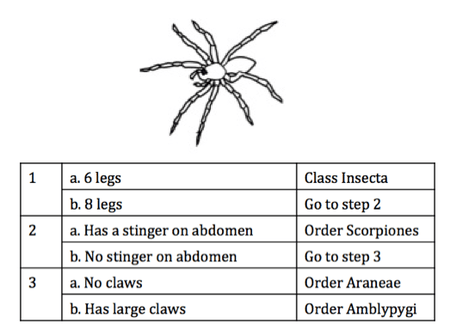
An illustration and a dichotomous key are given. What is the correct classification for this organism?
a)
Class Insecta
b)
Order Amblygygi
c)
Order Araneae
d)
Order Scorpiones