
 Worksheets
quiz
Total questions: 154
Worksheet time: 2hrs 38mins
Homeostasis
allows for a wildly fluctuating internal environment
is impossible in vertebrates
is the maintenance of a relatively stable internal environment and often incorporates a form of feedback regulation
When the body temperature drop below normal ranges, arterioles in the skin will
dilate to allow less blood to flow to skin surface
constrict to allow less blood to flow to skin surface
dilate to allow more blood to flow to skin surface
constrict to allow more blood to flow to skin surface

which organ will balance the glucose level in the blood by releasing hormones like insulin or glucagon?
Stomach
Small intensine
large intestine
Pancreas

Excess of glucose will be stored in what form?
insulin
glycogen
glucagon
glucose
Homeostasis
allows for a wildly fluctuating internal environment
is impossible in vertebrates
is the maintenance of a relatively stable internal environment and often incorporates a form of feedback regulation
When you are cold, you shiver and your blood vessels contract, which warms you up. When you are hot, you sweat and your blood vessels expand, which cools you down.
False
True
When the body temperature drop below normal ranges, arterioles in the skin will
dilate to allow less blood to flow to skin surface
constrict to allow less blood to flow to skin surface
dilate to allow more blood to flow to skin surface
constrict to allow more blood to flow to skin surface
which organ will balance the glucose level in the blood by releasing hormones like insulin or glucagon?
Stomach
Small intensine
large intestine
Pancreas
Excess of glucose will be stored in what form?
insulin
glycogen
glucagon
glucose

Which hormone is released when blood sugar gets too high?
glucose
glucagon
glycogen
insulin
Which of the following correctly pairs the hormone and the response that it causes
Glucagon - makes body cells take in glucose
Insulin - makes body cells take in glucose
Pancreas - makes liver release stored glucagon
Liver - makes pancreas take in stored insulin
diabetes is a disease that affects your body's ability to produce or use ___.
energy
insulin
glucose
negative feedback
Which body system controls the body to maintain homeostasis?
excretory
nervous
circulatory
skeletal
If pressure increases on a mothers cervix during childbirth then oxytocin increases, this is an example of ____ feedback?
Thermoregulation
Blood Pressure
positive
negative
Which of the following describes homeostasis?
keeps variables exactly at the set point
organism's ability to maintain steady (stable) internal conditions
acts to keep values outside of a desired range
operates through positive feedback
The group of organisms that use the process of homeostasis includes
mammals, only
animals, only
plants and animals
all living things
Which of the following is not regulated by homeostasis?
body temperature
blood sugar
blood pH
body movements
Which organs make up the circulatory system?
the heart, veins, blood vessels
the brain, spinal cord, and nerves
the kidneys, bladder, and ureters
bones
Which two systems work together to maintain homeostasis while transporting oxygen throughout the body and removing carbon dioxide?
circulatory and respiratory
respiratory and excretory
circulatory and digestive
respiratory and digestive
____________________ helps warm the human body when we are cold.
sweating
shivering
inhaling oxygen
exhaling carbon dioxide
Which of the following is an example of positive feedback?
Thermoregulation
Blood Pressure
Childbirth
Blood Sugar Levels

What is an example of a positive feedback mechanism?


The ultimate cause of death
Over Heating
Diabetes
Bad Hair
Loss of Homeostasis
Earth warms → Increased evaporation which produces more clouds → More reflection of light away from Earth → Temperature falls → Rates of evaporation fall
Is this situation amplifying or stabilize?
Amplifying
Stabilizing
Earth warms → Increased evaporation which produces more clouds → More reflection of light away from Earth → Temperature falls → Rates of evaporation fall
Positive Feedback
Negative Feedback
Earth warms → Ice cover melts, exposing soil or water → More heat is absorbed by Earth’s surface → Global temperature rises → More ice melts
Amplyfiying
Stabilizing
Earth warms → Ice cover melts, exposing soil or water → More heat is absorbed by Earth’s surface → Global temperature rises → More ice melts
Positive
Negative
Humans cut down trees for lumber → Deforestation loosens the soil → Water flow erodes unstable soil → Remaining unstable, low quality, soil can no longer sustain trees → More deforestation occurs
Amplifying
Stabilizing
Humans cut down trees for lumber → Deforestation loosens the soil → Water flow erodes unstable soil → Remaining unstable, low quality, soil can no longer sustain trees → More deforestation occurs
Positive
Negative
Rabbit population decreases when eaten by foxes → Less food causes fox population to decrease → Less predators causes rabbit population to increase → More food causes fox population to increase → Rabbit population decreases when eaten by foxes
Amplyfing
Stabilizing
Rabbit population decreases when eaten by foxes → Less food causes fox population to decrease → Less predators causes rabbit population to increase → More food causes fox population to increase → Rabbit population decreases when eaten by foxes
Positive
Negative
When the product of a reaction leads to an INCREASE in that reaction
Positive
Negative
Occurs when the product of a reaction leads to a DECREASE in that reaction. Counteracts what is happening.
Positive
Negative
Body temp is 98.6 --> body temp decreases --> shivering occurs --> body
Positive
Negative
Get a cut and start bleeding --> Platelets come to site and clump together & send signals for more platelets to come --> More platelets come & release more signals
Positive
Negative
Get a cut and start bleeding --> Platelets come to site and clump together & send signals for more platelets to come --> More platelets come & release more signals
Amplify
Stabilize
Body temp is 98.6 --> body temp increase --> sweating occurs --> body temp decreases
Amplify
Stabilize
Select the words that are key for the definition of homeostasis
stable
temperature
environment
internal
What is the name of the process that reverses an imbalance in the body's system by decreasing the effect?
negative feed forward
negative feedback
positive feedback
positive feed forward
In which case(s) would your body need to carry out negative feedback proccesses?
body temperature at 39oC
body temperature at 33oC
body temperature at 35oC
body temperature at 37oC
Which of these would your body do if its temperature dropped below optimum?
shivering
sweating
blood vessel dilation
blood vessel constriction
Which of these would your body do if its temperature was above optimum?
goosebumps
sweating
blood vessel dilation
blood vessel constriction
Which organ in the body produces the hormones insulin and glucagon?
intestines
liver
pancreas
heart
Which organ in the body converts glucose into glycogen and vice versa?
intestines
liver
pancreas
heart
If the blood glucose levels rise above optimum, the ______ will release ______ which will cause the _______ to convert _______ into ________ for storage, so glucose is taken out of the blood and the levels return to normal.
liver, glucagon, pancreas, glycogen, glucose
pancreas, glucagon, liver, insulin, glucose, glycogen
pancreas, insulin, liver, glucose, glycogen
liver, insulin, pancreas, glycogen, glucose
If the blood glucose levels fall below optimum, the ______ will release ______ which will cause the _______ to convert _______ into ________ for release back into the blood and the levels return to normal.
liver, glucagon, pancreas, glycogen, glucose
pancreas, glucagon, liver, glycogen, glucose
pancreas, insulin, liver, glucose, glycogen
liver, insulin, pancreas, glycogen, glucose
Thinking part of brain is
Hind brain
Mid brain
Fore brain
Hypothalamus
The microscopic gap between two adjacent neurons throgh which a nerve impulse passes is
Neurotransmitter
Synapse
Axon terminal
Dendrite
Part of the brain responsible for hearing is
Cerebrum
Cerebellum
Hypothalamus
Medulla
The central nervous system consists of the:
brain and spinal nerves
spinal nerves and cranial nerves
cranial nerves and spinal cord
spinal cord and brain


The gaps between neurons are called
answer choices
Effectors
neurotransmitters
reflexes
synapses
What is function of medulla?
answer choices
controls heart RATE
memory
controls balance
conscious thought
What detects a stimulus?
answer choices
A detector
An effector
A receptor
A Simulator
Identify the name of the white insulating substance that often covers the axon of a neuron and helps speed up the conduction of the message
answer choices
MYELIN
NEUROTRANSMITTER
SYNAPSE
VESICLE
Which is the correct sequence of the components of a reflex arc
Receptors, spinal cord,sensory neuron, motor neuron, muscle
Receptors, muscle, sensory neuron, motor neuron, spinal cord
Receptors, sensory neuron, spinal cord, motor neuron, muscle
Receptors, motor neuron, spinal cord, sensory neuron, muscle
Correct sequence of electrical impulse transmission in a neuron is from
dendrite, axon, axonal end,cell body
cell body, dendrite, axon,axonal end
dendrite, cell body, axon, axonal end
axonal end, axon, cell body, dendrite
Thinking part of brain is
Hind brain
Mid brain
Fore brain
Hypothalamus
The microscopic gap between two adjacent neurons throgh which a nerve impulse passes is
Neurotransmitter
Synapse
Axon terminal
Dendrite
Part of the brain responsible for hearing is
Cerebrum
Cerebellum
Hypothalamus
Medulla
The central nervous system consists of the:
brain and spinal nerves
spinal nerves and cranial nerves
cranial nerves and spinal cord
spinal cord and brain
What is function of medulla?
answer choices
controls heart beat
memory
controls balance
conscious thought
What detects a stimulus?
answer choices
A detector
An effector
A receptor
A Simulator
Which is the correct sequence of the components of a reflex arc
Receptors, spinal cord,sensory neuron, motor neuron, muscle
Receptors, muscle, sensory neuron, motor neuron, spinal cord
Receptors, sensory neuron, spinal cord, motor neuron, muscle
Receptors, motor neuron, spinal cord, sensory neuron, muscle
Correct sequence of electrical impulse transmission in a neuron is from
dendrite, axon, axonal end,cell body
cell body, dendrite, axon,axonal end
dendrite, cell body, axon, axonal end
axonal end, axon, cell body, dendrite
Which part of the brain controls the posture and balance of the body ?
Medulla
Cerebrum
Cerebellum
Pons Varoli
Outer covering of brain is called as ______
Pleura
Meninges
Peritoneum
Perimetrium
The involuntary actions in the body are controlled by _____
Cerebellum
Medulla in forebrain
Spinal Cord
Medulla in hindbrain
The part of neuron which brings information towards the cell body is ______
Dendrites
Axon
Myelin
Synaptic Knob
Structure and functional unit of nervous system is _______
Axon
Cyton
Neuron
Nephron
the brain is filled with a fluid called _____
Plasma
Cerebrospinal Fluid
Plasma
Perilymph
In a neuron, conversion of electrical signal to chemical signal occurs at
Axonal end
Dendritic end
Cell body
Axon
Taste receptors are
Phonoreceptors
Statoreceptors
Olfactory receptors
Gustatory receptors
Which part of the nervous system is not involved in producing reflex actions?
answer choices
brain
spinal cord
receptor
sensory
Which of the following is not a reflex action?
BLINKING
COUGHING
SNEEZING
EATING
A nerve cell is also known as a
answer choices
cerebrum
neuron
cerebellum
nucleus
The gaps between neurons are called
answer choices
Effectors
neurotransmitters
reflexes
synapses
The nervous system involves the use of both electrical signals (nerve impulses) and chemical signals (neurotransmitters).
answer choices
TRUE
FALSE
Identify the part of the brain that takes up the greatest volume
answer choices
BRAIN STEM
CEREBELLUM
PONS
CEREBRUM
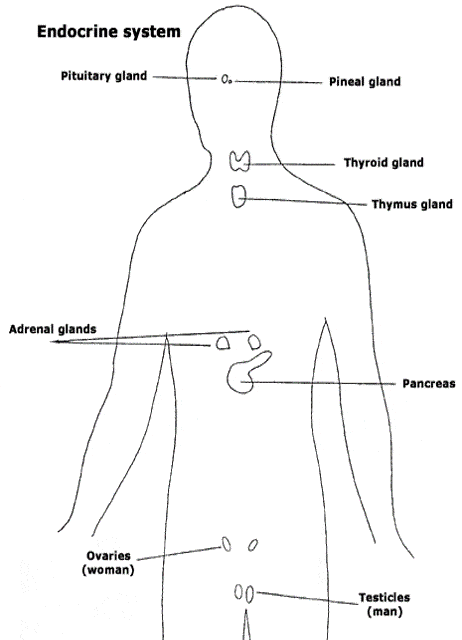
All hormones are produced in the
answer choices
endocrine glands
blood stream
brain
pancreas
Which part of the nervous system is not involved in producing reflex actions?
answer choices
brain
spinal cord
receptor
sensory
What is the eye an example of?
answer choices
stimulus
sense organ
a relay neuron
a part of nerve cell
What is function of medulla?
answer choices
controls heart RATE
memory
controls balance
conscious thought
What detects a stimulus?
answer choices
A detector
An effector
A receptor
A Simulator
The neurons that conduct information towards the CNS are _________.
answer choices
interneurons
motor neurons
sensory neurons
efferent neurons
What substance is the urine of a person suffering from diabetes mellitus likely to contain?
answer choices
amino acids
fatty acids
glucose
proteins
Which of the following is part of the peripheral nervous system?
answer choices
BRAIN
SPINAL CHORD
HEART MUSCLE
TASTE BUDS ON TONGUE
Which of the following is not a hormone?
answer choices
INSULIN
GLUCOSE
THYROXINE
ADRENALINE
which endocrine gland is called the master gland
answer choices
pituitary
pineal
adrenals
thyroid
Testosterone causes:
answer choices
A) Ovaries to produce oestrogen
A) Testes to produce sperm
A) Pituitary gland to release ADH
A) Pancreas to secrete glucagon
Identify the name of the white insulating substance that often covers the axon of a neuron and helps speed up the conduction of the message
answer choices
MYELIN
NEUROTRANSMITTER
SYNAPSE
VESICLE
Which hormone is known as the ‘fight or flight’ hormone?
answer choices
GROWTH HORMONE
ADRENALINE
OESTROGEN
ANTIDURETIC HORMONE
The nerve cells in your body are called neurons. From which part of the neuron is most likely responsible for carrying signals between the cell body and axon terminal?
answer choices
soma
axon
Node of Ranvier
Schwann cell
The central nervous system consists of the:
answer choices
brain and spinal nerves
spinal nerves and cranial nerves
cranial nerves and spinal cord
spinal cord and brain
Which part of the eye is where images are converted to nerve impulses?
answer choices
Retina
Cornea
Optic Nerve
Lens
In a neuron, conversion of electrical signal to chemical signal occurs at
Axonal end
Dendritic end
Cell body
Axon
Correct sequence of electrical impulse transmission in a neuron is from
dendrite, axon, axonal end,cell body
cell body, dendrite, axon,axonal end
dendrite, cell body, axon, axonal end
axonal end, axon, cell body, dendrite
Which is the correct sequence of the components of a reflex arc
Receptors, spinal cord,sensory neuron, motor neuron, muscle
Receptors, muscle, sensory neuron, motor neuron, spinal cord
Receptors, sensory neuron, spinal cord, motor neuron, muscle
Receptors, motor neuron, spinal cord, sensory neuron, muscle
Posture and balance of the body is controlled by
Cerebrum
Cerebellum
Medulla
Pons
Which is not a reflex action
Swallowing
Coughing
Knee jerk
Closing of eyes on flashing light
Spinal cord originates from
Cerebrum
Medulla
Cerebellum
Pons
Part of the brain that controls respiration, heart beat and peristalsis is
Cerebrum
Cerebellum
Hypothalamus
Medulla
Most highly developed part of human brain is
Pons
Medulla
Cerebrum
Cerebellum
Centre for regulating body temperature is
Pons
Cerebellum
Medulla
Hypothalamus
In human, the number of cranial nerves is
12
31
24
26
In humans, the number of spinal nerves is
12 pairs
31 pairs
33 pairs
11 pairs
Thinking part of brain is
Hind brain
Mid brain
Fore brain
Hypothalamus
Taste receptors are
Phonoreceptors
Statoreceptors
Olfactory receptors
Gustatory receptors
The microscopic gap between two adjacent neurons throgh which a nerve impulse passes is
Neurotransmitter
Synapse
Axon terminal
Dendrite
Which nerves arise from the brain and emerges through the skull
Spinal nerves
Thoracic nerves
Cranial nerves
Lumbar nerves
Which of the following is an example of autonomous nervous system
Knee jerk reflex
Swallowing of food
Peristalsis
Reflex action
Smooth muscles, cardiac muscle and organs are regulated by
Central nervous system
Autonomous nervous system
Peripheral nervous system
Somatic nervous system
The thalamus and hypothalamus are located in the
cerebrum
cerebellum
diencephalon
medulla oblongata
Part of the brain responsible for hearing is
Cerebrum
Cerebellum
Hypothalamus
Medulla
The autonomic nervous system has control over
Reflex actions
Sense organs
Skeletal muscles
Internal organs

