wayground logo

Free Printable Worksheets

Font size

S
M
L
XL
Worksheets

Semester 2 Biology Review

Total questions: 153

Worksheet time: 3hrs 9mins

Name
Class
Date
1.

What is the order of substances for the central dogma of DNA?

a)

DNA

b)

mRNA

c)

Protein

1)
2)
3)
2.

Match the following DNA sequences to their RNA complement

a)

ATG

1.

UAC

b)

TAC

2.

AUG

c)

CCC

3.

GGG

d)

GGG

4.

CCC

e)

CAG

5.

GUC

3.
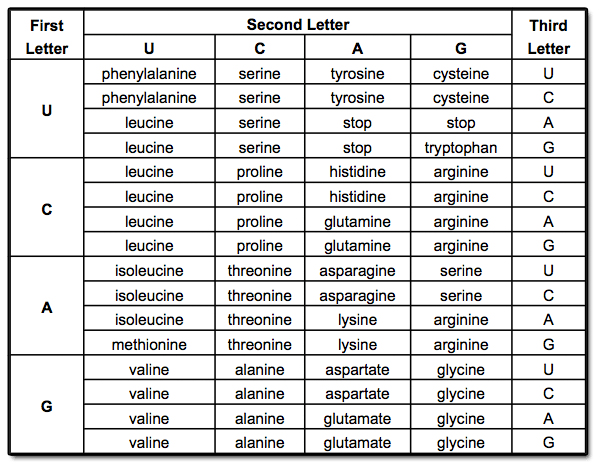
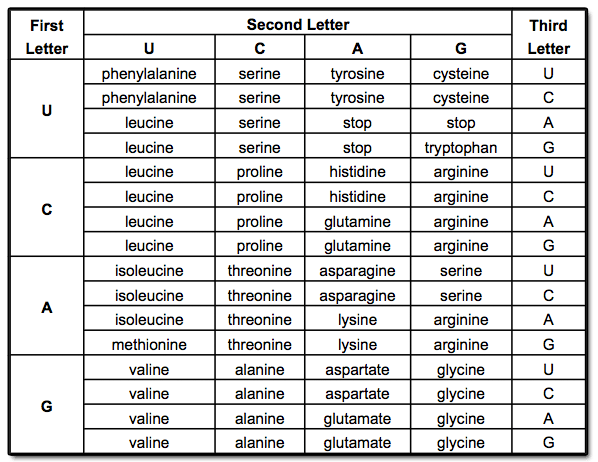
What amino acid is represented by the codon UUA?
a)
Phenylalanine
b)
Tyrosine
c)
Leucine
d)
Stop codon
4.
What is the correct amino acid sequence for the mRNA code AUGCCAGUAUGA
a)
Met-Pro-Ala-Val
b)
Met-Pro-Val
c)
Tyr-Gly-His
d)
Tyr-Gly-Arg-His
5.
How many amino acids are coded for by this sequence of nucleotides:
ATG GGA ACT CCA
a)
4
b)
2
c)
6
d)
12
6.

Is this individual male or female?

a)

Male

b)

Female

7.

Pairs of similar chromosomes are called...

a)

homologous chromosomes

b)

sister chromatids

8.

When a cell divides, DNA strands coil around proteins to form ...

a)

chromatin

b)

chromosomes

9.

Homologous chromosome pairs are a combination of how many chromosomes from each parent?

a)

1 from each parent

b)

2 from each parent

10.

Which of the following is used to determine genetic defects or if an extra or missing chromosome exist in an organism?

a)

Pedigree

b)

Punnett Square

c)

Karyotype

11.
Why is DNA important?
a)
it is very small and very complicated
b)
it's in everything
c)
it serves as the blueprint for traits of all living things
d)
because we eat it every day for energy
12.
What determines the code, or information, of a DNA molecule?
a)
the shape (structure) of the nitrogen bases
b)
the order (sequence) of the nitrogen bases
c)
the color of the nitrogen bases
d)
the frequency (number) of nitrogen bases
13.
How are similarities passed from parent to offspring?
a)
through teaching
b)
through learning
c)
through blood
d)
through genes
14.
A change in DNA or chromosomes
a)
Mitosis
b)
Meiosis
c)
mutation
d)
Osmosis
15.

The failure of one or more pairs of homologous chromosomes or sister chromatids to separate "normally" during meiosis is called _____________________.

a)

nondisjunction

b)

anaphase I

c)

nondiploidy

d)

karyotype

16.

How many alleles does a person carry for a trait?

a)

1

b)

2

c)

3

d)

4

17.

How many alleles does a child get from each parent for a trait?

a)

1

b)

2

c)

3

d)

4

18.
What do we use pedigrees for?
a)
To look at families
b)
To make determinations about the offspring
c)
To track traits in families
d)
Nothing
19.

In a pedigree, which shape represents a male?

a)

circle

b)

square

20.

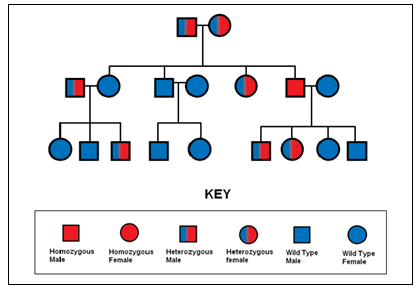
On a pedigree, this symbol represents a ---

a)

not affected female.

b)

not affected male.

c)

affected male.

d)

affected female.

21.

On a pedigree, this symbol represents a ----

a)

not affected male.

b)

not affected female.

c)

affected male.

d)

affected female.

22.

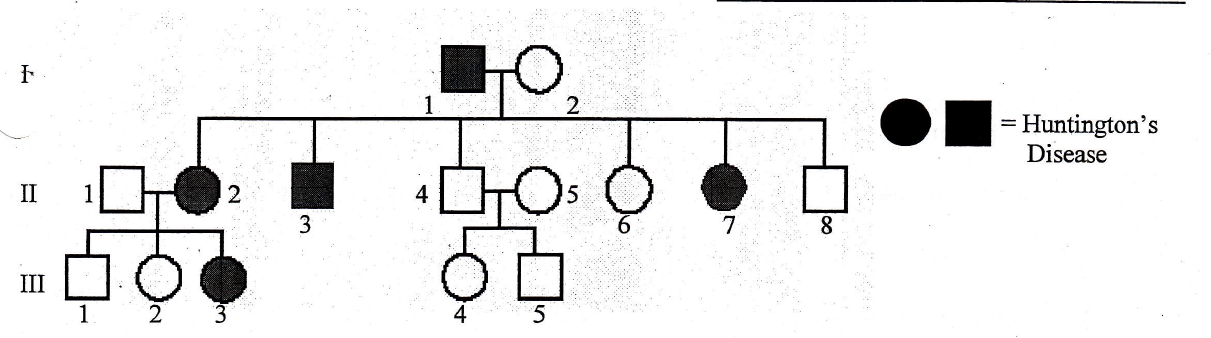
How many individuals are there in the 3rd generation?

a)

1

b)

2

c)

4

d)

6

23.

How are individuals III-2 and II-4 related?

a)

Brother and sister

b)

Dad and daughter

c)

Uncle and niece

d)

Grandfather and granddaughter

24.

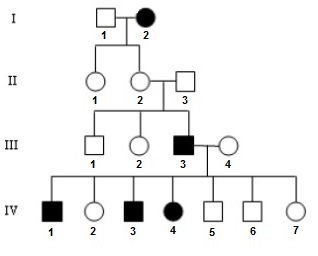
The trait this pedigree traces is recessive because it skips a generation and individuals can be carriers. What is the most likely genotype for person III-3?

a)

GG

b)

Gg

c)

gg

25.
If this pedigree shows an autosomal recessive disorder, what MUST the genotype of individual II-3 be?
a)
HH
b)
Hh
c)
hh
d)
None of the above
26.
How many kids did the mother and father from the first generation have?
a)
2
b)
4
c)
5
d)
6
27.
There are no carriers for Huntington's Disease- you either have it or you don't. Is Huntington's disease caused by a dominant or recessive trait?
a)
Dominant
b)
Recessive
28.
How are individuals I-2 and III-5 related?
a)
Grandpa and grandson
b)
Mom and son
c)
Uncle and nephew
d)
Grandma and grandson
29.
This pedigree represents the inheritance of hemophilia in this family. How many of the females have the hemophilia trait?
a)
8
b)
5
c)
2
d)
3
30.
What is the genotype of the mother?
a)
BB
b)
bb
c)
Bb
d)
BB or Bb
31.
What is the genotype of the father?
a)
AA
b)
aa
c)
Aa
d)
AA or aa
32.
What are the possible genotypes for this cross?
a)
TT = 25% Tt= 50% tt=25%
b)
all tall
c)
TT= 75% tt = 25%
d)
Tt = 100%
33.
Which of the following genotypes is homozygous dominant?
a)
A
b)
Aa
c)
AA
d)
aa
34.
If brown eyes are dominant over blue eyes, what would be the  parent genotypes if two heterozygous brown eyed persons were crossed?
a)
BB and bb
b)
BB and Bb
c)
Bb and Bb
d)
bb and Bb
35.

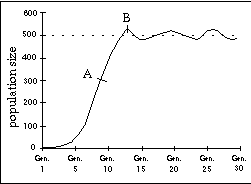
What is the carrying capacity of the graph?

a)

around 500

b)

more than 800

c)

less than 300

d)

around 700

36.
Which of the following would INCREASE the carrying capacity of an ecosystem?
a)
increase in predators
b)
disease
c)
increase in available food
d)
drought
37.

When death rate is equal to birth rate...

a)

population increases

b)

population decreases

c)

population stays the same.

d)

population rapidly increases then becomes stable

38.

When birth rate is high and death rate is low...

a)

population increases

b)

population decreases

c)

population stays the same

d)

all of these

39.

Match the following

a)
1.

Predation

b)
2.

Symbiosis

c)
3.

Commensalism

d)
4.

Parasitism

40.

A scientist was studying a population of fish in a pond over a period of 10 years. He observed that

the population increased each year for 3 years, and then remained nearly constant for the rest of

the study. The best explanation for this observation is that the population had

a)

stopped reproducing

b)

reached carrying capacity

c)

mutated into a different species

d)

run out of food and all died

41.
2 factors which increase population size
a)
Birth Rate, Immigration
b)
Death Rate, Immigration
c)
Birth Rate, Emigration
d)
Death Rate, Emigration
42.

Which graph depicts exponential growth in a population?

a)
b)
c)
d)
43.
One of the main causes of biodiversity loss is?
a)
Habitat fragmentation
b)
Invasive species
c)
Climate change
d)
All of the Above
44.

Over time, scientists are predicting the Baltic Sea to become less salty. As a result, there will be less biodiversity. Which best explains why the biodiversity of the Baltic Sea would decrease?

a)

Fewer types of plants and animals are found in warm water than in cool water.

b)

Plants and animals adapted for living in saltwater will grow more slowly in water that has less salt.

c)

Plants and animals adapted for living in saltier conditions will not be able to survive and reproduce.

d)

Animals adapted for living in warm water will eat all the plants and animals adapted for living in cool water.

45.

This biome has hot summers, cold winters, diverse grasses, trees, and shrubs, and is common in central US.

a)

savanna

b)

temperate grassland

c)

temperate forest

d)

tundra

46.

Which biome consists of very low precipitation and can be hot or cold? 

a)

savanna

b)

tropical rainforest

c)

tundra

d)

desert

47.

Which biome consists of warm weather year-round, a dry season and a rainy season, and diverse trees, shrubs, and grasses?

a)

tropical rainforest

b)

temperate grassland

c)

savanna

d)

desert

48.

Which biome consists of lakes, rivers, and streams and only includes 3% of the Earth’s water?

a)

Marine open ocean

b)

Marine coastal

c)

Tundra

d)

Freshwater

49.

Which biome consists of long bitter winters, cool summers, and diverse coniferous trees?

a)

Taiga

b)

Tundra

c)

Temperate forest

d)

Grassland

50.

Which biome consists of grasses, shrubs, cold temperatures, and the permafrost?

a)

Taiga

b)

Tundra

c)

Temperate forest

d)

Temperate grasslands

51.

Which biome consists of diverse deciduous trees, warm summers, cool winters, and can be found in the eastern US?

a)

Taiga

b)

Temperate forest

c)

Tropical rainforest

d)

Temperate grassland

52.

Which biome is warm year-round, receives LOTS of rain, and is rich in. biodiversity?

a)

Temperate forest

b)

Temperate grassland

c)

Boreal Forest

d)

Tropical rainforest

53.
Anatomical Position 
a)
Posterior
b)
Anterior
c)
Inferior
d)
Superior
54.
Anatomical Position 
a)
Posterior
b)
Medial
c)
Proximal
d)
Anterior
55.
Anatomical Position 
a)
Inferior
b)
Proximal
c)
Superior
d)
Superficial
56.
Anatomical Position 
a)
Inferior
b)
Proximal
c)
Superior
d)
Superficial
57.
Vertebrates don't have a backbone
a)
True
b)
False
58.
Octopus is...
a)
Vertebrate
b)
Invertebrate
59.
What symmetry do all insects have?
a)
Radial
b)
Asymmetry
c)
Bilateral 
60.
Choose the characteristics that animals must possess in the Animal Kingdom.
a)
multicellular
b)
eukaryotic and multicellular
c)
eukaryotic, multicellular, heterotroph
d)
eukaryotic, multicellular, autotroph
61.
Animals are
a)
all unicellular
b)
all multicellular
c)
mostly unicellular
d)
mostly multicellular
62.

This anemone displays what kind of symmetry? ​ (a)  

Choose from the below words
Radial symmetry
Asymmetry
Bilateral symmetry
63.

All animals are broadly split into what two categories?

a)

Cute and ugly

b)

Vertebrates and invertebrates

c)

Water-breathing proboscis monkeys and air-breathing proboscis monkeys

d)

Compound and complex

64.
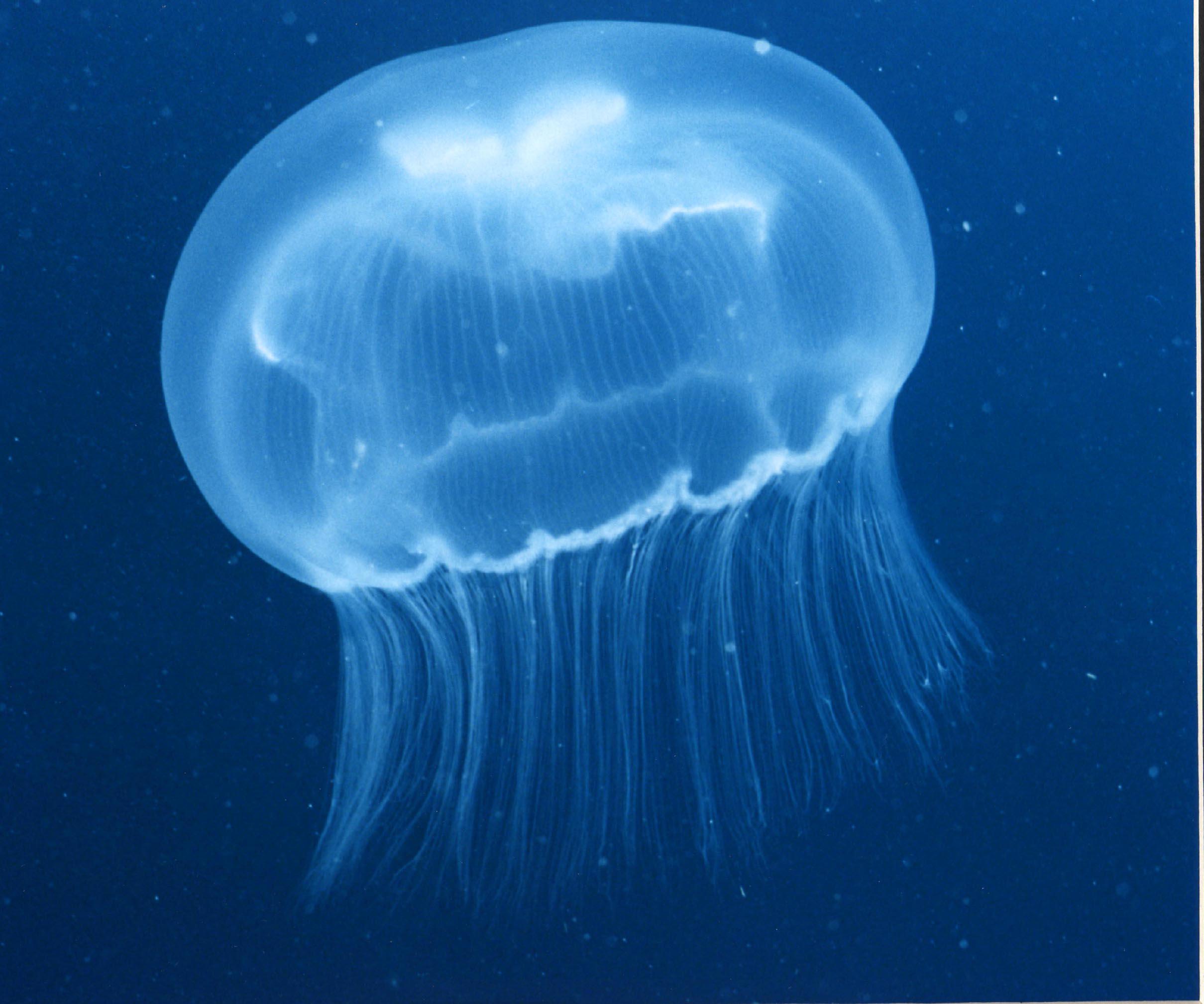
What type of symmetry does this organism have?
a)
Asymmetry
b)
Radial
c)
Bilateral
65.
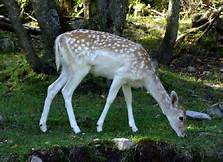
What type of symmetry does this animal exhibit?
a)
Asymmetry
b)
Bilateral symmetry
c)
Radial symmetry
66.

What type of symmetry does the organism have?

a)

Asymmetrical

b)

Radial

c)

Bilateral

67.
What occurs when the body can’t be divided into similar sections (mirror images)?
a)
asymmetry
b)
symmetry
c)
segmented
d)
unsegmented
68.
Organisms that cannot make their own food are called
a)
heterotrophs
b)
autotrophs
c)
producers
d)
sessile
69.
What is a producer?
a)
an organism that gets energy from eating other organisms
b)
an organisms that uses sunlight to make its own food
c)
an organism that gets energy from eating dead organisms, non-living material or waste
d)
an organism that uses chemical energy to make its own food
70.
A community of living and nonliving things in their natural environment makes up a 
a)
food web
b)
ecosystem
c)
food chain
d)
population
71.
What is a herbivore?
a)
an animal that gets energy from eating other animals
b)
an organism that gets energy from eating only plants
c)
an animal that gets energy by eating both plants and other animals
d)
an animal that eats only herbs
72.
An organism that gets energy from eating other organisms is a ______________.
a)
producer
b)
consumer
c)
decomposer
d)
prey
73.
An organism that gets energy from breaking down dead organisms, non-living material or waste is a(an) ___________.
a)
producer
b)
consumer
c)
decomposer
d)
autotroph
74.
What is a carnivore?
a)
an animal that gets energy by eating other animals
b)
An animal that gets energy by eating only plants
c)
an animal that gets energy by eating both plants and animals
d)
an animal that makes its own energy through photosynthesis
75.
A connection of food chains with many food energy paths in an ecosystem is a ____________.
a)
ecosystem
b)
food web
c)
environment
d)
population
76.
Which of the following is NOT a consumer?
a)
grass
b)
dog
c)
shark
d)
fish
77.
Where do all life forms get their energy?
a)
Earth's Core
b)
Water
c)
Plants
d)
The Sun
78.
In the energy pyramid here, how much of the energy in each level gets lost as heat or used by the organism for survival?
a)
80%
b)
90%
c)
10%
d)
20%
79.
What percentage of energy is passed on to each tropic level?
a)
10%
b)
50%
c)
90%
d)
100%
80.
The arrows in a food chain or web represents what?
a)
They point to the organism that is being eaten.
b)
It shows how sunlight flows within an ecosystem.
c)
They show what direction the energy is flowing between organisms. 
d)
They represent how water is transferred within a habitat.
81.

Organisms that is able to convert the energy from the sun into chemical energy (glucose).

a)

Heterotroph

b)

Autotroph

c)

Carnivore

d)

Omnivore

82.
The diagram represents a pyramid of energy in an ecosystem.  Which level would most likely contain members of the plant kingdom?
a)
A
b)
B
c)
C
d)
D
83.
Which of these organisms would receive energy from the snake?
a)
Plant
b)
Rabbit
c)
Mouse
d)
Hawk
84.
What's the role of consumers in a food chain?
a)
Use sunlight to make food 
b)
Eat other species and keep them from overpopulating
c)
Break down dead stuff
d)
Add nutrients to the soil
85.
What is the role of a producer?
a)
Use sunlight to make food
b)
Gain energy from eating other organisms
c)
Keep other species from overpopulating
d)
Breaking down dead stuff 
86.
What are the organisms that break down dead stuff?
a)
Producers
b)
Consumers
c)
Decomposers
d)
Organisms
87.
Which best describes what a food chain shows you?
a)
Energy flow through an ecosystem
b)
Food flowing through an ecosystem
c)
Consumers going into other consumers
d)
Who eats who
88.

The idea of evolution by natural selection was developed by

a)

Charles Darwin

b)

Charles Lyell

c)

Jean Baptiste Lamarck

d)

Albert Einstein

89.

Darwin discovered 13 species of finch on the Galapagos. He noticed that they had different shaped beaks, and hypothesized that the different beaks developed due to

a)

predators

b)

their diet

c)

the tortoise population

d)

randomly developed

90.

One of the requirements for natural selection to occur in a population is

a)

all animals are the same

b)

acquired traits

c)

common ancestors

d)

variation

91.

Evolution is

a)

a trait that helps an organism reproduce

b)

the ability to survive and reproduce

c)

changes in organisms over time

d)

organisms that have better suited traits survive

92.

The ability to survive and reproduce is called

a)

evolution

b)

adaption

c)

trait

d)

fitness

93.

What happens to organisms when there is a big change in their environment, like a forest fire?

a)

organisms become extinct

b)

organisms die

c)

organisms with the best adaptations survive

d)

nothing, they just go on with life

94.

Natural selection is

a)

a process where organisms better suited for their environment survive and reproduce

b)

an inherited characteristic that benefits organisms

c)

a process of change over time to a species

d)

surviving and reproducing in an environment
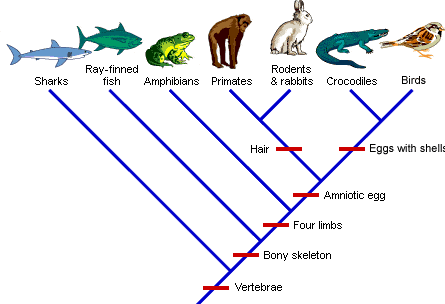
95.
According to this cladogram, sharks are MOST closely related to which organism? 
a)
Amphibians
b)
Ray finned fish
c)
Crocodiles
d)
Birds
96.

All rabbits of the same species living in a particular area would be an example of a(n)

a)

population

b)

species

c)

community

d)

ecosystem

97.

Adaptations can be:

a)

camouflage

b)

ability to survive cold weather

c)

hunting skills

d)

all of the above

98.

Differences in traits are called:

a)

natural selection

b)

genetic variations

c)

artificial selection

d)

adaptations

99.

A species could go extinct if:

a)

food becomes more plentiful.

b)

members of the species have adaptations to enhance survival.

c)

the environment changes drastically and no one can adapt.

d)

there is less competition for resources.

100.

What is most likely to happen to moth populations in the picture shown?

a)

Light moths--hunted easily, dark moths--population increase

b)

Dark moths--hunted easily, dark moths--population increase

c)

Light moths--hunted easily, light moths--population increase

d)

Lights moths will change their color to match dark moths.
101.

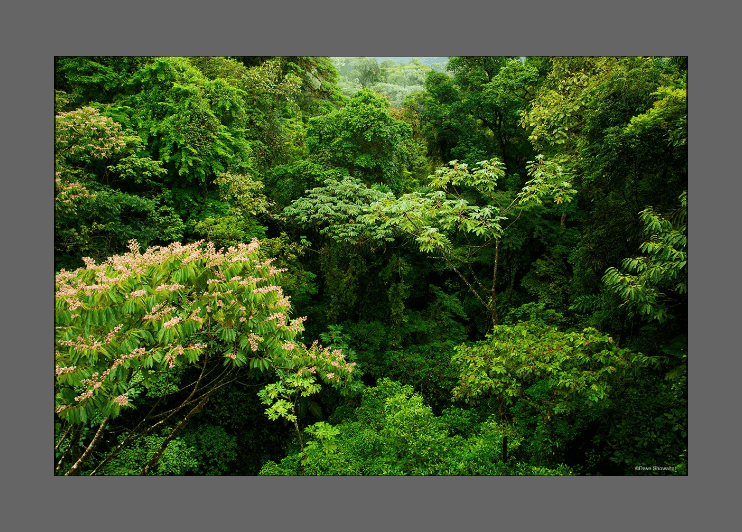
A yellow morph and green morph of an insect lives in the rainforest canopy. You would expect:

a)

the green population to increase and the yellow to decrease

b)

both populations should stay the same

c)

both populations will increase

d)

the green population to decrease and the yellow to increaseThis is a wrong answer

102.

How do you "win" at natural selection?

a)

survive

b)

go extinct

c)

survive & reproduce

103.
Survival of the Fittest and Evolution were proposed by what scientist?
a)
Charles Darwin
b)
Albert Einstein
c)
Steven Hawking
d)
Isaac Newton
104.

What word describes a trait that helps an organism survive in its environment?

a)

natural selection

b)

mutation

c)

camouflage

d)

adaptation

105.
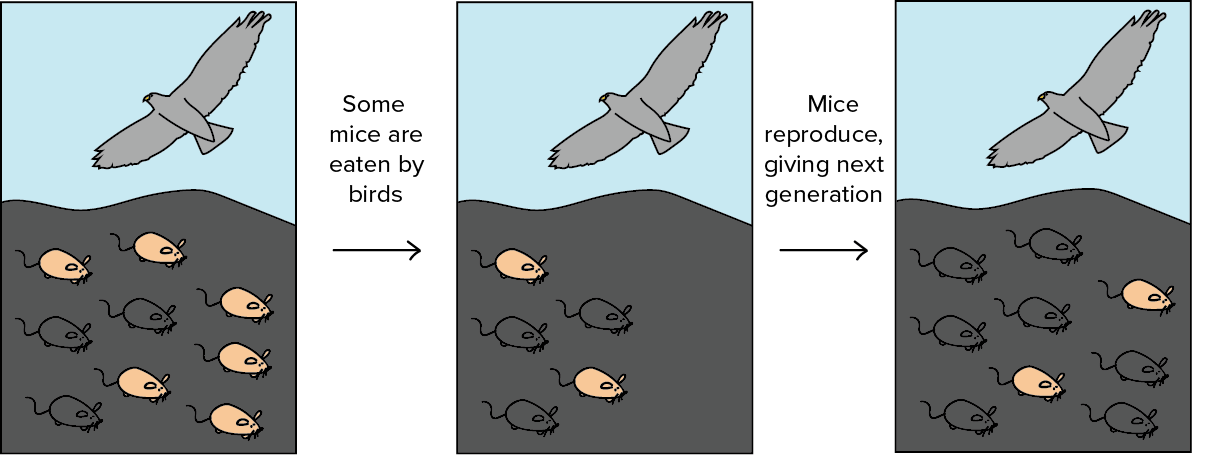
Why is the mouse population changing over time?
a)
The light mice can reproduce more successfully than the dark mice
b)
The hawks eat more dark mice than light mice because the dark mice taste better
c)
The hawks eat more light mice than dark mice because they can see the light mice more easily
d)
The hawks eat more dark mice than light mice because they can see the dark mice more easily
106.
What process is being shown in this image?
a)
Variation
b)
Natural Selection
c)
Selective Breeding
d)
Homeostasis
107.
Which organisms are most likely to survive?
a)
the best adapted
b)
the fastest
c)
the strongest
d)
the most domesticated (tamed)
108.

What happens to new traits that HELP organisms survive over time?

a)

They become MORE COMMON

b)

They become LESS COMMON

c)

They are EQUALLY COMMON

109.

If a new trait DOES NOT help an organism survive, what may happen to it?

a)

It dies and its DNA is not passed on

b)

It survives and its DNA is passed on

c)

It changes its traits to adapt and survive

110.
Almost all adaptations started off as?
a)
selective breeding
b)
physiological
c)
structural
d)
mutation
111.

Change over time

a)

Natural Selection

b)

Evolution

c)

Selective Breeding

d)

Homeostasis

112.

Natural selection is where ___________ decides which traits should be passed on.

a)

nature

b)

a human

c)

traits

d)

evolution

113.
Body parts that function like each other, but are different in structure.
a)
embryos
b)
homologous structures
c)
analogous structures
d)
vestigial structures
114.
Body parts of organisms that are the same in structure and position but different in function.
a)
embryos
b)
homologous structures
c)
analogous structures
d)
vestigial structures
115.
Body parts that have lost their original function.
a)
embryos
b)
homologous structures
c)
analogous structures
d)
vestigial structures
116.

A human arm and a whale fin have similar bone structure but the whale fin is used for swimming and the arm is used for reaching and grabbing. What type of structures are these?

a)

Homologous structures

b)

Analogous structures

c)

Vestigial structures

d)

Fossil structures

117.

The similarities of bone structure in the diagram provide evidence of what?

a)

The organisms probably use there forelimbs for the same thing.

b)

The organisms evolved from a common ancestor.

c)

The organisms have the same DNA.

d)

All vertebrate species have identical forelimbs.

118.

The first word in a scientific name is the

a)

species

b)

phylum

c)

genus

d)

class

119.

The science of grouping and naming organisms

a)

Phylogeny

b)

Dichotomy

c)

Taxonomy

d)

Genetics

120.

The taxonomic level that would include the MOST number of species

a)

class

b)

kingdom

c)

phylum

d)

genus

121.

What are the eight major classification groups from most broad to most specific?

a)

class, kingdom, order, family, species, genus, domain

b)

domain, kingdom, class, phylum, family, order, genus, species

c)

kingdom, phylum, class, order, domain, family, species, genus

d)

domain, kingdom, phylum, class, order, family, genus, species

122.

Which taxonomic level would include the LEAST number of organisms?

a)

species

b)

genus

c)

order

d)

phylum

123.
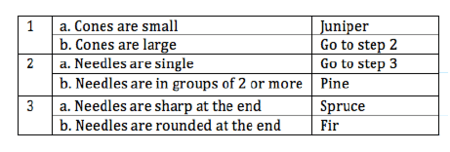
What is the purpose of a dichotomous key?
a)
to find a common ancestor
b)
to show the evolution of organisms
c)
to show relationships between organisms
d)
to identify organisms
124.
What step do we always start with when using dichotomous keys?
a)
1
b)
2
c)
3
d)
4
125.
When using a dichotomous key to identify organisms, what do we look at?
a)
physical features
b)
weather patterns
c)
environment
d)
diet
126.
A dichotomous key for trees is provided. Hikers found a tree that has large brown cones and single sharp needles. What species of tree have the hikers found?
a)
Juniper
b)
Pine
c)
Spruce
d)
Fir
127.
A dichotomous key for insects is given. To what order does an insect with two pairs of scaly wings belong?
a)
Coleoptera
b)
Heteroptera
c)
Diptera
d)
Lepidoptera
128.
Which kingdom has the following characteristics... Eukaryotic, Sexual, Multicellular, Heterotrophic.
a)
Bacteria
b)
Protista
c)
Plant
d)
Animal
129.
Which kingdom has the following characteristics... Eukaryotic, Sexual, Multicellular, and Autotrophic
a)
Bacteria
b)
Protista
c)
Plant
d)
Animal
130.
Which kingdom has the following characteristics... Eukaryotic, Asexual, Unicellular and Multicellular, and Heterotrophic.
a)
Fungi
b)
Protista
c)
Plant
d)
Animal
131.
Which kingdom has the following characteristics... Prokaryotic, Asexual, Unicellular, and can be both Autotrophic and Heterotrophic.
a)
Bacteria
b)
Protista
c)
Fungi 
d)
Plant
132.
Which type of cells contain a nucleus?
a)
Prokaryotes
b)
Eukaryotes
c)
Both prokaryotes and eukaryotes 
133.

Fungi and bacteria share which of the following similiarities?

a)

Members of both groups have cell walls made of chitin

b)

Members of both groups are decomposers

c)

Members of both groups are capable of photosynthesis

d)

Members of both groups are classified as eukaryotes

134.

Which of the following is a common trait to all members of the six kingdoms: Eubacteria, Archaebacteria, Protista, Fungi, Plantae, and Animalia?

a)

Presence of a cell wall

b)

Capable of sexual reproduction

c)

Presence of genetic material

d)

Presence of a nucleus

135.

which domain contains eukaryotic organisms?

a)

eukarya

b)

bacteria

c)

archaea

136.

Reorder the following from most to least inclusive of taxa in classification.

a)

Domain

b)

Kingdom

c)

Phylum

d)

Class

e)

Order

1)
2)
3)
4)
5)
137.
Which rank contains the largest number of organisms?
a)
Genus
b)
Species
c)
Class
d)
Order
138.
Lions and housecats share some common traits, but can't breed with one another. What can you infer about how they're classified?
a)
They might belong to the same family, but a different genus and species
b)
They might belong to the same order, but different phyla
c)
They might belong to the same domain, but different kingdoms
d)
They might belong to the same species, but different subspecies
139.

What levels of classification are used in the scientific name?

a)

Kingdom, Phylum

b)

Kingdom, Species

c)

Genus, Species

d)

Phylum, Genus

140.

A wolf's scientific name is Canis rufus. Which genus does it belong to?

a)

Canis

b)

rufus

c)

wolf

d)

animal

141.

Which organism follows an r-strategy for reproduction?

a)

robin

b)

zebra

c)

human

d)

fly

142.

What is an example of uniform dispersal?

a)

random elephant groups

b)

school of fish

c)

territorial pair of jaguars

d)

one large herd of buffalo

143.

Which characteristic is typical of a k-strategist?

a)

produces many offspring

b)

lengthy parental care

c)

generally small organism

d)

short life span

144.

Emigration is

a)

the movement out of an area

b)

the movement into an area

c)

movement in and out of an area

d)

migration

145.

Why don't populations grow indefinitely?

a)

limiting factors

b)

only biotic factors

c)

only abiotic factors

d)

none of the above

146.

(Im)migration is ...

a)

the movement into an area

b)

The movement out of an area

c)

The migration process

d)

exponential graph

147.

Match the picture with the type of population distribution

a)
1.

uniform distribution

b)
2.

Random distribution

c)
3.

Clumped distribution

148.

Match the following

a)

The number of trout in a stream

1.

Population size

b)

The size of a population of bears in a certain area

2.

Population density

c)

How people or organisms are spread out in an area

3.

Population dispersion

149.

The graphs below show the changes in crab color at one beach.

Which of the following is most likely to have caused the change in the distribution?

a)

A new predator arrived that preferred dark-tan crabs.

b)

A new predator arrived that preferred light-tan crabs.

c)

A change in beach color made medium-tan crabs the least visible to predators.

d)

A change in beach color made medium-tan crabs the most visible to predators.

150.

What type of selection is depicted in the picture?

a)

stabilizing

b)

directional

c)

disruptive

151.
What type of selection?
a)
Directional 
b)
Stabilizing
c)
Disruptive
152.
Which of the three graphs shows stabilizing selection?
a)
A
b)
B
c)
C
153.
Which of the three graphs shows disruptive selection?
a)
A
b)
B
c)
C