
 Worksheets
State Test Prep Part 2
Total questions: 150
Worksheet time: 3hrs 35mins
Name
Class
Date
1.
Cells work together to make the following.
a)
tissues
b)
organs
c)
organ systems
d)
organism
2.
Tissues work together to make the following.
a)
cells
b)
organs
c)
organ systems
d)
organism
3.
Organs work together to make the following.
a)
cells
b)
organs
c)
organ systems
d)
organism
4.
Animal and Plant cells are both this type of cell.
a)
Eukaryote
b)
Prokaryote
5.
Bacteria cells are this type of cell.
a)
Eukaryote
b)
Prokaryote
6.
This type of cell needs a cell wall and chloroplasts
a)
Plant cell
b)
Animal Cell
c)
Bacteria
7.
The powerhouse of the cell is the...It converts energy from food into energy the cell can use
a)
Mitochondrion
b)
Golgi body
c)
Nucleus
d)
Ribosomes
8.
Where are proteins made? These are small, grain-like or rod shaped organelles.
a)
Golgi body
b)
Mitoichondrion
c)
Chromosomes
d)
Ribosomes
9.
This organelle is in both plants and animals. It is a barrier between the cell and the environment. It controls what goes in and out of a cell.
a)
cell wall
b)
cell membrane
c)
cell organelles
d)
mitochondria
10.
This cell part is in ALL cells. It is the gel-like substance that provides cell shape.
a)
Chloroplasts
b)
Chromosomes
c)
Cytoplasm
d)
Mitochondria
11.
This organelle is in all eukaryotic cells. It is the control center of the cell because it holds the DNA.
a)
Mitochondria
b)
Nucleus
c)
Chloroplasts
d)
Ribosomes
12.
Tiny cell structures that carry out specific functions within the cell.
a)
membranes
b)
nucleus
c)
organelles
d)
animalicules
13.
This structure is a storage area for the cell. Plants usually have one large one.
a)
Lysosome
b)
Vacuole
c)
Ribosome
d)
Golgi Body
14.
These are passageways in the cell that carry proteins and other materials from one part of the cell to another.
a)
Golgi Body
b)
Endoplasmic Reticulum
c)
Ribosome
d)
Nucleolus
15.

What is the name of the genetic material that is inside the nucleus?
a)
ER
b)
ATP
c)
YOLO
d)
DNA
16.

What is the main function of the cell membrane?
a)
Digestion
b)
Storage
c)
Protecitve Barrier
d)
INSANE IN THE MEMBRANE!
17.

How are eukaryotes different from prokaryotes?
a)
They aren't different, except the spelling.
b)
Phone a friend :/
c)
Eukaryotes have a NUCLEUS, prokaryotes do NOT!
d)
Prokaryotes have a NUCLEUS, eukaryotes do NOT!
18.

How does the Golgi Complex package and ship proteins and other materials?
a)
Membrane pinches to form a small bubble.
b)
Red blood cells transport materials.
c)
Bacteria delivers the materials.
d)
FedEx
19.

What is NOT a reason that lysosomes are important for cells?
a)
Lysosomes destroy worn out cells.
b)
Lysosomes contain instructions for how to make proteins.
c)
Lysosomes attack foreign invaders.
d)
Lysosomes get rid of waste from inside the cell.
20.

All living things are made up of...
a)
cells
b)
cell tissues
c)
organ
d)
organ systems
21.
The levels of organization in an organism go in which order: from smallest to largest.
a)
Cell, Tissue, Organ System, Organ
b)
Cell, Organ, Tissue, Organ System
c)
Organ System, Organ, Tissue, Cell
d)
Cell, Tissue, Organ, Organ System
22.

I am only found in a plant cell. What am I?
a)
cell wall
b)
mitochondria
c)
cytoplasm
d)
chloroplast
23.

What does this structure do?
a)
supports the cell
b)
cell's control center
c)
converts energy to food
d)
makes proteins
24.

Amino acids link together to form proteins. In which organelle would this process occur?
a)
Lysosome
b)
Ribosome
c)
Centriole
d)
Mitochondria
25.

a)
Vascular Flowering
b)
Vascular Seedless
c)
Vascular Nonflowering
d)
Non-Vascular
26.

Why do plant cells need chlorophyll?
a)
for protection
b)
to store water
c)
to make food (photosynthesis)
d)
for reproduction
27.

Why do plant cells have a cell wall?
a)
for protection
b)
to store water
c)
to make food (photosynthesis)
d)
for reproduction
28.

A _______ plant has tubes to carry food, water, and minerals through a plant.
a)
angiosperm
b)
gymnosperm
c)
vascular
d)
nonvascular
29.

A ______ plant does not have any tubes.
a)
angiosperm
b)
gymnosperm
c)
vascular
d)
nonvascular
30.

The dots on the back of this fern plant are tiny reproductive cells called
a)
chloroplasts
b)
anthers
c)
spores
d)
ovaries
31.

One way that mosses and ferns are similar is they both
a)
are flowering plants
b)
produce spores
c)
grow with little rainfall
d)
are vascular plants
32.

Plants that produce seeds in cones are called
a)
angiosperms
b)
gymnosperms
c)
vascular
d)
nonvascular
33.

Plants with flower parts in 4's or 5's
a)
monocots
b)
dicots
34.

Plants with flower parts in multiples of 3
a)
monocots
b)
dicots
35.

Seeds with two cotyledons
a)
monocots
b)
dicots
36.

Wider leaves with branching network of veins
a)
monocots
b)
dicots
37.

Vascular bundles arranged in rings
a)
monocots
b)
dicots
38.

Scattered vascular bundles
a)
monocots
b)
dicots
39.
A seed is a form of ____ reproduction.
a)
sexual
b)
asexual
c)
simple
40.

What is D? (pg.134)
a)
Anther
b)
Ovules
c)
Pollen Tube
d)
Stigma
41.
What is necessary for photosynthesis to occur?
a)
Carbon Dioxide
b)
Oxygen
c)
Nitrogen
d)
Helium
42.

a)
Prophase
b)
Interphase
c)
Anaphase
d)
Telophase
43.

a)
Anaphase
b)
Cytokinesis
c)
Telophase
d)
Metaphase
44.
Nuclear membrane forms around chromosomes and begins to separate.
a)
Anaphase
b)
Telophase
45.

a)
Cytokinesis
b)
Interphase
c)
Anaphase
d)
Metaphase
46.

a)
Anaphase
b)
Cytonkinesis
c)
Interphase
d)
Prophase
47.

a)
Cytokinesis
b)
Anaphase
c)
Telophase
d)
Prophase
48.
The structures that hold together sister chromatids
a)
tissues
b)
chromosomes
c)
spindle
d)
centromeres
49.
The process by which the nuclear material is divided equally between two new cells
a)
mitosis
b)
cancer
c)
spindle
d)
centromere
50.

Which phase comes NEXT?
a)
prophase
b)
metaphase
c)
anaphase
d)
telophase
51.

Why would it be important to replicate DNA before a cell divides in mitosis or meiosis?
a)
In order for genetic information to be transferred into daughter cells.
b)
In order for the cell to be able to increase in size.
c)
In order for the DNA to be contained in the nucleus.
d)
In order for the cell to re-order the DNA sequencing in the new cells.
52.

In mitosis, the two resulting cells are
a)
different from the starting cell and identical to each other.
b)
different from the starting cell and different from each other.
c)
identical to the starting cell and different from each other.
d)
identical to the starting cell and identical to each other.
53.

How many chromosomes do humans have?
a)
46
b)
21
c)
10
54.
If there are 16 chromosomes in the egg cells of an organism, how many chromosomes would be found in its muscle cells?
a)
16
b)
8
c)
32
d)
64
55.
If there are 20 chromosomes in the egg cells, how many chromosomes would be found in the sperm cells of the same species?
a)
10
b)
20
c)
40
d)
80
56.

Structure A refers to the _____.
a)
chromatid
b)
chromosome
c)
centromere
57.

Which process and type of resulting cells are represented?
a)
mitosis, gametes
b)
mitosis, body cells
c)
meiosis, gametes
d)
meiosis, body cells
58.

Which cellular process is shown?
a)
meiosis
b)
endocytosis
c)
mitosis
d)
phagocytosis
59.

Which best describes the process shown?
a)
mutation in which the DNA content of the gene is ltered
b)
segregation of sister chromatids
c)
condensation and segregation of the alleles
d)
crossing-over which alleles are exchanged
60.
Which sequence of DNA bases would pair with this partial strand
ATG TGA CAG
ATG TGA CAG
a)
ATG TGA CAG
b)
TAC ACT GTC
c)
GTA AGT GAC
d)
CAT TCA CTG
61.

Which of the following best describes a DNA molecule?
a)
double helix
b)
contains ribose
c)
made of amino acids
d)
contains Uracil
62.
Which of the following units are repeatedly joined together to form a strand of DNA? (This is the MONOMER of DNA.)
a)
amino acids
b)
nucleotides
c)
fatty acids
d)
polysaccharides
63.

In a molecule of double-stranded DNA, the amount of Adenine present is always equal to the amount of
a)
cytosine
b)
guanine
c)
thymine
d)
uracil
64.
Guanine bonds with ______________.
a)
Adenine
b)
Guanine
c)
Cytosine
d)
Thymine
65.
Which 2 molecules form the sides (backbone) of the DNA ladder?
a)
deoxyribose and adenine
b)
deoxyribose and a hydrogen bond
c)
sugar and the nucleus
d)
deoxyribose (sugar) and phosphate
66.

In the middle of the DNA strand, the bases (ATCG) are held together by what type of bond?
a)
polar bonds
b)
ionic bonds
c)
covalent bonds
d)
hydrogen bonds
67.

Name this structure
a)
double helix
b)
nucelotide
c)
twisted ladder
d)
hydrogen bond
68.

Nucleotides are made up of a sugar, phosphate, and..?
a)
nitrogenous base
b)
nucleic acid
c)
cholesterol
d)
fatty acid
69.
The process by which a DNA molecule is copied is called _____.
a)
binary fission
b)
mitosis
c)
replication
d)
translation
70.
Enzyme involved in DNA replication that joins individual nucleotides to produce a DNA molecule
a)
RNA polymerase
b)
helicase
c)
lactase
d)
DNA polymerase
71.
Who realized that A is always equal to T and C is always equal to G?
a)
Franklin
b)
Watson and Crick
c)
Chargaff
d)
Mendel
72.
Which of the following best describes how DNA and RNA are similar?
a)
they both contain A and T
b)
They both have a double helix
c)
They are both composed of 5 different nucleotides
d)
they both have C and G
73.
Genetic info flows in one direction. Which best represents this flow?
a)
DNA-protein-RNA
b)
Protein-RNA-DNA
c)
RNA-protein-DNA
d)
DNA-RNA-protein
74.

The diagram shows the process of
a)
Transcription
b)
Translation
c)
Replication
d)
Mitosis
75.
What is the function of mRNA?
a)
storage of food
b)
prevents mutations
c)
provides energy
d)
carries genetic message
76.
The process of making mRNA from DNA is called.
a)
Replication
b)
Transcription
c)
Translation
d)
Protein synthesis
77.
Before the cell divides, what process needs to happen?
a)
Transcription
b)
Translation
c)
Replication
d)
Protein synthesis
78.
Amino acids are bonded together by a
a)
hydrogen bond
b)
peptide bond
c)
ionic bond
d)
they are not bonded
79.
Any change in the sequence of DNA nucleotides or chromosomes is called a
a)
mutation
b)
single genotype
c)
monohybrid trait
d)
transgenic shift
80.
The separation of DNA fragments using electric current is called
a)
gel electrophoresis
b)
karyotyping
c)
chromosome painting
d)
polymerase chain reaction
81.
The banding patterns that gel electrophoresis results in can be used
a)
to produce proteins
b)
to compare various genomes for similarities
c)
make copies of DNA
d)
analyze DNA structures
82.
Chloroplast is to glucose as a ribosome is to
a)
DNA
b)
protein
c)
lipid
d)
molecule
83.

The human karyotype shown above experienced a nondisjunction during meiosis. The person with the karyotype above is a --
a)
klinefelter's syndrome male with an extra X chromosome
b)
turner's syndrome female with a single X chromosome
c)
down syndrome female with a missing chromosome
d)
down syndrome male with an extra chromosome
84.
Two brown eyed parents (Bb) have a baby. What is the chance the baby is blue eyed?
a)
0 %
b)
25%
c)
50%
d)
75%
85.
A person heterozygous for wet earwax (Ww) mates with a person homozygous recessive for dry earwax. What is the chance their baby is heterozygous?
a)
0%
b)
25%
c)
50%
d)
100%
86.
Two mice heterozygous for red eyes mate. What is the expected genotypic ratio of their offspring?
a)
1 RR: 1 Rr: 1 rr
b)
0 RR: 4 Rr: 0 rr
c)
1 RR: 2 Rr: 1 rr
d)
1 RR: 1 Rr
87.
Which of the following is a phenotype?
a)
Aa
b)
red hair
c)
heterozygous
d)
DNA
88.
Which of the following is NOT a genotype?
a)
heterozygous
b)
a trait
c)
Bb
d)
homozygous recessive
89.
Which of the following alleles is homozygous (purebred) recessive?
a)
Tt
b)
tt
c)
TT
d)
t
90.
Aa is
a)
homozygous (purebred)
b)
heterozygous (hybrid)
91.
G = green, g = yellow
The genotype for a yellow plant is...
The genotype for a yellow plant is...
a)
GG
b)
Gg
c)
gg
d)
all of the choices result in yellow
92.
In a heterozygous genotype, the ___________ allele takes over in the phenotype.
a)
recessive
b)
dominant
c)
lower case letter
d)
both
93.
How many alleles (letters) do each person carry for a trait?
a)
1
b)
2
c)
3
d)
4
94.

T - tall and t = short
In the punnett square below, what belongs in the missing square
In the punnett square below, what belongs in the missing square
a)
tt
b)
Tt
c)
Bb
d)
TT
95.

A sex cell that has half the amount of DNA that is found in a body cell.
a)
gene
b)
gamete
c)
fertilization
d)
allele
96.
Mendel's "character" is to ________ as trait is to _______.
a)
allele / gene
b)
gene / allele
c)
DNA / RNA
d)
genotype / phenotype
97.
In a pedigree ______ are circles and organisms who express the trait under study are _______.
a)
females / not shaded in
b)
males / not shaded in
c)
females / shaded in
d)
males / shaded in
98.
If a certain allele of a trait masks the expression of another allele, the allele that is masked is referred to as ________.
a)
Dominant
b)
Recessive
c)
Primary
d)
Genetic
99.

This chicken is the offspring of a black chicken and a white chicken. What kind of inheritance does it's feather color have?
a)
Incomplete Dominance
b)
Codominance
c)
Pleiotropy
d)
Simple Mendelian Inheritance
100.
If the dominant allele is G and the recessive allele is g, an organism that is GG is called ________ while an organism that is gg is called _______.
a)
Homozygous / heterozygous
b)
Heterozygous / homozygous
c)
Homozygous / homozygous
d)
Heterozygous / heterozygous
101.

This image shows a ________
a)
Punnett Square
b)
Genetic Tree
c)
Phylogenic Tree
d)
Pedigree
102.
Disorders on the X chromosome affect _____ at a higher frequency.
a)
males
b)
females
c)
They affect both males and females evenly
d)
none of the above
103.

This type of inheritance pattern is a MIXTURE of both traits.
a)
incomplete dominance
b)
codominance
c)
complete dominance
d)
recessive pattern
104.

What genotype is missing from this Punnett Square?
a)
RrYy
b)
RRYY
c)
rryy
d)
RrYY
105.
A breed of chicken shows codominance for feather color. One allele codes for black feathers, another codes for white feathers. The feathers of heterozygous chickens of this breed will be:
a)
all black
b)
all white
c)
all gray
d)
speckled black and white
106.

B = brown fur b = white fur
In the punnett square, what is the probability for white fur?
In the punnett square, what is the probability for white fur?
a)
0%
b)
25%
c)
50%
d)
75%
107.
If a gene is found only on the X chromosome and not the Y chromosome, it is said to be what?
a)
sex-linked trait
b)
polygenic trait
c)
codominant trait
d)
incomplete dominance trait
108.
Which of the following organisms are LEAST closely related?
a)
organisms that share a domain
b)
organisms that share a family
c)
organisms that share a genus
d)
organisms that share a species
109.
The scientific name for an organism is made from the:
a)
class and family name
b)
genus and species name
c)
domain and kingdom name
d)
kingdom and phylum name
110.
The 8 levels of classification, most broad to most specific.
a)
Domain, Genus, Family, Order, Class, Phylum, Kingdom, Species
b)
Domain, Species, Kingdom, Genus, Phylum, Family, Class, Order
c)
Domain, Kingdom, Phylum, Class, Order, Family, Genus, Species
d)
Order, Kingdom, Species, Domain, Phylum, Family, Class, Genus
111.
Term given to describe the 2 name naming system is:
a)
dichotmous key
b)
binomial nomenclature
c)
2 scientific names
d)
binomial key
112.
Fill-in-the-blank:
Domain--Kingdom--Phylum--____________
Domain--Kingdom--Phylum--____________
a)
Order
b)
Family
c)
Class
d)
Species
113.

Which organisms are closely related?
a)
American badger and leopard
b)
coyote and gray wolf
c)
european otter and leopard
d)
coyote and american badger
114.
Organisms in this smallest taxonomic group share many characteristics.
a)
domain
b)
kingdom
c)
species
d)
class
115.
An organism made up of more than one cell would be called:
a)
multicellular
b)
unicellular
c)
heterotroph
d)
autotroph
116.
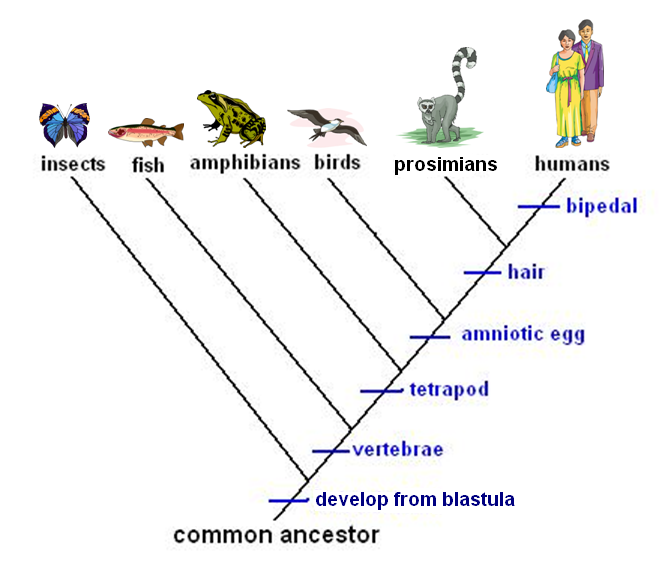
Which organisms pictured on the cladogram have hair?
a)
prosimians only
b)
prosimians and humans
c)
humans only
d)
prosimians and birds
117.
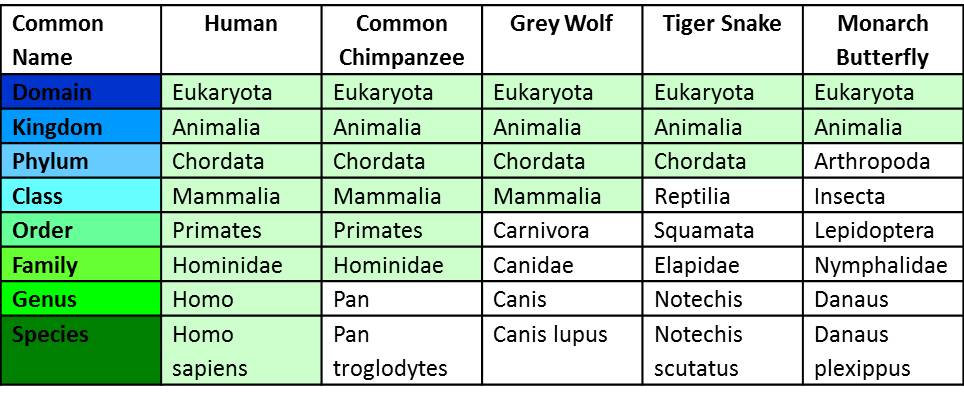
Which organism in the table is least closely related to the chimpanzee?
a)
human
b)
grey wolf
c)
tiger snake
d)
monarch butterfly
118.
Members of this kingdom are multicellular and heterotrophic.
a)
Plantae
b)
Protista
c)
Animalia
d)
Achaebacteria
119.
I have a nuclear membrane, can do photosynthesis and am multicellular. What kingdom do I belong to?
a)
Animalia
b)
Archaebacteria
c)
Plantae
d)
Protista
120.

I am prokaryotic and am found everywhere. What kingdom do I belong to?
a)
Eubacteria
b)
Archaebacteria
c)
Fungi
d)
Protista
121.
What Domain do I belong to?
I am multicelled.
My cells do have a nucleus.
I reproduce sexually.
I love the sun! It helps me make my food through photosynthesis.
I can be found anywhere in the world.
a)
Archaea
b)
Bacteria
c)
Eukarya
122.
This scientist heat, gravy, and two flasks to disprove Needham's experiment
a)
Redi
b)
Leeuwenhoek
c)
Pasteur
d)
Spallanzani
123.
This scientists WRONGLY thought he proved spontaneous generation
a)
Redi
b)
Leeuwenhoek
c)
Needham
d)
Spallanzani
124.
This scientist used flies and meat to determine how maggots were created.
a)
Redi
b)
Leeuwenhoek
c)
Needham
d)
Spallanzani
125.
This scientist went back and further backed up Spallanzani's experiment using an S-shaped flask
a)
Redi
b)
Leeuwenhoek
c)
Pasteur
d)
Needham
126.
What is another name for natural selection?
a)
survival of the smartest
b)
survival of the fastest
c)
survival of the biggest
d)
survival of the fittest
127.
What is a change in an organism that allows for it to survive in its environment?
a)
homologous
b)
vestigial
c)
variation
d)
adaptation
128.

What is this an example of?
a)
diversity of species
b)
variation
c)
vestigial structures
d)
DNA studies
129.
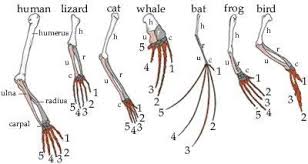
What is this an example of?
a)
vestigial structures
b)
embryology
c)
homologous structures
d)
fossil record
130.

Which layer is the oldest?
a)
1
b)
2
c)
3
d)
4
131.

Darwin wrote that organisms with traits that are best suited to the environment will ________________
a)
increase in number
b)
become extinct
132.
Which term refers to the process by which individuals that are better suited to the environment survive and reproduce therefore passing down their genes to their offspring?
a)
Evolution
b)
Variation
c)
Adaptation
d)
Natural Selection
133.
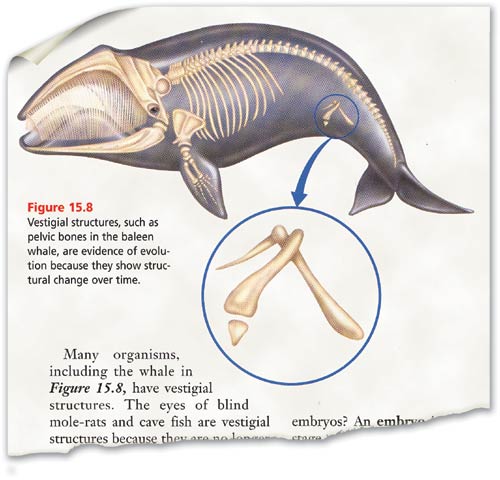
Which of the following is an example of a vestigial structure?
a)
the wings of a red-tailed hawk
b)
the hind limbs of a house cat
c)
the fins of sharks
d)
the tailbone of a human
134.
Why are advantageous traits more likely to be passed onto offspring?
a)
Because they are more likely to survive and reproduce.
b)
Because they come from dominant alleles.
c)
Because they come from recessive alleles.
d)
Because the trait is an acquired phenotype.
135.
The struggle for existence against other members of an organisms species is
a)
Competition
b)
Natural Selection
c)
gene flow
d)
genetic drift
136.

If an organism has a vestigial structure, that structure likely once had a function in a(n)
a)
close relative
b)
early ancestor
c)
unrelated organism
d)
embryological stage
137.

two species are in different environments and look very similar. However, that are not closely related (analogous). Their resemblance is most likely an example of.
a)
sexual selection
b)
temporal isolation
c)
convergent evolution
d)
divergent evolution
138.

The study of the early stages of development that is one evidence of evolution is:
a)
Homologous Structures
b)
Embryology
c)
Vestigial Organs
139.
Almost all adaptations started off as?
a)
selective breeding
b)
physiological
c)
structural
d)
mutation
140.
Which statement best describes conditions on early Earth?
a)
hot with volcanic activity and electrical storms
b)
dry land covered with volcanic dust
c)
cold oceans
d)
dark and dusty with abundant water
141.
If finches with large beaks and finches with small beaks increase in a population while finches with average sized beaks decreases, which pattern of natural selection has occurred?
a)
Directional selection
b)
Disruptive selection
c)
Stabilizing selection
142.
Human babies don't do well if they are born too small. If they are too big complications can occur during birth. Baby size should then be selected for by which method?
a)
stabilizing
b)
directional
c)
disruptive
d)
Beyonce is having twins
143.

You would find mushrooms in which kingdom?
a)
Plantae
b)
Protists
c)
Fungi
d)
Animalia
144.

According to this cladogram, birds are LEAST related to:
a)
Amphibians
b)
Sharks
c)
Ray Finned Fish
d)
Crocodiles
145.

On the cladogram, which organism is the closest relative of the human?
a)
Frog
b)
Hare
c)
Caiman
d)
Parrot
146.

Algae and Kelp belong to the Kingdom...
a)
Plantae
b)
Protista
c)
Fungi
d)
Eubacteria
147.
What is the genus name here:
Canis lupus
Canis lupus
a)
Canis
b)
lupus
148.

The name for the phylum of segmented worms is called...
a)
Echinodermata
b)
Arthropoda
c)
Annelida
d)
Cnidaria
149.

Choose the correct way to write the scientific name for humans:
a)
homo sapiens
b)
Homosapiens
c)
Homo sapiens
d)
Homo Sapiens
150.
Fish, amphibians, reptiles, birds and mammals all belong to which group?
a)
Vascular
b)
Vertebrates
c)
Invertebrates
d)
Nonvascular
100 %

