wayground logo

Free Printable Worksheets

Font size

S
M
L
XL
Worksheets

Biology EOC Review

Total questions: 150

Worksheet time: 2hrs 55mins

Name
Class
Date
1.
What are the four biological molecules?
a)
proteins, carbohydrates, lipids, nucleic acids
b)
A, T, C, G
c)
water, air, earth, and fire
d)
Joe, Nick, and Kevin Jonas
2.
Which biomolecule is also known as enzymes?
a)
Carbohydrate
b)
Lipid
c)
Nucleic Acid
d)
Protein
3.
Which biomolecule is made of nucleotides and contain you DNA?
a)
Carbohydrate
b)
Lipids
c)
Protein
d)
Nucleic Acid
4.

Which biomolecule helps form muscles?

a)

Nucleic Acid

b)

Carbohydrate

c)

Protein

d)

Lipids

5.
Which biomolecule is responsible for insulation and energy storage?
a)
Protein
b)
Nucleic Acid
c)
Lipid
d)
Carbohydrate
6.
Which biomolecule is your main source of quick energy?
a)
Nucleic Acid
b)
Protein
c)
Lipid
d)
Carbohydrate
7.
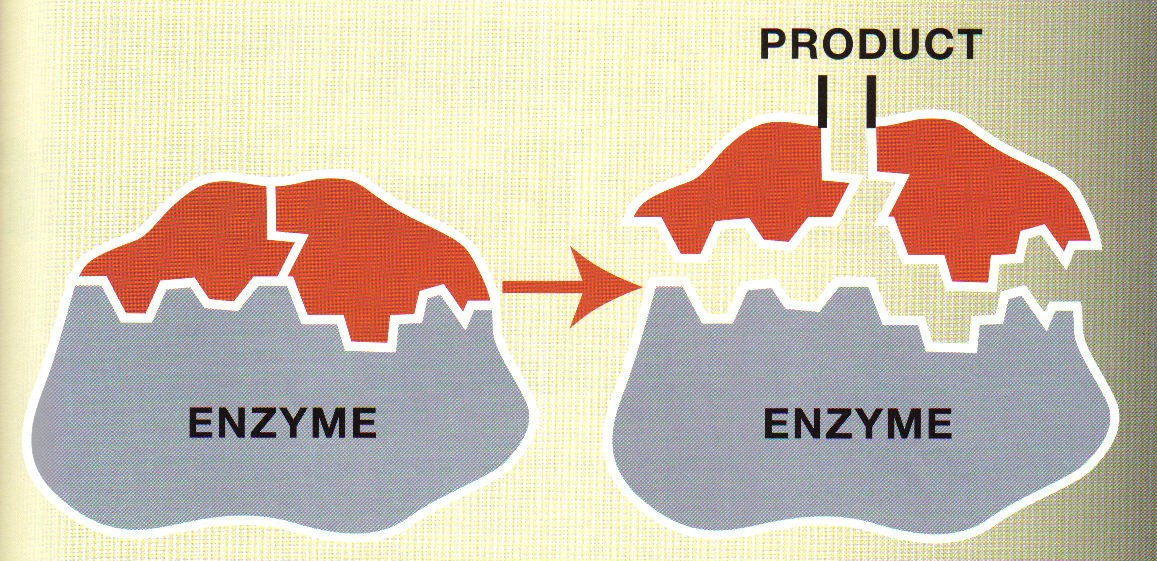
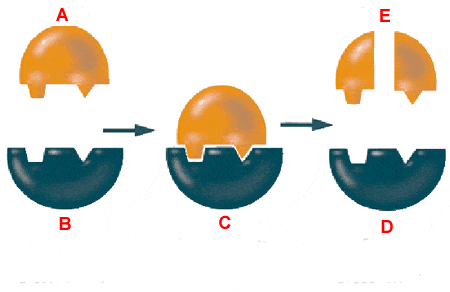
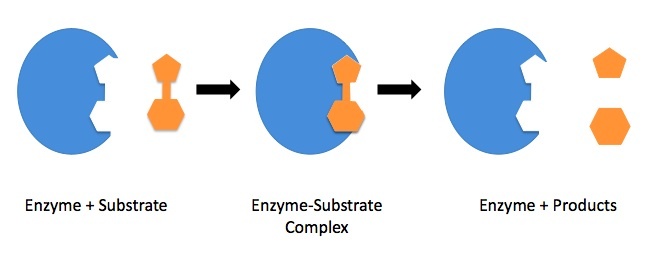
Enzymes produce a specific reaction.
a)
True
b)
False
8.
Once an enzyme does it's work, the enzyme is ___________.
a)
destroyed
b)
unchanged
c)
duplicated
d)
changed
9.
The area that the substrate fits into on the enzyme is called the:
a)
Active Site
b)
Allosteric Site
c)
DiSulphide Bridge
d)
β-Pleated Sheet
10.
Enzymes catalyze reactions by ___________ Activation Energy.
a)
Increasing
b)
Decreasing
11.
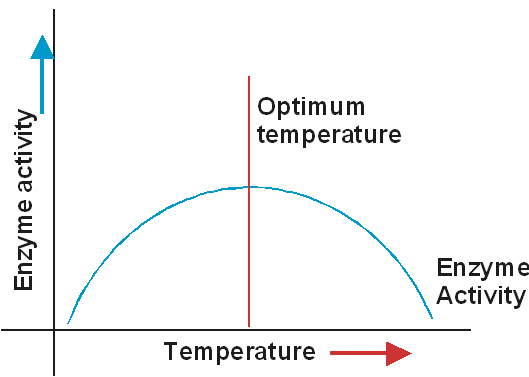
At high temperatures enzyme activity declines because of:
a)
Denaturation
b)
Decreased Kinetic Motion
c)
Increased H-Bonding
d)
Dissociation of Ionic Compounds
12.
Most enzymes have the ending:
a)
-ase
b)
-ose
c)
-ic acid
d)
-ate
13.
The molecule an enzyme is working on is called the:
a)
Substrate
b)
Solvent
c)
Allosteric Inhibitor
d)
CoEnzyme
14.
What kind of transport does not require energy?
a)
Active 
b)
Vacuole 
c)
Passive 
d)
Na/K Pump 
15.
What is something that prokaryotic and eukaryotic cells have in common?
a)
They have a nucleus. 
b)
They are multi-cellular. 
c)
They have DNA. 
d)
They have organelles that are membrane-bound.
16.
What is facilitated diffusion?
a)
Transport that uses proteins to help move molecules across the membrane. 
b)
Movements of substances through a membrane. 
c)
When molecules spread from High to Low concentration on their own. 
d)
When pressure pushes something through a membrane. 
17.
What macromolecules help to make the cell membrane? 
a)
Proteins 
b)
Carbohydrates 
c)
Phospholipids 
d)
All of the above 
18.
All of the following statements are true about prokaryotic cells EXCEPT 
a)
No nucleus 
b)
They are simple and small 
c)
Have a cell wall 
d)
Have organelles 
19.
Which of the following is the best example of osmosis? 
a)
NA/K Pump 
b)
Water moving though the cell membrane 
c)
Kidneys 
d)
Photosynthesis 
20.
What is the significance of the cell membrane? 
a)
Provides protection 
b)
Maintains homeostasis 
c)
Give a cell hydrophobic ends
d)
Provides cholesterol 
21.
Movement of materials through a vesicle into the cell that requires energy is 
a)
exocytosis
b)
endocytosis 
c)
osmosis 
d)
simple diffusion 
22.
What are the 2 parts of a phospholipid? 
a)
Hydrophobic head, hydrophilic tails 
b)
Hydrophobic heads, hydrophobic tails 
c)
Hydrophilic heads, hydrophobic tails 
d)
Hydrophilic heads, hydrophilic tails 
23.
What is an isotonic solution?
a)
When solutions are in equilibrium 
b)
When the solution has more solute 
c)
When the solution has less solute 
d)
Has a greater pressure 
24.
Active transport does not require energy.
a)
True 
b)
False 
25.
Which of the following is correct about the Golgi? 
a)
Digests waste materials 
b)
Protection and Support 
c)
Modifies and packages molecules 
d)
cellular movement 
26.
Which structures are found in plant cells, but not in animal cells?
a)
Cell membranes and mitochondria
b)
Vacuoles and cholorplasts
c)
Cell walls and cytoplasm
d)
Chloroplasts and cell walls
27.
The concentration of water is higher in the soil than in plant root cells. Water moves into root cells of a plant by...
a)
Facilitated Diffusion
b)
Simple Diffusion
c)
Active Transport
d)
Osmosis
28.
What type of transport is illustrated?
a)
facilitated diffusion
b)
active transport
c)
diffusion
d)
osmosis
29.

Which way would the purple molecules move through the semi permeable membrane?

a)

From the A side to the B side

b)

From the B side to the A side

c)

None of the purple molecules would move.

30.
A portion of mRNA is coded CUG. The corresponding DNA is coded
a)
GAC
b)
GTC
c)
CTG
d)
CAG
31.
A portion of DNA reads GAG. The corresponding mRNA would be
a)
GUG
b)
GTG
c)
CTC
d)
CUC
32.
The process of creating RNA using DNA as the template is
a)
translation
b)
transcription
c)
translocation
d)
Transylvania
33.
In RNA, uracil takes the place of the DNA nitrogen base called
a)
guanine
b)
cytosine
c)
thymine
d)
adenine
34.
The process shown in this image
a)
is called replication
b)
results in a new copy of the DNA
c)
does not happen during mitosis
d)
All of these apply
35.
In eukaryotes, molecule 1 is found in
a)
ribosomes
b)
chloroplasts
c)
cytoplasm
d)
the nucleus
36.
Molecule 3 is synthesized in 
a)
ribosomes
b)
chloroplasts
c)
the cell membrane
d)
the nucleus
37.

There are 3 types of RNA. What are they? (Select all that apply)

a)

tRNA

b)

rRNA

c)

mRNA

d)

xRNA

38.
RNA contains the sugar
a)
ribose
b)
deoxyribose
c)
glucose
d)
lactose
39.
What is the product of translation?
a)
DNA
b)
mRNA
c)
tRNA
d)
proteins
40.

What combines together to make a protein?

a)

Amino Acid

b)

RNA

c)

Ribosome

d)

DNA

41.

What is the order for Protein Synthesis?

a)

Transcription -> Translation -> Protein

b)

Translation - > Transcription -> Protein

c)

Protein -> Transcription -> Translation

d)

Translation -> Protein -> Transcription

42.

What type of RNA is shown in this image?

a)

rRNA

b)

mRNA

c)

tRNA

43.

What type of RNA is shown in this image?

a)

rRNA

b)

mRNA

c)

tRNA

44.

This image shows a picture of a ribosome - what type of RNA is this?

a)

rRNA

b)

mRNA

c)

tRNA

45.
What is a series of events a cell goes through as they grow and divide?
a)
Cell Division
b)
Cell Cycle
c)
Cytokinesis
d)
Mitosis
46.
What is the longest stage of the cell cycle called?
a)
Cytokinesis
b)
M phase
c)
Interphase
d)
G1 Phase
47.
During what stage does the G1, S and G2 phases happen?
a)
Interphase
b)
M phase
c)
Mitosis
d)
Cytokinesis
48.
During which stage of the cell cycle does mitosis and cytokinesis occur?
a)
Interphase
b)
S phase
c)
M phase
d)
G1 phase
49.
During what phase of the cell cycle is DNA replicated?
a)
G1 phase
b)
S phase
c)
G2 phase
d)
M phase
50.
During what phase of the cell cycle does the cell grow?
a)
G1 phase
b)
S phase
c)
M phase
d)
Cytokinesis
51.
How many stages are in mitosis?
a)
1
b)
2
c)
3
d)
4
52.
Put the following stages of mitosis in order: anaphase, prophase, metaphase, and telophase. 
a)
prophase, metaphase, telophase, anaphase
b)
prophase, anaphase, metaphase, telophase
c)
prophase, metaphase, anaphase, telophase
d)
prophase, telophase, metaphase, anaphase
53.
Why would it be important to replicate DNA before a cell divides in mitosis or meiosis?
a)
In order for genetic information to be transferred into daughter cells.
b)
In order for the cell to be able to increase in size.
c)
In order for the DNA to be contained in the nucleus.
d)
In order for the cell to re-order the DNA sequencing in the new cells.
54.
What causes genetic variation in meiosis?
a)
chromosomes lining up
b)
crossing over of chromosomes
c)
separation of chromosomes
d)
chromosomes pulling apart
55.
What kind of cells are made in MEIOSIS?
a)
Haploid cells
b)
Diploid Cells
c)
Skin Cells
d)
Liver Cells
56.
If the Diploid number of Carrots is 18, the haploid number is
a)
18
b)
9
c)
27
d)
36
57.
The process of crossing over occurs in what phase of meiosis?
a)
anaphase 1
b)
prophase 1
c)
prophase 2
d)
telophase 1
58.
The chromosomes that pair up during meiosis, are called __________ chromosomes.  
a)
homozygous 
b)
asexual
c)
homologous
d)
genes
59.
When homologous chromosomes match up, they form a structure call a ___________.
a)
tetrad (pair of chromosomes, one from mom and one from dad)
b)
triad
c)
diploid
d)
quad (group of 4 replicated chromosomes, 2 from mom and 2 from dad)
60.
Crossing over creates
a)
male genotype
b)
genetic variation (differences)
c)
DNA replication
d)
mitosis
61.
Which of the following best describes meiosis?
a)
It is carried out in all tissues theat require cell replacement
b)
It occurs only in cells in the reproductive structures of an organism
c)
It happens in all of the tissues except the brain and spinal cord
d)
It is the first stage of mitosis
62.
What phase of mitosis is shown in the picture?
a)
Prophase
b)
Anaphase
c)
Telophase
d)
Metaphase
63.
What phase of mitosis is shown in the picture?
a)
Prophase
b)
Anaphase
c)
Telophase
d)
Metaphase
64.
What phase of mitosis is shown in the picture?
a)
Prophase
b)
Anaphase
c)
Telophase
d)
Metaphase
65.
What phase of mitosis is shown in the picture?
a)
Prophase
b)
Anaphase
c)
Telophase
d)
Metaphase
66.
a)
Prophase
b)
Interphase
c)
Anaphase
d)
Telophase
67.
the genetic code for the gene
a)
phenotype
b)
genotype
c)
homozygous
68.
trait shows only if both parents pass it on
a)
recessive
b)
dominant
c)
codominan
69.
when you have two different genes
a)
heterozygous
b)
dominant
c)
homozygous
70.
when you have two of the same genes
a)
heterozygous
b)
recessive
c)
homozygous
71.
phenotypes that shows both traits
a)
semi-dominant
b)
heterozygous
c)
codominance
72.
rule where genes come in only dominant or recessive
a)
Regulatory Genes
b)
Mendelian Inheritance
c)
Incomplete Dominance
73.
the physical look of a trait
a)
phenotype
b)
genotype
c)
recessive
74.
the following letters are an example of _______  dd
a)
recessive
b)
homozygous recessive
c)
homozygous dominant
d)
dominant
75.
Dd letters are an example of....
a)
heterozygous genes
b)
homozygous genes
c)
dominant genes
d)
recessive genes
76.
DD is an example of
a)
homozygous recessive
b)
dominant
c)
Homozygous dominant
d)
recessive
77.
The man who studied pea plants and came up with genetics was
a)
Watson
b)
Crick
c)
Mendel
d)
Darwin
78.
Two brown eyed parents (Bb) have a baby. If brown eyes are dominant, what is the chance the baby is blue eyed?
a)
0 %
b)
25%
c)
50%
d)
75%
79.
Flowers are awesome! You decide to cross a red flower and a white flower. The result is a pink flower. What type of inheritance is this called?
a)
Complete Dominance
b)
Incomplete Dominance
c)
Codominance
d)
Polygenic Inheritance
80.
Imagine you went to Mexico to your friend's farm. She has a white rooster and a black hen. The white rooster and black hen make 5 babies that are speckled (black AND white). What type of inheritance is this called?
a)
Codominance
b)
Incomplete dominance
c)
Multiple alleles
d)
Linked genes
81.
A woman has heterozygous Type A blood (AO). She has a child with a man who is also heterozygous Type A. What is the probability of their child having Type O blood?
a)
0%
b)
25%
c)
50%
d)
75%
82.
Colorblindness is a recessive sex-linked trait. If mom is a carrier for colorblindness (XCXc) and dad is colorblind (XcY), what is the probability that their child will be colorblind?
a)
25%
b)
50%
c)
75%
d)
100%
83.

Evolution is best defined as:

a)

the process which organisms die.

b)

the process which organisms change over time.

c)

the process which organisms that are extinct become revived.

d)

the process which non-living things fossilize.

84.

What type of evidence is represented in the picture above:

a)

Fossils

b)

Vestigial Structures

c)

DNA

d)

Homologous Structures

85.

What type of evidence is shown in the image above?

a)

Fossils

b)

Vestigial structures

c)

Homologous Structures

d)

DNA

86.

What type of evidence is shown in this picture?

a)

Fossils

b)

Homologous Structures

c)

Vestigial Structures

d)

DNA

87.

What type of evidence are shown in the picture above?

a)

Fossils

b)

Embryology

c)

Homologous Structures

d)

Vestigial Structures

88.

Adaptations are:

a)

physical or behavioral tendencies.

b)

physical or behavioral characteristics that help an organisms survive and reproduce.

c)

physical or behavioral characteristics that do not help the organism in any way.

d)

genetic mutations that have gone wrong.

89.
The similarities of the bones in the diagram provide evidence that---
a)
The organisms shown lived in the same natural envionrment
b)
The organisms shown may have developed from a common ancestor
c)
The organisms shown have the same genetic diseases
d)
All vertebrate species have identical forelimbs
90.
According to this data, the unknown bacterial species is most closely related to: 
a)
Species I
b)
Species II
c)
Species III
d)
Species IV
91.
The diagram shows fossils in different rock layers. Which of these statements about the age of these fossils is most likely correct?
a)
Fossil A and C are the same age
b)
Fossil B is older than fossil C
c)
Fossils A is older than fossil B
d)
Fossil D is older than fossil C
92.
What process is being shown in this image?
a)
Variation
b)
Natural Selection
c)
Selective Breeding
d)
Homeostasis
93.

Which scientist is known for his work that he did on the Galapagos Islands to develop his theory of natural selection?

a)

Gregor Mendel

b)

Charles Darwin

c)

Anton Van Leewenhoek

d)

Robert Brown

94.

The process by which two populations of the same species become so different that they can no longer interbreed.

a)

natural selection

b)

artificial selection

c)

speciation

d)

fossilization

95.

A species is defined as:

a)

a group of organisms that are extremely different.

b)

a group of organisms that have similar characteristics and always live in the same place.

c)

a group of organisms with similar characteristics and can reproduce to make fertile offspring.

d)

any two organisms to make a hybrid.

96.
Is a virus considered living or non-living?
a)
Living
b)
Non-Living
c)
Neither
97.
What is the first step of the virus reproduction cycle?
a)
The viruses genetic material (DNA) starts to take over the functions of the cell
b)
The host cell bursts open, releasing the new viruses
c)
The virus injects its genetic material into the cell
d)
A virus attaches to the surface of a host cell
98.
What is the last step in the viral reproduction cycle?
a)
A virus attaches to the surface of a host cell
b)
The proteins and genetic material start to assemble in the cell
c)
The host cell bursts open, releasing the new viruses
d)
The virus injects its genetic material into the cell
99.
Which is bigger, a bacteria or a virus?
a)
Bacteria
b)
Virus
100.
Most bacteria are surrounded by a strong structure that acts like a shield for the virus called the…?
a)
Cell Wall
b)
Cell Membrane
c)
Protein Coat
101.
Where do viruses reproduce?
a)
Outside of a cell
b)
Inside of a cell
c)
They do not reproduce
102.
Which of the following helps prevent the spread of infectious diseases?
a)
Surgery
b)
Medication
c)
Vaccines
103.
What do viruses need to reproduce?
a)
they need genetic material
b)
They need a host cell
c)
They need  bacteria
d)
They need insulin
104.
Antibiotics kill viruses
a)
True
b)
False
105.
Reasons that viruses are considered to be nonliving is because
a)
They are not cellular
b)
They cannot reproduce on their own
c)
They cannot make proteins
d)
all of the above
106.
Which can be treated with antibiotics?
a)
Virus
b)
Bacteria
c)
Mutagen
d)
Parasite
107.
Which domain is capable of living in extreme environments like hot springs, geysers, or very salty waters?
a)
Bacteria
b)
Archaea
c)
Eukarya
108.
Which domain includes all animals and plants?
a)
Archaea
b)
Eukarya
c)
Bacteria
109.
Almost all bacteria are...
a)
Unicellular
b)
Multicellular
110.
Which two kingdoms are entirely multicellular?
a)
Animalia and Plantae
b)
Animalia and Protista
c)
Protista and Plantae
111.
To say that an organism is heterotrophic means...
a)
it cannot reproduce asexually
b)
it cannot make its own food
c)
it cannot breathe oxygen gas
112.
Organisms whose cells have NO nucleus are classified as...
a)
Eukaryotic
b)
Prokaryotic
c)
Dead
113.
True or False: All cells have DNA.
a)
True
b)
False
114.
True or False: All living things are made of one or more cells.
a)
True
b)
False
115.
Algae and Kelp belong to the Kingdom...
a)
Plantae
b)
Protista
c)
Fungi
d)
Eubacteria
116.
Fungi are a type of...
a)
decomposer
b)
producer
117.
What is the genus name here:
Canis lupus
a)
Canis
b)
lupus
118.
Mold, yeast, and mushrooms all belong to the Kingdom _______.
a)
Archaebacteria
b)
Fungi
c)
Eubacteria
d)
Protista
119.
Which is a function of the roots?
a)
absorb sunlight
b)
start photosynthesis
c)
pull nutrients from the soil
d)
turn gray when they get old
120.
Which is a function of the stem?
a)
to be green
b)
to support the plant
c)
to absorb nutrients from the soil
d)
to talk about science, technology, engineering, and math
121.
Which is a function of the leaves?
a)
to provide shade
b)
to attract pollinators
c)
to make food through photosynthesis
d)
to absorb nutrients
122.
Which is a function of the flower?
a)
attract pollinators and produce seeds for reproduction
b)
to make food through photosynthesis
c)
to be pretty
d)
to absorb nutrients from the soil
123.
Members of a species in a defined area
a)
Ecosystem
b)
community
c)
biodiversity
d)
population
124.
Consumer that eats plants
a)
heterotroph
b)
herbivore
c)
producer
d)
community
125.
Series of steps in which organisms transfer energy by eating and being eaten
a)
foodweb
b)
consumer
c)
food chain
d)
omnivore
126.
What may happen if the snowshoe hare was removed from the food web pictured?
a)
The insects in the habitat would increase.
b)
The shrew population would decrease due to being only hawk food source.
c)
The willow tree population would decrease.
d)
Foxes would dies due to no food source. 
127.
In the energy pyramid here, how much of the energy in the producers gets passed to the herbivores?
a)
10%
b)
20%
c)
80%
d)
90%
128.
In the food web shown, the snail would be considered...
a)
primary consumer
b)
secondary consumer
c)
tertiary consumer
d)
producer
129.
What does NOT produce carbon dioxide?
a)
Photosynthesis
b)
Burning Fossil Fuels
c)
Animal respiration
d)
Plants decaying
130.
TRUE or FALSE?
All of the carbon in existence is continually recycled in the carbon cycle.
a)
True
b)
False
131.
Carbon can be found in...
a)
The atmosphere
b)
Soil
c)
Fossil fuels
d)
All of the above
132.
Which of the following removes carbon from the atmosphere?
a)
Combustion
b)
Respiration
c)
Photosynthesis
d)
Death
133.
Respiration is the process by which animals take in _____ and release _____. 
a)
photosynthesis, air
b)
carbon, oxygen
c)
oxygen
d)
oxygen, carbon dioxide
134.
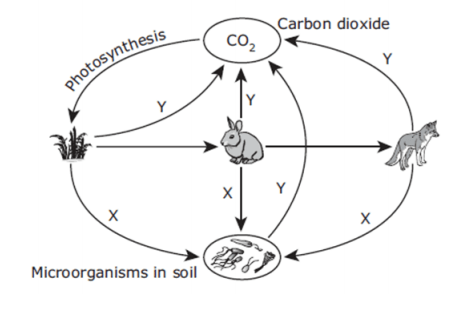
The diagram shows the flow of organic molecules through an ecosystem. What two processes are identified by the labels X and Y?
a)
X : Respiration
Y : Predation
b)
X : Adaptation
Y : Decomposition
c)
X : Fermentation
Y : Nitrogen Fixation
d)
X : Decomposition
Y : Respiration
135.
How animals get the nitrogen they need
a)
from the air they breathe
b)
from the water they drink
c)
from the food they eat
d)
from the Sun
136.
Organisms that play a role in the nitrogen cycle
a)
only plants
b)
only animals
c)
only bacteria
d)
plants, animals, & bacteria
137.
Bacteria fix nitrogen on plant roots. Plant roots provide sugar to bacteria. This is an example of
a)
mutualism
b)
parasitism
c)
commensalism
d)
competition
138.
Nitrogen rich fertilizers and manure can cause water pollution.
a)
True
b)
False
139.
How nitrogen is "fixed" into useable form for plants
a)
only through action of bacteria
b)
only through lightning
c)
through action of bacteria & lightning
d)
through photosynthesis
140.
Organism that breaks down dead plants & animals and releases nitrogen back into atmosphere
a)
bacteria
b)
plants
c)
animals
d)
producers
141.
How plants get the nitrogen they need
a)
from the air
b)
from the soil or water in which they live
c)
from the Sun
d)
from broken down rocks
142.
Where does cellular respiration occur?
a)
Nucleus
b)
Mitochondria
c)
Vacuole
d)
Chloroplast
143.
This is referred to as the energy currency of the cell
a)
ADP
b)
ATP
c)
Mitochondria
d)
Nucleus
144.
This means that oxygen is needed
a)
anaerobic 
b)
aerobic
145.
What is the correct equation for cellular respiration?
a)
6O2 + C6H12O6 -> 6CO2 + 6H2O + Energy
b)
6O2 + C6H12O6 + Energy -> 6CO2 + 6H2O
c)
6CO2 + 6H2O -> 6O2 + C6H12O6 + Energy
d)
6CO2 + 6H2O + Energy -> 6O2 + C6H12O6
146.
Anaerobic respiration.....
a)
doesn't require CO2
b)
requires CO2
c)
doesn't require oxygen
d)
requires oxygen
147.
What is one of the reactants of cellular respiration?
a)
energy
b)
glucose
c)
carbon dioxide
d)
water
148.
______________ produces the most ATP.
a)
photosnthesis
b)
aerobic respiration
c)
anaerobic respiration
d)
glycolysis
149.
 The expression "feel the burn" means that a person exercising is doing 
a)
lactic acid fermentation
b)
alcoholic fermentation
c)
photosynthesis
d)
aerobic respiration
150.
Where does anaerobic respiration occur?
a)
glucose molecule
b)
mitochondria
c)
cytoplasm