wayground logo

Free Printable Worksheets

Font size

S
M
L
XL
Worksheets

Biology Ch. 1-6:

Total questions: 148

Worksheet time: 7hrs 24mins

Name
Class
Date
1.
Which of the following is a scientific observation? 
a)
The potato is brown in color.
b)
The potato tastes the best.
c)
The potato may cause allergies.
d)
The potato smells funny. 
2.
What is another word for hypothesis?
a)
evidence
b)
graph
c)
investigation
d)
prediction
3.
A scientist is collecting data on the number of times a cricket chips per minute. What sense is the scientist most likely using to make observations?
a)
hearing
b)
smell
c)
sight
d)
touch
4.
Justin blows his nose, but mucus seems to leak through the tissue.  He decides to test which tissue holds up the best while sneezing.  What is the independent variable?
a)
sneezing
b)
Justin
c)
amount of tissue
d)
type of tissue
5.
Mr. McNeice wanted to know if different types of music affected people's heart rates, so he played different music and checked their pulses.  What is the dependent variable?
a)
type of music
b)
heart rate
c)
how long they listend to music
d)
Mr. McNeice
6.
Which question can best be investigated by a scientist?
a)
Should I buy a red shirt or a green shirt?
b)
Does chocolate milk or plain milk taste better?
c)
Does a plant need sunlight to grow?
d)
Which feels softer, cat fur or dog fur?
7.
The container is filled to the 350 mL mark with water. 
a)
observation
b)
inference
c)
problem
d)
hypothesis
8.
Why should an experiment be repeated?
a)
to form a hypothesis
b)
to reduce the chance of error
c)
to change controls
d)
to identify the problem
9.
This is the outcome of the experiment. We get data and results from this.
a)
Independent Variable
b)
Dependent Variable
c)
Control
d)
Constant
10.
How many independent variables should be tested at a time in a scientific investigation?
a)
none
b)
one
c)
two
d)
three
11.
Which is the dependent variable in Amelia's experiment?
a)
the number of bean plants in each group 
b)
the amount of water given daily to each plant 
c)
the height of each bean plant 
d)
the amount of fertilizer given to each group of bean plants
12.
To get data from systematic observations, you must:
a)
Create a model of what you are studying
b)
Collect animals to study and bring inside
c)
Design an entire experiment
d)
Use 5 senses or take pictures to study
13.
The variable that is changed on purpose is: 
a)
Control
b)
Dependent
c)
Independent
d)
Outcome
14.
How would you collect data about the stars?
a)
Make a bar graph
b)
Read about the stars
c)
Ask a friend what they think
d)
Draw what you see
15.
The variable in the experiment that is the outcome that you measure is called:
a)
Control
b)
Dependent
c)
Independent
d)
Hypothesis
16.
What is an inference? 
a)
Just a guess.
b)
A statement based off of your observations. 
c)
The same as an observation. 
d)
Examples of something. 
17.
Which statement is an observation?
a)
That house is empty because there are no lights on. 
b)
Her hair is brown. 
c)
Her hair is brown because she dyed it. 
d)
Her hair has not been cut in two years. 
18.
When experimenting with the growth of a plant, a scientist uses three plants, two different fertilizers, equal light, and equal water. What type of variable is the water?
a)
Dependent
b)
Independent
c)
Control
d)
Outcome
19.
In the paper airplane experiment, changing the size of the airplane would be which variable?
a)
Dependent
b)
Independent
c)
Control
d)
Conclusion
20.
Squidward found new reeds to tryout for his clarinet.  He used an APPLAUSOMETER to measure clapping/applause after playing  Under the Sea with each reed.  The results were put in the table.
What was the dependent variable?
a)
The Song
b)
The Reed
c)
The Applause
d)
The clarinet
21.

6 O2 + C6H12O6 ===> 6H2O + 6 CO2

What are the Reactants of this chemical reaction?

a)

6 Oxygen molecules

b)

Glucose

c)

6 Water molecules

d)

6 Carbon Dioxide molecules

22.

6 O2 + C6H12O6 ===> 6H2O + 6 CO2

What are the Products of this chemical reaction?

a)

6 Oxygen molecules

b)

Glucose

c)

6 Water molecules

d)

6 Carbon Dioxide molecules

23.

An attraction between a slightly positive hydrogen atom and a slightly negative atom

a)

hydrogen bond

b)

weak bond

c)

bond energy

d)

james bond

24.

Why does it take a lot of heat to raise water temperature?

a)

high heat capacity

b)

lower activation energy

c)

more active sites

d)

hydrogen bonds

25.

The elements or compounds that enter into a chemical reaction

a)

reactants

b)

solutions

c)

catalysts

d)

carbohydrates

26.

2 or more different atoms combined

a)

endothermic

b)

exothermic

c)

monosaccharide

d)

compound

27.

Amount of energy that needs to be absorbed for a chemical reaction to start.

a)

activation energy

b)

bond energy

c)

kinetic energy

d)

5 hour energy

28.

Decreases activation energy and increases the rate of a chemical reaction.

a)

catalyst

b)

compound

c)

ion

d)

solvent

29.

Which of the following is made of nucleotides?

a)

carbohydrate

b)

lipid

c)

protein

d)

nucleic acid

30.

Which of the following is made of amino acids?

a)

carbohydrate

b)

lipid

c)

protein

d)

nucleic acid

31.

Which of the following is made of simple sugars?

a)

carbohydrate

b)

lipid

c)

protein

d)

nucleic acid

32.

Which of the following are organic molecules?

a)

carbohydrate

b)

lipid

c)

protein

d)

nucleic acid

e)

sulfuric acid

33.

In salt water, what is the solution?

a)

salt

b)

water

c)

salt water

d)

carbon dioxide

34.

In salt water, what is the solute?

a)

salt

b)

water

c)

salt water

d)

carbon dioxide

35.

In salt water, what is the solvent?

a)

salt

b)

water

c)

salt water

d)

carbon dioxide

36.

A neutral substance like water has __________________

a)

A ph below 7

b)

A ph above 7

c)

A ph of 7

d)

A Ph.D

37.

A base has __________________

a)

A ph below 7

b)

A ph above 7

c)

A ph of 7

d)

A Ph.D

38.

An acid has __________________

a)

A ph below 7

b)

A ph above 7

c)

A ph of 7

d)

A Ph.D

39.

A covalent bond is formed by ______________

a)

sharing of electrons

b)

change in heat capacity

c)

lowering of activation energy

d)

amino acids

40.

An atom that loses or gains electrons

a)

neutron

b)

ion

c)

proton

d)

catalyst

41.

What part of the atom has neutral or no charge?

a)

proton

b)

neutron

c)

electron

d)

chevron

42.

What part of the atom has a negative charge?

a)

proton

b)

neutron

c)

electron

d)

chevron

43.

What part of the atom has a positive charge?

a)

proton

b)

neutron

c)

electron

d)

chevron

44.
An animal that hunts other animals for food is a ___________
a)
herbivore
b)
predator
c)
prey
d)
omnivore
45.
What is another name for producer?
a)
consumer
b)
herbivore
c)
autotroph
d)
lichen
46.
What does every food chain start with?
a)
producers
b)
sun
c)
consumer
d)
decomposers
47.
An organism that needs to eat other organisms to obtain energy is known as a:
a)
Autotroph
b)
Producer
c)
Consumer
d)
Mutualist
48.
Consumer that eats plants
a)
heterotroph
b)
herbivore
c)
producer
d)
community
49.
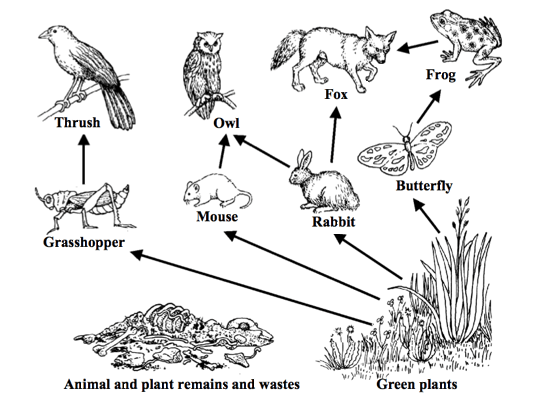
The rabbit in this food web would be considered a:
a)
Decomposer
b)
Producer
c)
Secondary Consumer
d)
Primary Consumer
50.
In this Food Web Pyramid Which type of consumer gets only 10% of the energy stored in plants?
a)
Herbivore
b)
Carnivore
c)
Omnivore
d)
Secondary Consumer
51.
What does a Secondary Consumer eat?
a)
Tertiary Consumers
b)
Primary Consumers
c)
Producers
d)
Secondary Consumers
52.
Energy increases as you move up the food pyramid (from bottom to top).
a)
True 
b)
False
53.
Which of the following is a herbivore?
a)
cricket
b)
frog
c)
hawk
d)
shrew
54.
How many carnivores are shown in this food web?
a)
6
b)
4
c)
5
d)
3
55.
Which of the following organisms in the food web is a producer?
a)
Giant Panda
b)
Snow Leopard
c)
Mushroom
d)
Bamboo
56.
Use the diagram to answer the question.
The Mayfly is a food source for which 3 organisms?
a)
Frog, Dragon Fly and snake
b)
Frog, trout and dragon fly
c)
Frog, salamander and trout
d)
Frog and phytoplankton
57.
What part of the food chain is missing?
a)
Producer
b)
Consumer
c)
Decomposer
d)
Heterotroph
58.
Which of the following organism provides energy for more than one organism in the food web?
a)
Mouse
b)
Hawk
c)
Snake
d)
Lizard
59.
Based on the food web, which shows correctly the one way that energy flows?
a)
Plant -->Rat -->Owl
b)
Plant <--Rat <-- Owl
60.
In this food web, which two organisms could be harmed if the mouse population were to decrease?
a)
Deer and caterpillar
b)
Wolf and snake
c)
Oak and grass
d)
Hawk and songbird
61.
What is this called?
a)
Food Web
b)
Food Chain
c)
Abiotic Factors
62.
What is this called?
a)
Food Web
b)
Food Chain
c)
Abiotic Factors
63.
Use the diagram answer the question.
What is a fitting description for this diagram?
a)
A Food Chain
b)
An Ecosystem
c)
A Food Web
d)
Biotic and Abiotic Factors
64.
In the food web shown, the smaller bird would be considered....
a)
primary consumer
b)
secondary consumer
c)
tertiary consumer
d)
producer
65.
In the food web shown, the snail would be considered...
a)
primary consumer
b)
secondary consumer
c)
tertiary consumer
d)
producer
66.
True or False. In this Food Web Pyramid Which type of consumer gets only 10% of the energy stored in plants?
a)
Herbivore
b)
Carnivore
c)
Omnivore
d)
Secondary Consumer
67.
In the energy pyramid here, which organisms have the most energy available?
a)
Producers
b)
Carnivores
c)
Herbivores
d)
Top Predator
68.
The diagram is intended to show relationships in an ecosystem. What do the arrows represent?
a)
The direction of population migration
b)
Differences in dietary habits
c)
Progressively smaller organisms
d)
The direction of the energy flow
69.
In this Food Web Pyramid what is the proper name for the organisms above the producer level at the bottom.
a)
herbivores
b)
decomposer
c)
carnivores 
d)
omnivores
70.
Which biome is hot all year with wet and dry seasons?
a)
tropical rainforest
b)
chaparral
c)
temperate grassland
d)
savanna
71.
Dropping leaves in the fall is a characteristic of what type of tree?
a)
deciduous
b)
evergreen
c)
conifer
d)
bonsai
72.
In which biome can you find permafrost?
a)
taiga
b)
tundra
c)
desert
d)
chaparral
73.
Which biome do we live in?
a)
temperate grassland
b)
temperate rainforest
c)
temperate deciduous forest
d)
chaparral
74.
In which biome is Georgia located?
a)
tropical rainforest
b)
temperate rainforest
c)
temperate deciduous forest
d)
alpine forest
75.
Which biome receives between 0 to 25 centimeters of rain per year, has a temperature range of 0 to 50 degrees Celsius, has poor soil, and is home to lizards, scorpions, and snakes?
a)
desert
b)
mountain
c)
taiga
d)
tundra
76.
Which biome receives between 0 and 25 centimeters of precipitation each year, has a temperature range from -27 to 5 degrees Celsius, has frozen soil, and is home to hares, caribou, and wolves?
a)
desert
b)
mountain
c)
savannah
d)
tundra
77.
This biome contains mostly spruce trees and Douglas firs, which are both evergreen.  The winters are long and cold and the summers are short and rainy.  The soil is very rich.  Moose and elk live here.  This biome is classified as a
a)
taiga
b)
tundra
c)
deciduous forest
d)
temperate forest
78.
Which biome, because of its climate, has the largest number of species of plants and animals?
a)
tundra
b)
desert
c)
rain forest
d)
pine forest
79.
Which biome is home to lions, zebras, wildebeests, giraffes, and elephants?
a)
Grasslands
b)
Tundra
c)
Rainforest
d)
Temperate Forest
80.
How do adaptations help animals?
a)
To hide from predators
b)
to hunt for food
c)
to survive in their habitats
d)
All of these are correct
81.
1. What is an adaptation?
a)
A feature or behavior that helps an animal survie.
b)
The food that an animal eats.
c)
How energy moves in a food web.
82.
An animal's color or pattern that helps it blend into its surroundings
a)
Environment 
b)
Mimicry
c)
Camouflage
83.
 Which of these BEST describes how some birds survive when the weather gets cold? 

     
a)
 a.   They store twigs and sticks in their nest 
b)
 b. They migrate to a warmer climate 
c)
 c. They grow more feathers to stay warm in the winter 
d)
 d. They hide in bushes and wait for warm weather 
84.
Lions often hide in the tall grass while stalking their prey.  This is an example of...
a)
camouflage
b)
warning coloration
c)
mimicry
d)
hibernation
85.
Giraffes have long necks. This allows them to eat from the tops of trees where other animals cannot reach. This is a result of...
a)
Natural Selection 
b)
Adaptation 
c)
Variation
86.
Does the shape of a bird's beak matter? 
a)
Yes
b)
No
87.
Beak shape depends on...
a)
where birds live 
b)
who they hang out with 
c)
diet (fish or seeds) 
d)
exercise 
88.
What is the scientific term for the ability to blend in with the surroundings?
a)
invisibility
b)
conservation
c)
ninja skills
d)
camouflage
89.
What does it mean to hibernate?
a)
To change your physical characteristics
b)
To sleep for an extended period of time during the winter
c)
To travel to a warmer location
d)
To blend in with the environment
90.
Which foot is best suited for a wet environment?
a)
Clawed foot with talon 
b)
Human-like foot
c)
Webbed foot
d)
Small clawed foot without a talon 
91.
I live in the tundra. What adaptation will not help me survive in this environment?
a)
hibernation
b)
ability to store food
c)
growing thick fur
d)
swinging from trees
92.
The items in the following picture would allow you to simulate bird beaks. What about this picture is true?
a)
The tools used aren't the same size as actual bird beaks. 
b)
The tools used allow you to see how bird beaks work. 
c)
The tools used aren't as detailed as an actual bird beak.
d)
All of the above 
93.
What do flowers use to attract animals for pollination?
a)
Texture
b)
The sound of flowers.
c)
Animals are not attract to flowers.
d)
Sizes, shapes, smells, or colors.
94.
The owl receives energy from which organisms?
a)
grasshopper and mouse
b)
mouse and rabbit
c)
rabbit and butterfly
d)
butterfly and frog
95.
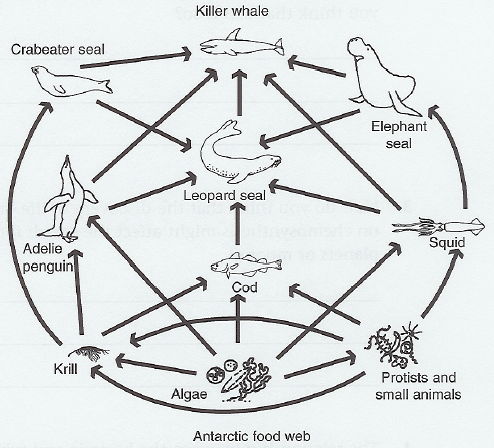
Which organism is the top predator in this food web?
a)
leopard seal
b)
killer whale
c)
elephant seal
d)
crabeater seal
96.
What might happen if you remove a primary consumer from the ecosystem?
a)
There would be more food for secondary consumers.
b)
The number of primary consumers would increase.
c)
The number of plants would increase.
d)
The number of secondary consumers would increase.
97.
What percentage of energy is passed on to each tropic level?
a)
10%
b)
50%
c)
90%
d)
100%
98.
Which is NOT an abiotic factor:
a)
soil
b)
air
c)
bacteria;
d)
water
99.
How do producers obtain energy?
a)
They conduct photosynthesis.
b)
They consume plants.
c)
They consume primary consumers.
d)
They consume secondary consumers.
100.
A consumer that hunts is called:
a)
a producer.
b)
an omnivore.
c)
a predator.
d)
a herbivore.
101.
Where do decomposers go in your food chain?
a)
at the beginning
b)
they don't belong in a food chain
c)
at the end
d)
at every level
102.
A food web can be broken down into several seperate
a)
food chains
b)
food pyramids
c)
producers
d)
consumers
103.
Which represents the largest group in a food web?
a)
carnivores
b)
omnivores
c)
herbivores
d)
producers
104.
What might occur when a carnivore is removed from the food web?
a)
A)  Nothing.  Organisms cannot impact things below them on the energy pyramid.
b)
B)  Primary consumers will overpopulate.
c)
C)  Plants will be over browsed by herbivores.
d)
D)  both B and C might occur.
105.
diagram that shows the energy available to each trophic level in an ecosystem; 10% is passed on to upper levels, the rest is lost as heat
a)
succession 
b)
cellular respiration
c)
energy pyramid
d)
biochemical cycle
106.
anything that an organism needs to live, ex. food, water, space
a)
carrying capacity
b)
resource
c)
succession
d)
denitrification 
107.
a relationship between two in which one species, the predator, feeds on the other species, the prey
a)
chemosynthesis
b)
predation
c)
cellular respiration 
d)
commensalism
108.
Non-living factor that affects an ecosystem
a)
biotic factor
b)
abiotic factor
c)
food chain 
d)
biome
109.
Consumer that eats plants
a)
heterotroph
b)
herbivore
c)
producer
d)
community
110.
Living factors or organisms that affect an ecosystem
a)
abiotic factors
b)
species
c)
trophic level
d)
biotic factors
111.
Series of steps in which organisms transfer energy by eating and being eaten
a)
foodweb
b)
consumer
c)
food chain
d)
omnivore
112.
Organisms that makes its own food using sunlight or chemicals; producer
a)
decomposer
b)
autotroph
c)
heterotroph
d)
herbivore
113.
This adaptation helps animals hide for either predators or prey. What is it?
a)
warning coloration
b)
camouflage
c)
instinct
d)
migration
114.
A bird's nest gets blown out of a tree during a strong storm.  How will the bird adapt?
a)
It will build a new nest.
b)
It will die.
c)
It will migrate.
d)
It will hibernate
115.
Which animal would hibernate to survive throughout the winter months?
a)
bear
b)
deer
c)
bird
d)
wolf
116.
Some animals move great distances as the seasons change.  What is this called?
a)
hibernation
b)
migration
c)
habitat
d)
coloration
117.
Which animal would migrate to survive throughout the winter months?
a)
bear
b)
deer
c)
bird
d)
wolf
118.
An animal's body covering helps it to survive.  Which group below is made up of body coverings?
a)
fur, teeth, feathers, skin
b)
bones, teeth, feet, eyes
c)
feathers, fur, skin, scales
d)
scales, fur, claws, skin
119.
Which example below is NOT an adaptation that helps a beaver survive?
a)
The beaver's webbed feet help it swim.
b)
The beaver's pointed teeth help it tear meat.
c)
The beaver's fur is oily which makes it waterproof.
d)
The beaver has flat teeth for ching bark and other plant material.
120.
1. What is an adaptation?
a)
A feature or behavior that helps an animal survive.
b)
The food that an animal eats.
c)
How energy moves in a food web.
d)
Classification of organisms based on traits.
121.
An example of a physical adaptation is...
a)
a turtle hiding inside its shell
b)
The spikes on a porcupine fish
c)
a rabbit burrowing underground
d)
a viper biting when threatened
122.
Which feature of a rose helps it grow without being eaten by large animals?
a)
flowers with bright colors
b)
sharp thorns
c)
small seeds
d)
deep roots
123.
A nice smell is an adaptation that __________________.
a)
helps the plant keep water inside the leaves.
b)
pokes animals that try to eat the plant.
c)
attracts pollinators to the plant.
d)
repels pollinators from the plant.
124.
Which feature would help a plant avoid being burnt by excessive sunlight in a desert environment?
a)
small leaves
b)
large seeds
c)
small roots
d)
smelly flowers
125.
Some trees shed their leaves in time for winter. Why is this adaptation useful?
a)
The trees save energy during the darker, colder months.
b)
The trees take in more sunlight through their branches.
c)
The trees attract animals to spread their seeds.
d)
The trees blend into their environment and hide.
126.
An organism that makes its own food is 
a)
an omnivore
b)
a heterotroph
c)
an autotroph
d)
a carnivore
127.
_________________is a signal to which a living thing responds.
a)
Stimulus
b)
Reaction
c)
Development
d)
Homeostasis
128.
Every organism must pass on its ________________, stored in DNA.
a)
metabolism
b)
response
c)
growth
d)
genetic code
129.
A reaction to a stimulus is a ______________.
a)
hiccup
b)
response
c)
metabolism
d)
homeostasis
130.
Type of reproduction that produces two genetically identical offspring from one parent is _________________.
a)
Sexual
b)
Asexual
c)
reproduction
d)
homeostasis
131.
______________________ is the scientific term for a living thing.
a)
organism
b)
cell
c)
photosynthesis
d)
DNA
132.
To maintain stable internal conditions is  __________________________________.
a)
growth
b)
adaptation
c)
homeostasis
d)
development
133.
The ability of an organism to create offspring is ___________________________________.  
a)
reproduction
b)
evolution
c)
development
d)
growth
134.
A/An ____________is the smallest unit of life.
a)
atom
b)
stimulus
c)
cell
d)
DNA
135.
The ability of a living thing to get bigger is known as _______________.
a)
Development
b)
Growth
c)
Adaptation
d)
Response
136.

The bond that holds the Oxygen and Hydrogen atoms together in a water molecule is a ________ bond.

a)

ionic

b)

Hydrogen

c)

Covalent

d)

Weak

137.

How many hydrogen atoms are in a water molecule?

a)

5

b)

1

c)

2

d)

0

138.
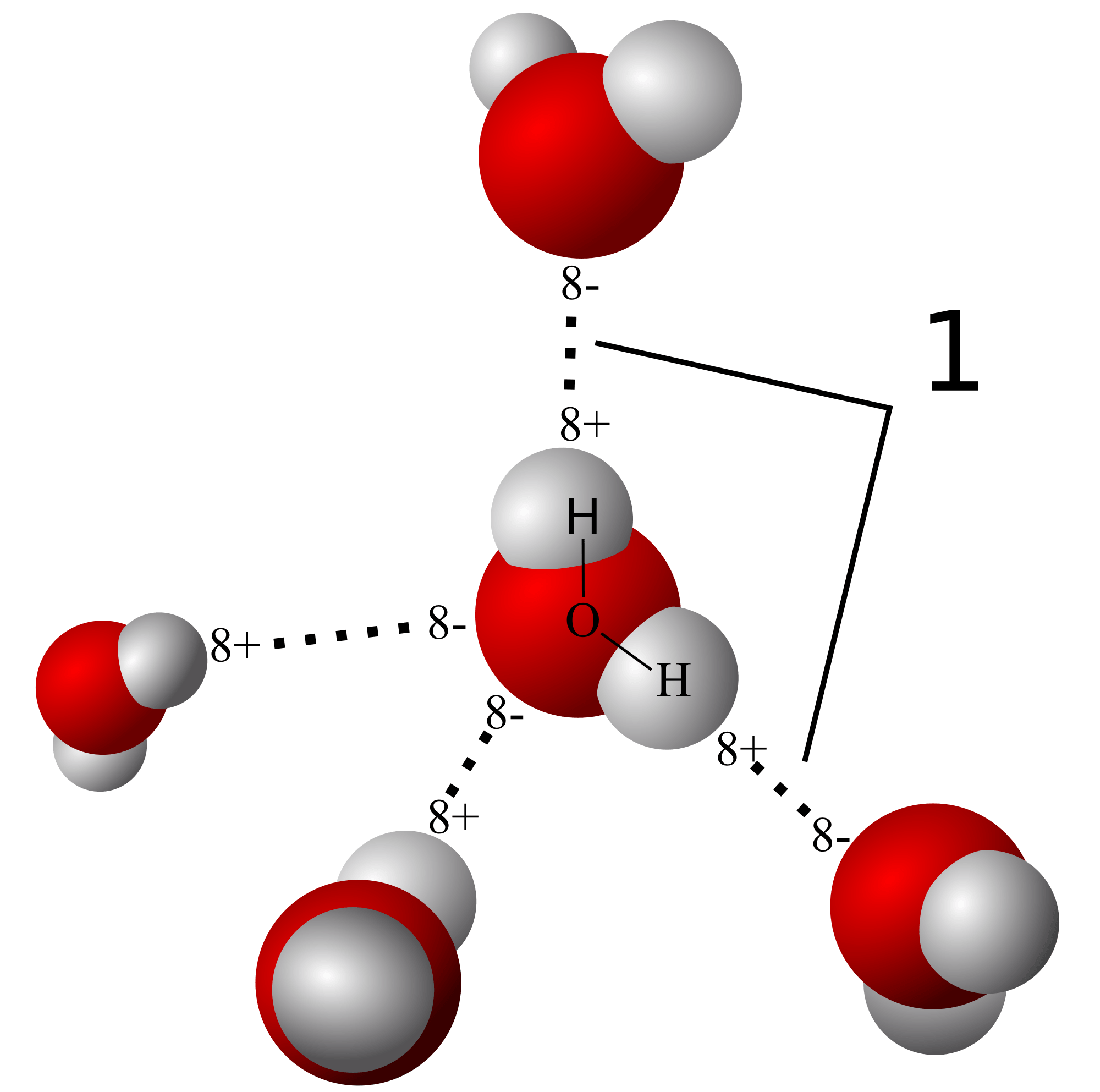
Water is polar because...
a)
The unequal sharing of electrons gives the water molecule a slight negative charge near its oxygen atom and a slight positive charge near its hydrogen atoms.
b)
The molecule has two poles, at which the it is colder than other regions of the molecule.
c)
The unequal sharing of electrons gives the water molecule a slight negative charge near its hydrogen atoms and a slight positive charge near its oxygen atom.
d)
The water molecule is neutral.
139.
Why does ice float?
a)
As water freezes, it expands and its density decreases.
b)
As water freezes, it takes up more hydrogen from the atmosphere, causing it to have a greater buoyancy.
c)
As water freezes, air becomes trapped between the hydrogen bonds of water molecules.
d)
As water freezes, it takes up more oxygen from the atmosphere, causing it to have a greater buoyancy.
140.
What property of water helps to moderate earth's temperature?
a)
adhesion
b)
chohesion
c)
Specific heat capacity
d)
Latent heat of vaporization
141.
Which is NOT a unique property of water?
a)
Frozen water floats on liquid water.
b)
Water covers most of the Earth’s surface and retains a large amount of heat.
c)
Water molecules stick to each other through hydrogen bonds.
d)
Water cools very rapidly.
142.
Attractions between water molecules are called
a)
Covalent bonds
b)
Ionic bonds
c)
Polar bonds
d)
Hydrogen bonds
143.
Why does water move from the roots to the leaves of plants?
a)
Water is pushed by solutes
b)
Capillary action pulls the water molecules like a chain
c)
Water is pulled by gravity
d)
Water’s cohesion causes it to “pull” towards the leaves
144.
What word describes when water is attracted to other substances?
a)
cohesion
b)
adhesion
c)
capillary action
d)
surface tension
145.
What two elements make up water?
a)
Helium and oxygen
b)
Hydrogen and oxygen
c)
helium and carbon
d)
oxygen and carbon
146.
Water striders can walk across the surface of calm water. Their feet push the surface of the water down slightly, but they do not break the surface. Why?
a)
The insects are light enough so they do not break the hydrogen bonds holding the water molecules together
b)
The insects actually use their wings to hover slightly above the water’s surface and they only skim it with their feet.
c)
The insect’s feet are non-polar, so they are repelled by the polar water molecules and are pushed away from the water’s surface.
d)
The insects are small enough to see the individual water molecules, so they are able to step carefully from one molecule to the next
147.
Large bodies of water do not quickly fluctuate in temperature. Why?
a)
Water is a solvent.
b)
Water has a high heat capacity.
c)
Water acts as a buffer.
d)
Water is non-polar.
148.
What property of water allows it to be such a versatile solvent that it is often called the "universal solvent?"
a)
Purity
b)
Polarity and cohesion
c)
High heat capacity
d)
Expansion upon freezing