
 Worksheets
Unit 3: Molecular Genetics Review
Total questions: 150
Worksheet time: 2hrs 1mins
There are three tenets of the Cell Theory. Which of the following is NOT a tenet?
Cells are the basic structure and function of life.
All living things are made of one or more cells.
The cell is the basic unit of matter.
All cells come from preexisting cells.
Which of the following statements is true?
Plants and animal cells have cell walls for protection.
Plant cells contain chlorophyll
Animal cells have one large vacuole; the plant cell has tiny ones.
Animal cells are box shaped; plant cells are circular
In meosis, the newlyformed cells are duplicates of the parent cells
True
False
An acronym for explaining the stages of cellular division is______.
PNAT
DPOT
PMAT
DSOT
In mitosis, the newly formed cells are all different from each other
True
False
Chromosomes are located in
Nucleus
Mitochondria
Stomata
Chomaarti
Phenotype are the ___________ characteristics
Gene
Physical Traits
Hungry
I dont know
Genotype may be defined as the ______________.
I dont know
Mutant Variation
Phenotype
Genetic material
The Punnett Square is used to
Find the White Flower
Calculate Probability
Punt
Square the results of the traits
Gregor Mendel used the paintbrush as a tool to provide ______________ for his experiment
spraypaint
danger
creativity
control

What is the order of the three phases in interphase?
G1, G2, S
S, G1, G2
G1, S, G2
G1, G2, G3


What are the two parts of the cell cycle?
Interphase and Mitosis
Interphase and Cytokinesis
Interphase and Meiosis
Mitosis and Meiosis
In what part of the Cell Cycle does the cell grow and replicate DNA?
Interphase
Mitosis
Meiosis
Cytokinesis
What is the order of the three phases in interphase?
G1, G2, S
S, G1, G2
G1, S, G2
G1, G2, G3
In which process are Gametes produced?
Mitosis
Meiosis
In which phase of the cell cycle does a cell spend the longest time?
Interphase
Mitosis

What phase of mitosis is shown in D?
Prophase
Telophase
Anaphase
Metaphase

What is happening during crossing over in Meiosis?
chromatids are replicating
chromatids are exchanging genetic information
chromatids are changing color
chromatids are being deleted
In what phase of Meiosis 1 is crossing over occurring?
Prophase
Anaphase
Metaphase
Telophase

Which stage of Mitosis is being shown and described:
Chromosomes line up in the middle.
interphase
prophase
metaphase
anaphase

Which stage of Mitosis is being shown and described:
Daughter cells are pinched apart and parent cell's cytoplasm is divided between the 2 new cells.
Cytokinesis
Metaphase
Anaphase
Telophase

Which stage of Mitosis is being shown and described:
The nucleus begins to disappear and chromosomes form.
Telophase
Anaphase
Prophase
Interphase

Which stage of Mitosis is being shown and described:
Chromosome pairs are split and tugged to opposite ends of the cell
Prophase
Metaphase
Anaphase
Telophase

What stage of Mitosis is being shown and described:
New nuclear membrane begins to form around each new nucleus and the cell is pinched.
Anaphase
Telophase
Metaphase
Cytokinesis

What stage of Meiosis is being shown and described:
The homologs of each chromosome pair separate and are pulled to opposite ends
Prophase 1
Metaphase 1
Anaphase 1
Telophase 1

What stage of Meiosis is being shown and described:
Copied pairs partner up, chromosomes condense and nuclear membrane disappears.
Prophase 1
Metaphase 1
Anaphase 1
Telophase 1

What stage of Meiosis is being shown and described:
The pairs line up in the center of the cell.
Prophase 1
Metaphase 1
Anaphase 1
Telophase 1

What stage of Meiosis is being shown and described:
Cell divides into 2 daughter cells. (2n...Diploid cells)
Prophase 1
Metaphase 1
Anaphase 1
Telophase 1

What stage of Meiosis is being shown and described:
Chromatids split forming individual chromosomes and are pulled to opposite ends of the cell.
Prophase 2
Metaphase 2
Anaphase 2
Telophase 2

What stage of Meiosis is being shown and described:
Both cells divide producing 4-1n cells (haploid) containing half the number of chromosomes
Prophase 2
Metaphase 2
Anaphase 2
Telophase 2


Bacteria reproduce asexually by a process called
replication
meiosis
mitosis
binary fission

Homozygous are the
same pair of genes
Cc
different pair of genes

Recessive genes are
strong genes
weak genes
BB

Heterozygous are
The same pair of genes
different pair of genes
bb

Wrinkle seeds are recessive over Round.
Which pair is a recessive gene?
RR
rr
Rr
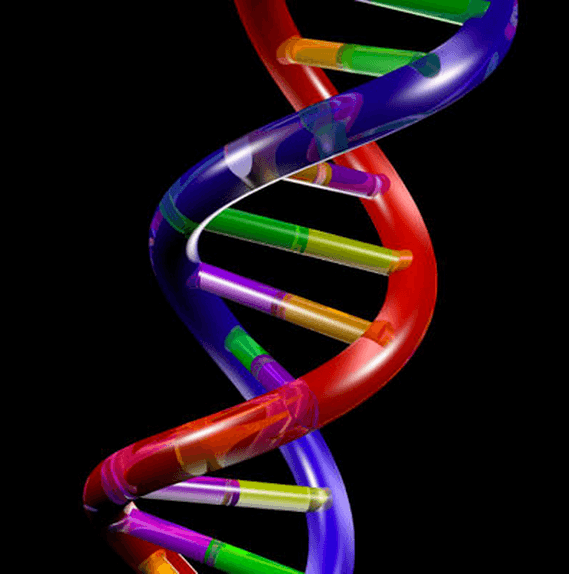
STRUCTURE: One difference between RNA and DNA is -
RNA has thymine where DNA has ademine
DNA is single stranded where RNA is double stranded
DNA is made in the nucleus where RNA is made in the ribosomes
RNA is single stranded where DNA is double stranded
STRUCTURE: What Nitrogenous Base does RNA contain that DNA does not?
Thymine
Uracil
Adenine
Love

STRUCTURE: In the DNA double helix, the bases (AtoT and CtoG) are held together by:
polar bonds
ionic bonds
covalent bonds
hydrogen bonds

TRANSLATION:
This is
tRNA
mRNA
DNA
a ribosome
HISTORY: Took the X-Ray crystallography photographs that revealed that DNA is a Double Helix
Rosalind Franklin
Linnus Pauling
Fredrick Griffeth
Martha Chase

TGGCAAGTACGT
ATG GGA ACT CCA
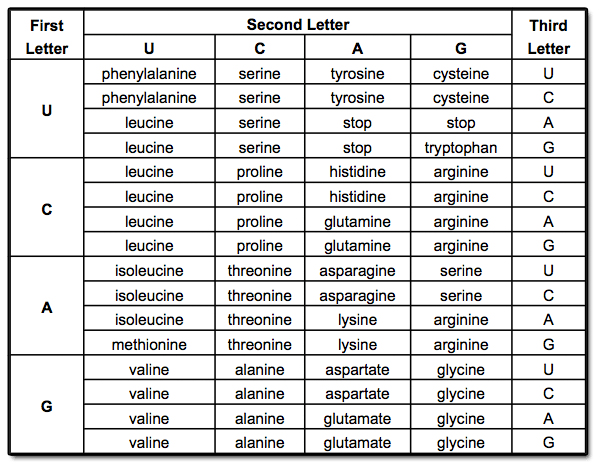
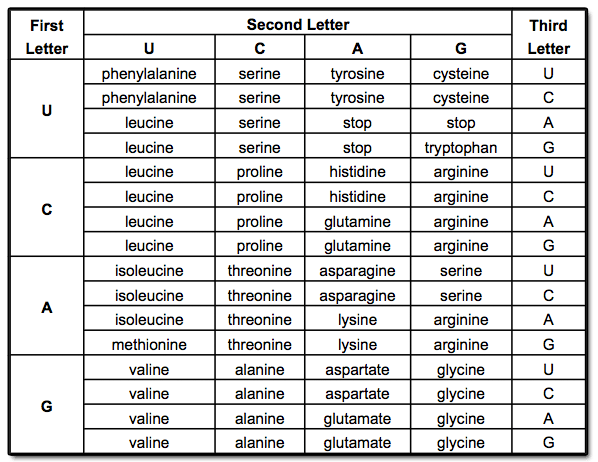
When using your codon chart, what sequence can you use to find the correct amino acid?
DNA
mRNA
tRNA
Any of these will do
What amino acid would the DNA TTT get you?
LYS
PHE
VAL
NONE
What amino acid does the mRNA AGG get?
SER
ARG
VAL
PRO
CCA
mRNA: CUCAAGUGCUUC

What is the correct order to make a protein?
Protein, DNA, RNA
RNA, DNA, Protein
DNA, RNA, Protein
Protein, RNA, DNA

STRUCTURE: One difference between RNA and DNA is -
RNA has thymine where DNA has ademine
DNA is single stranded where RNA is double stranded
DNA is made in the nucleus where RNA is made in the ribosomes
RNA is single stranded where DNA is double stranded
STRUCTURE: What Nitrogenous Base does RNA contain that DNA does not?
Thymine
Uracil
Adenine
Love
STRUCTURE: Which 2 molecules form the sides of the DNA ladder?
deoxyribose and adenine
deoxyribose and a hydrogen bond
sugar and the nucleus
deoxyribose (sugar) and phosphate
STRUCTURE: In the DNA double helix, the bases (AtoT and CtoG) are held together by:
polar bonds
ionic bonds
covalent bonds
hydrogen bonds
GENERAL: DNA is found in the:
cell membrane
vacuole
chloroplast
nucleus
HISTORY: Rosalind Franklin used x-ray crystallography to determine that the shape of the DNA molecule is:
a cloverleaf
a braided rope
a pleated sheet
a twisted ladder

STRUCTURE: Nucleotides monomers are made up of a sugar, a phosphate, and a:
nitrogenous base
nucleic acid
cholesterol
fatty acid
STRUCTURE: The five-carbon sugar found in DNA.
ribose
guanine
deoxyribose
helicase
GENERAL: What kind of organic molecule is DNA?
Protein
Nucleic Acid
Lipid
Carbohydrate
GENERAL: A nucleic acid that is composed of a phosphate, ribose sugar, and one of four nitrogen bases.
STP
ATP
DNA
RNA
PROCESSES: DNA making RNA is called:
Translation
Transcription
Transference
Translocation
PROCESSES: RNA making a protein is called:
Transmutation
Transferrance
Transcription
Translation
TRANSLATION: Smaller segments of clover leaf shaped RNA that transport amino acids:
Messenger RNA
Transfer RNA
Ribosomal RNA
Okazaki Fragments
TRANSLATION:
This is
tRNA
mRNA
DNA
a ribosome
TRANSCRIPTION: What is the mRNA complementary mRNA base sequence for: CAGTTCCAG
GUCAAGGUC
GTGAAGGTC
TRANSCRIPTION:
Transcription occurs in the:
nucleus
cytoplasm
ribosomes
kitchen
TRANSLATION:
Translation occurs in the:
office
cytoplasm
nucleus
cell membrane
HISTORY: Built the first correct model of DNA
Watson and Crick
Linnus Pauling
Rosalind Franklin
Hershey and Chase
HISTORY: Discovered Bacterial Transformation
Fredrick Griffeth
Erwin Chargaff
Rosalind Franklin
Martha Chase
HISTORY: Discovered that A and T bond together and C and G bond together...
Watson and Crick
Rosalind Franklin
Fredrick Griffeth
Erwin Chargaff
HISTORY: Performed an experiment with Bacteriophage viruses that proved DNA was the genetic material
Maurice Wilkens and Rosalind Franklin
James Watson and Francis Crick
Alfred Hershey and Martha Chase
Peanut butter and Jelly
HISTORY: Two time Nobel Prize winner who suggested a structure for DNA - but got it completely wrong...
James Watson
Francis Crick
Rosalind Franklin
Linnus Pauling
HISTORY: Took the X-Ray crystallography photographs that revealed that DNA is a Double Helix
Rosalind Franklin
Linnus Pauling
Fredrick Griffeth
Martha Chase
REPLICATION:
DNA replication is when:
DNA makes DNA
DNA makes RNA
RNA makes Protein
DNA makes Protein
REPLICATION:
DNA Replication is:
Is Semi-conservative
Is a double helix
Has no hydrogen Bonds
Makes a protein
A codon is a sequence of three nucleotides that code for an amino acid. If the DNA sequence shown here goes through transcription and translation, how many amino acids will result from this sequence?
ACTAGTGAT
5
4
2
3
Why do cells need both tRNA and mRNA?
Only tRNA bends into a shape that can carry specific amino acids.
Only mRNA can be used to repair mistakes in the DNA sequence.
The tRNA in used on the ribosomes and the mRNA is used in the nucleus.
The mRNA brings information to the nucleus for the tRNA to use.
A cell is replicating its DNA. Part of the DNA strand reads A-C-C-G-T-A-C. The new strand built off this section reads T-G-G-A-A-T-G. What effect might this have when the DNA replicates in the future?
Cells having the new DNA version will look or operate differently from cells with the original DNA.
Only the sections of DNA without mistakes will be used in the future so the DNA strand will shorten.
The DNA will be exactly like the original since only the original strand of DNA is used as a template.
When the new strand is used as a template the strand built from it will differ from the original DNA.

Which process is shown in the diagram
Mitosis
Meiosis
Transcription
Translation
Transcription must occur in order for proteins to be synthesized. What is the direct product of transcription?
tRNA
mRNA
RNA
DNA

Which type of molecule is the end product of the processes shown in the diagram?
DNA
RNA
Protein
Amino Acid
Where does Translation take place?
Nucleus
Mitochondria
Ribosome
Cytoplasm
A partial base sequence of a DNA molecule is shown below.
CAGCCATCA
What is the complementary base sequence of the DNA strand?
GTCGCATCA
GTCAACGGC
GTCGGCAGC
GTCGGTAGT
What 3 things make up DNA
Sugar, phosphate, base
Sugar, nitrogen, base
Sugar, base, acid
sugar, acid nitrogen
Which is NOT a difference between RNA and DNA?
RNA is single stranded while DNA is double stranded
RNA contains uracil while DNA contains Thymine
DNA uses deoxyribose sugar while RNA uses Ribose
All of these are corrent
The central dogma of molecular biology can be summed up by
DNA + RNA = Protein.
DNA to RNA to Protein.
RNA to DNA to Protein.
RNA + DNA = Protein.
Scientists who first determined that DNA is the genetic material were led by
Oswald Avery.
Erwin Chargaff.
James Watson.
Francis Crick.
The two polynucleotide chains of DNA are held together by bonds between
amino acids.
sugars and phosphates.
complementary bases.
adenine and uracil.
DNA replication results in
two DNA molecules that are identical to the original DNA molecule.
one mRNA molecule that is complementary to the DNA molecule.
one chain of amino acids that is complementary to the DNA molecule.
How does RNA differ from DNA?
RNA contains the sugar deoxyribose instead of ribose.
RNA contains the nitrogen base thymine instead of uracil.
RNA consists of one nucleotide chain instead of two.
The first step of transcription is
promotion.
elongation.
initiation.
splicing.
The genetic code is
unique in each species.
ambiguous.
uncommon.
redundant.
Translation involves all of the following types of molecules except
amino acids.
mRNA.
tRNA.
DNA.
A frameshift mutation is caused by an insertion or
deletion.
translocation.
inversion.
diversion.
Which of the following terms is most closely associated with a tRNA molecule?
codon
anticodon
transcription
ribosome
The molecule that copies the genetic instructions from DNA is
rRNA
mRNA
tRNA
The genetic code consists of ______ letter words.
one
two
three
four
The addition of nucleotides to a growing mRNA strand is called
splicing
frameshift
elongation
mutagen
Introns are removed from mRNA by the process of
splicing
frameshift
elongation
mutagen
What are the code “words” of the genetic code?
operator
anticodon
codon
RNA
Anything in the environment that causes a mutation is a(n)
splicing
frameshift
elongation
mutagen
What is the start codon which establishes the reading frame?
CCC
GGG
AUG
ACT
What mutation is a deletion or insertion of one or more nucleotides that changes the reading frame of the base sequence?
splicing
frameshift
elongation
mutagen
A disease caused by a mutation in one or a few genes is referred to as a(n)
genetic disorder
malfunction
inheritance
The region of an operon where regulatory proteins bind is the
operator
anticodon
codon
RNA
A type of RNA that "reads" the codons from messenger RNA
Stop Codon
GCCAUAGGC
Translation
Ribosomal RNA (rRNA)
a sequence of three nucleotide bases that represents the code for one amino acids
rRNA
DNA
Codon
Helicase
a type of RNA that transfers the code from DNA in the nucleus to the cytoplasm
Messenger RNA (mRNA)
Transcription
RNA
Ribose
Peptide Bond
the bond of bases C to G and A to T
the bond between each amino acid in a protein
the process of DNA
to be honest i dont know
the sequence of three nucleotides on transfer RNA that pairs with the codons of messenger RNA
Anticodons
Codons
Stop codon
Transfer RNA
Ribonucleic acid (RNA)
a single strand of chromoses
double helix structure
a single strand of nucleotides
all of the above
RNA polymerase
Translation
the enzyme responsible for creating RNA from a DNA template
Transcription
the process of never ending DNA
Stop Codon
a sequence of three nucleotide bases that indicate the end of protein synthesis.
A to T C to G
from DNA to RNA to Proteins
the bond between each amino acid in a protein
Transcription
copying of the DNA strand
the process occuring in the nucleus of a cell that copies the instructions from a part of DNA onto a strand of messenger RNA
the process occurring in the cytoplasm of a cell that builds proteins
code for a protein
Translation
a virus that spreads through the DNA and could harm the coding for the genes
the bond between an amino acid
the process occuring in the cytoplasm of a cell that builds proteins
the process occuring in the nucleus of a cell that copies the instructions from a part of DNA onto a strand of messenger RNA
Transfer RNA (tRNA)
a type of RNA that carries an amino acid and transfers it to the protein chain being assembled in the ribosome
Protein Synthesis to the Plasma Membrane
RNA that is transferred throughout cells and the DNA
RNA that is transferred from eukaryotic cells to prokaryotic
The monomers of DNA and RNA are
nucleic acids
fatty acids
nucleotides
monosaccharides
Which statement regarding DNA is false?
DNA molecules have a sugar-phosphate backbone
DNA contains the nitrogenous base uracil
One DNA molecule can include four different nucleotides in its structure
DNA contains the sugar deoxyribose
The shape of a DNA molecule is most like
beads on a string
a wooden ladder
a twisted rope ladder
a set of railroad tracks
Which enzyme catalyzes the elongation of a new DNA strand?
DNA ligase
reverse transcriptase
DNA polymerase
RNA polymerase
Which option best depicts the flow of information when a gene directs the synthesis of a cellular component?
DNA--> RNA--> protein
RNA--> DNA--> RNA--> protein
protein --> RNA --> DNA
DNA-->tRNA-->mRNA--> protein
Which enzyme catalyzes the elongation of a new DNA strand?
DNA ligase
reverse transcriptase
DNA polymerase
RNA polymerase
Any change in the nucleotide sequence of DNA is called a
mutation
base substitution
frameshift
silent
Anti-codons are found on which molecule?
mRNA
tRNA
rRNA
DNA
Codons are found on which molecule?
mRNA
tRNA
rRNA
DNA

