wayground logo

Free Printable Worksheets

Font size

S
M
L
XL
Worksheets

Final Exam 2018 Spring Semester Test Review Biology 1st-2nd

Total questions: 147

Worksheet time: 3hrs 30mins

Name
Class
Date
1.
Where the better adapted organisms survive to pass traits along to offspring.
a)
Evolution
b)
Natural Selection
c)
Extinction
d)
Artifical Selection
2.
What is the advantage of having different shaped beaks?
a)
To look different from other species.
b)
To be able to eat the food readily available in the environment.
c)
To protect itself against predators.
d)
To protect itself against prey.
3.
Why are advantageous traits more likely to be passed onto offspring?
a)
Because they are more likely to survive and reproduce.
b)
Because they come from dominant alleles.
c)
Because they come from recessive alleles.
d)
Because the trait is an acquired phenotype.
4.
Mutations are a change in what?
a)
DNA
b)
tRNA
c)
genotype
d)
phenotype
5.

What word describes a trait that helps an organism survive in its environment?

a)

natural selection

b)

mutation

c)

camouflage

d)

adaptation

6.
The differences among a species, like different bird beaks, are called
a)
genes.
b)
variations.
c)
traits.
d)
theories.
7.
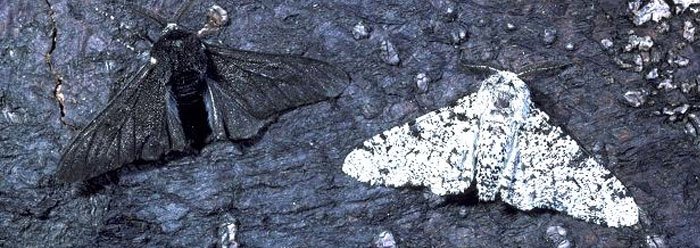
The trees these moths used to live on were white, but have been covered in soot from coal factories. Which moth will be more successful in this environment?
a)
Dark moth
b)
Light moth
c)
Both will be equally successful
d)
Neither will be successful
8.
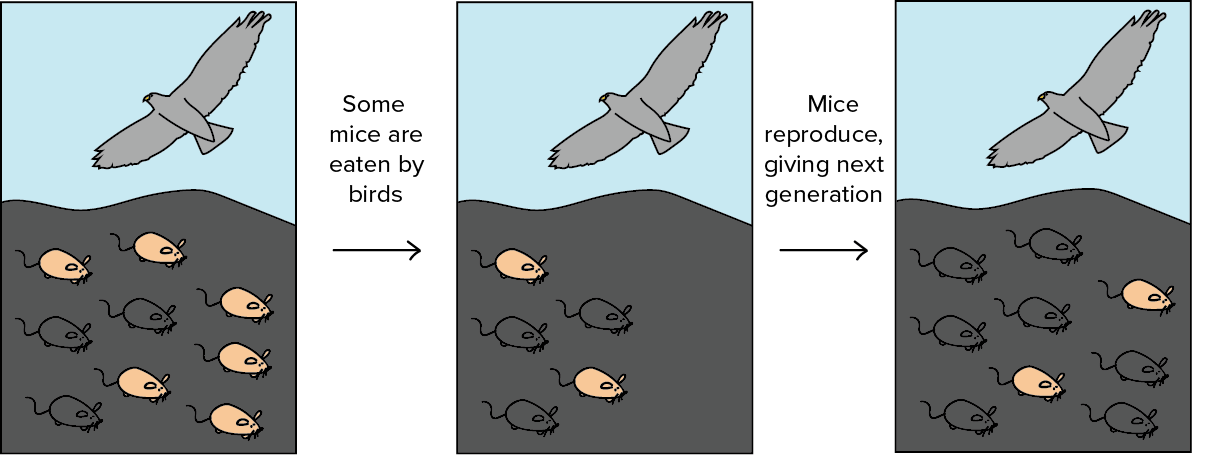
Why is the mouse population changing over time?
a)
The light mice can reproduce more successfully than the dark mice
b)
The hawks eat more dark mice than light mice because the dark mice taste better
c)
The hawks eat more light mice than dark mice because they can see the light mice more easily
d)
The hawks eat more dark mice than light mice because they can see the dark mice more easily
9.
Where do adaptations come from?
a)
The individual organism decides to adapt
b)
Mutations that give an organism an advantage in its environment
10.
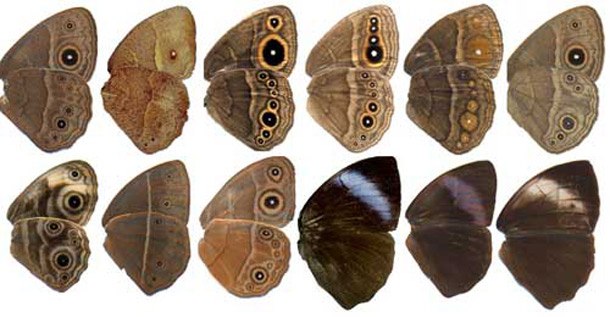
These moths are all the same species. The differences between their wings is an example of ________________
a)
Natural Selection
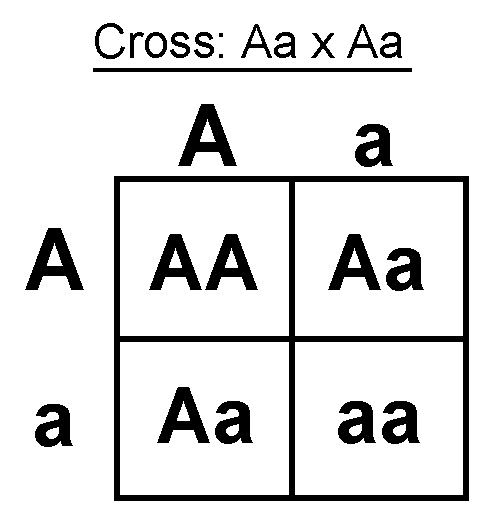
b)
Variation
c)
Homeostasis
d)
Extinction
11.
Organisms that are better adapted to the environment survive to pass traits to their offspring
a)
Natural Selection
b)
Homeostasis
c)
Selective Breeding
d)
Extinction
12.
All rabbits living in a particular area would be an example of a(n)
a)
population
b)
species
c)
fossil
d)
individual organism
13.
a bird that can easily outcompete other birds for food and that can produce many eggs has a high
a)
life expectancy
b)
mutation rate
c)
fitness
d)
adaptability
14.
a measure of how commonly a particular allele occurs in a population is known as the 
a)
gene pool
b)
allele frequency
c)
mutation rate
d)
phenotype
15.

The more genetic variation a population has,

the more likely it is for some individuals to

a)

evolve

b)

migrate

c)

survive

d)

mutate

16.
Change over time
a)
Natural Selection
b)
Selective Breeding
c)
Homeostasis
d)
Evolution
17.
What process is being shown in this image?
a)
Variation
b)
Natural Selection
c)
Selective Breeding
d)
Homeostasis
18.
Where do adaptations come from?
a)
The individual organism decides to adapt
b)
Mutations that give an organism an advantage in its environment
19.
These moths are all the same species. The differences between their wings is an example of ________________
a)
Natural Selection
b)
Variation
c)
Homeostasis
d)
Extinction
20.
Organisms that are better adapted to the environment survive to pass traits to their offspring
a)
Natural Selection
b)
Homeostasis
c)
Selective Breeding
d)
Extinction
21.
Any inherited trait that gives an organism an advantage in its environment is called a _________
a)
Mutation
b)
Adaptation
c)
Homeostasis
d)
Selection
22.
Which organism has an advantage in its environment?
a)
The fastest
b)
The strongest
c)
The best adapted
d)
The most tamed
23.
Which best describes the role of mutations in natural selection?
a)
Mutations help an organism to better survive in their environment
b)
An organism may acquire a helpful mutation by interacting with the environment
c)
A mutation may result in an adaptive trait that makes an organism more likely to survive and reproduce
d)
Organisms with certain traits are more likely to win competitions for mutations
24.
Domesticated dogs are an example of:
a)
Natural Selection
b)
Selective Breeding
25.
What type of selection is depicted in the picture? 
a)
stabilizing 
b)
directional 
c)
disruptive 
d)
the answer is not here
26.
Robins typically lay fours eggs. If more then four eggs are produced then the baby chicks are malnourished while smaller egg numbers result in no viable (able to live) baby chicks. This is an example of
a)
stabalizing
b)
disruptive
c)
direction
d)
none of the above
27.
What type of selection?
a)
Directional 
b)
Stabilizing
c)
Disruptive
28.
Only populations can evolve.
Individuals can not evolve.
a)
True
b)
False
29.
Which of the three graphs shows stabilizing selection?
a)
A
b)
B
c)
C
30.
Which of the three graphs shows disruptive selection?
a)
A
b)
B
c)
C
31.
If finches with large beaks and finches with small beaks increase in a population while finches with average sized beaks decreases, which pattern of natural selection has occurred?
a)
Directional selection
b)
Disruptive selection 
c)
Stabilizing selection
32.
What is the correct explanation for what is happening in this graph?
a)
There are a lot of average-sized beaks
b)
There are no beaks
c)
There are a lot of small beaks only
d)
There are a lot of small and large beaks, but not average-sized ones
33.
Bird wings and butterfly wings that have the same function but different structures and are not inherited from a common ancestor. 
a)
homologous structure
b)
analogous structure
c)
vestigial structure
d)
comparative biochemistry
34.
Modified structure derived from a common ancestor.
a)
homologous structure
b)
analogous structure
c)
vestigial structure
d)
comparative biochemistry
35.
A body structure that is no longer used for its original function but that might have been used in an ancestor.
a)
homologous structure
b)
analogous structure
c)
vestigial structure
d)
comparative biochemistry
36.
DNA and RNA comparisons that might indicated evolutionary relationships.
a)
homologous structure
b)
analogous structure
c)
vestigial structure
d)
comparative biochemistry
37.
A mutation is a random change in genetic material.
a)
true
b)
false
38.

Oldest rocks and ancestors would be deeper in the ground

a)

Speciation

b)

Homologies

c)

Recessive Traits

d)

Fossil Record

39.

Evolution occurring gradually and slowly over long periods of time

a)

Homeostasis

b)

Stasis

c)

Punctuated Equilibrium

d)

Gradualism

40.

Evolution occurring quickly due to catastrophic events

a)

Homeostasis

b)

Gradualism

c)

Statsis

d)

Punctuated Equilibrim

41.

Having a common ancestor

a)

Mitosis

b)

Punctuated Equilibrim

c)

Homology

d)

Radioactive Dating

42.

Various species show similar developmental patterns as embryos.

a)

DNA similarities

b)

Anatomical Homology

c)

Developmental Homology

d)

All of the above

43.

The idea that similar DNA or Amino Acid Sequences indicate common evolutionary ancestry

a)

Molecular Homology

b)

Anatomical Homology

c)

Developmental Homology

d)

all of the above

44.

The hypothesis that physical structures with no known purpose are leftovers from an ancestor.

a)

Homologous Structure

b)

Vestigial Structure

c)

Anatomical Analogy

d)

Developmental Homology

45.
Structures with the same parts have different functions; suggests that organisms share a common ancestry
a)
vestigial structures
b)
homologous structures
c)
adaptive radiation
d)
fossil
46.
If an organism has a vestigial structure, that structure likely once had a function in a(n)
a)
close relative
b)
early ancestor
c)
unrelated organism
d)
embryological stage
47.
Some organisms that share a common ancestor have features that have different functions, but similar structures.  These are known as
a)
vestigial structures
b)
analogous structures
c)
homologous structures
d)
fossil structures
48.
Study of embryos of various organisms to show a common ancestor because of similarities in development
a)
natural selection
b)
embryology
c)
speciation
d)
evolution
49.
Which of the following is an example of a vestigial structure?
a)
the wings of a red-tailed hawk
b)
the hind limbs of a house cat
c)
the fins of sharks
d)
the tailbone of a human
50.
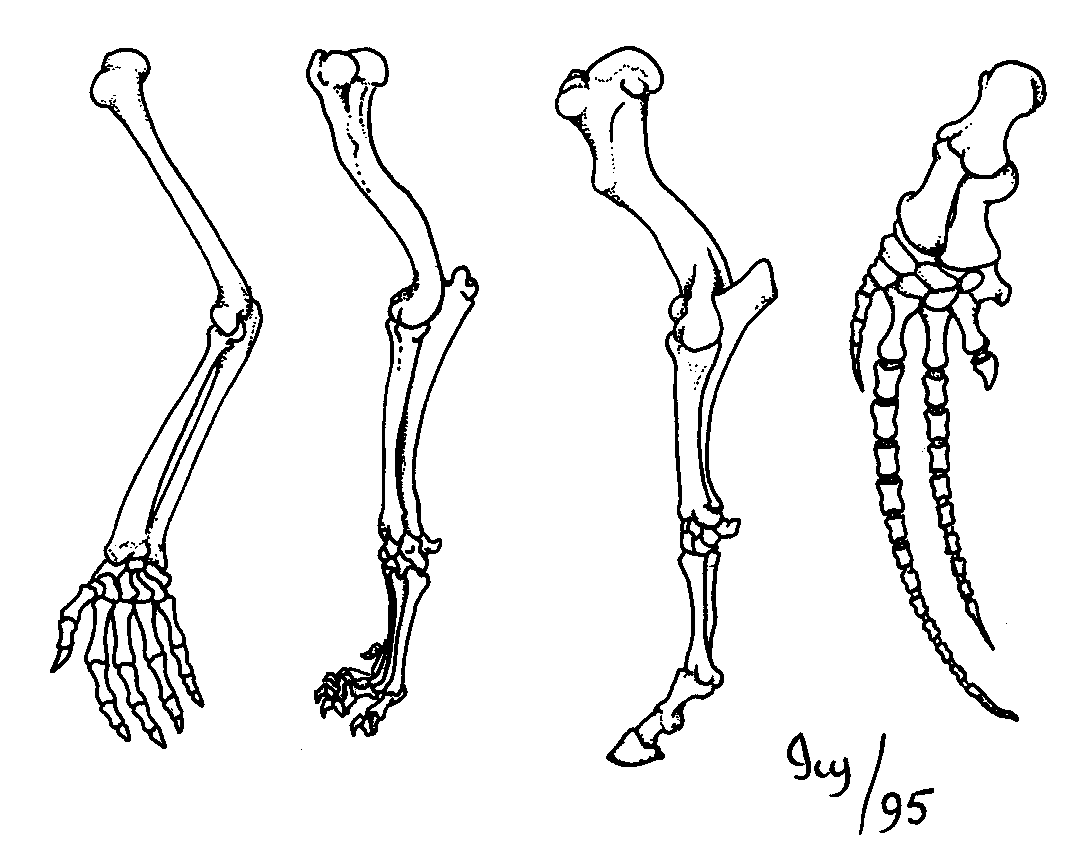
What type of structures are these?
a)
homologous
b)
vestigial 
c)
analogous
d)
fossil
51.
Structures that have the same function but different structures are...
a)
homologous structures
b)
analogous structures
c)
vestigial structures
d)
embryology 
52.
Two organisms that are closely related would have
a)
very similar DNA sequence
b)
exactly the same DNA sequences
c)
no proteins in common
d)
completely different DNA sequence
53.
If two organisms have similar traits of DNA they are probably
a)
share a common ancestor
b)
share a common environment
c)
share a common population
d)
speciation
54.
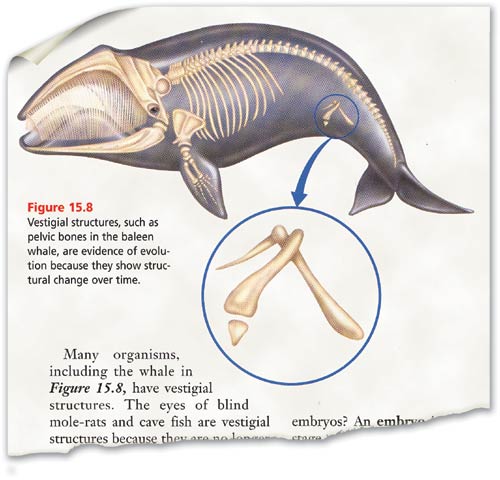
Whales are aquatic mammals that contain a pelvis bone.  Even though it does not aid in its movement, the function must have been used by a common ancestor of the whale.  Thus, the pelvis is referred to as a(n)
a)
vestigial structure
b)
analogous structure
c)
homologous structure
55.
If species A and B have very similar genes and proteins, what is probably TRUE?
a)
species A and B share a relatively recent common ancestor
b)
species A evolved independently of species B for a long period
c)
species A is younger than species B
d)
species A is older than species B
56.
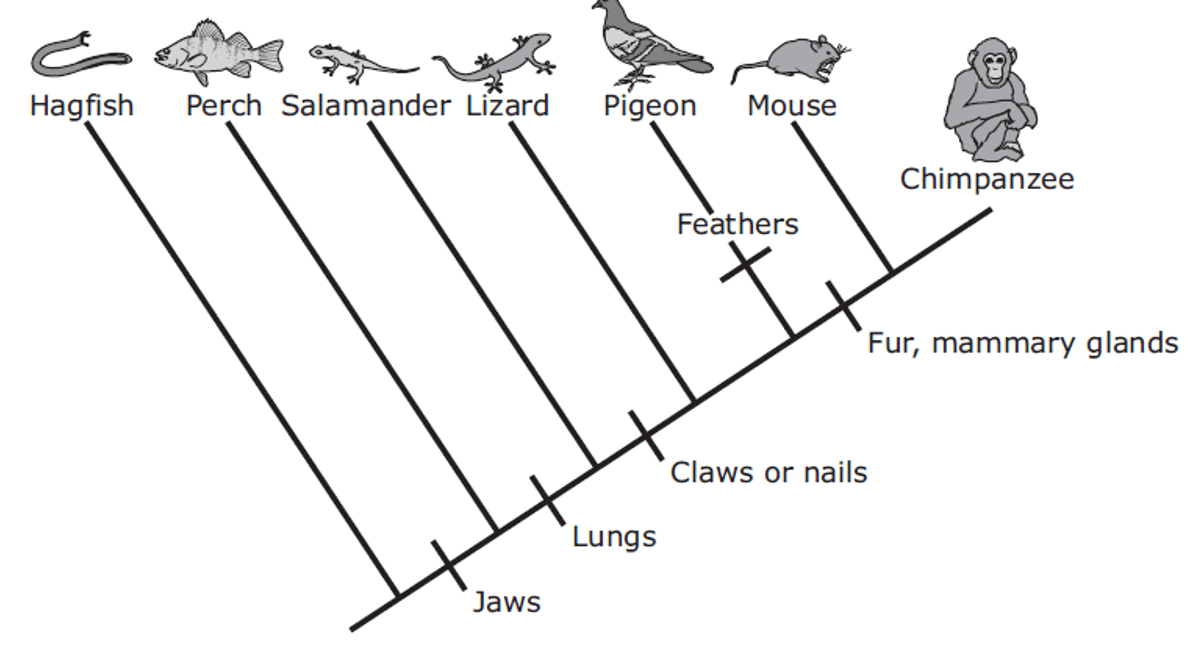
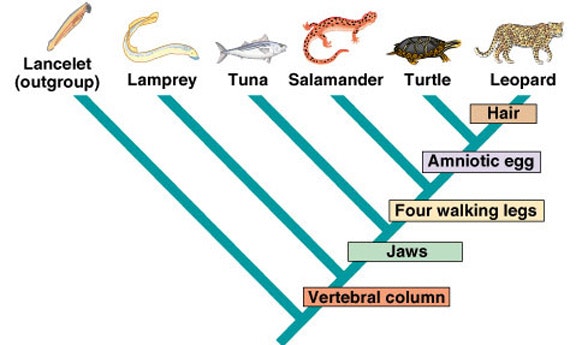
All the animals to the right of the hagfish would have the common characteristic of -
a)
Fur
b)
Claws or nails
c)
Lungs
d)
Jaws
57.
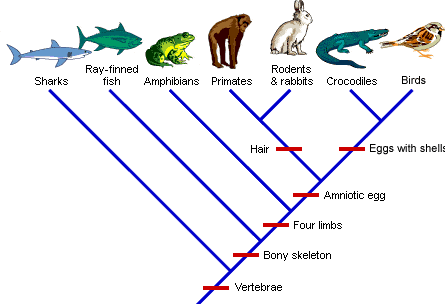
According to this cladogram, birds are LEAST related to -
a)
Amphibians
b)
Sharks
c)
Ray Finned Fish
d)
Crocodiles
58.
According to this cladogram, birds are LEAST related to -
a)
Amphibians
b)
Sharks
c)
Ray Finned Fish
d)
Crocodiles
59.
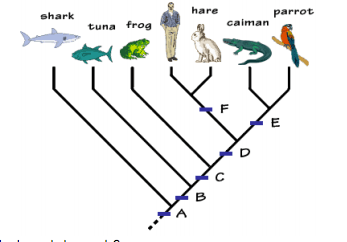
On the cladogram, which organism is the closest relative of the human?
a)
Frog
b)
Hare
c)
Caiman
d)
Parrot
60.
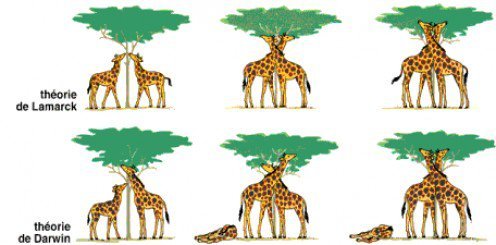
What would happen if the Giraffes never evolve?
a)
they would survive
b)
They would thrive
c)
They would become extinct
d)
They will find another source of food
61.

What trait separates lampreys from tuna on this cladogram?

a)

Hair

b)

Vertebral column

c)

amniotic egg

d)

jaws

62.

What separates a salamander from a turtle in this cladogram?

a)

four walking legs

b)

amniotic egg

c)

hair

d)

jaws

63.

Which organism is most related to the leopard?

a)

turtle

b)

salamander

c)

tuna

d)

lancelet

64.

What traits do the leopard and the turtle share? (Multiple choices)

a)

hair

b)

amniotic egg

c)

four walking legs

d)

jaws

65.

What trait separates amphibians from primates in this cladogram?

a)

amniotic egg

b)

four limbs

c)

egg with shells

d)

bony skeleton

66.

What separates rabbits and primates from crocodiles on this cladogram?

a)

eggs with shells

b)

amniotic egg

c)

four limbs

d)

vertebrae

67.

Which organism is most related to the crocodiles on this cladogram?

a)

birds

b)

rodents & rabbits

c)

primates

d)

amphibians

68.

Which traits do the birds and crocodiles NOT show?

a)

four limbs

b)

eggs with shells

c)

hair

d)

vertebrae

69.

Which organism will have DNA most similar to the birds?

a)

crocodiles

b)

primates

c)

rodents and rabbits

d)

amphibians

70.

What trait evolved first in this cladogram?

a)

vertebrae

b)

bony skeleton

c)

eggs with shells

d)

hair

71.

which two organisms share a most recent common ancestor in this cladogram?

a)

turtles and leopards

b)

lancelet and lamprey

c)

salamander and turtle

d)

lamprey and tuna

72.
According to this cladogram, sharks are MOST closely related to which organism? 
a)
Amphibians
b)
Ray finned fish
c)
Crocodiles
d)
Birds
73.
Individuals that are well adapted to their environment will survive and produce:
a)
Fewer mutations
b)
Stronger genes
c)
More offspring
d)
Better traits
74.
You look at two species and see very similar DNA. What does this likely tell you?
a)
These are the same animal.
b)
These animals have a common ancestor.
c)
These animals are not likely related.
d)
These animals are likely becoming one species.
75.
Natural selection
a)
process by which individuals that are better suited to their environment survive and reproduce most successfully; also called survival of the fittest
b)
Humans select which animals live and die
c)
both 
d)
IDK
76.
The scientific name for an organism is made from the:
a)
class and family name
b)
genus and species name
c)
domain and kingdom name
d)
kingdom and phylum name
77.
Term given to describe the 2 name naming system is:
a)
dichotmous key
b)
binomial nomenclature
c)
2 scientific names
d)
binomial key
78.
The 8 levels of classification, most broad to most specific.
a)
Domain, Genus, Family, Order, Class, Phylum, Kingdom, Species
b)
Domain, Species, Kingdom, Genus, Phylum, Family, Class, Order
c)
Domain, Kingdom, Phylum, Class, Order, Family, Genus, Species
d)
Order, Kingdom, Species, Domain, Phylum, Family, Class, Genus
79.
Which of the following organisms are MOST closely related?
a)
organisms that share a domain
b)
organisms that share a family 
c)
organisms that share a genus 
d)
organisms that share an order  
80.
Cladograms are constructed by grouping organisms together based on their____________ characteristics.
a)
shared
b)
different
c)
similar
d)
opposite
81.
Why is a spider spinning a web an innate behavior?
a)
It learns how to spin the web from its mother.
b)
It learns how to spin a web through insight learning.  
c)
It is born knowing how to spin a web.
d)
It learns how to spin a web through observational learning.
82.
Which of the following terms is another term for innate?
a)
instinct
b)
learned
c)
trial and error
d)
copying
83.
A mother is born knowing how to nurse her puppies. This is an example of which type of behavior?
a)
learned
b)
trial and error
c)
operant conditioning
d)
Innate
84.
Getting use to something after being exposed to it for a long period of time is an example of which type of learned behavior?
a)
insight learning
b)
playing
c)
habituation
d)
observational learning
85.
What behavior allows newborns to recognize and follow the first moving object they see?
a)
imprinting
b)
conditioning
c)
trial and error
d)
reflex
86.
A trainer using fish to reward a dolphin that jumps through a hoop is an example of
a)
imprinting
b)
conditioning
c)
trial and error
d)
insight
87.
A chick following a lawnmower because it was the first moving object it ever saw is an example of
a)
imprinting
b)
conditioning
c)
trial and error
d)
insight
88.
Michael went to the circus and saw a seal balance a beach ball on its nose.  This is an example of a...
a)
instinct
b)
mimicry
c)
camouflage
d)
learned behavior
89.

Which of the following is the best description of conditioning?

a)

A behavior in which newborn animals recognize and follow the first moving object they see

b)

A behavior in which an animal learns that a particular stimulus and its response to that stimulus will lead to a good result only.

c)

A behavior in which an animal learns that a particular stimulus and its response to that stimulus will lead to a bad result only.

d)

A behavior in which an animal learns that a particular stimulus and its response to that stimulus will lead to a good or bad result.

90.

Which of the following statements distinguishes an inherited behavior from a learned behavior

a)

A learned behavior passes from the parent to offspring and is with the animal from birth while an inherited behavior is the result of direction observations or experiences.

b)

An inherited behavior passes from the parent to offspring and is with the animal from birth while a learned behavior is the result of direct observation or experience.

c)

Both learned and inherited behaviors pass from the parent to the offspring.

d)

Both learned and inherited behaviors are the result of direct observation or experience.

91.
A type of behaviour animals are born with
a)
Instinctive Behavior 
b)
Learned Behavior 
92.
A type of behaviour that is shaped by an animal’s  experience.
a)
Instinctive Behavior 
b)
Learned Behavior 
93.
Ducklings follow their mother from birth
a)
learned behaviour
b)
instinct
c)
migration 
d)
hibernation 
94.
A chimpanzee using a stick to collect ants 
a)
learned behaviour
b)
instinct
c)
migration 
d)
hibernation 
95.
What behavior allows newborns to recognize and follow the first moving object they see?
a)
imprinting
b)
conditioning
c)
trial and error
d)
reflex
96.
Which best describes the role of mutations in natural selection?
a)
Mutations help an organism to better survive in their environment
b)
An organism may acquire a helpful mutation by interacting with the environment
c)
A mutation may result in an adaptive trait that makes an organism more likely to survive and reproduce
d)
Organisms with certain traits are more likely to win competitions for mutations
97.
Similarities in the structures of two different species provide evidence that the species evolved from a common ancestor.  This type of evidence includes similar structures that have different functions. Which of the following pairs of features have a similar structure but have a different function in each organism?
a)
a dolphin fin and a shark fin
b)
human fingernails and monkey fingernails
c)
the front leg of a cat and the wing of a bat   
d)
the wing of a bumble bee and the wing of
a bird
98.
Structures or attributes that have lost most or all of their function
a)
Vestigial Stuctures
b)
Homologous Stuctures
c)
Analogous Stuctures
d)
Mr. Robinson's Soul
99.

Select all of the correct statements about Analogous Structures

a)

They have the same function

b)

They Indicate an evolutionary relationship

c)

They have evolved independently

d)

They are adaptations to the same environment

100.

Select all of the correct statements about vestigial structures

a)

They are often diminished in size

b)

They were useful structures in an ancestral species

c)

They no longer provide a fitness advantage

d)

The human appendix is often considered vestigial

101.

Which are true about about the theory of punctuated equilibrium

a)

Evolution occurs quickly during times of environmental change

b)

Quick evolution followed by periods of almost no change

c)

You should find lots of intermediate fossilized species
102.
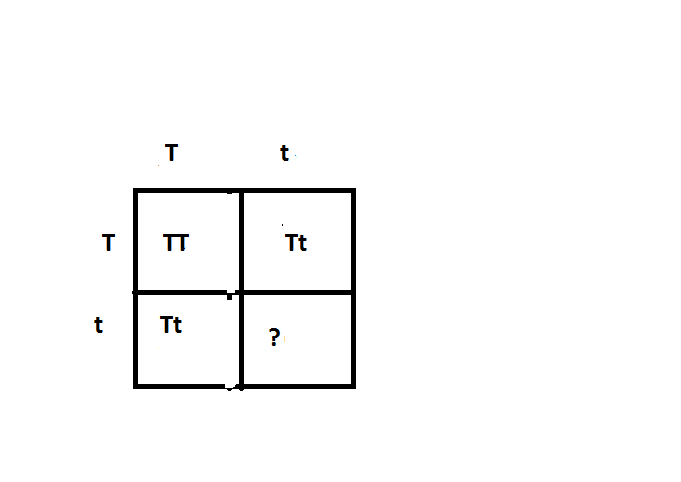
T - tall and t = short
In the punnett square below, what belongs in the missing square
a)
tt
b)
Tt
c)
Bb
d)
TT
103.
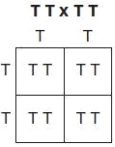
What ratio of the offspring from the cross shown will be homozygous recessive for the  trait of tallness? 
a)
0 in 4
b)
1 in 4
c)
2 in 4
d)
4 in 4
104.
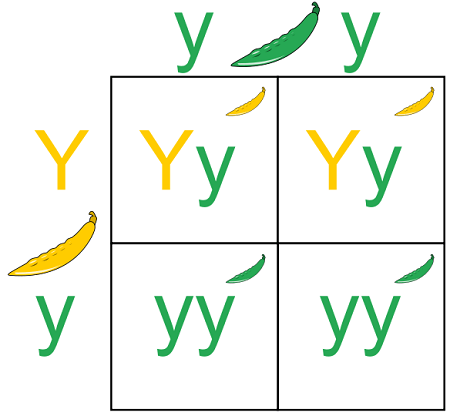
Which choice best represents the genotype of this cross?
a)
1 Yy: 2 yy: 0 YY
b)
2 Yy: 2 yy: 0 YY
c)
3 Yy: 1 yy: 0 YY
d)
1 Yy: 3 yy: 0 YY
105.
What is the phenotype of the offspring? (A-Brown hair; a-blond hair) 
a)
50 % Brown Hair and 50% Blond Hair 
b)
25 % Brown Hair and 75% Blond Hair 
c)
75 % Brown Hair and 25% Blond Hair 
d)
0% Brown Hair and 100% Blond Hair 
106.
What does a filled in square represent?
a)
Not affected Female
b)
Not affected Male
c)
Affected Male
d)
Affected Female
107.
What do half colored symbols represent?
a)
The individual is a carrier (heterozygous).
b)
The individual expresses the trait.
c)
The individual has both recessive alleles.
d)
The individual has both dominant alleles.
108.
Is this trait (the shaded individuals) dominant or recessive?
a)
dominant
b)
recessive
109.
What is the mode of inheritance shown here?
a)
 Recessive
b)
Sex Linked
c)
 Dominant
110.
In the second generation-how many people are carriers of the trait?
a)
2
b)
3
c)
5
d)
6
111.
What is the mode of inheritance shown here?
a)
Autosomal Dominant
b)
Autosomal Recessive
c)
Sex Linked Recessive
112.
What is the mode of inheritance shown here?
a)
Sex Linked
b)
Autosomal Dominant
c)
Autosomal Recessive
113.
What is the mode of inheritance shown here?
a)
Autosomal Recessive
b)
Autosomal Dominant
c)
Sex Linked
114.
What is the mode of inheritance shown here?
a)
Autosomal Dominant
b)
Autosomal Recessive
c)
Sex Linked
115.
The genotype of the affected son and daughter at the bottom of this pedigree...
a)
homozygous dominant
b)
homozygous recessive
c)
heterozygous
d)
Can't tell
116.
In DNA, Adenine bonds with ______________.
a)
Guanine
b)
Thymine
c)
Cytosine
d)
Adenine
117.
Which 2 molecules forms the sides (backbone) of the DNA ladder?
a)
deoxyribose and adenine
b)
deoxyribose and a hydrogen bond
c)
sugar and the nucleus
d)
deoxyribose (sugar) and phosphate
118.
What is responsible for holding the two strands of the DNA double helix together?
a)
hydrogen bonds
b)
alleles
c)
London dispersion forces
d)
deoxyribose sugars
119.
Which sequence of DNA bases would pair with this partial strand
ATG TGA CAG
a)
ATG TGA CAG
b)
TAC ACT GTC
c)
GTA AGT GAC
d)
CAT TCA CTG
120.
What are the 4 nitrogen bases?
a)
adenine, thymine, cytoplasm, and guanine
b)
adenine, thymine cytosine, and guanine
c)
adenine, thymine, cytosine, and gylcerol
d)
adenine, thymine, cytosine, and glucose
121.
Which organelle is DNA usually found in?
a)
cell membrane
b)
vacuole
c)
ribosome
d)
nucleus
122.
The image illustrates which process?
a)
Mitosis
b)
Meiosis
123.
Which of the following statements best explains the overall purpose of MEIOSIS?
a)
Asexual reproduction of somatic cells
b)
To produce gametes
124.
If a parent cell has 88 chromosomes, following MITOSIS, the daughter cells will have ___ chromosomes.
a)
42
b)
88
c)
Impossible to know
125.
Only mistakes during ____ can be passed to future generations.
a)
Mitosis
b)
Meiosis
c)
Both Mitosis and Meiosis
126.
Process that begins with diploid parent cell.
a)
Mitosis
b)
Meiosis
c)
Both Mitosis and Meiosis
127.
Process that produces two daughter cells.
a)
Mitosis
b)
Meiosis
c)
Both Mitosis and Meiosis
128.
Process that produces four daughter cells.
a)
Mitosis
b)
Meiosis
c)
Both Mitosis and Meiosis
129.
Process that produces somatic daughter cells.
a)
Mitosis
b)
Meiosis
c)
Both Mitosis and Meiosis
130.
Process that produces sex cells (gametes).
a)
Mitosis
b)
Meiosis
c)
Both Mitosis and Meiosis
131.
Process that includes two cell/nucleic divisions.
a)
Mitosis
b)
Meiosis
c)
Both Mitosis and Meiosis
132.
Process that includes one cell/nucleic divisions.
a)
Mitosis
b)
Meiosis
c)
Both Mitosis and Meiosis
133.
Interphase takes place only once prior to _________________.
a)
Mitosis
b)
Meiosis
c)
Both Mitosis and Meiosis
134.
Process used to produced new cells
a)
Mitosis
b)
Meiosis
c)
Both Mitosis and Meiosis
135.
Produces genetically identical daughter cells.
a)
Mitosis
b)
Meiosis
c)
Both Mitosis and Meiosis
136.
Produces genetically varied daughter cells.
a)
Mitosis
b)
Meiosis
c)
Both Mitosis and Meiosis
137.
DNA is replicated only once prior to _________.
a)
Mitosis
b)
Meiosis
c)
Both Mitosis and Meiosis
138.
Includes the pairing up and crossing over of homologous chromosomes.
a)
Mitosis
b)
Meiosis
c)
Both Mitosis and Meiosis
139.
Diploid --> Diploid
a)
Mitosis
b)
Meiosis
c)
Both Mitosis and Meiosis
140.
Diploid --> Haploid
a)
Mitosis
b)
Meiosis
c)
Both Mitosis and Meiosis
141.

What process does a multi-cellular organism use to replace its damaged body cells?

a)

Replication

b)

Meiosis

c)

Mitosis

d)

Transcription

142.

The image illustrate which process?

a)

Mitosis

b)

Meiosis

143.

Process that includes two cell/nucleic divsions

a)

Mitosis

b)

Meiosis

c)

Both Mitosis and Meiosis

144.

Process needed for growth and repair

a)

Mitosis

b)

Meiosis

145.

Human somatic cells contain _____ chromosomes, human haploid sex cells contain ____ chromosomes.

a)

46 --- 23

b)

23 --- 46

c)

46 --- 46

d)

23 ---- 23

146.

During MEIOSIS, the process that is responsible for increasing genetic variation is called ____________. It happens during which phase?

a)

Crossing Over, metaphase

b)

Fertilization, prophase 2

c)

Crossing Over, Prophase 1

d)

Crossing Over, Prophase 2

147.

What process, and which type of resulting cells are represented?

a)

mitosis, gametes

b)

mitosis, body cells

c)

meiosis, body cells

d)

meiosis, gamete cells