wayground logo

Free Printable Worksheets

Font size

S
M
L
XL
Worksheets

CLASSIFICATION UNIT TEST REVIEW

Total questions: 151

Worksheet time: 7hrs 25mins

Name
Class
Date
1.

What is binomial nomenclature?

a)

system of 3 names

b)

system of 2 names

c)

the names of the kingdoms

d)

the levels of classification

2.

Who created the 2 name system?

a)

Linnaeus

b)

Edison

c)

Darwin

d)

Einstein

3.

The 3 domains are Eukarya, Archaea, and

a)

Fungi

b)

Plantae

c)

Animalia

d)

Bacteria

4.

What two levels make up a scientific name?

a)

genus and order

b)

genus and species

c)

domain and kingdom

d)

family and genus

5.

What level comes after order?

a)

genus

b)

kingdom

c)

family

d)

species

6.

What level comes before class?

a)

phylum

b)

domain

c)

order

d)

family

7.

The _________ levels that 2 organisms share, the more similar they are to each other.

a)

fewer

b)

more

8.

What is the study of classification?

a)

taxonomy

b)

biology

c)

botany

d)

microbiology

9.

What is the correct order of classification?family

a)

kingdom, domain, phylum, class, order, family, genus, species

b)

domain, kingdom, phylum, class, order, family, genus, species

c)

domain, phylum, class, order, kingdom, family, genus, species

d)

species, genus, family, phylum, order, class, domain, kingdom

10.

What is the proper way to write a scientific name?

a)

Symbion pandora

b)

Symbion Pandora

c)

symbion Pandora

d)

symbion pandora

11.
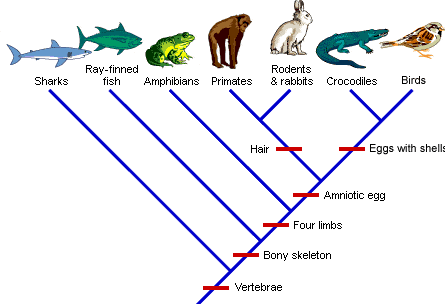
According to this cladogram, primates are most closely related to -
a)
Amphibians
b)
Rodents and rabbits
c)
Crocodiles
d)
Birds
12.
According to this cladogram, birds are LEAST related to -
a)
Amphibians
b)
Sharks
c)
Ray Finned Fish
d)
Crocodiles
13.
Which trait do only humans have, according to the cladogram?
a)
jaws
b)
mammary glands & hair
c)
terrestrial during all life stages
d)
opposable thumbs
14.
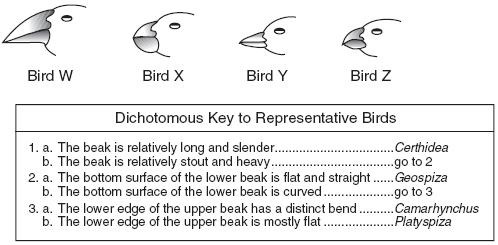
What genus does Bird Z belong to?
a)
Certhidea
b)
Geospiza
c)
Camarhynchus
d)
Platyspiza
15.
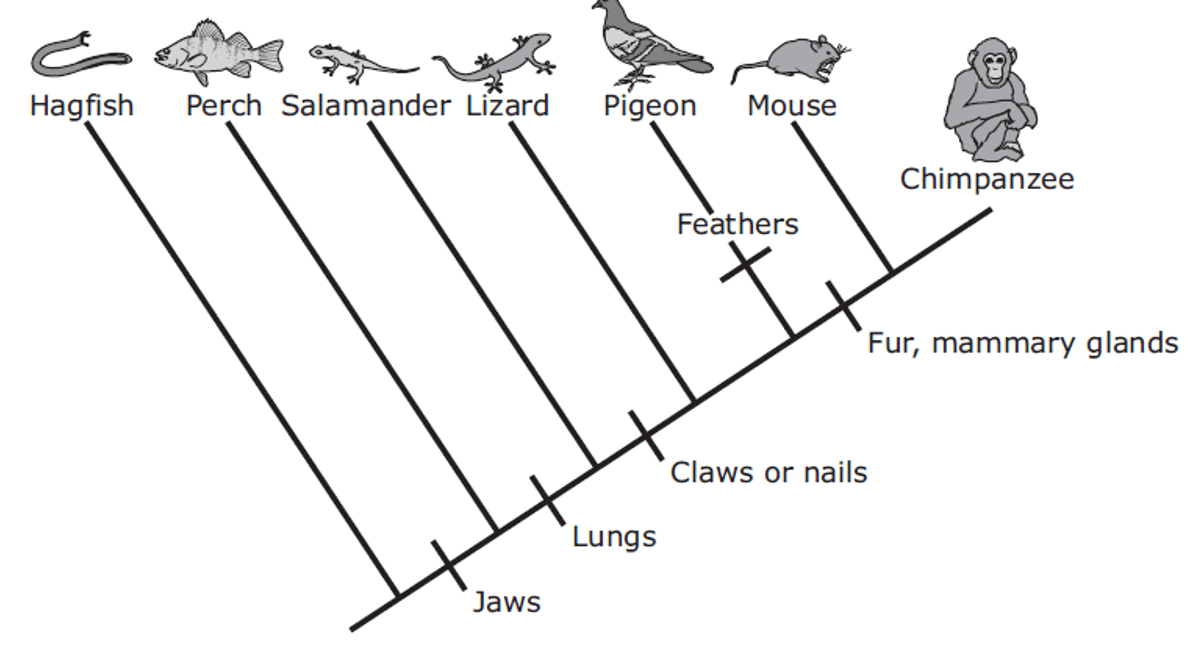
All the animals to the right of the hagfish would have the common characteristic of -
a)
Fur
b)
Claws or nails
c)
Lungs
d)
Jaws
16.

According to this diagram, is the pig more closely related to the dog or kangaroo?

(a)  

17.

What is the closest relative of humans shown in this diagram?

a)

horse

b)

turtle

c)

monkey

d)

dog

18.

What organism on this diagram would have DNA most similar to the penguin?

(a)  

19.

Are humans related to tuna?

a)

yes

b)

no

20.

Which species are extinct? (Check all that apply.)

a)

A

b)

D

c)

E

d)

H

e)

J

21.

Which species is a common ancestor for species B and D?

a)

C

b)

F

c)

G

d)

H

e)

K

22.

Which species are extinct? (Check all that apply)

a)

Asian elephant

b)

Mammoth

c)

Mastadon

d)

Stellar's sea cow

e)

Dugong

23.

What is this a picture of?

a)

Pedigree

b)

Cladogram

c)

Family Tree

d)

Oak Tree

24.

What distinguishes zebras from from giraffes?

a)

un-branching horns (in males)

b)

even number of toes

c)

fur

d)

carnivorous teeth

25.
Tool used by a taxonomist to identify an unknown organism is a:
a)
dichotomous key
b)
binomial nmenclature
c)
scientific name
d)
binomial key
26.
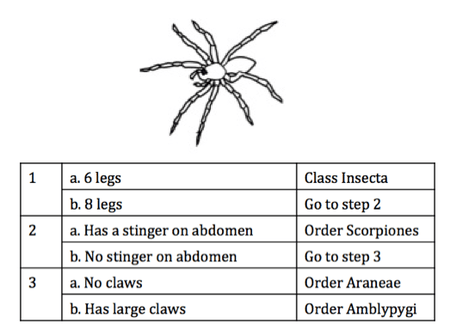
An illustration and a dichotomous key are given. What is the correct classification for this organism?
a)
Class Insecta
b)
Order Amblygygi
c)
Order Araneae
d)
Order Scorpiones
27.
A table of arachnid and insect characteristics is shown. Which characteristic could be used to distinguish between
arachnids and insects?
a)
Jointed legs
b)
Body segments
c)
Presence of eyes
d)
Presence of antennae
28.
When using a dichotomous key to identify organisms, what do we look at?
a)
physical features
b)
weather patterns
c)
environment
d)
diet
29.
What step do we always start with when using dichotomous keys?
a)
1
b)
2
c)
3
d)
4
30.
What is the name of bird Z?
a)
Certhidea
b)
Geospiza
c)
Camarhynchus
d)
Platyspiza
31.
The 8 levels of classification, most broad to most specific.
a)
Domain, Genus, Family, Order, Class, Phylum, Kingdom, Species
b)
Domain, Species, Kingdom, Genus, Phylum, Family, Class, Order
c)
Domain, Kingdom, Phylum, Class, Order, Family, Genus, Species
d)
Order, Kingdom, Species, Domain, Phylum, Family, Class, Genus
32.
What is the scientific name of housefly?
a)
Musca domestica
b)
Insect domestica
c)
Animalia domestica
d)
Diptera domestica
33.
From the table, which two animals are MOST CLOSELY related
a)
House Cate and Red Fox
b)
Red Fox and Dog
c)
Dog and Wolf
d)
Wolf and Gopher
34.
Using this dichotomous key, identify the name of the circled Fish, J.
a)
peacock flounder
b)
band-tail puffer
c)
trumpet fish
d)
spotted goat fish
35.

Which of the following is the correct way to show the scientific name for tiger?

a)

Panthera Tigris

b)

Panthera tigris

c)

panthera Tigris

d)

panthera tigris

36.

What is the genus name here:

Canis lupus

a)

Canis

b)

lupus

37.

How many options should every branch in a dichotomous key have?

a)

1

b)

2

c)

3

d)

4

38.

Why do scientists use dichotomous keys?

a)

To arrange organisms based on habitat

b)

To determine evolutionary history

c)

To identify different organisms

d)

To analyse feeding habits

39.

If you were to make a dichotomous key to identify this organism, which option would NOT be used?

a)

Presence of webbed feet

b)

Presence of tail

c)

Fur on the body

d)

Ability to swim

e)

Absence of wings

40.

Which of the following organisms is M. erminea?

a)

A

b)

B

c)

C

d)

D

e)

E

41.
What are the three domains?
a)
Archaea, Bacteria, and Eubacteria
b)
Archaea, Protists, and Eubacteria
c)
Archaea, Bacteria, and Eukarya
d)
Archaea, Fungi, Animalia
42.
What are the three domains?
a)
Archaea, Bacteria, and Eubacteria
b)
Archaea, Protists, and Eubacteria
c)
Archaea, Bacteria, and Eukarya
d)
Archaea, Fungi, Animalia
43.
How many kingdoms are there?
a)
3
b)
4
c)
6
d)
9
44.
Cells that have a nucleus are called....
a)
eukaryotes
b)
prokaryotes
c)
unicellular
d)
multicellular
45.

Autotrophs

a)

Make their own food

b)

Get their food from others

c)

are Fungi

d)

are none of the above

46.

Heterotrophs

a)

make their own food

b)

get their food from others

c)

are fungi

d)

none of the above

47.
What is the difference between unicellular and multicellular?
a)
They are the same
b)
One has a nucleus and one doesn't
c)
Unicellular has one cell and multicellular has many 
d)
One is bacteria and the is archaebacteria
48.
The broadest or most general taxonomic classification of living organisms is organized by -- 
a)
Kingdom
b)
Domain
c)
Species
d)
Organisms
49.
Which of the following is NOT a domain?
a)
bacteria
b)
archaea
c)
eukarya
d)
prokarya
50.
Which is TRUE about the members of the domain Bacteria?
a)
They are multicellular.
b)
They are prokaryotes.
c)
They are only heterotrophic.
d)
The cell walls always contain peptidoglycans.
51.
Which is TRUE about members of the domain Eukarya?
a)
They have a nucleus
b)
They are only multicellular
c)
They are only heterotrophs
d)
They all have cell walls and chloroplasts
52.
The domain Eukarya has 4 kingdoms, protista, fungi, plantae and ________.
a)
Animalia
b)
Mammalia
c)
Crustacea
d)
Amphibia
53.

Bacteria and archaea are similar because both _________________.

a)

are eukaryotes

b)

are prokaryotes

c)

have the same kind of cell wall

d)

store their DNA in a nucleus

54.

I have many organisms that cause diseases. What Domain am I in?

a)

Bacteria

b)

Archaebacteria

c)

Fungi

d)

Eukarya

55.

MUSHROOMS ARE IN WHAT KINGDOM

a)

PLANT

b)

ANIMAL

c)

FUNGI

d)

PROTIST

56.

AMOEBA-PARAMECIUM-EUGLENA-DINOFLAGELLATES BELONG TO WHAT KINGDOM

a)

PLANT

b)

PROTIST

c)

FUNGI

d)

ANIMAL

e)

ARCHAEBACTERIA

57.

APES BELONG TO WHAT KINGDOM

a)

PLANT

b)

ANIMAL

c)

FUNGI

d)

PROTIST

58.

Mutlicellular decomposers are in which kingdom

a)

Fungi

b)

Protist

c)

Plantae

d)

Animalia

59.

Which Kingdom has organisms that help humans digest their food?

a)

Protist

b)

Archaebacteria

c)

Eubacteria

d)

Fungi

60.

I have no nucleus and live in very hot liquids. Which Kingdom am I in?

a)

Fungi

b)

Protist

c)

Eubacteria

d)

Archaebacteria

61.
I am unicellular
I am prokaryotic
I am found in extreme ecosystems
What kingdom do I belong to?
a)
The Candy Kingdom
b)
Kingdom Plantae
c)
Kingdom Animalia
d)
Kingdom Archaebacteria
62.
I have cell walls
I am an autotroph
I am multicellular
What am I?
a)
Plant
b)
Animal
c)
Eubacteria
d)
Unicorn
63.
Kingdom Animalia is
a)
Eukayotic
b)
Prokaryotic
c)
Pick me!
d)
No, Pick me!!
64.
Which kingdom is prokaryotic?
a)
Animalia
b)
Archaebacteria
c)
Planta
d)
Fungi
65.
In what kingdom would you find trees and flowers?
a)
Plantae
b)
Fungi
c)
Eubacteria
d)
Animalia
66.
What levels of classification are used in the scientific name?
a)
Kingdom + Phylum
b)
Kingdom + Species
c)
Genus + Species
d)
Phylum + Genus
67.
Smallest taxonomic group with only one kind of organism
a)
domain
b)
kingdom
c)
species
d)
class
68.
What do protists, plants, fungi, and animals ALWAYS have in common? They are all...
a)
Multicellular
b)
Eukaryotic
c)
Prokaryotic
d)
Consumers
69.
A wolf's scientific name is Canis rufus. Which genus does it belong to?
a)
Canis
b)
rufus
c)
wolf
d)
animal
70.
What kingdoms are PROKARYOTIC?
a)
plant and animal
b)
protist and fungus
c)
archaebacteria and eubacteria
d)
archaebacteria and protist
71.

What kingdom has the most diversity?

a)

Protist

b)

Plant

c)

Animal

d)

Fungus

72.

What kingdom: ALL eukaryotic, ALL multicellular, ALL autotrophic?

a)

Plant

b)

Animal

c)

Eubacteria

d)

Fungus

73.

what kingdom?- eukaryotic, multi-celled-photosynthetic.

a)

animal

b)

plant

c)

protist

d)

fungi

74.

What kingdom-Prokaryotic-lives in hot,salts environments

a)

plants

b)

animals

c)

archaebacteria

d)

eubacteria

75.

What kingdom- eukaryotic-multi-celled-heterotrophic

a)

plant

b)

animal

c)

protista

d)

fungi

76.

What kingdom- prokaryotic-single celled-found on humans & other surfaces

a)

eubacteria

b)

archaebacteria

c)

protists

d)

fungi

77.

WHAT KINGDOM-EUKARYOTIC-MOST SINGLE CELLED-PHOTOSYNTHETIC AND HETEROTROPHIC

a)

PLANT

b)

ANIMAL

c)

PROTIST

d)

FUNGI

78.

ATHLETES FOOT IS CAUSED BY MEMBERS OF WHAT KINGDOM

a)

PROTIST

b)

FUNGI

c)

EUBACTERIA

79.

RINGWORM IS CAUSED BY MEMBERS OF WHAT KINGDOM

a)

PLANT

b)

ANIMAL

c)

PROTIST

d)

FUNGI

80.

SWISS CHEESE HAS HOLES FROM GAS GIVEN OFF BY MEMBERS OF WHAT KINGDOM

a)

PLANT

b)

ANIMAL

c)

PROTIST

d)

EUBACTERIA

e)

FUNGI

81.

DECOMPOSERS CAUSE WOOD TO ROT-WHAT KINGDOMS ARE DECOMPOSERS

a)

PLANT - ANIMAL

b)

PROTIST-BACTERIA

c)

BACTERIA-FUNGI

d)

FUNGI-PROTIST

82.

CAUSES DISEASE-NO NUCLEUS

a)

FUNGI

b)

BACTERIA

c)

PROTIST

83.

HAS A CELL WALL

a)

FUNGI-ANIMALS

b)

SOME BACTERIA-FUNGI

c)

SOME BACTERIA-FUNGI-PLANTS

d)

SOME PROTIST-ANIMALS

84.
Which of the following is the key difference between kingdom Protista and Bacteria?
a)
Unicellular
b)
Autotrophic and Heterotrophic
c)
Asexual
d)
Protista has a nucleus
85.
Which kingdom is Autotrophic, Eukaryotic and reproduces sexually?
a)
Bacteria
b)
Fungi
c)
Plantae
d)
Protista
86.
Examples are mushrooms and yeast
a)
Fungi
b)
Protista
Protista
c)
Plantae
d)
Animalia
87.
Examples are daisies and oak trees
a)
Fungi
b)
Plantae
c)
Protista
d)
Animalia
88.
Tigers, Jellyfish, Gorillas and Sponges are all part of kingdom _______.
a)
Animalia
b)
Plantae
c)
Fungi
d)
Bacteria
89.
Answer the Question. 
a)
A
b)
B
c)
C
d)
D
90.
What type of cell is this?
a)
Plant
b)
Fungus
c)
Animal
d)
Monera
91.
The order of Taxonomy is:
a)
Phylum, Class, Order, Kingdom, Family, Genus, Species
b)
Species, Kingdom, Phylum, Order, Class, Family, Genus.
c)
Kingdom, Phylum, Class, Genus, Order, Species
d)
Kingdom, Phylum, Class, Order, Familiy, Genus, Species
92.
All organisms that do not fit into plant, fungi, and animal kingdoms but have a nucleus are:
a)
archaebacteria
b)
eubacteria
c)
protists
93.
Archeabacteria...
a)
are eukaryotic
b)
live in extreme environments
c)
are non-living
d)
live in the soil
94.
Eubacteria
a)
have a nucleus
b)
are true bacteria
c)
live in extreme locations
d)
are large
95.
The three domains consist of Eukarya, Bacteria, and Archaea
a)
True
b)
False
96.
Organisms in kingdom animalia reproduce
a)
Asexually
b)
Sexually
c)
Chemically
d)
Both
97.

What are the kingdoms that are eukaryotic? (select all that apply)

a)

animalia

b)

Fungi

c)

Protista

d)

Plantae

e)

Eubacteria

98.

What kingdoms are prokaryotic?

a)

animalia

b)

fungi

c)

eubacteria

d)

archeabacteria

99.
In which way do protists obtain food? 
a)
Autotroph
b)
Heterotroph
c)
Both
100.
This organism is best classified as...
a)
prokaryotic, unicellular, and heterotrophic
b)
eukaryotic, unicellular, heterotrophic
c)
eukaryotic, unicellular, autotrophic
d)
prokaryotic, unicellular, autotrophic
101.
Viruses are...
a)
prokaryotic
b)
eukaryotic
c)
non-living
d)
endospores
102.
Viruses are...
a)
prokaryotic
b)
eukaryotic
c)
non-living
d)
endospores
103.
Needs host cell to reproduce.
a)
Virus
b)
Bacteria
c)
Fungus
d)
Protozoan
104.
How does a virus cause a person to develop the common cold?
a)
invades the host cell to reproduce
b)
removes energy from the host cell
c)
produces toxins in the host cell
d)
protects the host cell from bacteria
105.
When a virus invades a living cell, its _______
takes over the cell's functions.
a)
outer coat
b)
genetic material
c)
core
d)
cytoplasm
106.
One reason that viruses are considered to be nonliving is that they are not made of ______.
a)
protein
b)
viruses
c)
bacteria
d)
cells
107.
What do viruses have in common with living cells? They both...
a)
store genetic information
b)
have chloroplasts
c)
use glucose for cellular respiration
d)
have endoplasmic reticulum
108.
What part of the phage is the DNA?
a)
A
b)
B
c)
C
d)
D
109.
True or False
The flu is caused by a virus.
a)
true
b)
false
110.
What do viruses need to reproduce?
a)
they need genetic material
b)
They need a host cell
c)
They need  bacteria
d)
They need insulin
111.
Antibiotics kill viruses
a)
True
b)
False
112.
Viruses are cells. 
a)
True 
b)
False
113.
How could you describe the size of a virus?
a)
Smaller than bacteria
b)
Larger than a parasite
c)
About the size of a dime
d)
Smaller than a proton
114.
What part of the virus is number 1?
a)
Capsid
b)
DNA
c)
Surface Markers
d)
Envelope
115.
What part of the virus is number 2?
a)
Capsid
b)
DNA
c)
Surface Markers
d)
Envelope
116.
What part of the virus is number 3?
a)
Capsid
b)
DNA
c)
Surface Markers
d)
Envelope
117.
What part of the virus is number 4?
a)
Capsid
b)
DNA
c)
Surface Markers
d)
Envelope
118.
What is the purpose of surface marker on a virus
a)
As defense.
b)
They provide structural support.
c)
To allow the virus to move.
d)
To attach to the host cell.
119.
Some viruses have envelopes made of cell membranes. Where did they get those membranes?
a)
It is coded in their DNA.
b)
From the host cell.
c)
From the protein capsid
d)
They make it during mitosis.
120.

Does a virus need to be specific on the type of cell it attaches to?

a)

Yes

b)

No

121.

Which viral cycle takes the longest to show symptoms?

a)

Lysogenic

b)

Lytic

122.

What is the first step to both cycles?

a)

The virus attaches to a host

b)

the virus injects genetic material

c)

the host gets sick

d)

the cell is destroyed

123.

When the viral DNA becomes active in the lysogenic cycle, which life cycle does it enter?

a)

lytic

b)

lysogenic

c)

cell cycle

d)

DNA replication

124.

What happens to cells when their membranes break apart?

a)

The virus dies

b)

The virus destroys and damages a host cell

c)

the capsid bursts

d)

the virus becomes dormant

125.

Which is the smallest out of the following?

a)

eukaryotic cell

b)

prokaryotic cell

c)

viruses

126.
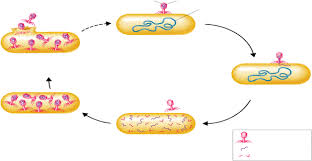
What is shown here?
a)
Lysogenic Cycle
b)
Lytic Cycle
c)
Binary Fission
d)
Conjugation
127.
What process is this?
a)
phagocytosis
b)
lytic cycle
c)
lysogenic cycle
d)
formation of antibodies
128.
What happens in the lysogenic cycle? 
a)
Virus goes in and leaves the host cell
b)
Virus quickly kills the host cell
c)
Virus inject the nucleic acid into the host cell, and the nucleic acid integrates into the host cell DNA, and stay dormant for a long time
d)
Bacteria injects DNA into a host cell
129.

Viruses contain genetic material which carries the instructions for the construction of new virus particles. This genetic material is primarily composed of-

a)

phospholipids

b)

polysaccharides

c)

nucleic acids

d)

polypeptides

130.
Which of the following is something bacteria and viruses have in common?
a)
they are both living
b)
they are both cells
c)
they can both cause disease
d)
they are both non-living
131.
Contain DNA
a)
Cell
b)
Virus
c)
Both
132.
Capable of reproducing
a)
Cell
b)
Virus
c)
Both
133.
May contain a cell wall
a)
Cell
b)
Virus
c)
Both
134.

Which of the following is able to carry out all life functions?

a)

Viruses

b)

Cells

c)

Both cells and viruses

d)

Neither cells or viruses

135.

Which of the following statements is true?

a)

All cells are prokaryotes

b)

All eukaryotes have a nucleus

c)

All viruses are prokaryotes

d)

All viruses are living

136.
Proteins can be found on outer surface and are used for recognition
a)
Cell
b)
Virus
c)
Both
137.
Contains a capsid
a)
Cell
b)
Virus
c)
Both
138.
Smaller than the other one
a)
Cell
b)
Virus
c)
Both
139.
Contains a nucleus
a)
Cell
b)
Virus
c)
Both
140.
Classified as either prokaryotic or eukaryotic
a)
Cell
b)
Virus
c)
Both
141.
What is one way that a lysogenic infection differs from a lytic infection?
a)
A lysogenic virus does not act on bacteria as a lytic virus does.
b)
A lysogenic virus can remain in the host DNA for a longer period without becoming active.
c)
A lysogenic virus contains RNA instead of DNA.
d)
A lysogenic virus directs the production of new viruses right away.
142.
The lytic cycle takes the longest out of the two viral reproductive cycles. 
a)
True
b)
False
143.
This infectious viral disease has many symptoms, from chills, fever, and aching muscles to coughing and sneezing to nausea and vomiting. The symptoms show up within 2-7 days after the cell is infected.  This is an example of?
a)
Lytic Cycle
b)
Lysogenic Cycle
c)
Meiosis
144.
The lysing of a cell occurs in which phase?
a)
1
b)
2
c)
4
d)
5
145.
This virus attacks the white blood cells (immune cells) of the human body. Eventually, the immune system cannot handle the viral invasion. This makes the body prone to attack from other viruses and bacteria. What is the name of this infectious viral disease?
a)
AIDS
b)
Cancer
c)
Diabetes
146.
What happens in the lysogenic cycle? 
a)
Virus goes in and leaves the host cell
b)
Virus quickly kills the host cell
c)
Virus inject the nucleic acid into the host cell, and the nucleic acid integrates into the host cell DNA, and stay dormant for a long time
d)
Bacteria injects DNA into a host cell
147.
What happens in the lytic cyle?
a)
Virus goes in and leaves the host cell
b)
Virus quickly kills the host cell
c)
Virus sleeps inside of the host cell
d)
Virus stay dormant for a long time
148.
Symptoms of HIV do not show up immediately because the virus can 
a)
stay dormant for years
b)
mutate quickly 
c)
stay outside the cell for a long time
149.
A _____________________ infection involves the phage combining its DNA with the host cells DNA. Often hiding for years.
a)
lysogenic
b)
lytic
c)
vaccine
d)
vinerial
150.
What is the 1st step of virus infection?
a)
Entry
b)
Attachment
c)
Replication
d)
Assembly
151.
Influenza infects a cell and causes it to lyse immediately. Which type of virus is influenza?
a)
Lytic
b)
Lysogenic
c)
Bacterial
d)
None of the above