

wayground logo

Free Printable Worksheets

Font size

S
M
L
XL
Worksheets

Bio 1 Final Review

Total questions: 147

Worksheet time: 3hrs 46mins

Name
Class
Date
1.

Put the following stages of the cell cycle in order: G2, S, G1, M, C

a)

G1, S, C, G2, M

b)

C, S, G1, G2, M

c)

G1, M, G2, S, C

d)

M, G1, S, G2

e)

G1, S, G2, M, C

2.
a)

Anaphase

b)

Cytokinesis

c)

Telophase

d)

Metaphase

e)

interphase

3.
a)

Cytokinesis

b)

Interphase

c)

Anaphase

d)

Metaphase

4.
a)
Cytokinesis
b)
Anaphase
c)
Telophase
d)
Prophase
e)

metaphase

5.
Fruit fly body cells have 8 chromosomes. After mitosis, you would expect a resulting fruit fly daughter cell to have -
a)
16 chromosomes.
b)
46 chromosomes.
c)
8 chromosomes.
d)
4 chromosomes.
e)

32 chromosomes

6.

the division of the cytoplasm is called

a)

mitosis

b)

interphase

c)

cytokinesis

d)

somatic

e)

anaphase

7.

Why do cells go through mitosis?

a)

to make food from sunlight

b)

to create proteins

c)

to get air into the cells

d)

to reproduce, grow and repair/replace

8.

Why is the metaphase important?

a)

The DNA gets copied and the cell grows and develops

b)

The DNA lines up so exact copies can be pulled to each side

c)

The nuclear membrane disappears and the spindle fibers appear

d)

Two identical daughter cells are formed

9.

Before cells can divide, what happens to the DNA?

a)

It is replicated

b)

It increases in size

c)

It is divided in half

d)

It decreases in size

10.
What correctly describes the DNA content in the G1 phase?
a)
normal amount
b)
double amount
c)
increasing
d)
decreasing
11.
An abnormal mass of cancer cells is called a 
a)
tumor
b)
cyst
c)
lesion
d)
polyp
12.
a)

Prophase

b)

Interphase

c)

Anaphase

d)

Telophase

13.

Name the phase:

a)

Prophase

b)

Metaphase

c)

Anaphase

d)

Telophase

14.
When cancer spreads to other tissues of the body, it is called...
a)
Metastasis
b)
Invasiveness
c)
Angiogenesis
d)
Chemotherapy
15.
A cancer causing agent is called a(n)...
a)
Somatic mutation
b)
Carcinogen
c)
Oncogene
d)
Germline mutation
16.
Why does the S phase always occur before the M phase in the cell cycle?
a)
The cell must have 2 sets of chromosomes in order to complete M phase
b)
The cell must grow to a certain size before beginning M phase
c)
The cell must complete all the necessary checkpoints in order to enter M phase
d)
The cell must begin the process of cytokinesis before beginning the M phase
17.
What is a checkpoint in the cell cycle?
a)
A check to see if the cell is ready to move on
b)
A check to slow mitosis down
c)
A check to see if the cell is performing mitosis or meiosis
d)
A check to make sure the cell doesn't die
18.
Stem cells are ____________________.
a)
cells that grow uncontrollably
b)
undifferentiated and can turn into any type of cell
c)
those that never go through cell division
d)
differentiated cells that do one job
19.
What is the difference between embryonic stem cells and adult stem cells?
a)
Embryonic can differentiate into more cell types than adult
b)
Adult only turn into blood, while embryonic turn into many things.
c)
Adult can differentiate into more cell types than embryonic
d)
Adult grow bigger than embryonic
20.
Structure (b) is a ____.
a)
chromosome
b)
chromatid
c)
centromere
21.

What is the name of the structure labeled X?

a)

Centriole

b)

Centrosome

c)

Chromatid

d)

Chromosome

22.

Label the images.

23.

Reorder the following phases of the cell cycle. (Cytokinesis is missing).

a)

b)

c)

d)

e)

1)
2)
3)
4)
5)
24.

Why is the surface area to volume ratio important for cells?(choose all correct answers)

a)

Cells need to have large volumes so they can grow.

b)

Cells need a lot of surface area so that materials can diffuse into cells and wastes diffuse out.

c)

If the cell volume increases faster than the surface area it becomes too difficult to control all the activities of the cell as the nucleus gets information overload.

d)

Cells should have a larger volume than surface area so that it is easier to protect itself.
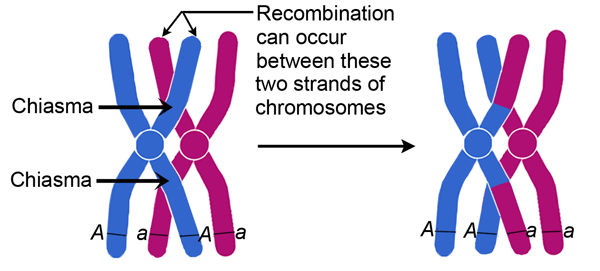
25.
This image shows chromosomes during Prophase 1. Which of the following correctly describes the process shown?
a)
segregation of sister chromatids
b)
condensation and segregation of alleles
c)
mutationin which the DNA content of the gene is altered
d)
crossing - over in which alleles are exchanged
26.
The haploid number of human chromosomes is
a)
11
b)
12
c)
23
d)
46
27.

What is the main purpose of meiosis

a)

make new cells

b)

heal wounds

c)

create sex cells

d)

replace old cells

28.

The yellow curved lines in the image.

a)

chromosomes

b)

chromatids

c)

spindle fibers

d)

centrioles

29.

One pair of identical chromosomes joined together by a centromere

a)

Chromosome

b)

Centriole

c)

Sister Chromatid

d)

DNA

30.

What are clues that a cell is in any metaphase 1 of Meiosis click all that apply

a)

nuclear membrane is dissolving

b)

centrioles are not at equator(opposite)

c)

chromosomes are lined up in middle

d)

chromosomes are paired up

31.

The end product of Meiosis 2 is

a)

4 genetically different haploid cells

b)

4 identical haploid cells

c)

2 identical diploid cells

d)

2 genetically different diploid cells

e)

2 genetically different haploid cells

32.

The end product of Meiosis 1 is

a)

4 genetically different haploid cells

b)

4 identical haploid cells

c)

2 identical diploid cells

d)

2 genetically different diploid cells

e)

2 genetically different haploid cells

33.

What is being separated in anaphase during Meiosis 1

a)

sister chromatids

b)

homologous pairs

34.

What is being separated in anaphase during Meiosis 2

a)

sister chromatids

b)

homologous pairs

35.

When your cells reproduce asexually what process should be undertaken

a)

meiosis

b)

mitosis

c)

photosynthesis

d)

cytokinesis

36.

Which of these statements about asexual reproduction is false?

a)

Asexual reproduction requires only one parent.

b)

Asexual reproduction increases variations in a population.

c)

Asexual reproduction is carried out by bacteria.

d)

Asexual reproduction can produce more offspring faster than sexual reproduction can.

37.

There are a couple thousand different species of brittle star. At certain times of the year, male and female stars release sperm and eggs into the ocean. They can also reproduce by simply splitting in half and grow new body parts. How does the organism reproduce?

a)

Sexual reproduction

b)

Asexual Reproduction

c)

Both Asexual and Sexual reproduction

d)

Can't reproduce

38.

The whiptail lizard is an all-female species and is able to reproduce without a male to fertilize her eggs through a process called _________________. After a false mating , the female will lay eggs. The daughters are genetically identical to their mom. What type of reproduction?

a)

parthenogenesis, sexual

b)

budding, asexual

c)

regeneration, asexual

d)

binary fission, sexual

e)

fragmentation, asexual

39.
Which type of asexual reproduction is taking place?
A planarian is a non-parasitic flatworm.  If a planarian was injured by a predator, it could re-grow its body parts.  If the body parts were not eaten by the predator, the part could re-grow into a whole new planarian as well.
a)
Budding
b)
Fission
c)
Vegetative propagation
d)
Regeneration
40.
Prokaryotes (bacteria) reproduce asexually via -
a)
spore formation
b)
bud creation
c)
vegetative propagation
d)
binary fission
41.
This is when a new organism grows by cell division on the body of its parent. The bud, or offspring is identical to the parent. The bud, when large enough, can break off of the parent and live on its own.  Examples of this include yeast, hydra and potatoes.
 
a)
Regeneration
b)
Vegetative propagation
c)
Fission
d)
Budding
42.

Check all that apply.

Reproductive cells are _______.

a)

haploid

b)

gametes

c)

somatic

d)

identical

e)

diverse

43.

A mosquito has a haploid number of 3. After fertilization, a mosquito zygote has ___ chromosomes..

a)

6

b)

9

c)

12

d)

15

44.
Question Image

Match the letter with the correct term.

a)

A

1.

Meiosis

b)

E

2.

Mitosis

c)

D

3.

Zygote

d)

C

4.

Fertilization

e)

B

5.

Gametes

45.

What are some disadvantages to sexual reproduction? (select all that apply)

a)

it takes a lot of energy to find a mate

b)

you don't need another mate

c)

it requires a male and a female

d)

it takes a lot more time than asexual reproduction

46.

Some advantages of sexual reproduction include: (select all that apply)

a)

genetic variation

b)

improves chances of adapting to the environment

c)

helps species survive catastrophes

d)

it doesn't take as much energy as asexual reproduction

47.
Determine the sex of the individual whose karyotype is displayed in the image.
a)
female
b)
male
48.
Determine the sex of the individual whose karyotype is displayed in the image.
a)
female
b)
male
49.
What phase is shown here?
a)
Prophase II
b)
Metaphase I
c)
Metaphase II
d)
Anaphase I
50.
What phase is shown here?
a)
Metaphase II
b)
Telophase I
c)
Telophase II
d)
Metaphase I
51.
What phase is shown here?
a)
Anaphase I
b)
Prophase I
c)
Metaphase II
d)
 Metaphase I
52.
What phase is shown here?
a)
Telophase II
b)
Anaphase II
c)
Metaphase I
d)
Interphase I
53.
What phase is shown here?
a)
Telophase I
b)
Metaphase II
c)
Telophase II
d)
Anaphase I
54.

What does DNA stand for?

a)

deoxyribonucleic acid

b)

ribonucleic acid

c)

dnase

55.

Which class of organic polymers does DNA belong to?

a)

protein

b)

lipid

c)

nucleic acid

d)

carbohydrate

56.

DNA is made of monomers or subunits called

a)

monosaccharides

b)

amino acids

c)

nucleotides

d)

fatty acids

57.

Which of the following scientists used enzymes to break down DNA or protein in an attempt to determine which was heritable material?

a)

Avery

b)

Hershey & Chase

c)

Griffith

d)

Watson & Crick

e)

Franklin

58.

Which of the following scientists discovered transformation

a)

Avery

b)

Hershey & Chase

c)

Griffith

d)

Watson & Crick

e)

Franklin

59.

Which of the following scientists concluded once and for all that DNA was the heritable material?

a)

Avery

b)

Hershey & Chase

c)

Griffith

d)

Watson & Crick

e)

Chargaff

60.

Which of the following scientists used made x-ray crystallography photos of DNA?

a)

Chargaff

b)

Watson & Crick

c)

Rosalind Franklin

d)

Avery

e)

Griffith

61.

Which of the following scientists determined that C and G are always present in the same quantity?

a)

Chargaff

b)

Watson & Crick

c)

Rosalind Franklin

d)

Avery

e)

Hershey Chase

62.

Which of the following scientists modeled the structure of DNA as a double helix?

a)

Chargaff

b)

Watson & Crick

c)

Sponge Bob

d)

Franklin

e)

Hershey & Chase

63.

What are the steps in order of DNA replication?

a)

Unwind the double helix, bond and proofread with DNA polymerase, pair new nucleotides with each old template strand, end result is 2 semi-conservative strands of DNA.

b)

Unwind the double helix, pair new nucleotides with each old template strand, bond and proofread with DNA polymerase, end result is 2 semi-conservative strands of DNA.

c)

Pair new nucleotides with each old template strand, bond and proofread with DNA polymerase, end result is 2 semi-conservative strands of DNA, unwind the double helix,

d)

Bond and proofread with DNA polymerase,unwind the double helix, pair new nucleotides with each old template strand, end result is 2 semi-conservative strands of DNA.

64.
#3 is 
a)
tRNA
b)
mRNA
c)
DNA
d)
rRNA
65.

The enzyme that builds a new strand of DNA is called

a)

DNA Polymerase

b)

RNA Polymerase

c)

Topoisomerase

d)

Helicase

66.

What type of bonds are responsible for holding rungs of the strands of DNA together(nitrogenous bases)?

a)

hydrogen bonds

b)

ionic bonds

c)

covalent bonds

d)

nucleobonds

67.

Which of the following refers to copying DNA

a)

DNA Replication

b)

DNA Synthesis

c)

Transcription

d)

All of these are correct

68.

If the left side of DNA contains the following bases: ATCGATCG, what would the right side contain?

a)

CGATCGAT

b)

TAGGTAGG

c)

TAGCTAGC

d)

ATCGATCG

69.

What are the steps in order of DNA replication?

a)

Unwind the double helix, bond and proofread with DNA polymerase, pair new nucleotides with each old template strand, end result is 2 semi-conservative strands of DNA.

b)

Unwind the double helix, pair new nucleotides with each old template strand, bond and proofread with DNA polymerase, end result is 2 semi-conservative strands of DNA.

c)

Pair new nucleotides with each old template strand, bond and proofread with DNA polymerase, end result is 2 semi-conservative strands of DNA, unwind the double helix,

d)

Bond and proofread with DNA polymerase,unwind the double helix, pair new nucleotides with each old template strand, end result is 2 semi-conservative strands of DNA.

70.

Where in a Eukaryote cell is DNA located?

a)

ribosomes

b)

nucleus

c)

cell membrane

d)

Golgi apparatus

71.

If a DNA template strand is 5' T T C G A G 3', what will the complementary strand be?

a)

5' A A G C T C 3'

b)

3' A A G C T C 3'

c)

3' A A G C T C 5'

72.

What significant role does DNA play in the formation and development of an organism?

a)

Contains the codes for making proteins

b)

Protection from disease

c)

Production of food and energy

d)

Release energy and consume energy

73.

In the strawberry DNA lab, what did the soap do in the extraction buffer solution? What was the purpose?

a)

The dissolve phospholipids in the cell membranes and organelle membranes

b)

break up protein chains

74.
Thymine makes up 42% of the nucleotides in a sample of DNA from an organism. Approximately what percentage of the nucleotides in this sample will be cytosine?
a)
42%
b)
31%
c)
16%
d)
8%
75.
The process of making mRNA from DNA is called.
a)
Replication
b)
Transcription
c)
Translation
d)
Protein synthesis
76.
Where does transcription take place?
a)
nucleus
b)
ribosome
c)
cytoplasm
d)
smooth ER
77.
In DNA which is a correct base pairing?
a)
A with G
b)
G with T
c)
A with U
d)
A with T
78.
RNA is different from DNA in ___
a)
RNA is single stranded
b)
RNA has uracil 
c)
RNA has the sugar ribos
d)
All of these
79.
The anticodon is located on 
a)
DNA
b)
mRNA
c)
tRNA
d)
rRNA
80.
The codon is located on the 
a)
DNA
b)
mRNA
c)
tRNA
d)
rRNA
81.
Which molecule brings the amino acid to the ribosome?
a)
DNA
b)
mRNA
c)
tRNA
d)
rRNA
82.
Where does translation take place?
a)
Nucleus
b)
Ribosome
c)
Golgi Body
d)
Cytoplasm
83.
In messenger RNA, each codon specifies a particular...
a)
Nucleotide
b)
Enzyme
c)
Amino Acid
d)
Promoter
84.
The number of nitrogen bases in a codon is ....
a)
2
b)
3
c)
4
d)
6
85.
_______ is made during transcription and ________ is made during translation.
a)
mRNA / a protein
b)
a protein / mRNA
c)
Ribosome / Nucleus
d)
mRNA / tRNA
86.
Which RNA bases would pair with TACGAA in transcription
a)
AUGCUU
b)
ATGCTT
c)
GCATCC
d)
GCAUCC
87.
How many amino acids are coded for by this sequence of nucleotides:
ATG GGA ACT CCA
a)
4
b)
2
c)
6
d)
12
88.
What amino acid is represented by the codon CAG?
a)
Aspartic Acid
b)
Histidine
c)
Glutamine
d)
Methionine
89.
when DNA is transcribed to RNA.... 
a)
A pairs with U
b)
G pairs with U
c)
C pairs with T
d)
A pairs with C
90.

In a rat which of the following would cause translation to stop it sequence?

a)

AUG

b)

UGC

c)

UAA

d)

AAG

91.

What amino acids would the following DNA sequence code for?

TAC-TAG-CAT-ACT

a)

Met-Cys-Ala-STOP

b)

Cys-Iso-Ala-STOP

c)

Met-Iso-Val-STOP

d)

Val-Iso-Met-Ala

92.

What is the amino acid for AGU?

a)

SER

b)

ISO

c)

ALA

d)

LEU

93.
Which of the following best explains why TRANSCRIPTION is necessary
a)
RNA carries the original "recipe" for the building of a protein
b)
Amino acids must be signaled for at the ribosome
c)
DNA cannot leave the nucleus, but mRNA can
d)
DNA is found in the ribosome, where proteins are made
94.
Which enzyme is responsible for making RNA?
a)
DNA polymerase
b)
RNA enzymase
c)
RNA polymerase
d)
RNA proliferase
95.

What mutation has occurred here?

T-G-A-C-C-A

T-G-A-G-C-A

a)

Substitution

b)

Deletion

c)

Insertion

d)

Frameshift

96.

DNA molecule segment is : TTACGCAAG

The mutated DNA segment is TTACGCAAC. This is an example of ___ mutation.

a)

Substitution

b)

Insertion

c)

Inversion

d)

Translocation

97.

ATT-TGA-GCC- Original

ATT-GAG-CC - Mutated

The example above is an example of a

a)

Insertion- Frameshift

b)

Deletion- Substitution

c)

Deletion -Frameshift

d)

All of the above

98.

DNA molecule segment is : TTA-CGC-AAG

The mutated DNA segment is TTC-GCA-AG. This is an example of ___ mutation.

a)

Substitution

b)

Deletion

c)

Insertion

d)

Inversion

99.

Original DNA: CAT GAT CCA

New DNA: CAT TGA TCC A

What mutation occurred?

a)

deletion

b)

substitution

c)

tranverse

d)

insertion

100.
Are all mutations bad?
a)
Yes
b)
No
c)
Maybe?
101.

Mutations are__________

a)

Harmful

b)

Harmful or beneficial

c)

Neutral

d)

Harmful, neutral, or beneficial

102.

A point mutation where one nucleotide base replaces an original nucleotide base

a)

Inversion Mutation

b)

Chromosomal Mutation

c)

Translocation

d)

Substitution Mutation

103.

Part of a chromosome is reversed.

a)

Inversion Mutation

b)

Deletion Mutation

c)

Translocation

d)

Point Mutation

104.

The chromosomal mutation shown in the image is a

a)

deletion

b)

duplication

c)

inversion

d)

translocation

105.
what does a promoter do?
a)
it allows a gene to be transcribed
b)
it creates a DNA segment
c)
it is another word for ribosomes
d)
it is another word for RNA
106.
How can a person's muscle cells have the same exact DNA sequences as their nerve cells even though the look and perform completely different?
a)
The two different cells become mutated
b)
The proteins expressed in each cell are different
c)
They actually have different DNA in the two types of cells.
d)
The genome of the different cells changes
107.

In eukaryotic cells, the ____________ are segments of mRNA that are cut out of the final transcript.

a)

promoters

b)

poly A tails

c)

exons

d)

introns

108.

What is added to the processed mRNA transcript in eukaryotic cells to help the transcript attach to ribosomes and to be prevented from being broken down?

a)

the exon

b)

the intron

c)

the poly A tail

d)

the cap

109.

The TATA box is

a)

a promoter in eukaryotes.

b)

an operator in prokaryotes.

c)

an exon in prokaryotes.

d)

a tail in eukaryotes.

110.

Gene regulation looks a bit different in eukaryotes. Which of the following are unique to Eukaryotes? Select all that apply.

a)

Transcription factors

b)

RNA polymerase

c)

DNA folds over onto itself

d)

Sections of DNA called enhancers (where transcription factors bind)

111.

___ are DNA sequences which are often located far from the genes they regulate in eukaryotes where transcription activators can bind.

a)

histones

b)

promotors

c)

enhancers

112.

a regulatory protein that binds to an operator and blocks transcription of the genes of an operon

a)

transcription factor

b)

homeobox

c)

repressor protein

d)

gene expression

113.
In peas, the trait for tall plants is dominant (T) and the trait for short plants is recessive (t).  The trait for yellow seeds is dominant (Y) and the trait for green seeds is recessive (y).
A cross between two plants results in 292 tall, yellow plants and 103 short, green plants.  What are the most likely genotypes of the parents?
a)
TtYY x Ttyy
b)
TTYy x TTYy
c)
TTyy x TTYy
d)
TtYy x TtYy
114.
Suppose that in sheep, a dominant allele (B) produce black hair and a recessive allele (b) produce white hair. If you saw a black sheep, you would be able to identify
a)
its phenotype for hair color
b)
its genotype for hair color
c)
the genotype of only one of its parents
d)
the phenotype of both of its parents
115.
One of the main reasons genes assort independent of one another  is that 
a)
they produce unrelated traits
b)
they produce related traits
c)
they are on the same chromosome
d)
they are on different chromosomes.
116.
A single gene has 3 or more alternative forms. These are called
a)
heterozygotes
b)
multiple alleles
c)
epistatic
d)
polygenic
117.
If the parents of a cross are AaBcCc x aaBBcc. What is the probability of an offspring that is homozygous recessive for all 3 traits?
a)
1/64
b)
1/32
c)
1/8
d)
O
118.
Red x white = pink
What is the genotype of the pink flower?
a)
RR
b)
rr
c)
Rr
d)
Can't be determined
119.
Blood type AB
a)
epistasis
b)
codominance
c)
incomplete dominance
d)
hybrid vigor
120.
In the second generation-how many people have the disease?
a)
2
b)
4
c)
6
d)
8
121.
Freckles (F) are dominant over nonfreckles.   What is the phenotype of individual #3
a)
Ff
b)
ff
c)
freckles 
d)
nonfreckles 
122.
What is the relationship between person I 1 and III 2?
a)
Father and Son
b)
Father and Daughter
c)
Grandfather and Granddaughter
d)
Uncle and Niece 
123.
What do we use pedigrees for?
a)
To look at families
b)
To make determinations about the offspring
c)
To track traits in families
d)
Nothing
124.
A dog gives birth to 5 puppies. What percentage of the chromosomes does each puppy share with the mother?
a)
25%
b)
50%
c)
75%
d)
100%
125.
What does heterozygous mean?
a)
An organism that has the same genes for a trait (TT or tt)
b)
An organism that has different genes for a trait (Tt)
c)
When neither gene is fully dominant; offspring is a mixture of both
d)
the different forms of a trait (hair color--> brown, blonde, red
126.
If a heterozygous tall pea plant is crossed with a short pea plant, what are the possible genotypes of the future offspring?
a)
100% Tt
b)
50% Tt, 50% tt
c)
75%Tt, 25%tt
d)
25%TT, 50%Tt, 25%tt
127.
If T=Tall & t=short, what is the genotypic ratio?
a)
1:3
b)
3:1
c)
1:2:1
d)
2:2
128.
Two brown eyed parents (Bb) have a baby. What is the chance the baby is blue eyed?
a)
0 %
b)
25%
c)
50%
d)
75%
129.
Which process and type of resulting cells are represented?
a)
mitosis, gametes
b)
mitosis, body cells
c)
meiosis, gametes
d)
meiosis, body cells
130.
Red/green color blindness is a recessive trait.  A woman who is a carrier for this allele marries a normal-vision male.  What is the probability that they will have a child who is color blind?
a)
1/4
b)
1/2
c)
3/4
d)
1
131.
W=white hair
w= non-white hair
If you cross a horse with WW and a horse with ww what fraction of the offspring would be expected to have white hair?
a)
none
b)
3/4
c)
1/2
d)
all
132.
What is a phenotype?
a)
The expression of a trait; what you see.
b)
refers to the genetic makeup of an individual
c)
An organism that has the same genes for a trait (ex. TT or tt)
d)
the passing of traits from parent to offspring
133.
The inherited combination of alleles is known as the offspring's
a)
heredity
b)
phenotype
c)
genotype
d)
redigree
134.
B=brown eyes
b= blue eyes
What is true about two brothers that have brown eyes?
One has genotype BB the other Bb.
a)
they have same phenotype and genotype
b)
they have different genotypes and phenotypes
c)
they have same phenotype but different genotypes
d)
they have same genotype but different phenotypes
135.
In certain rats, black fur is dominant over white fur. If two rats, both heterozygous for fur color are mated, their offspring would be expected to have 
a)
four different genotypes and two different colors
b)
two different genotypes and three different colors
c)
three different genotypes and two different colors
d)
three different genotypes and three different colors
136.
Which of the following genotypes is homozygous recessive?
a)
RR
b)
Rr
c)
rr
d)
None of the Above
137.
In screech owls, red feathers are dominant over gray feathers. If two heterozygous red-feathered owls are mated, what percentage of their offspring would be expected to have red feathers?
a)
25%
b)
50%
c)
75%
d)
100%
138.
If the four existing children in a family are all sons, what chance would there be that the next child would also be a son?
a)
75%
b)
50%
c)
25%
d)
20%
139.
A cross between two tall garden pea plants produced 314 tall plants and 98 short plants. What genotypes are the parents?
a)
TT and tt
b)
TT and Tt
c)
Tt and Tt
d)
TT and TT
140.
 Recessive alleles are-
a)
capital
b)
lowercase
c)
both
d)
neither
141.
 Recessive alleles are-
a)
capital
b)
lowercase
c)
both
d)
neither
142.
Tt is-
a)
homozygous dominant
b)
homozygous recessive
c)
heterozygous
d)
none of these
143.
Another word for homozygous is...
a)
purebred
b)
hybrid
c)
heterozygous
d)
dominant
144.
What does a Punnett Square help you do?
a)
Determine the ratio of phenotypes
b)
Determine the ratio of genotypes
c)
Predict possible traits the offspring will have
d)
All of the above
145.
True/False: Different genotypes can code for the same phenotype.
a)
True
b)
False
146.
If something is heterozygous, it is also...
a)
purebred
b)
hybrid
c)
dominant
d)
recessive
147.
B - black, b - brown.  Two black mice mate and have some black and some brown mice.  What is the genotype of the parents?
a)
BB x Bb
b)
BB x bb
c)
Bb x Bb
d)
Bb x bb
