
 Worksheets
State Test Prep Part 1
Total questions: 150
Worksheet time: 2hrs 12mins
Name
Class
Date
1.
Why do we use SI units in science?
a)
Measures in powers of ten.
b)
It's more difficult.
c)
It's more accurate.
d)
It's more precise.
2.
On which axis would you place the independent variable?
a)
X
b)
Y
c)
Z
3.
On which axis would you place the dependent variable?
a)
X
b)
Y
c)
Z
4.
What unit of measure is used for volume of liquids?
a)
Liters
b)
Gallons
c)
Cups
d)
Pints
5.
Which unit of measure is used for mass?
a)
Grams
b)
Pounds
c)
Stone
d)
Mole
6.
Which term describes a prediction for one experiment?
a)
theory
b)
hypothesis
c)
law
d)
rule
7.
Which term describes an idea supported by a large body of evidence (many experiments)?
a)
theory
b)
hypothesis
c)
prediction
d)
guess
8.
Which variable in an experiment is the factor being tested?
a)
experimental group
b)
independent variable
c)
dependent variable
d)
control group
9.
Which variable in an experiment is the factor being measured (as a response)?
a)
independent variable
b)
dependent variable
c)
control group
d)
constant
10.
Which is the group not receiving the test factor (IV)?
a)
control group
b)
experimental group
c)
constant
d)
placebo
11.
What is the term for all conditions that stay the same throughout the experiment?
a)
constant
b)
independent variable
c)
dependent variable
d)
control group
12.

a)
flammable
b)
radioactive
c)
biohazard
d)
disposal
13.

a)
corrosive
b)
radioactive
c)
biohazard
d)
flammable
14.

a)
disposal
b)
radioactive
c)
biohazard
d)
flammable
15.

a)
eye safety
b)
clothing safety
c)
animal safety
d)
corrosive
16.

a)
fumes
b)
biohazard
c)
flammable
d)
corrosive
17.
What graph would you use if there are percentages involved?
a)
Pie chart
b)
Bar graph
c)
Line graph
d)
Data table
18.
What tool do we use to measure mass?
a)
graduated cylinder
b)
beaker
c)
ruler
d)
balance
19.
This is the responding variable, or the variable you don't control.
a)
Independent
b)
Dependent
20.
This is the data that you get from your experiment.
a)
Results
b)
conclusion
c)
Hypothesis
d)
Experiment
21.
Which term refers to data that is described using numbers?
a)
quantitative data
b)
qualitative data
c)
results
d)
trend
22.
Which term refers to data that is described using words?
a)
quantitative data
b)
qualitative data
c)
results
d)
trend
23.
How do you calculate total magnification?
a)
objective lens - ocular lens
b)
ocular lens - objective lens
c)
objective lens + ocular lens
d)
objective lens x ocular lens
24.
Which instrument is used for precise measurements of liquids?
a)
graduated cylinder
b)
measuring cup
c)
watch glass
d)
beaker
25.
Which term describes an idea supported by a large body of evidence (many experiments)?
a)
theory
b)
hypothesis
c)
prediction
d)
guess
26.
The possible answer to the problem.
a)
Hypothesis
b)
Conclusion
c)
Data
d)
Experiment
27.
Which of the following is an example of qualitative data?
a)
the color of the fur of an animal
b)
the mating behavior of an animal
c)
the average number of offspring that an organism has
d)
the description of an odor that a chemical produces
28.

What is the first step in the scientific method?
a)
Make an observation
b)
Design and conduct an experiment
c)
Make an hypothesis
d)
Share your results
29.

This is the last step in the scientific method
a)
Draw a conclusion
b)
Record your data as results
c)
Share what you have learned with others
d)
Collaborate with others
30.
What is the variable that we are measuring in an experiment?
a)
Independent
b)
Dependent
c)
Control
d)
Experimental
31.
What two types of atoms make a covalent bond?
a)
2 Nonmetals
b)
1 Nonmetal and 1 Metal
c)
2 Metals
d)
2 Noble Gases
32.
How are covalent bonds explained?
a)
When one atom takes the other atom's electron
b)
When the atom shares an electron with an another atom
c)
When the two nucleus merge
d)
When the neutrons leave the nucleus
33.
How many are shared in a single bond?
a)
2 pairs
b)
4
c)
2
d)
1
34.
How are ionic bonds formed?
a)
When atoms share an electron
b)
When opposite charged atoms attract
c)
When one atom takes a proton
d)
When one atom takes a neutron
35.
Why do ionic bonds form?
a)
so the number of protons equals the number of electrons
b)
to fill the outermost energy level
c)
so an atom can become unstable
36.
Ionic Bonding involves...
a)
The transfer of protons
b)
The transfer of nuetrons
c)
The transfer of electrons
d)
None Of the above
37.
What happens when the sodium atom loses an electron?
a)
It become negatively charged
b)
It become positively charged
c)
none
38.
What is the mass number?
a)
the number of protons
b)
the sum of the number of protons and the number of neutrons in the nucleus of an atom
39.
an electron has this charge
a)
positive
b)
negative
c)
neutral
40.
a neutron has this charge
a)
negative
b)
positive
c)
neutral
41.
a proton has this charge
a)
negative
b)
positive
c)
neutral
42.

What two elements make up water?
a)
Helium and oxygen
b)
Hydrogen and oxygen
c)
helium and carbon
d)
oxygen and carbon
43.

A water strider can skate along the top of a pond because:
a)
covalent bonds result in water cohesion
b)
hydrogen bonds result in water cohesion (surface tension)
c)
water striders have adapted to take advantage of water cohesion
d)
low surface tension of water
44.

What word describes when water is attracted to other substances?
a)
cohesion
b)
adhesion
c)
capillary action
d)
surface tension
45.
Why can water have no net charge but have slight charges in different parts of the molecule?
a)
The oxygen end is slightly negative and the hydrogen end is slightly positive
b)
The hydrogen end is slightly negative and the oxygen end is slightly positive
c)
The hydrogen and oxygen ends change in polarity
d)
Because it is hydrophobic
46.

Attractions between water molecules are called
a)
Covalent bonds
b)
Ionic bonds
c)
Polar bonds
d)
Hydrogen bonds
47.
What word describes when a molecule is attracted to water?
a)
hydrophobic
b)
hydrophilic
c)
bipolar
d)
solvent
48.
What is the range of pH values in an acidic solution?
a)
0-7
b)
7-14
c)
15-239058204958
d)
pH = 7
49.
Tastes bitter.
a)
Acids
b)
Bases
c)
Salts
d)
All
50.
Tastes Sour
a)
Acids
b)
Bases
c)
Salts
d)
All
51.
pH greater than 7.
a)
Acids
b)
Bases
c)
All
52.
The pH scale is based off of the concentration of _________ ions.
a)
Oxygen
b)
Hydrogen
c)
Nitrogen
d)
None of the others
53.
What is a solution that has an excess of hydroxide (OH-) ions?
a)
pH
b)
acid
c)
neutral
d)
base
54.

According to the pH range which substance is more acidic than lemon juice
a)
Hydrochloric acid
b)
cabbage
c)
milk
55.
Where does the energy from our food originally come from?
a)
the Sun
b)
chemical reactions
c)
carbohydrates
d)
mitochondria
56.
Which macromolecule is made of simple and complex sugars?
a)
lipids
b)
proteins
c)
carbohydrates
d)
nucleic acids
57.
Which macromolecule stores energy, insulates us, and makes up the cell membrane?
a)
lipids
b)
proteins
c)
carbohydrates
d)
nucleic acids
58.
Which are enzymes?
a)
simple carbohydrates
b)
proteins that speed up chemical reactions
c)
lipids that make up the cell membrane
d)
a building block of DNA
59.
DNA and RNA are examples of...
a)
proteins
b)
nucleic acids
c)
carbohydrates
d)
lipids
60.
Another name for fats and oils
a)
proteins
b)
sugar
c)
lipids
d)
nucleic acids
61.
Which organelle breaks down sugar into something our cells can use? (ATP)
a)
cell membrane
b)
mitochondria
c)
Golgi body
d)
endoplasmic reticulum
62.
Phospholipids are used in what biological structure?
a)
RNA
b)
DNA
c)
Cell membrane
d)
Cell wall
63.
What is the monomer of nucleic acids?
a)
Glycerol
b)
Monosaccharides
c)
Amino Acids
d)
Nucleotides
64.
What is the function of a carbohydrate?
a)
Stores energy
b)
Movement
c)
Stores genetic information
d)
Speeds up reactions
65.
What is the monomer of proteins?
a)
amino acids
b)
polypeptides
c)
nucleotides
d)
monosaccharides
66.
What is the function of nucleic acids?
a)
Stores energy
b)
Stores genetic information
c)
Movement
d)
Physical structure
67.
All polymers are made up of...
a)
monosaccharides
b)
monomers
c)
proteins
d)
None of these
68.

a)
carbohydrate
b)
lipid
c)
protein
d)
nucleic acid
69.

a)
carbohydrate
b)
lipid
c)
protein
d)
nucleic acid
70.

a)
carbohydrate
b)
lipid
c)
protein
d)
nucleic acid
71.

a)
carbohydrate
b)
lipid
c)
protein
d)
nucleic acid
72.
Most enzymes:
a)
speed up the chemical reaction
b)
have no effect on the rate of the chemical reaction
c)
slow the rate of the chemical reaction
d)
keep the rate of the chemical reaction the same
73.
What suffix is used in the names of most carbohydrates?
a)
-ase
b)
-nic
c)
-ose
d)
-yme
74.
What suffix is used in the names of most enzymes?
a)
- ase
b)
- gen
c)
- yme
d)
-nic
75.
RNA contains the sugar...
a)
Deoxyribose
b)
Glucose
c)
Ribose
d)
Lipids
76.

These steroids are classified as _______.
a)
carbohydrates
b)
lipids
c)
proteins
d)
nucleic acids
77.
What is the ratio of the elements found in carbohydrates?
a)
1:2:1
b)
2:1
c)
1:2
d)
1:4
78.
What is the function of carbohydrates?
a)
store genetic information
b)
store energy (long-term)
c)
store energy (short-term)
d)
build skin, hair, nails, muscles
79.
What type of macromolecule are enzymes?
a)
Protein
b)
Carbohydrate
c)
Lipid
d)
Nucleic Acid
80.
When respiration occurs with oxygen, it is called _______
a)
anaerobic
b)
aerobic
c)
light-dependent
d)
fermentation
81.
Where does the Krebs' Cycle occur?
a)
mitochondria
b)
cell membrane
c)
chloroplast
d)
cytoplasm
82.
During which portion of photosynthesis is carbon dioxide absorbed?
a)
light-dependent
b)
light- independent
c)
Krebs Cycle
d)
ETC
83.
Which molecule is broken down by glycolysis?
a)
citric acid
b)
oxygen
c)
ADP
d)
glucose
84.
What does the light-independent reaction use for energy?
a)
glucose
b)
water
c)
ATP s
d)
sunlight
85.
Which of the following best represents the waste products of cellular respiration?
a)
carbon dioxide and water
b)
carbon dioxide
c)
water
d)
carbon dioxide and oxygen
86.
What is produced during the light- dependent reaction?
a)
glucose
b)
oxygen
c)
water
d)
CO2
87.
Which of the following is NOT a stage of cellular respiration?
a)
glycolysis
b)
Krebs Cycle
c)
fermentation
d)
ETC
88.
Energy is released from ATP when
a)
a phosphate group is added
b)
a phosphate group is removed
c)
adenine binds to ribose
d)
ATP is exposed to sun
89.
Which of the following formulas represents photosynthesis?
a)
6 H2O + 6 O2 = C6H12O6 + 6 CO2
b)
6 H2O + 6 CO2 = C6H12O6 + 6 O2
c)
C6H12O6 + + 6 O2 = 6 H2O + 6 CO2
90.
What is the correct balanced chemical equation for cellular respiration?
a)
C6H12O6+6O2=6CO2+6H2O
b)
C6H12O6+O2=6CO2+6H2O+energy(ATP)
c)
6C6H12O6+6O2=6CO2+6H2O+energy(ATP)
d)
C6H12O6+6O2=6CO2+6H2O+energy(ATP)
91.
What is climate
a)
long term weather conditions
b)
short term weather conditions
c)
the forces which create wind
d)
atmospheric conditions over a short term conditions over local
92.

Which climatic factor likely explains why you observe snowfall in the diagram?
a)
ocean currents
b)
latitude
c)
elevation
d)
global winds
93.
Clouds form through
a)
precipitation
b)
condensation
c)
evaporation
d)
infiltration
94.
What is the process during which water cools and turns from a gas to a liquid?
a)
Codensation
b)
Runoff
c)
Precipitation
d)
Evaporation
95.
Any type of liquid or solid water that falls to earth's surface
a)
evaporation
b)
condensation
c)
precipitation
d)
runoff
96.
The ________ is the driving force of the earth's surface.
a)
sun
b)
moon
c)
stars
97.

What is it called when plants give off water vapor as a waste product?
a)
condensation
b)
evaporation
c)
sublimation
d)
transpiration
98.
When water pools in large areas, it is know as
a)
Infiltration
b)
Accumulation
c)
Both of these
99.
When humans burn fossil fuels, most of the carbon quickly enters the as carbon dioxide.
a)
Water
b)
Atmosphere
c)
Sun
d)
Air
100.
Combustion is another word for _______________.
a)
a train
b)
a bus
c)
a dog
d)
burning
101.
What does not produce carbon dioxide?
a)
Photosynthesis
b)
Burning Fossil Fuels
c)
Animal respiration
d)
Plants decaying
102.
How do living organisms return carbon to the atmosphere in the carbon cycle?
a)
respiration and photosynthesis
b)
decomposition and respiration
103.
Respiration
a)
absorbs CO2
b)
releases CO2
104.
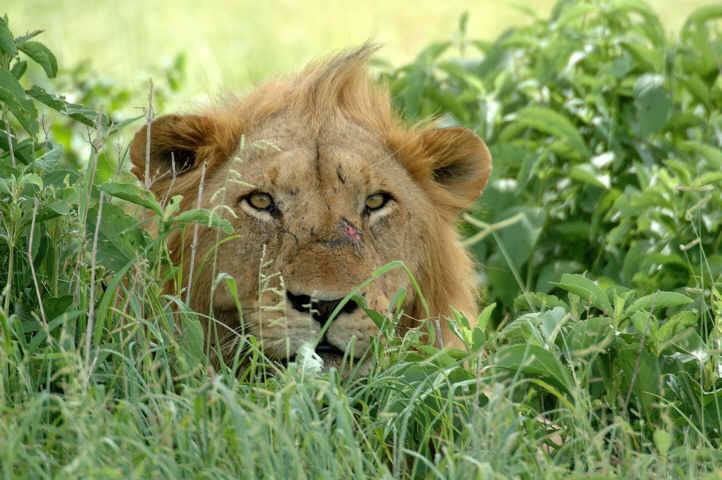
How does the carbon in grass become part of a lion?
a)
The lion eats the grass
b)
Carbon from grass doesn't end up in a lion.
c)
The carbon ends up in the food the lion eats.
d)
The lion breathes in carbon given out by the plant
105.
How nitrogen is "fixed" into useable form for plants...
a)
through action of bacteria only
b)
through lightning only
c)
through action of bacteria & lightning
d)
through photosynthesis
106.
What is the process of combining nitrogen gas with other elements to make nitrogen into usable compounds?
a)
nitrogen composition
b)
ammonia
c)
nitrogen fixation
d)
denitrification
107.

The process where excess nutrients enter body of water causing overgrowth of aquatic plants and algae...
a)
Eutrophication
b)
Acid Precipitation
c)
Nitrogen Fixation
d)
Decomposition
108.

Bacteria fix nitrogen on plant roots. Plant roots provide sugar to bacteria. This is an example of _______.
a)
mutualism
b)
parasitism
c)
commensalism
d)
competition
109.

A parrotfish will graze with a rabbitfish for protection. The rabbitfish doesn't benefit.
What type of relationship is this?
What type of relationship is this?
a)
mutualism
b)
commensalism
c)
parasitism
d)
none of the above
110.
Which list correctly matches up the definitions for each type of symbiosis?
a)
mutualism: both benefit
commensalism: 1 helped, 1 unbothered
parasitism: 1 helped, 1 harmed
commensalism: 1 helped, 1 unbothered
parasitism: 1 helped, 1 harmed
b)
mutualism: 1 helped, 1 harmed
commensalism: both helped
parasitism: 1 helped, 1 unbothered
commensalism: both helped
parasitism: 1 helped, 1 unbothered
c)
mutualism: 1 helped, 1 unbothered
commensalism: 1 helped, 1 harmed
parasitism: both benefit
commensalism: 1 helped, 1 harmed
parasitism: both benefit
d)
mutualism: both benefit
commensalism: both harmed
parasitism: both unbothered
commensalism: both harmed
parasitism: both unbothered
111.

Human intestines give good bacteria a place to live. The good bacteria help break down food. what type of relationship is this?
a)
mutualism
b)
commensalism
c)
parasitism
d)
none of the above
112.

Hook worms enter through the skin and live off the blood of the host.
What type of symbiotic relationship is this?
What type of symbiotic relationship is this?
a)
mutualism
b)
commensalism
c)
parasitism
d)
none of the above
113.

The biotic factors in this image are ____________________.
a)
frog, snail, water
b)
frog, fish, air
c)
frog, tadpoles, fish
d)
frog, tadpoles, sun
114.
The abiotic factors in this image are ________________.
a)
frog, water, sun
b)
air, water, snail
c)
air, sun, water weeds
d)
air, sun, water
115.

A single flower is an example of an ___________.
a)
organism
b)
population
c)
community
d)
environment
116.

The daisies in this field are an example of a _____________.
a)
organism
b)
population
c)
community
d)
ecosystem
117.

The daisies and other types of flowers, grasses and organisms like insects are _________________.
a)
an organism
b)
a population
c)
a community
d)
an ecosystem
118.
Which organisms make their own food through the process of photosynthesis?
a)
decomposers
b)
consumers
c)
organisms
d)
producers
119.
How do consumers get their energy?
a)
by laying in the sun
b)
by eating other organisms
c)
by making their own food
d)
by surviving in an ecosystem
120.
What is an adaptation?
a)
A feature or behavior that helps an animal survie.
b)
The food that an animal eats.
c)
How energy moves in a food web.
121.
A remora is a small fish that attaches itself to a shark. The remora is carried around by the shark and eats the scraps from the shark's meals. This helps the remora but has no effect on the shark. Which type of symbiotic relationship do the shark and remora have?
a)
parasitism
b)
mutualism
c)
commensalism
122.
A small bird lands on a hippo and eats the ticks off the hippo's back. This helps the bird by giving it an easy meal and helps the hippo by removing annoying pests from its skin. Which type of symbiotic relationship do the bird and hippo share?
a)
parasitism
b)
mutualism
c)
commensalism
123.
The first organisms that appear in an ecological community
a)
ecological succession
b)
primary succession
c)
secondary succession
d)
pioneer speciles
124.

What is this called?
a)
Food Web
b)
Food Chain
c)
Abiotic Factors
125.

What is this called?
a)
Food Web
b)
Food Chain
c)
Abiotic Factors
126.
A third-level consumer has to be which type?
a)
Carnivore.
b)
Decomposer.
c)
Producer.
d)
Herbivore.
127.
In a food web, arrows point at:
a)
who gets energy.
b)
who gets eaten.
128.
Bacteria, fungi, and earthworms are examples of:
a)
scavengers
b)
predators
c)
prey
d)
decomposers
129.

Which organism recieves the least amount of energy from the producer?
a)
Owl
b)
Grasshopper
c)
Lilypad
d)
Mouse
130.

Which level has the most energy available?
a)
producer
b)
primary consumer
c)
secondary consumer
d)
tertiary consumer
131.

What does X in the picture represent?
a)
nutrients
b)
food
c)
space
d)
heat
132.

The fox in this food web would be considered a:
a)
Tertiary Consumer
b)
Producer
c)
Secondary Consumer
d)
Primary Consumer
133.
The term "terrestrial" means
a)
land.
b)
water.
134.

a)
tundra
b)
tropical rainforest
c)
desert
d)
grassland
135.

a)
tundra
b)
tropical rainforest
c)
desert
d)
grassland
136.

a)
savanna
b)
temperate deciduous forest
c)
taiga/coniferous forest
137.

In which biome would you MOST LIKELY find this organism?
a)
temperate grassland
b)
desert
c)
tropical rainforest
d)
savanna
138.
Regions of Earth that are defined by their climate and the unique plants & animals that live there
a)
biome
b)
ecosystem
c)
environment
d)
niche
139.
Which biome, because of its climate, has the largest number of species of plants and animals?
a)
tundra
b)
desert
c)
rain forest
d)
pine forest
140.
This biome contains mostly spruce trees and Douglas firs, which are both evergreen. The winters are long and cold and the summers are short and rainy. The soil is very rich. Moose and elk live here. This biome is classified as a
a)
taiga
b)
tundra
c)
deciduous forest
d)
temperate forest
141.
Which biome do we live in?
a)
temperate grassland
b)
temperate rainforest
c)
temperate deciduous forest
d)
chaparral
142.
In which biome can you find permafrost?
a)
taiga
b)
tundra
c)
desert
d)
chaparral
143.
The part of the Earth that can support life is called
a)
a biome
b)
the biosphere
c)
an ecosystem
d)
a biotic factor
144.
An Estuary is where
a)
fresh water meets ponds
b)
fresh water meets lakes
c)
fresh water meets streams
d)
fresh water meets salt water
145.

A aquatic biome classified as marine would have...
a)
Fresh Water
b)
Salt Water
c)
Either Fresh Water or Salt Water
d)
Neither Fresh Water or Salt Water
146.
The beginning of most aquatic food chains is
a)
phytoplankton
b)
fish
c)
sharks
d)
turtles
147.
The leafy roof formed by tall trees in a forest is called the ____________.
a)
understory
b)
canopy
c)
floor
d)
intertidal zone
148.
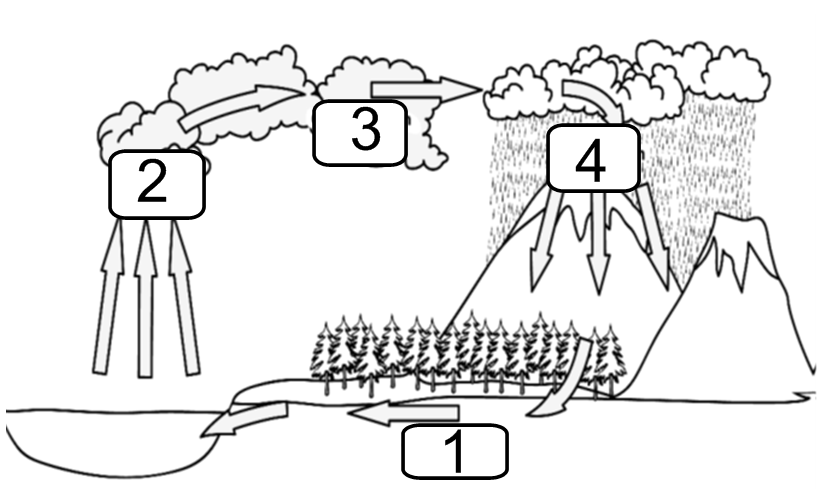
Which stage does the #2 show in the diagram?
a)
condensation
b)
evaporation
c)
precipitation
d)
run off
149.

Most of the Earth's water (about 97 percent) is
a)
salt water in the oceans.
b)
freshwater in lakes and rivers.
c)
in the form of snow or ice.
d)
in the clouds.
150.

Most water pollution is the result of
a)
human activities.
b)
drought.
c)
volcanic eruptions.
d)
storms.
100 %

